wayground logo

Free Printable Worksheets

Font size

S
M
L
XL
Worksheets

HBS 1.1 Review 2024

Total questions: 100

Worksheet time: 1hrs 22mins

Name
Class
Date
1.
The bone most anterior if this patient were laying on their back
a)
Femur
b)
Fibula
c)
Patella
d)
Tibia
2.
The hamstrings are anterior or posterior?
a)
anterior
b)
posterior
3.

The hands are ____ to the feet.

a)

superior

b)

inferior

c)

superficial

d)

deep

4.

The heel is ___ to the toes.

a)

anterior

b)

deep

c)

posterior

d)

intermediate

5.

The knee is _____ to the thigh.

a)

distal

b)

proximal

c)

medial

d)

lateral

6.

The heart is medial to the arm.

a)

TRUE

b)

FALSE

7.

The skin is superficial to the skeletal muscles.

a)

TRUE

b)

FALSE

8.

toward side of the body

a)

ventral

b)

dorsal

c)

medial

d)

lateral

9.

Which anatomical plane is the ONLY horizontal plane?

a)

sagittal

b)

transverse

c)

frontal

10.

Which anatomical plane divides the body into anterior and posterior

a)

frontal

b)

transverse

c)

sagittal

d)

midsagittal

11.

Plane that divides body into left and right sides:

a)

Sagittal

b)

medial

c)

transverse

12.
This type of tissue lines the internal organs and covers the outside of the body as  skin
a)
epithelial
b)
connective
c)
muscular
d)
nervous
13.

This type of tissue relays messages

a)

epithelial

b)

connective

c)

muscular

d)

nervous

14.

What type of tissue is this?

a)

connective tissue

b)

nervous tissue

c)

epithelial tissue

d)

muscle tissue

15.

What type of tissue is this?

a)

epithelial

b)

muscle

c)

nervous

d)

connective

16.

What type of tissue is this?

a)

nervous tissue

b)

muscle tissue

c)

epithelial tissue

d)

connective tissue

17.
What type of bone is the femur?
a)
Long bone
b)
Short bone
c)
Flat bone
d)
Irregular bone
18.
Name the bone located at number  8.
a)
Humerus
b)
Radius
c)
Fibula
d)
Tibia
19.
The shaft of the long bone. 
a)
epphysis
b)
diaphysis
c)
epiphyseal line
d)
growth plate
20.
The shiny white substance at #8 is the 
a)
articular cartilage
b)
periosteum
c)
yellow marrow
d)
diaphysis
21.
In adults, the substance at #6 would be 
a)
red marrow
b)
yellow marrow
c)
spongy bone
d)
clotted blood
22.
The epiphysis is 
a)
The shaft of a bone
b)
a bone cell
c)
the end of a long bone
d)
the covering of a bone
23.

How many vertebrae are in the thoracic region?

a)

12

b)

20

c)

10

d)

7

24.

How many vertebrae are in the neck?

a)

2

b)

4

c)

7

d)

12

25.

Which is the correct order of ribs from superior to inferior?

a)

floating, true, false

b)

true, false, floating

c)

true, floating, false

d)

false, floating, true

26.
What is the name of this bone?
a)
Femur
b)
Humerous
c)
Skull
d)
Shin
27.

Identify bone "F"

a)

Temporal

b)

Parietal

c)

Sphenoid

d)

Zygomatic

28.

Identify Bone "H"

a)

Zygomatic

b)

Maxilla

c)

Sphenoid

d)

Lacrimal

29.

identify Bone "G"

a)

Maxilla

b)

Mandible

c)

Zygomatic

d)

Vomer

30.
a)
Zygomatic
b)
Temporal
c)
Parietal
d)
Occipital 
31.
a)
Zygomatic
b)
Frontal
c)
Parietal
d)
Lacrimal
32.
a)
Occipital
b)
Parietal
c)
Temporal
d)
Sphenoid
33.
Flat muscles on the sides of the head that connect to the mandible and allow it to move and chew.
a)
Orbicularis oris
b)
Temporalis
c)
Frontalis
d)
Orbicularis oculi
34.
Circular muscle around the mouth that allows the lips to move.
a)
Temporalis
b)
Orbicularis oris
c)
Orbicularis oculi
d)
Frontalis
35.
Cells that work together to perform a similar function
a)
organs
b)
organisms
c)
organ systems
d)
tissues
36.
Profesionals who study the microscopic anatomy of tissues
a)
EMTs
b)
histologists
c)
endocrinologist
d)
herpatologists
37.
(1.2.2) How many thoracic vertebrae are there?
a)
5
b)
27
c)
7
d)
12
38.
Found where tissues connect (i.e. between muscles/bones and bones/joints) - supports/connects other tissue types
a)
Nervous Tissue
b)
Muscle Tissue
c)
Epithelial Tissue
d)
Connective Tissue
39.
Striated/skeletal, smooth (walls of organs) or cardiac (in heart)
a)
Nervous Tissue
b)
Muscle Tissue
c)
Epithelial Tissue
d)
Connective Tissue
40.
Spinal cord & brain - send & receive signals
a)
Nervous Tissue
b)
Muscle Tissue
c)
Epithelial Tissue
d)
Connective Tissue
41.
Tissues that work together to perform a similar function
a)
tissues
b)
organisms
c)
organ systems
d)
organs
42.
Lining surfaces of organs & blood vessels - absorbs, secretes, protects & senses
a)
Nervous Tissue
b)
Muscle Tissue
c)
Epithelial Tissue
d)
Connective Tissue
43.
The way in which a living organism or bodily part functions.
a)
Organ systems
b)
Physiology
c)
Histology
d)
Pathology
44.
Make up of mostly spongy bone with a thin layer of compact bone on the surface.
a)
Irregular bones
b)
Flat bones
c)
Long bones
d)
Short bones
45.
Bones like the humerous and the femur?
a)
Long bones
b)
Irregular bones
c)
Flat bones
d)
Short bones
46.
Make up of a shaft and two ends .  Shaft is compact bone and the ends of the bone contain spongy bone
a)
Long bones
b)
Flat bones
c)
Short bones
d)
Irregular bones
47.
Make up of a thin layer of spongy bone between two thin layers of compact bone.
a)
Short bones
b)
Long bones
c)
Flat bones
d)
Irregular bones
48.
The carpel bones
a)
Short bones
b)
Long bones
c)
Irregular bones
d)
Flat bones
49.
A porous bone found in aminals containing red bone marrow.
a)
Mesentary bone
b)
Spongy bone
c)
Carsenoma bone
d)
Compact bone
50.
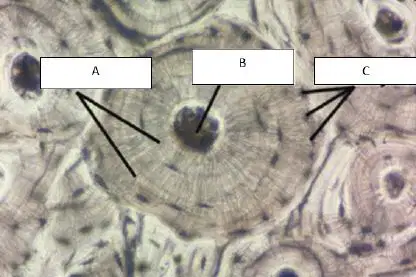
Examine this photomicrograph of compact bone.  What is B pointing to?
a)
Osteocytes
b)
Trabeculae
c)
Haversian canal
d)
Canaliculi
51.
Make up of thin layers of spongy bone and don’t fit into any of the other categories of bones.
a)
Irregular bones
b)
Flat bones
c)
Short bones
d)
Long bones
52.
What is the letter “H” labeling?
a)
epiphysis
b)
periosteum
c)
trabeculae
d)
diaphysis
53.
Examine this photomicrograph of spongy  bone.  What is B pointing to?
a)
Trabeculae
b)
Bone marrow
c)
Haversian canal
d)
Canaliculi
54.
What is the letter “A” labeling?
a)
periosteum
b)
diaphysis
c)
epiphysis
d)
trabeculae
55.
The bones of the skull
a)
Flat bones
b)
Short bones
c)
Long bones
d)
Irregular bones
56.
Examine this photomicrograph of compact bone.  What is A pointing to?
a)
Haversian canal
b)
Osteocytes
c)
Trabeculae
d)
Canaliculi
57.
A solid and hard bone that makes up the outer layer of all bones and the shaft of long bones.
a)
Spongy bone
b)
Compact bone
c)
Carsenoma bone
d)
Mesentary bone
58.
The bones of the vertebral column
a)
Short bones
b)
Flat bones
c)
Irregular bones
d)
Long bones
59.
What is the letter “B” labeling?
a)
diaphysis
b)
epiphysis
c)
periosteum
d)
trabeculae
60.
Examine this photomicrograph of compact bone.  What is C pointing to?
a)
Haversian canal
b)
Canaliculi
c)
Osteocytes
d)
Trabeculae
61.

The skin is superficial to the skeletal muscles.

a)

TRUE

b)

FALSE

62.
First name
4 lines
63.
LAST name
4 lines
64.

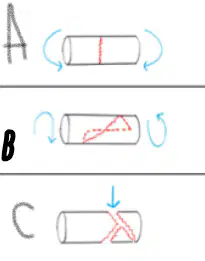
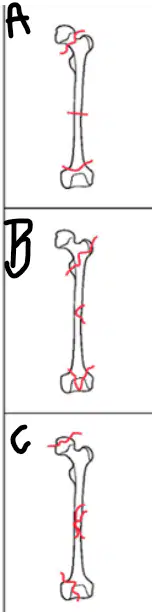
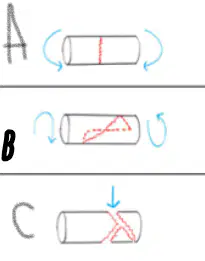
Which type of fracture is found at letter 'A'? ONE WORD SPELL THIS CORRECTLY!

(a)  
65.

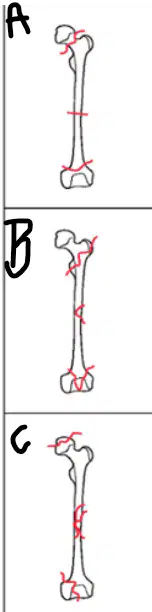
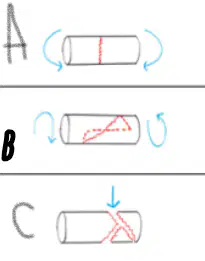
Which type of fracture is found at letter 'B? ONE WORD SPELL THIS CORRECTLY!

(a)  
66.

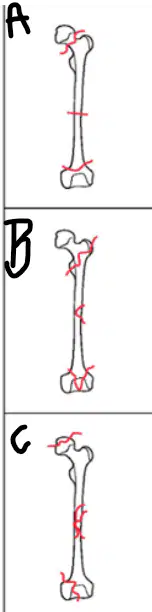
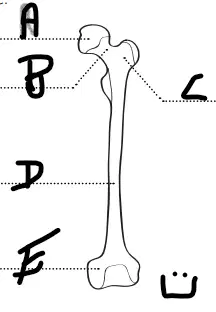
Which type of fracture is found at letter 'C? ONE WORD SPELL THIS CORRECTLY!

(a)  
67.
Which of these is a bone cell?
a)
osteoclast
b)
osteoblast
c)
osteoma
d)
ostecoma
68.
What is the first stage of fracture healing?
a)
hematoma formation
b)
fibrocartilage callus formation
c)
bony callus formation
d)
bone remodeling
69.
What is the third stage of fracture healing?
a)
hematoma formation
b)
fibrocartilage callus formation
c)
bony callus formation
d)
bone remodeling
70.
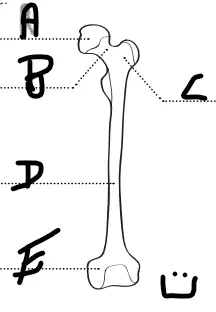
What would be the best label for line 'A'?
a)
femoral head
b)
femoral neck
c)
shaft
d)
condyles
e)
trochanteric region
71.
What would be the best label for line 'C"?
a)
trochanteric region
b)
femoral head
c)
femoral neck
d)
shaft
e)
condyles
72.
What would be the best label for line 'E"?
a)
condyles
b)
femoral head
c)
femoral neck
d)
shaft
e)
trochanteric region
73.
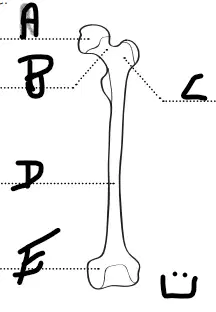
Which of these shows a 'transverse, extra-articular, femoral neck' fracture?
a)
A
b)
B
c)
C
74.
Which of these shows a comminuted, intra-articular, femoral head fracture?
a)
A
b)
B
c)
C
75.
Which of these shows a spiral, intra-articular, femoral trochanteral region fracture?
a)
A
b)
B
c)
C
76.

The position of the heart relative to the structures around it would be described accurately as:

a)

Posterior to the vertebral column

b)

medial to the lungs

c)

Superior to the brain

d)

Inferior to the ribs

77.

In the anatomical position, the nose and belly button are on the  ________ body surface, the calves and shoulder blades are on the  _______ body surface.

a)

posterior, anterior

b)

anterior, posterior

c)

medial, lateral

d)

lateral, medial

78.

The smallest bone in the body is located where?

a)

the leg

b)

the ear

c)

the hand

d)

the wrist

79.

What are bones made of?

a)

Cells and protein fibers

b)

Hard mineral salts

c)

Blood vessels and nerves

d)

All of the above

80.

What is the function of bones in the body?

a)

To provide a tough and flexible frame

b)

To withstand stress

c)

To protect internal organs

d)

All of the above

81.

How many categories do bones in the human skeleton fall into?

a)

Two

b)

Three

c)

Four

d)

Five

82.
Periosteum
a)
the membrane lining the bone cavity
b)
the tough membrane covering the shaft of the bone
c)
the shiny, articulating cartilage on the ends of a bone
d)
the blood vessels inside a bone
83.
Spongy bone would primarily be found where in a bone?
a)
diaphysis
b)
epiphysis
c)
periosteum
d)
endosteum
84.

collar bone

a)

patella

b)

scapula

c)

clavicle

d)

hyoid

85.

shoulder blade

a)

clavicle

b)

patella

c)

hyoid

d)

scapula

86.

Upper arm bone

a)

humerus

b)

femur

c)

radius

d)

tibia

87.
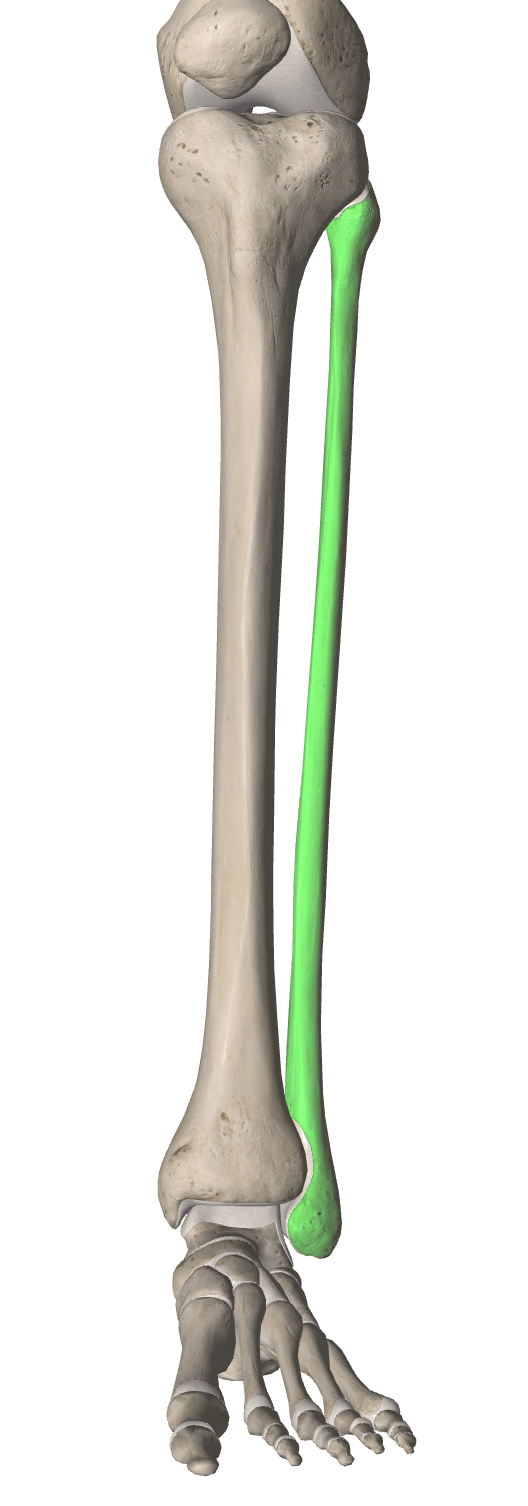
Name the bone shown in green.
a)
Femur
b)
Tibia
c)
Patella 
d)
Fibula
88.

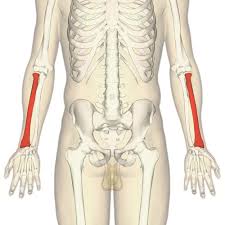
Which bone is highlighted

a)

humerus

b)

radius

c)

ulna

d)

femur

e)

fibula

89.
How many bones does an adult human have?
a)
300
b)
306
c)
206
d)
602
90.

Blood, bone, and fat are all examples of _____ tissue.

a)

transport

b)

support

c)

connective

d)

epithelial

91.

This pelvis most likely belongs to a

a)

male

b)

female

92.

What is the anatomical term for the armpit?

a)

sternal

b)

axillary

c)

acromial

d)

brachial

93.

What region represents behind the knee?

a)

Patellar

b)

Axillary

c)

Antecubital

d)

Popliteal

94.

The scapular region is ______ to the vertebral region

a)

Medial

b)

Distal

c)

Superior

d)

Lateral

95.

The nose is ______ to the eyes.

a)

Medial

b)

Distal

c)

Superior

d)

Inferior

96.

What type of fracture is this?

a)

greenstick

b)

comminuted

c)

spiral

d)

impacted

97.
 a fracture in which the bone breaks diagonally. 
a)
Oblique Fracture
b)
Fracture
c)
Diagonal Fracture
d)
Horizontal Fracture 
98.
Bone breaks into many fragments.
a)
Shattered Fracture
b)
Traction Fracture 
c)
Comminuted Fracture
d)
The Magic School Bus
99.
Bone breaks incompletely, occurs most commonly during the infantile stages of life.
a)
Greenstick Fracture
b)
Stable Fracture
c)
Bluestick Fracture
d)
Comminuted Fracture 
100.
a)
Compression Fracture
b)
Compound Fracture
c)
Greenstick Fracture
d)
Comminuted Fracture