wayground logo

Free Printable Worksheets

Font size

S
M
L
XL
Worksheets

Evolution Pre-Test

Total questions: 100

Worksheet time: 1hrs 26mins

Name
Class
Date
1.
What is a change in an organism that allows for it to survive in its environment?
a)
homologous
b)
vestigial
c)
variation
d)
adaptation
2.
When all of the organisms of a species have died it is called
a)
evolution
b)
extinction
c)
adaptation
d)
natural selection
3.
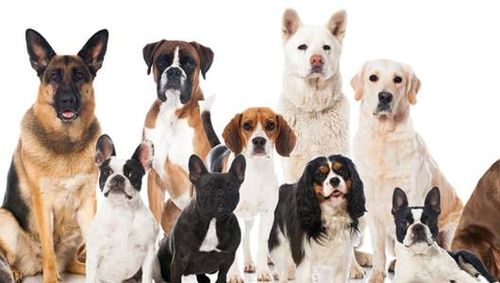
What is this an example of?
a)
diversity of species
b)
variation
c)
vestigial structures
d)
DNA studies
4.
Which layer is the oldest?
a)
1
b)
2
c)
3
d)
4
5.
When the DNA of an organism is altered it is referred to as…
a)
Mutation
b)
Gene Flow
c)
Genetic Drift
d)
Sexual Selection
6.
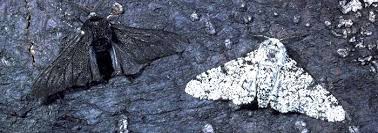
Predict which moth would increase in population
a)
light 
b)
dark
7.
The cause of artificial selection is…
a)
The environment
b)
Humans
c)
Mutation
d)
Gene Flow
8.
Which of the following is NOT an example of natural selection? 
a)
People selectively breeding hamsters.
b)
Insect populations developing resistance to certain pesticides.
c)
Bacteria becoming resistant to antibiotics.
d)
Male birds of certain species developing colorful feathers to attract female mates.
9.
Which species’ DNA is most similar to the DNA of the toothed whale? 
a)
Hippopotamus 
b)
Baleen Whale
c)
Grazing Mammals
d)
Camels
10.
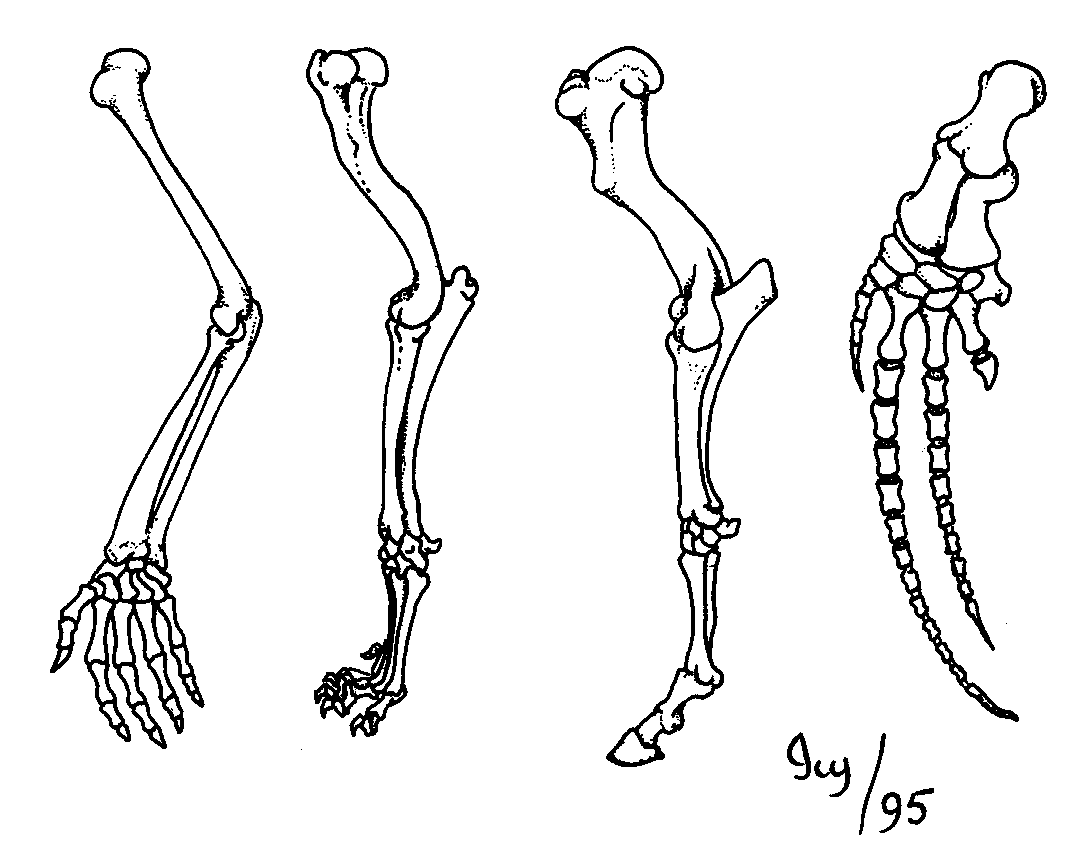
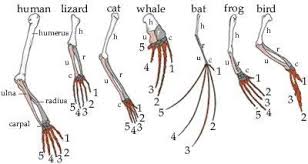
Structures with the same parts have different functions; suggests that organisms share a common ancestry
a)
vestigial structures
b)
homologous structures
c)
adaptive radiation
d)
fossil
11.
Which of the following is an example of a vestigial structure?
a)
the wings of a red-tailed hawk
b)
the hind limbs of a house cat
c)
the fins of sharks
d)
the tailbone of a human
12.
Which of the following is a term for a group of similar organisms that can reproduce fertile offspring?
a)
individual
b)
population
c)
species
d)
fossil
13.
The ability of an organism to survive and reproduce in its specific environment 
a)
diversity.
b)
evolution
c)
adaptation
d)
 fitness
14.
Who was the naturalist that traveled the world to study plants and animals?
a)
Albert Einstein
b)
Charles Darwin
c)
Charles Barkley
d)
Isaac Newton
15.
Genetic differences between organisms of the same species
a)
Variation
b)
Adaptation
c)
Behavior
d)
Environment
16.
what did Charles Darwin observe in finch populations of the Galapagos Islands off the coast of South America?
a)
different species on different islands
b)
all species on one of the islands
c)
identical species on all the islands
d)
the same species as North America
17.
a bird that can easily outcompete other birds for food and that can produce many eggs has a high
a)
life expectancy
b)
mutation rate
c)
fitness
d)
adaptability
18.
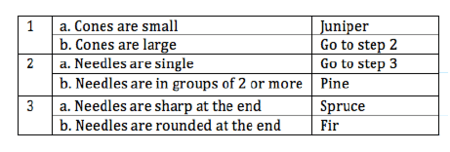
A dichotomous key for trees is provided. Hikers found a tree that has large brown cones and single sharp needles. What species of tree have the hikers found?
a)
Juniper
b)
Pine
c)
Spruce
d)
Fir
19.
What step do we always start with when using dichotomous keys?
a)
1
b)
2
c)
3
d)
4
20.
When using a dichotomous key to identify organisms, what do we look at?
a)
physical features
b)
weather patterns
c)
environment
d)
diet
21.
An illustration and a dichotomous key are given. What is the correct classification for this organism?
a)
Class Insecta
b)
Order Amblygygi
c)
Order Araneae
d)
Order Scorpiones
22.
Survival of the Fittest and Evolution were proposed by what scientist?
a)
Charles Darwin
b)
Albert Einstein
c)
Steven Hawking
d)
Isaac Newton
23.
Mutations are a change in what?
a)
DNA
b)
tRNA
c)
genotype
d)
phenotype
24.
What process is being shown in this image?
a)
Variation
b)
Natural Selection
c)
Selective Breeding
d)
Homeostasis
25.
Which best describes mutations?
a)
Always helpful
b)
Always harmful
c)
Can be helpful or harmful
d)
Always neutral
26.
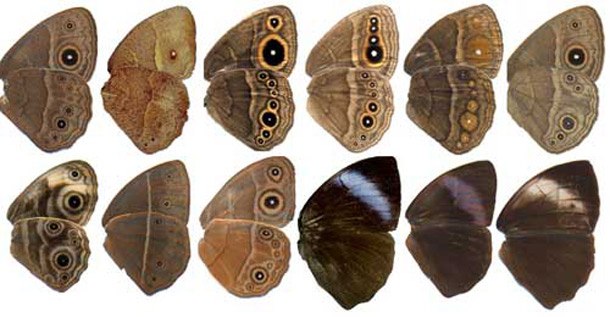
These moths are all the same species. The differences between their wings is an example of ________________
a)
Natural Selection
b)
Variation
c)
Homeostasis
d)
Extinction
27.
An organism's genetic make-up:
a)
phenotype
b)
recessive
c)
genotype
d)
dominant
28.
An organism's appearance or other observable characteristics:
a)
phenotype
b)
recessive
c)
genotype
d)
dominant
29.
Natural selection can best be defined as the _____.
a)
survival of the biggest and strongest in a population
b)
survival and reproduction of those in the largest area
c)
elimination of the smallest organism by the biggest
d)
survival and reproduction of those that are best adapted
30.
Darwin conducted much of his research on
a)
the Samoan Islands
b)
the Hawaiian Islands
c)
Catalina Island
d)
the Galapagos Islands
31.
which of the folllowing is an exammple of a vestigial structure?
a)
the wings of a red-tailed hawk
b)
the hind limbs of a house cat
c)
the fins of sharks
d)
the wings of an ostrich
32.
If an organism has a vestigial structure, that structure likely once had a function in a(n)
a)
close relative
b)
early ancestor
c)
unrelated organism
d)
embryological stage
33.

The combined alleles of all individuals in a population is called the population's

a)

phenothype

b)

gene pool

c)

mutation rate

d)

allele frequency

34.
Which of the following is NOT considered evidence of evolution?
a)
similar DNA
b)
similar development
c)
similar behavior
d)
vestigial structures
35.
Bird's beaks evolve mainly due to the type of ___________________ available.
a)
food
b)
water
c)
shrubs
d)
mates
36.
Kangaroos and opossums both incubate their immature in pouches. This means they -
a)
share a common ancestor
b)
possess vestigial organs
c)
have similar skeleltal structures
d)
belong to the same species
37.
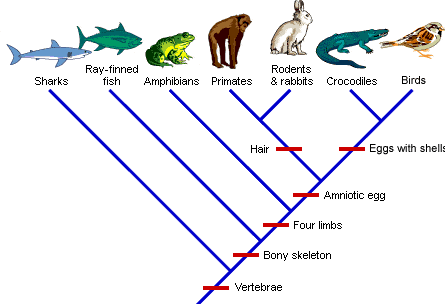
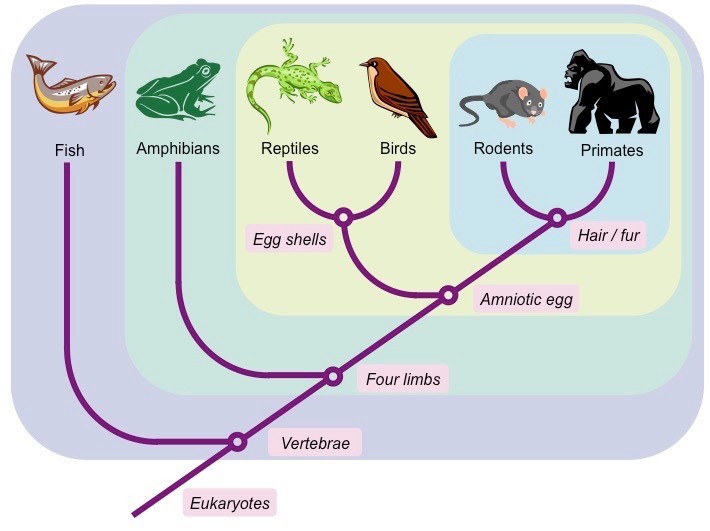
According to this cladogram, primates are most closely related to -
a)
Amphibians
b)
Rodents and rabbits
c)
Crocodiles
d)
Birds
38.
Which trait do only humans have, according to the cladogram?
a)
jaws
b)
mammary glands & hair
c)
terrestrial during all life stages
d)
opposable thumbs
39.
Individuals that are well adapted to their environment will survive and produce:
a)
Fewer mutations
b)
Stronger genes
c)
More offspring
d)
Better traits
40.
Breeding dogs for specific desired traits is an example of which type of evolutionary evidence?
a)
Artificial selection
b)
Embryology
c)
Fossils
d)
Biochemical molecules
41.
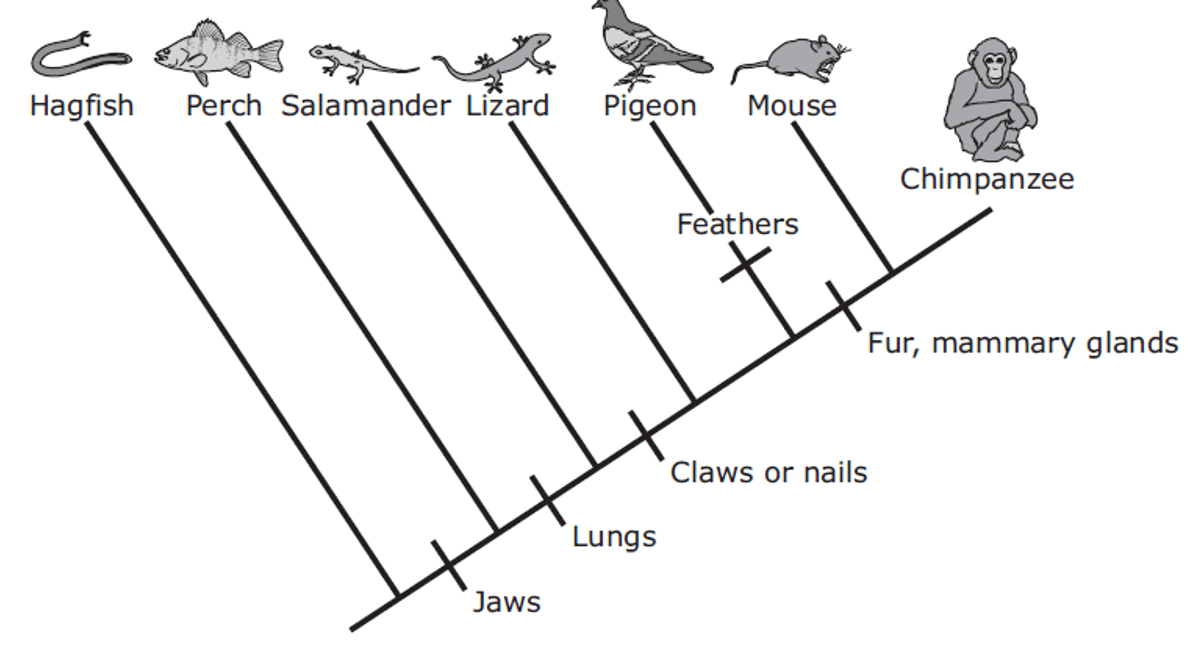
All the animals to the right of the hagfish would have the common characteristic of -
a)
Fur
b)
Claws or nails
c)
Lungs
d)
Jaws
42.

What characteristic distinguishes amphibians from birds and reptiles?

a)

Amniotic egg

b)

Egg shells

c)

Vertebrae

d)

Hair/fur

43.
What is this a picture of?
a)
Pedigree
b)
Cladogram
c)
Family Tree
d)
Oak Tree
44.
A common ancestor for both A and E could be at position __.
a)
1
b)
2
c)
3
d)
4
45.
The two extant species that are closely related to each other are __.
a)
A and B
b)
B and C
c)
C and D
d)
D and E
46.
Variety of alleles that exist and are expressed in a population
a)
Genetic Variation
b)
Adaptation
c)
Heterozygous
d)
Dominant
47.
Mineral replacement, preserved remains, or trace of organisms that lived in the past
a)
Fossil
b)
Fossil Record
c)
Trace Fossil
d)
Body Fossil
48.

Evolution is a scientific theory because

a)

it is supported by data through repeated observation and experiment.

b)

it is the best guess as to how species change over time.

c)

it is an educated guess.

d)

it has been proven to correct.

49.

Which is the most modern definition for evolution?

a)

Change in populations of organisms over time.

b)

Change in traits of populations of organisms over time.

c)

Change in allele frequencies of populations of organisms over time.

d)

Change in adaptive characteristics of populations of organisms over time.

50.
What kind of cell is this?
a)
eukaryotic cell
b)
prokaryotic cell
51.
What kind of cell is this?
a)
eukaryotic cell
b)
prokaryotic cell
52.
What is an autotroph?
a)
an organism that makes its own food
b)
an organism that has to eat to get its food
c)
an organism that only does cellular respiration
53.
What is an heterotroph?
a)
an organism that makes its own food
b)
an organism that has to eat to get its food
c)
an organism that only does photosynthesis
54.
What kind of organism is this?
a)
fungi
b)
protista
c)
plant
d)
archaea 
55.
Land vertebrates evolved before marine (ocean) vertebrates
a)
true
b)
false
56.
What is this an example of?
a)
vestigial structures
b)
embryology
c)
homologous structures
d)
fossil record
57.
Which is not one of the main lines of evidence supporting evolution?
a)
embryology
b)
fossil record
c)
DNA
d)
cloning
58.
What do cladograms show?
a)
Human family trees
b)
timelines of mutations
c)
evolutionary relatedness of different species
d)
embryos
59.
Which organism lacks a jaw?
a)
Leopard
b)
Salamander
c)
Tuna
d)
Lamprey
60.
What is this an example of?
a)
diversity of species
b)
variation
c)
vestigial structures
d)
DNA studies
61.
Which layer is the oldest?
a)
1
b)
2
c)
3
d)
4
62.
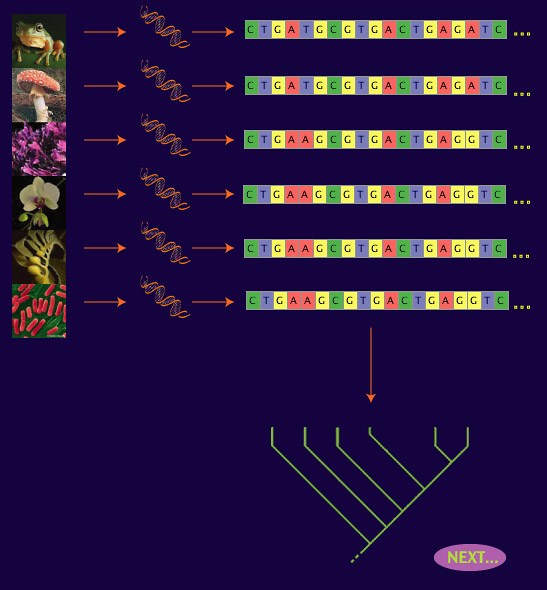
Two organisms that are closely related would have
a)
very similar DNA sequence
b)
exactly the same DNA sequences
c)
no proteins in common
d)
completely different DNA sequence
63.
The diagram shows fossils in different rock layers. Which of these statements about the age of these fossils is most likely correct?
a)
Fossil A and C are the same age
b)
Fossil B is older than fossil C
c)
Fossils A is older than fossil B
d)
Fossil D is older than fossil C
64.
The process to go from DNA to mRNA is _______
a)
translation
b)
transcription
c)
replication
65.
The process to go from mRNA to a protein is called ____
a)
transcription
b)
rRNA
c)
replication
d)
translation
66.
Choose the nucleotide sequence of the RNA strand that would be complementary to the following strand: 
GTAGTCA
a)
UATUAGA
b)
ACGACTG
c)
CAUCAGU
d)
CATCAGT
67.

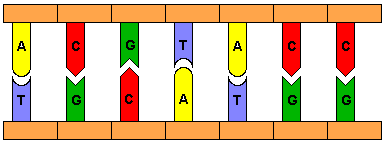
In DNA, Adenine (A) pairs with ___________.

a)

Guanine (G)

b)

Cytosine (C)

c)

Thymine (T)

d)

Uracil (U)

68.
Mutation can be passed onto 
a)
Siblings
b)
Parents
c)
Offspring (children)
d)
Neighbors
69.
Why are advantageous traits more likely to be passed onto offspring?
a)
Because they are more likely to survive and reproduce.
b)
Because they come from dominant alleles.
c)
Because they come from recessive alleles.
d)
Because the trait is an acquired phenotype.
70.

Which of the following is an example of a vestigial structure?

a)

Thumb

b)

Small Intestine

c)

Wisdom teeth

d)

Tongue

71.

Which of the following is an example of an analogous structure?

a)

The bones in the arm of a human and a cat

b)

The wings of a butterfly and a bat

c)

A humans appendix

72.

Gigantopithecus were very large primates that lived 500,000 years ago. Since none of these mammals are still today, they are said to be....

a)

Extinct

b)

Threatened

c)

Endangered

d)

Declining

73.
Which two species are most related?
a)
B&C
b)
A&B
c)
A&C
d)
C&B
74.

According to the theory of evolution, which of the following statements is true?

a)

Humans evolved from chimpanzees

b)

Chimpanzees evolved from humans

c)

There is no evolutionary relationship between humans and chimpanzees

d)

Humans and chimps evolved from common ancestors

75.

If you wanted to excavate fossils of the earliest human ancestors, to what country might you travel?

a)

Australia

b)

China

c)

Kenya

d)

Iceland

76.
Which mechanism is known as random change in population’s gene pool, changes to the DNA?
a)
genetic drift
b)
gene flow
c)
mutation
d)
nonrandom mating
77.
How is a scientific theory different from a guess?
a)
Theories are created by scientists; guesses are made by regular people
b)
Theories are backed up by multiple pieces evidence and reason, guesses are not always
c)
Theories are usually longer than guesses
d)
"Theory" is a fancier word for "guess"
78.

Organisms that live in similar environments, such as the desert, often have similar adaptations. This is often due to

a)

convergent evolution

b)

coevolution

c)

gradualism

d)

sexual selection

79.

Which pattern of evolution results in one species splitting into many over time?

a)

coevolution

b)

divergent evolution

c)

convergent evolution

d)

sexual selection

80.

Multiple species evolving from a common ancestor

a)

Gradualism

b)

Speciation

c)

Punctuated Equilibrium

d)

Convergent Evolution

e)

Coevolution

81.

What did Darwin notice about the organisms on the various islands?

a)

all of the organisms looked the exact same even though they lived on different islands

b)

the organisms on the various islands were not of the same species

c)

Darwin studied the rocks on the island, not the organisms

d)

the organisms looked slightly different based off what island they lived on

82.

What was the name of Darwin's book?

a)

Species Around Us

b)

On the Origin of Species

c)

The Tree of Life

d)

The Galapagos Finches

83.
The ability to walk on two rear legs.
a)
archaeology
b)
primate
c)
collective learning
d)
bipedalism
84.
Darwin wrote that organisms with traits that are best suited to the environment will ________________
a)
increase in number
b)
become extinct
85.
Related organisms have similar _______.
a)
Genetic Material
b)
Diet
c)
Behavioral Patterns
86.
The image displays which type of anatomical structure?
a)
Analogous
b)
Homologous
c)
Vestigial
87.
Does the following provide evidence of evolution?
a)
No, the image depicts analogous structures
b)
Yes, the image depicts homologous structures
88.
Where would the oldest fossils be found?
a)
Bottom
b)
Top
c)
Middle
89.
What is the process of which humans breed organisms for certain traits?
a)
artificial selection
b)
descent without modification
c)
inheritance of acquired characteristics
d)
natural selection
90.
Individuals that are well adapted to their environment will survive and produce
a)
better traits
b)
stronger genes
c)
more offspring
d)
fewer mutations
91.
The study of the early stages of development that is one evidence of evolution is:
a)
Homologous Structures
b)
Embryology
c)
Vestigial Organs
92.
The opossum and kangaroo both incubate their young in a pouch. This provides evidence that they---
a)
are descended from a common ancestor
b)
Have very similar skeletal structures
c)
belong to the same species
d)
must range great distances to eat
93.
Bat wing, butterfly wing
a)
Homologous
b)
Analogous
c)
Vestigial
94.
Bat wing, human arm
a)
Homologous
b)
Analogous
c)
Vestigial
95.
Which mechanism is known as sexual selection (ex. peacock tail length)?
a)
genetic drift
b)
gene flow
c)
mutation
d)
nonrandom mating
96.
Which mechanism depends upon excess reproduction, variations, inheritance, and advantages of specific traits in an environment
a)
genetic drift
b)
gene flow
c)
natural selection
d)
mutation
97.
The diagram shows the movement of genes in and out of a population which is:
a)
Gene pool
b)
Gene flow
c)
Genetic drift
d)
Natural selection
98.
The diagram shows a random change in the population which is:
a)
Gene flow
b)
Gene pool
c)
Genetic drift
d)
Natural selection
99.
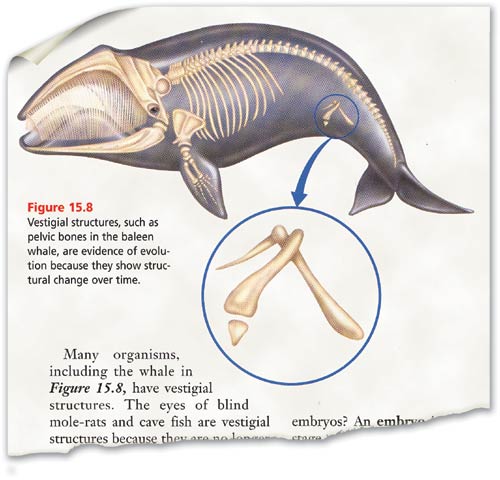
The whale's pelvis is an example of a(n) __ structure. 
a)
Analogous
b)
Homologous
c)
Adaptive
d)
Vestigial
100.
What do phylogenic trees do?
a)
Help you visualize how species are related.
b)
Provide windbreaks in your yard.
c)
Provide DNA details.