
 Worksheets
Biology Unit 7 Test Review
Total questions: 100
Worksheet time: 2hrs 55mins
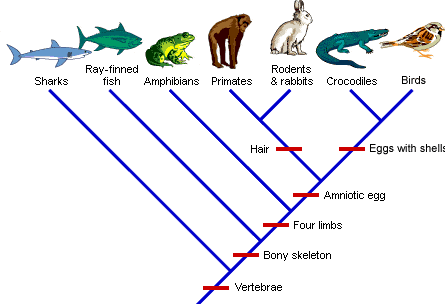
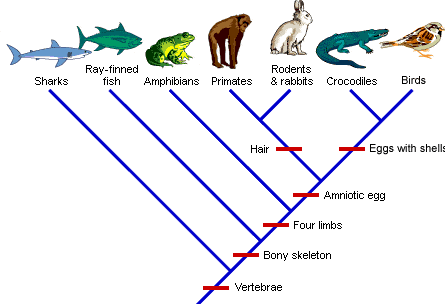
According to this cladogram, primates are most closely related to....
Amphibians
Rodents & rabbits
Crocodiles
Birds
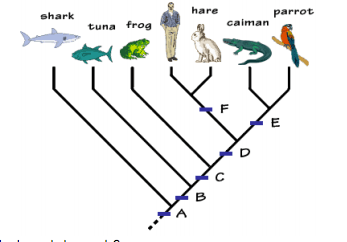
On the cladogram, which organism is the closest relative of the parrot?
Frog
Hare
Caiman
Parrot
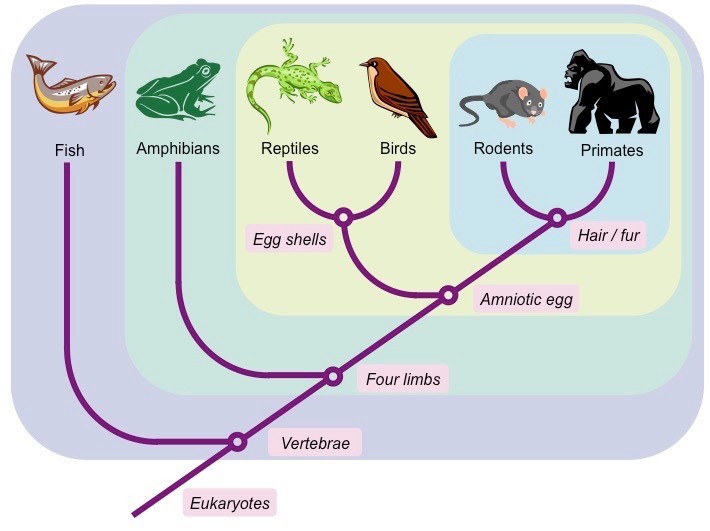
What characteristic distinguishes amphibians from birds and reptiles?
Amniotic egg
Egg shells
Vertebrae
Hair/fur

What distinguishes zebras from from giraffes?
un-branching horns (in males)
even number of toes
fur
carnivorous teeth

According to this cladogram, which organism is the out group?
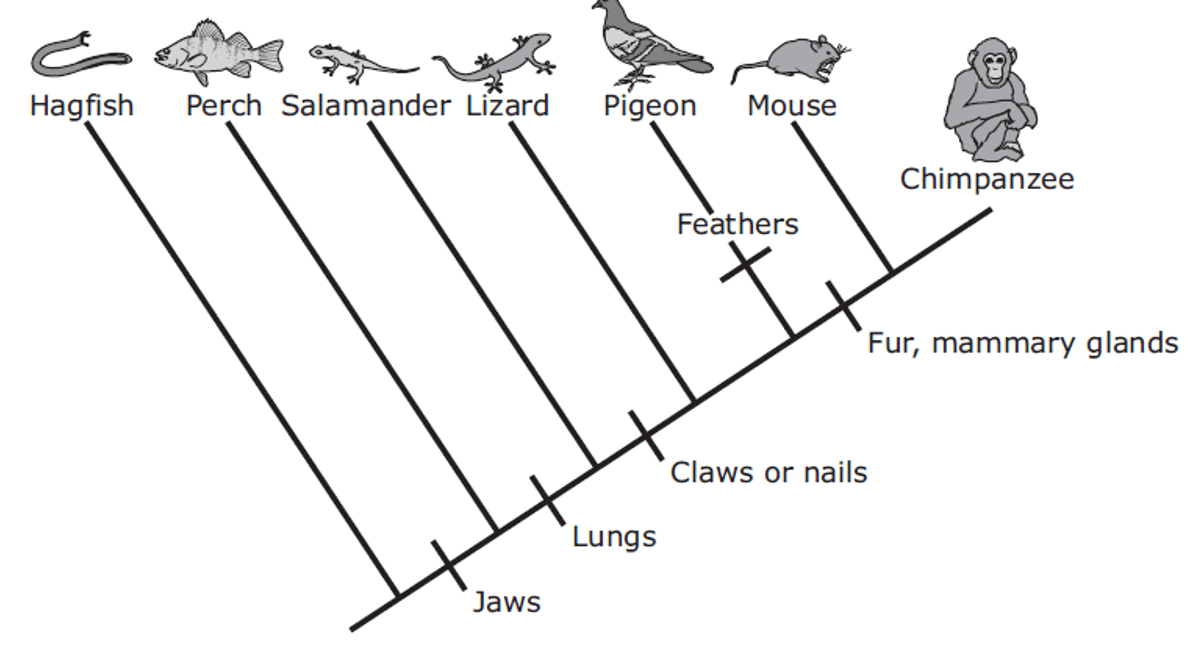

According to the cladogram in this figure, which characteristics are common characteristics between Mouse and Salamander? (Check all boxes that apply)
Jaws
Lungs
Claws and Nails
Feathers
Fur, Mammary Glands

Using the cladogram, which characteristics do Lynx and Lizards have in common (check all the boxes that apply).
Jaws
Lungs
Amniotic Membrane
Hair
No tail

Using the cladogram, determine all the characteristics that turtles and salamanders have in common. (Check the boxes next to all the correct answer).
vertebral column
jaws
four walking legs
amniotic egg
hair
Starting in 1954, commercial fishers in the northwest Pacific were paid by weight, rather than by the individual fish, for pink salmon. The fishers increased the use of a type of net that selectively catches larger fish. Which of the following effects did this change in fishing technique most likely have on the salmon population over the next 20 years?
The average body size of the salmon population decreased significantly.
The average body size of the salmon population increased significantly.
The average body size of the males in the salmon population increased, and the females stayed the same.
None of the above.
The Asian shore crab invaded parts of the eastern coast of the United States about 15 years ago. The Asian shore crab preys on blue mussels. In the time since the Asian shore crab arrived, the average shell thickness of the blue mussel population has increased.
Which of the following is the most likely reason that this increase in shell thickness has occurred?
Blue mussels with thick shells attract more crabs that mussels without thick shells.
Blue mussels with thick shells grow in larger colonies than mussels without thick shells.
Blue mussels with thick shells catch more food per day than mussels without thick shells.
Blue mussels with thick shells survive and reproduce more successfully than mussels without thick shells.
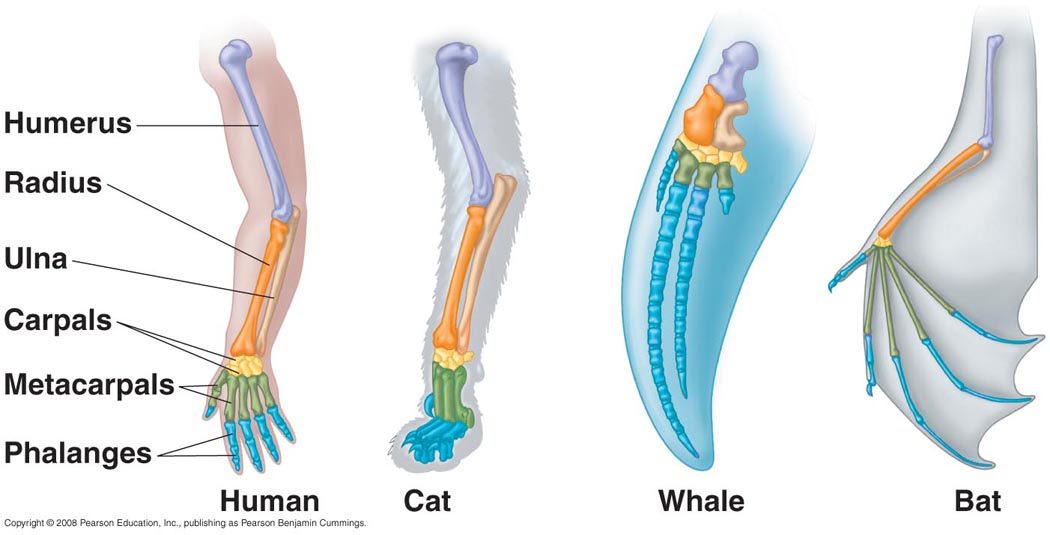
Structures with the same parts but have different functions, suggesting that organisms with a backbone share common ancestry is called…
Not related
Not homologous
Homologous
Young in origin
Structures with no function that are remnants of an organism’s evolutionary past are
Not visible organisms
Young in origin
Vestigial
Useful to the organism

The fossil record provides evidence that
Fossils cannot be dated.
All species were formed during Earth’s formation and have changed little since then.
The fossilized species have no connection to today’s species.
Older species gave rise to more-recent species.
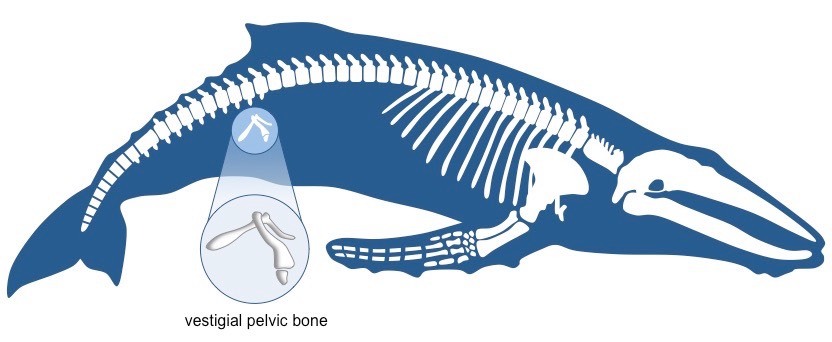
The presence of pelvic bones in the baleen whale is evidence of which of the following?
Whales can travel on land when necessary.
Whales are developing into animals with four functioning limbs.
Whales have functional legs that are hidden by fat and skin.
Whales evolved from four-legged animals.
Comparing the human hemoglobin amino acid sequence to the chimpanzees, horses, kangaroos, and chickens, reveal that humans have the fewest amino acid differences with
kangaroos
horses
chickens
chimpanzees

What is suggested by the similary of early embryos of different species of vertebrates?
No evolutionary relationship between the groups
A recent common ancestry
Similar environments in the past
Evolution from a distant common ancestor
Mutations are a change in what?
DNA
tRNA
genotype
phenotype
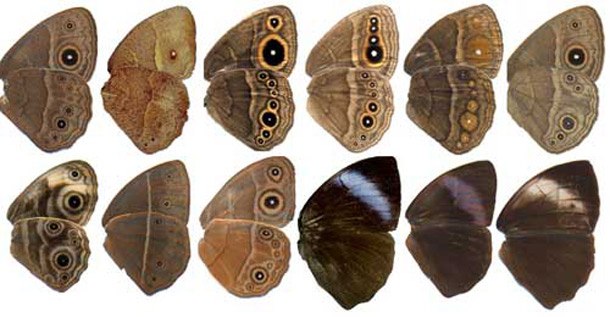
These moths are all the same species. The differences between their wings is an example of ________________
Natural Selection
Variation
Homeostasis
Extinction

Which layer is the youngest
1
2
3
4
Which of the following is the collection of life's remains found in sedimentary rock?
natural selection
homologous structures
Charles Darwin
the fossil record
Similar structures with different purposes found in different species are known as _____
vestigial structures
DNA
homologous structures
the fossil record
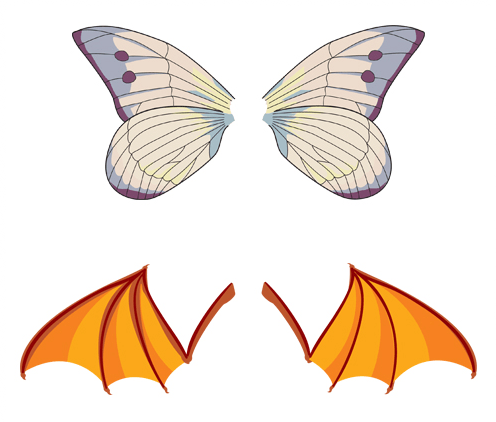
What is this an example of?
Homologous structure
Analogous structure
Vestigial organs
Functional adaption
According to this cladogram, primates are most closely related to -
Amphibians
Rodents and rabbits
Crocodiles
Birds
According to this cladogram, birds are LEAST related to -
Amphibians
Sharks
Ray Finned Fish
Crocodiles

According to the cladogram, which organism is most distantly related to the human?
crayfish
rat
perch
frog

What is the name of bird Z?
Certhidea
Geospiza
Camarhynchus
Platyspiza
Cladograms are constructed by grouping organisms together based on their____________ characteristics.
shared
different
similar
opposite
According to this cladogram, birds are LEAST related to -
Amphibians
Sharks
Ray Finned Fish
Crocodiles
Why are advantageous traits more likely to be passed onto offspring?
Because they are more likely to survive and reproduce.
Because they come from dominant alleles.
Because they come from recessive alleles.
Because the organism knew it needed that trait, survives, and passes it on.
Mutations are a change in what?
DNA
tRNA
genotype
phenotype
The differences among a species, like different bird beaks, are called
genes.
variations.
traits.
theories.
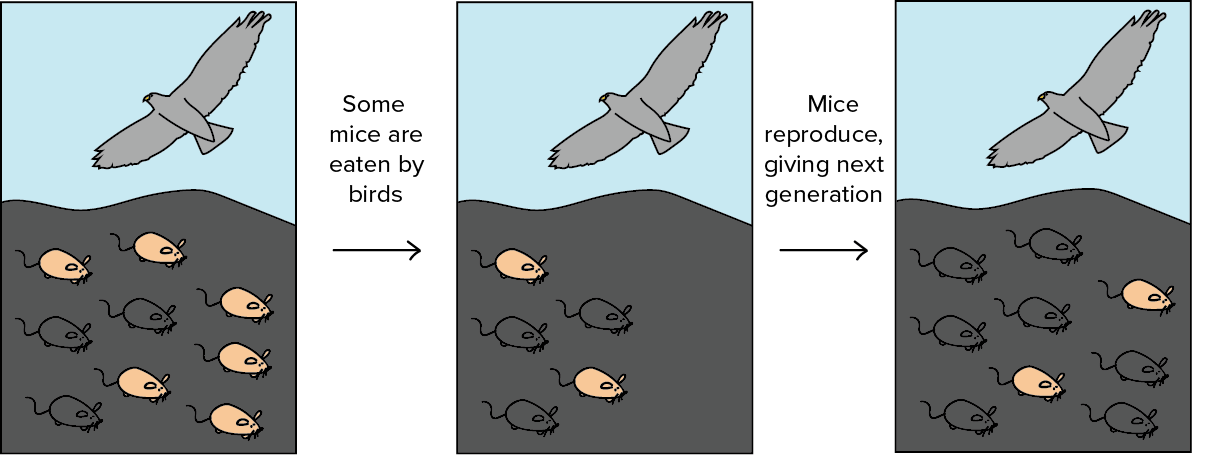
Why is the mouse population changing over time?
The light mice can reproduce more successfully than the dark mice
The hawks eat more dark mice than light mice because the dark mice taste better
The hawks eat more light mice than dark mice because they can see the light mice more easily
The hawks eat more dark mice than light mice because they can see the dark mice more easily
Which best describes the role of mutations in natural selection?
Mutations help an organism to better survive in their environment
An organism may acquire a helpful mutation by interacting with the environment
A mutation may result in an adaptive trait that makes an organism more likely to survive and reproduce
Organisms with certain traits are more likely to win competitions for mutations
The more genetic variation a population has,
the more likely it is for some individuals to
evolve
migrate
survive
mutate
Why do frogs and other organism reproduce so many eggs or offspring?
so that their babies can have friends to play with
the more offspring the more likely the offspring will survive
the more offspring the less likely offspring will survive
the more offspring the less competition

Domesticated dogs are an example of:
Natural Selection
Selective Breeding

The long and sharp beak of a woodpecker is an example of:
Natural Selection
Selective Breeding
Darwin observed many finch species on the Galapagos Islands. To explain these observations, he
proposed that each species evolved from the same common ancestor, which was a finch species
that migrated to the islands from the mainland. What additional evidence did Darwin use to support
his explanation?
The finch populations were very numerous, and different species often bred with one another.
The finch species lived in different habitats on different islands, which isolated them from one another.
The finch species were distributed evenly among all of the islands, but did not interbreed.
The beaks of the finches were identical, allowing them to eat the same foods on any of the islands.
A population of rabbits grows rapidly from one year to the next. Then one year, a disease strikes approximately one fourth of the adult rabbits. The disease remains with the population in the years that follow.
As explained by Darwin’s theory, which of these conditions allows the rabbit population to evolve by natural selection?
The disease affects adult and juvenile rabbits equally.
The disease reduces the ability of the rabbits to reproduce.
Some rabbits are resistant to the disease, and they pass the resistance to their offspring.
No rabbits are resistant to the disease, and all die when the disease strikes them.

The graphs below show the changes in crab color at one beach.
Which of the following is most likely to have caused the change in the distribution?
A new predator arrived that preferred dark-tan crabs.
A new predator arrived that preferred light-tan crabs.
A change in beach color made medium-tan crabs the least visible to predators.
A change in beach color made medium-tan crabs the most visible to predators.
Scientists use several concepts to explain patterns of evolutionary change. Which evidence would be most useful for identifying a pattern of punctuated equilibrium in an evolutionary lineage?
Similar bone structures among mammal species alive today
An identical genetic code in use among all species alive today
Fossil sequences that show gradual changes over long spans of geologic time
Fossil sequences that show rapid changes over brief spans of geologic time
Which of the following best illustrates natural selection?
An organism with favorable genetic variations will tend to survive and breed successfully.
A population monopolizes all of the resources in its habitat, forcing other species to migrate.
A community whose members work together utilizing all existing resources and migratory routes.
The largest organisms in a species receive the only breeding opportunities.

Which of the following statements best describes what will most likely occur to the moth populations in the image above?
The light moths will be captured by predators more easily than the dark moths, and the population of dark moths will rise.
The light moths will be captured by predators more easily than the dark moths, and the population of light moths will rise.
The dark moths will be captured by predators more easily than the light moths, and the dark moths will probably go extinct.
The light moths will change their wing color to match that of the dark moths.
Suppose a certain species of insect lives in the lush green canopy of the rain forest. Some of the insects are bright green in color, and some are bright yellow. Assume there is a natural predator of the insect in the area. What do you expect to happen to the populations of the green and the yellow insects over time?
The green insect population will increase and the yellow insect population will decrease.
The green insect population will decrease and the yellow insect population will increase.
Both insect populations will remain constant over time.
Both insect populations will increase over time.
When lions prey on a herd of antelopes, some antelopes are killed and some escape. Which part of Darwin’s concept of natural selection might be used to describe this situation?
reproductive isolation
descent with modification
acquired characteristics
survival of the fittest
According to Darwin’s theory of natural selection, the individuals that tend to survive are those that have
characteristics their parents acquired by use and disuse.
the greatest number of offspring.
characteristics that plant and animal breeders value.
variations best suited to the environment.
Organisms with traits that are favorable to their survival and reproduction are ________ likely to pass on their genes to the next generation, and thus ________ common in the population
more, less
more, more
less, less
less, more

In his book On the Origin of the Species, Charles Darwin described how species change over time. Which of the following is NOT part of his observations that describes the mechanisms of natural selection?
Organisms produce more offspring than can survive.
Disease and natural disaster will limit population growth.
Species today descended with modifications from ancestral species.
Organisms with advantages will survive and reproduce.

Who is considered to be the father of traditional classification?
Gregor Mendel
Robert Hooke
Francis Crick
Carolus Linnaeus

The first part of a scientific name is an organism's _______________ and the second part is its ________________.
species, genus
phylum, order
class, spices
genus, species

Which of the following shows taxonomic groups in order from broadest to most specific?
kingdom, phylum,order, class, genus, species
species, genus, family, order, class, phylum, kingdom
kingdom, phylum, class, order, family, genus, species
phylum, kingdom, order, class, genus, family, species

Modern classification relies on _________________ to determine degrees of relatedness.
evolutionary descent
similarities of structures
differences of anatomical structures
clades
Which kingdom contains members who are prokaryotic?
Archaebacteria and Eubacteria
Archaebacteria and Protista
Eubacteria and Animalia
Eubacteria and Fungi
What do protists, plants, fungi, and animals ALWAYS have in common? They are all...
Multicellular
Eukaryotic
Prokaryotic
Consumers
Which of the following means sorting living things into groups based on similarities?
Taxonomy
Scientific Sortation
Classification
Taxidermy
Giving living things a two part name is called
Taxonomy
Binomial Nomenclature
Classification
Kingdom Phylum

A dichotomous key for trees is provided. Hikers found a tree that has large brown cones and single sharp needles. What species of tree have the hikers found?
Juniper
Pine
Spruce
Fir

What is the name of bird W?
Certhidea
Geospiza
Camarhynchus
Platyspiza

Using this dichotomous key, identity the name of the circled fish.
band-tail puffer
spotted goat fish
peacock flounder
trumpet fish

A student discovers an arachnid with a segmented abdomen, long legs, and a tail with no stinger. The student uses the dichotomous key below to identify it. Which arachnid has the student found?
Whip Scorpion
Wind Scorpion
Daddy long legs
Scorpion

Using this dichotomous key, identify the name of the circled Fish, J.
peacock flounder
band-tail puffer
trumpet fish
spotted goat fish

Which of the following is the correct way to write the scientific name of a house cat? (imagine that these options are all in italics)
Felis Domesticus
felis domesticus
Felis domesticus
felis Domesticus
The main language of scientific names is:
Greek
English
Latin
Arabic
The scientific name for an organism is made from the:
class and family name
genus and species name
domain and kingdom name
kingdom and phylum name
Fill-in-the-blank:
Domain--Kingdom--Phylum--____________
Order
Family
Class
Species
The scientific name for a kangaroo is Macropus rufus, which indicates the kangaroo’s
Class and genus
Genus and species
Kingdom and class
Class and species

The 2-part naming system developed by Linneus is known as:
dichotomous key
taxonomy
binomial nomenclature
classification
A botanist discovers a new plant in the jungle. Which of the
following observations of the plant’s characteristics would be useful in determining its identity with a dichotomous key?
It was discovered in the summertime
It is wet from a recent rain storm.
Its leaves curl up on the edges.
It is eaten by native jungle ants.
When using a dichotomous key to identify organisms, what do we look at?
physical features
weather patterns
environment
diet

What is the scientific name of housefly?
Musca domestica
Insect domestica
Animalia domestica
Diptera domestica
In a properly written scientific name, which part is lowercase?
species
genus
In a properly written scientific name, which part is capitalized?
species
genus

Who is the closest relative to the birds?
crocodiles
sharks
fish
amphibians
Match the following descriptions with their kingdoms
eukaryotic, heterotrophic, no cell wall
Animalia
eukaryotic, heterotrophic, cell wall made if chitin
Fungi
eukaryotic, autotrophic, cell wall made of cellulose
Plantae
Some multicellular, mostly unicellular, all eukaryotic
Protista
Prokaryotic, cell wall made of peptidoglycan
Eubacteria


As scientists studied the kingdoms eubacteria and archaebacteria, they realized that they were so different that __________________________.
they were placed into the same kingdom
they created domains to further separate them
they created a microscope
Which level of organization is the BROADEST?
Kingdom
Species
Genus
Phylum
A whale is part of which kingdom of life?
plant
animal
bacteria
fungi
True or False: Scientific names are used by scientists all over the world
True
False
Which two levels of organization make up an organism's scientific name?
domain and kingdom
order and class
phylum and class
genus and species
How are organisms classified into kingdoms?
by their habitat
by similar characteristics
by their fur color
by date of discovery
Multicellular, heterotrophic, and no cell walls
Plant Kingdom
Archaebacteria Kingdom
Animal Kingdom
Eubacteria Kingdom
Which kingdom are mushrooms, yeast, and athlete's foot found?
Fungi
Plant
Animal
Bacteria
What is the major difference between the plant and animal kingdom?
Animals need water but plants don't.
Animals grow and develop and plants don't
Animals are unicellular and plants are multicellular
Animals consume their food and plants use photosynthesis
Example of an organism that makes it own food
elephant
plant
dog
mushroom
How do organisms in the Fungi kingdom obtain nutrients?
decomposes matter
uses sun to make its food
eats it

