wayground logo

Free Printable Worksheets

Font size

S
M
L
XL
Worksheets

PAP Biology 1st Sem Final Review

Total questions: 100

Worksheet time: 2hrs 42mins

Name
Class
Date
1.
Susan said, “If I fertilize my geranium plants, they will blossom.”
a)
recognize a problem
b)
test the hypothesis with an experiment
c)
form a hypothesis   
d)
draw conclusions
2.
A series of steps used by scientists to solve a problem or answer a question. 
a)
scientific method
b)
recipe
c)
data collection
d)
metric system
3.

Scientists create both scientific theories and scientific laws as they make observations and conduct experiments about the natural world. Which of the following statements most accurately compares the difference between scientific theories and scientific laws

a)

science laws are based on evidence while science theories are not

b)

science theories involve only biology, while laws involve all types of science

c)

science theories involve mathematical equations, while science laws are based on observations

d)

science theories are ideas that explain natural events, while science laws predict what will happen in a natural event.

4.

Maintaining a stable internal

environment is called

a)

homeostasis

b)

equilibrium

c)

balance

d)

evenness

5.
Scientific theories are based on
a)
general assumptions of how systems work.
b)
mathematical principles that can be proven true.
c)
large amounts of data collected over time.
d)
observations from within only one scientific discipline.
6.

As you add drops of water to the surface of a coin, each drop sticks to the other water droplet because of ________________, and sticks to the penny because of ______________.

a)

adhesion, cohesion

b)

cohesion, adhesion

c)

capillary action, specific heat

d)

specific heat, capillary action

7.
A worm turns away from light is an example of a worm
a)
reproducing
b)
doing cellular respiration
c)
having cells
d)
responding to its environment
8.

What do you call any substance that dissolves another substance?

a)

Solvent

b)

Height

c)

Atoms

d)

Oxygen

9.
Green plants produce their own food through the process of photosynthesis.
a)
All living things use energy
b)
All living things contain cells
c)
All living things maintain homeostasis
d)
All living things grow
10.
Observations made during an experiment are called:
a)
data
b)
problems
c)
conclusions
d)
questions
11.
What two elements make up water?
a)
Helium and oxygen
b)
Hydrogen and oxygen
c)
helium and carbon
d)
oxygen and carbon
12.
What is the monomer for a protein?
a)
Monosaccharide
b)
Triglyceride
c)
Amino Acid
d)
Nucleotide
13.
The study of how living things interact with one another and with their environment.
a)
Biology
b)
Lithology
c)
Ecology
d)
Farmacology
14.
Two or more members of a particular species living and interacting in the same area
a)
Community
b)
Population
c)
Organisms
d)
Biosphere
15.

Living things are made up of units called

a)

DNA

b)

Cells

c)

Homeostasis

d)

Seeds

16.
The ecological niches of three bird species are shown in the diagram. What is the advantage of each bird species having a different niche?
a)
As more birds feed higher in the tree, available energy increases.
b)
More abiotic resources are available for each bird.
c)
Predators are less likely to feed on birds in a variety of locations.
d)
There is less competition for food.
17.
What is the monomer of nucleic acids?
a)
Glycerol
b)
Monosaccharides
c)
Amino Acids
d)
Nucleotides
18.
A collection of organisms that belong to different populations but all live in the same area and interact with one another.
a)
Population
b)
Ecosystem
c)
Community
d)
Ecosphere
19.
Different populations living and interacting with each other in the same area
a)
Biome
b)
Ecosystem
c)
Community
d)
Niche
20.

What are the ecological levels of organization from smallest to the largest?

a)

species, population, community, ecosystem, biome, biosphere

b)

species, community, population, ecosystem, biome, biosphere

c)

species, population, community, biome, ecosystem, ecosphere.

d)

species, community, population, biome, ecosystem, ecosphere

21.

Two organisms that are so similar they can interbreed in nature and produce fertile offspring.

a)

biotic factor

b)

herbivore

c)

ecosystem

d)

species

22.
A __________ includes all living and non-living things in an environment. 
a)
population
b)
niche
c)
abitotic
d)
ecosystem
23.
What is the greenhouse effect?
a)
The warming of a planet due to trapped radiation.
b)
The cooling of Earth due to air pollution.
c)
The heating of a solid, such as a rock.
24.
Which biomolecule has sugars and starches?
a)
Lipids
b)
Proteins
c)
Carbohydrates
d)
Nucleic Acid
25.

Performing a test or experiment allows you to test your ___________.

a)

draw conclusions

b)

hypothesis

c)

senses

d)

battery

26.
Consumer that eats plants
a)
heterotroph
b)
herbivore
c)
producer
d)
community
27.
The continuous movement of water from Earth's surface to the atmosphere and back again.
a)
water cycle
b)
weather
c)
rock cycle
28.
An organism's _________ is defined as the environment in which it lives.
a)
habitat
b)
niche
c)
social structure
d)
ecosystem
29.

The ecological role an organism performs in their specific environment is considered the organism's...

a)

Habitat

b)

Population

c)

Biome

d)

Niche

30.
The image provided is an example of a(n):
a)
Carnivore
b)
Herbivore
c)
Producer
d)
Autotroph
31.
James Hutton’s and Charles Lyell’s work suggests that
a)
Earth is several million years old.
b)
all rocks on Earth contain fossils.
c)
Earth is several thousand years old.
32.
As you move upward, from level to level, in an energy pyramid, energy _____.
a)
increases
b)
decreases
c)
stays the same
d)
increases exponentially
33.
An organism that is killed and eaten by another organism
a)
Predator
b)
Prey
c)
Competition
d)
Adaptation
34.
A consumer that hunts is called:
a)
a producer.
b)
an omnivore.
c)
a predator.
d)
a herbivore.
35.
what did Charles Darwin observe in finch populations of the Galapagos Islands off the coast of South America?
a)
different species on different islands
b)
all species on one of the islands
c)
identical species on all the islands
d)
the same species as North America
36.
Jean-Baptiste Lamarck proposed that organisms
a)
have an innate tendency to become simpler as time passes.
b)
have an innate tendency toward complexity and perfection.
c)
inherit all of the adaptations they display.
37.
James Hutton’s and Charles Lyell’s work was important to Darwin because these scientists
a)
suggested that Earth was old enough for evolution to have occurred.
b)
explained all geologic events on Earth.
c)
refuted the work of Lamarck, which was based on misunderstandings.
38.
What type of selection is depicted in the picture? 
a)
stabilizing 
b)
directional 
c)
disruptive 
d)
the answer is not here
39.
The idea that events like war, starvation, and disease could prevent the endless growth of human populations was presented by
a)
Thomas Malthus.
b)
Jean-Baptiste Lamarck.
c)
Charles Darwin.
40.
When farmers select animals or plants to use for breeding, they look for
a)
natural variations that are present in a species.
b)
characteristics acquired during the lifetime of the organism. 
c)
homologous structures.
41.
a bird that can easily outcompete other birds for food and that can produce many eggs has a high
a)
life expectancy
b)
mutation rate
c)
fitness
d)
adaptability
42.
The economist Thomas Malthus suggested that
a)
in the human population, people die faster than babies are born.
b)
without certain checks on population size, there would soon be insufficient food for the growing human population.
c)
the majority of a species’ offspring die.
43.

The ability of an organism to survive and reproduce

a)

diversity

b)

fitness

c)

adaptation

d)

evolution

44.
Which of these is an example of natural selection?
a)
The largest animal in a population will have more opportunities for reproduction.
b)
Several species of organisms work together so that they all succeed.
c)
One species takes all the resources in an environment leaving none for others.
d)
Organism that are best suited to an environment tend to survive and reproduce more often.
45.
Which of the following explains adaptation.
a)
An individual organism changes to meet its needs in the environment. These changes pass down to their offspring.
b)
The species as a whole changes their characteristics.
c)
Beneficial traits allow organism to survive and pass on those traits
d)
New characteristics arise in a species as needed.  If these traits are helpful, they are passed down.
46.

Darwin had knowledge of DNA and its structure while investigating evolution

a)

True

b)

False

47.
What type of selection?
a)
Directional 
b)
Stabilizing
c)
Disruptive
48.

Darwin viewed the fossil record as useful support of his theory of evolution.

a)

True

b)

False

49.

A universal genetic code is molecular evidence in support of natural selection

a)

True

b)

False

50.

A gene pool consists of

a)

all of the genes, including all the different alleles, that are present in a population

b)

some of the genes, including the different alleles, that are present in a population

c)

all of the genes that are present in all populations

d)

all of the genes, including all the different alleles, that are present in all populations

51.
Sources of variations include _______ and ______?
a)
sexual reproduction, mutations
b)
asexual reproduction, mutations
c)
biological evolution, genetics
d)
biological evolution, genetics
52.
What is the correct explanation for what is happening in this graph?
a)
There are a lot of average-sized beaks
b)
There are no beaks
c)
There are a lot of small beaks only
d)
There are a lot of small and large beaks, but not average-sized ones
53.

What is the independent variable on this graph?

a)

Year

b)

Number of Visitors

c)

Visitors to a Park

d)

none of these

54.
Human babies don't do well if they are born too small. If they are too big complications can occur during birth. Baby size should then be selected for by which method?
a)
stabilizing
b)
directional
c)
disruptive
d)
Beyonce is having twins
55.
Genetic drift is change in the allele frequency of a population due to...
a)
random chance
b)
natural selection
c)
non-random mating (sexual selection)
d)
artificial selection
56.

situation in which allele frequencies in a population remain the same

a)

Mutation

b)

Fossil

c)

genetic equilibrium

d)

Hardy-Weinburg Principle

57.
The term for the formation of new and distinct species over the course of evolution is...
a)
speciation
b)
biological species concept
c)
reproductive barrier
d)
natural selection
58.
What is a species? 
a)
A group of organisms that can mate with each other and produce fertile offspring. 
b)
A group of organisms that can mate and produce offspring even if those offspring are infertile.
c)
A group of organisms that genetically are very different from each other. 
d)
Indivual organisms that live in the same environment. 
59.
A population of chimpanzees was separated when the forest that they lived in had a section cut down and a town was built. After a long period of time, the chimpanzees came back into contact but were incapable of breeding. Which of the following best describes the process that occurred?
a)
adaptation
b)
speciation
c)
convergent selection
d)
stabilizing selection
60.
The scientific name for an organism is made from the:
a)
class and family name
b)
genus and species name
c)
domain and kingdom name
d)
kingdom and phylum name
61.

A dichotomous key for insects is given. To what order does an insect with two pairs of scaly wings belong?

a)

Coleoptera

b)

Heteroptera

c)

Diptera

d)

Lepidoptera

62.
Giving living things a two part name is called
a)
Taxonomy
b)
Binomial Nomenclature
c)
Classification
d)
Kingdom Phylum
63.
The 2-part naming system developed by Linneus is known as:
a)
dichotomous key
b)
taxonomy
c)
binomial nomenclature
d)
classification
64.
What type of natural selection is this?
a)
Disruptive Selection
b)
Directional Selection
c)
Stabilizing Selection
d)
Sexy Selection
65.
 Genetic Drift is more likely to happen in... 
a)
aquatic populations
b)
small populations
c)
terrestrial populations
d)
older populations
66.

Which is more closely related?

a)

Lamprey and tiger

b)

Gorilla and Human

c)

Salamander and Tiger

d)

Shark and Lizard

67.

What is the dependent variable on this graph?

a)

Year

b)

Number of Visitors

c)

none of these

68.

What is the independent variable?

a)

Months

b)

Temperature

c)

Highs

d)

Lows

69.

How many people visited the park in 1997?

a)

20

b)

40

c)

60

d)

50

e)

35

70.
Things that stay the same throughout the whole experiment are called
a)
controls
b)
dependent variables
c)
independent variables
d)
constants
71.
What is mean by homeostasis?
a)
Controls and coordinates body activities through chemical 
b)
controls and coordinates body activities through electrical impulses
c)
For maintenance of a steady state in the internal environment
d)
remove metabolic waste products from the cel
72.
This part of the experiment serves as a basis of comparison; the one variable being tested has been omitted. 
a)
experimental group
b)
control group
c)
data
d)
variables
73.
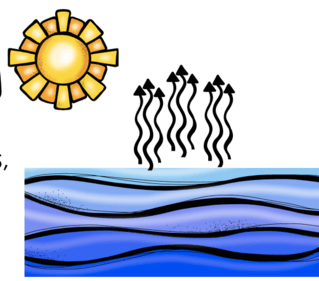
What part of the water cycle does this picture show?
a)
condensation
b)
precipitation
c)
evaporation
74.
The change that happens because of your experiment is called the ___________ variable.
a)
independent
b)
dependent
c)
controlled
75.
What are the reactants in photosynthesis?
a)
carbon dioxide and water
b)
water and glucose
c)
glucose and oxygen
d)
water and oxygen
76.
If the environment gets cold, we will often shiver in order to:
a)
keep body temperature the same as the external temperature
b)
decrease body temperature
c)
increase body temperature
d)
regulate blood pressure
77.
The process by which plants release water through the pores in their leaves is called...
a)
accumulation
b)
dormancy 
c)
photosynthesis 
d)
transpiration
78.
The one variable you change is called the ___________ variable.
a)
independent
b)
dependent
c)
controlled
79.
Which gas is removed from the atmosphere during photosynthesis?
a)
hydrogen
b)
oxygen
c)
nitrogen
d)
carbon dioxide
80.
How can photosynthesis be related to cellular respiration?
a)
What's produced by one is needed for the other
b)
They both produce the same products
c)
They both have the same reactants (need the same things)
d)
These 2 processes have nothing in common
81.
Which of the following organisms are carnivores?
a)
Krill and squid
b)
Phytoplankton and Crabs
c)
Killer whales and Leopard Seals
d)
Zooplankton and seaweed
82.
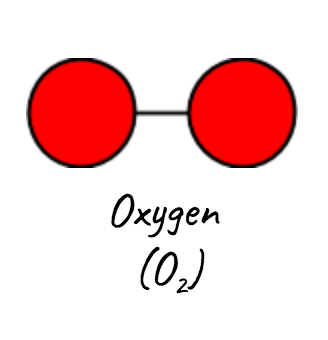
Oxygen is...
a)
A product of photosynthesis and cellular respiration
b)
A reactant of photosynthesis and cellular respiration
c)
A product of photosynthesis and a reactant of cellular respiration
d)
A reactant of photosynthesis and a product of cellular respiration
83.
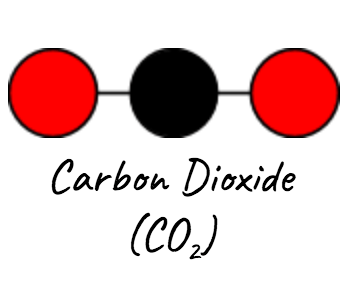
Carbon dioxide is...
a)
A product of photosynthesis and cellular respiration
b)
A reactant of photosynthesis and cellular respiration
c)
A product of photosynthesis and a reactant of cellular respiration
d)
A reactant of photosynthesis and a product of cellular respiration
84.
What is evaporation?
a)
The part of the water cycle when the sun heats up water, turning it from a liquid into water vapor or steam. It rises from the ground into the air.
b)
The part of the water cycle when the water vapor in the air gets cold. The water turns back into a liquid and forms clouds.
c)
The part of the water cycle when clouds get heavy and can no longer hold the liquid water. This causes the water to fall from the sky to the earth as rain, snow, sleet, or hail.
85.
Which organism in the food web is a producer?
a)
Mouse
b)
Owl
c)
Green Plant
d)
Snake
86.
Which organism in this food web is an herbivore?
a)
Frog
b)
Grasshopper
c)
Mouse
d)
Snake
87.
Which of the organisms on the food web are producers?
a)
Seaweed and zooplankton
b)
Seaweed and Phytoplankton
c)
Phytoplankton and Zooplankton
d)
Zooplankton and krill
88.
Which organisms in this food web can be a primary or a secondary consumer?
a)
Benthic Invertebrates and bald eagle
b)
Small Plankivorous Fish and Bivalves
c)
Bivalves and Zooplankton
d)
Zooplankton and Vegetation
89.
In the energy pyramid here, which organisms have the most energy available?
a)
Producers
b)
Carnivores
c)
Herbivores
d)
Top Predator
90.
Which of the examples below can BEST be described as mutualism between animals?
a)
A tapeworm lives in the intestine of a bird and consumes the food that the bird has eaten
b)
Mountain lions and wolves fight each other for the same deer
c)
A bird eats parasites off a rhinoceros while the rhinoceros provides protection to the bird
d)
Rats live in the garbage dump of a town and rarely interact with people
91.
Which of the following symbiotic relationships is considered parasitic?
a)
Ticks feeding on a dog
b)
Bees transporting pollen from flowers
c)
Pilotfish swimming under sharks
d)
Birds eating the insects fromo the back of hippo
92.
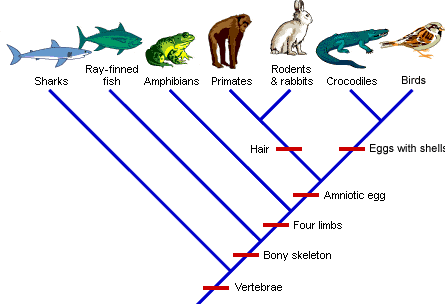
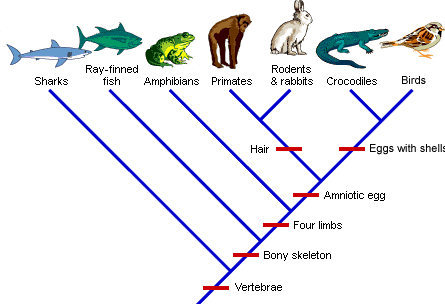
According to this cladogram, birds are LEAST related to: 
a)
Amphibians
b)
Sharks
c)
Ray Finned Fish
d)
Crocodiles
93.
An organism where one organism benefits and another is harmed
a)
Commensalism
b)
Parasitism
c)
Mutualism
d)
Competition
94.
In the energy pyramid below, which organism has the least amount of energy available?
a)
Producers
b)
Herbivores
c)
Carnivores
d)
Top Predator
95.
Relationship where one organism benefits and the other is neither harmed nor helped
a)
Commensalism
b)
Parasitism
c)
Mutualism
d)
Competition
96.
According to this cladogram, sharks are MOST closely related to which organism? 
a)
Amphibians
b)
Ray finned fish
c)
Crocodiles
d)
Birds
97.
Relationship where both organism benefit
a)
Competition
b)
Commensalism
c)
Mutualism
d)
Parasitism
98.
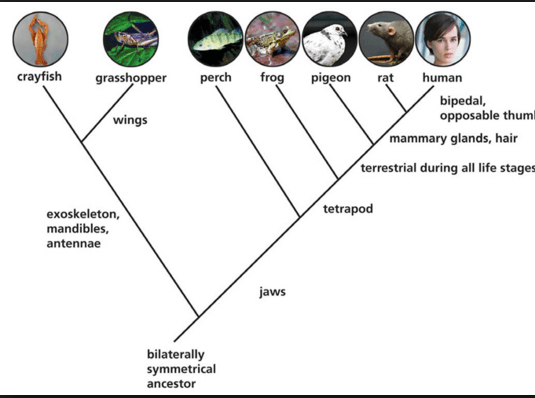
According to the cladogram, which organism is most distantly related to the human?
a)
crayfish
b)
grasshopper
c)
perch
d)
frog
99.
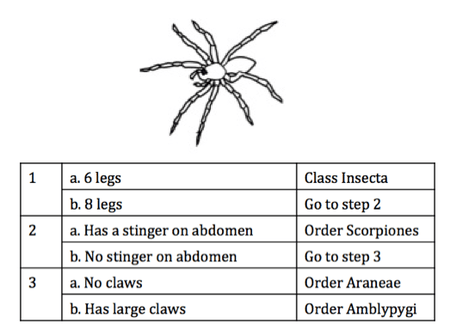
An illustration and a dichotomous key are given. What is the correct classification for this organism?
a)
Class Insecta
b)
Order Amblygygi
c)
Order Araneae
d)
Order Scorpiones
100.
What is a dichotomous key used for in science?
a)
To organize biomes
b)
Classify organisms
c)
Identify bacteria only
d)
None of these