
 Worksheets
Biology Semester 1 Review
Total questions: 100
Worksheet time: 1hrs 14mins
Name
Class
Date
1.
This variable in an experiment is the one being deliberately changed by the scientist.
a)
dependent variable
b)
independent variable
c)
data
d)
control group
2.
A series of steps used by scientists to solve a problem or answer a question.
a)
scientific method
b)
recipe
c)
data collection
d)
metric system
3.
Mr. S. sets up an experiment to see how the mass of a ball affects the distance it rolls off a ramp. Identify the dependent variable.
a)
height of the ramp
b)
distance traveled by the ball
c)
mass of the ball
d)
weight of the ball
4.
When experimenting with the growth of a plant, a scientist uses three (of the same type of) plants, two different fertilizers, equal light, and equal water. What type of variable is the fertilizer?
a)
Dependent
b)
Independent
c)
Control
d)
Compound
5.

Which type of cell?
a)
Prokaryote
b)
Eukaryote
6.
What type of cell has a nucleus?
a)
eukaryotic
b)
prokaryotic
7.
Has membrane bound organelles
a)
Prokaryote
b)
Eukaryote
c)
both
8.
Which states a difference between an animal and an amoeba?
a)
An animal is made up of only one cell and an amoeba is made of many cells.
b)
An animal is found on land and an amoeba is found in water.
c)
An amoeba is single-celled and an animal is multicellular.
d)
An animal is a living organism and an amoeba is a non living organism
9.
Which is an example of a multicellular organism?
a)
bacteria
b)
bear
c)
algae
d)
yeast
10.
What is the cell organelle that stores water, food and waste called?
a)
The cytoplasm
b)
The lysosomes
c)
The vacuole
d)
The mitochondria
11.
What is the main
difference between prokaryotic and eukaryotic cells?
a)
Prokaryotic cells have a nucleus and Eukaryotic cells do not
b)
Prokaryotic cells are unicellular and Eukaryotic cells are multicellular.
c)
Prokaryotic cells do not have a nucleus, Eukaryotic cells do have a nucleus.
d)
Prokaryotic cells are plant cells and Eukaryotic cells are animal cells.
12.
The main function of chloroplasts is:
a)
To control what enters and leaves the cell.
b)
To break down food to release energy for the cell.
c)
To control all activities of the cell.
d)
To produce food for the cell using the sun's energy.
13.
The cytoplasm
a)
Is the gel-like fluid that holds other organelles in place.
b)
Breaks down food to produce energy for the cell.
c)
Is known as the "brain" of the cell.
d)
Is where photosynthesis takes place.
14.
The mitochondria
a)
Controls what enters and leaves the cell
b)
Performs photosynthesis to make food for the cell.
c)
Contains the chromosomes and is known as the "brain" of the cell.
d)
Breaks down food to produce energy for the cell.
15.
The function of the chromosomes is:
a)
To break down food to produce energy for the cell.
b)
To control what enters and leaves the cell.
c)
To break down broken cell parts.
d)
To direct all activities of the cell.
16.
Ribosomes are the cell organelle that
a)
Break down food to produce energy for the cell.
b)
Produce proteins for the cell.
c)
Break down broken cell parts.
d)
Make food for the cell using the sun's energy.
17.
Autotrophs
a)
Make their own food using the energy from the sun.
b)
Have to eat other organisms.
c)
Are the same as consumers.
d)
Do not have a nucleus.
18.
The cell wall
a)
Controls what enters and leaves the cell.
b)
Provides structure and support for the plant cell.
c)
Is a flexible out layer of the cell.
d)
Is the transportation system of the cell.
19.
What is the function of the cell membrane?
a)
To protect and support the cell
b)
To perform different functions in each cell
c)
To control what enters and leaves the cell
d)
To form a hard outer covering for the cell
20.
What is the function of the lysosomes?
a)
To make proteins for the cell
b)
To store water and other materials
c)
To convert food and oxygen into energy
d)
To use enzymes to digest old or worn out cell parts
21.
Which organelle in plant cells captures the energy in sunlight?
a)
Cell Wall
b)
Nucleus
c)
Chloroplasts
d)
Vacuole
22.
Heterotrophs
a)
Are all prokaryotic
b)
Can make their own food
c)
Cannot make their own food
d)
Are producers
23.
The nucleus
a)
Controls what enters and leaves the call
b)
Is known as the brain of the cell
c)
Makes proteins for the cell
d)
Makes food for the cell
24.

The organelle that looks like small dots. It makes proteins.
a)
nucleus
b)
cell membrane
c)
ER
d)
ribosomes
25.

The jelly-like fluid that supports the organelles in place.
a)
nucleus
b)
cell membrane
c)
chloroplast
d)
cytoplasm
26.

Which rigid organelle provides strength and support to plant cells.
a)
Chloroplast
b)
Cell Wall
c)
Cell Membrane
d)
Vacuole
27.

Which organelle is found in both plant and animal cells and converts sugars into energy? (the powerhouse of the cell)
a)
Mitochondria
b)
Cell Wall
c)
Cell Membrane
d)
Vacuole
28.
What provides the energy during photosynthesis?
a)
dirt
b)
water
c)
sunlight
29.
This structure regulates the passage of water, food and waste into and out of the cell.
a)
nucleus
b)
vacuole
c)
cytoplasm
d)
cell membrane
30.
Which organelle is in a plant cell but not in an animal cell?
a)
cytoplasm
b)
chloroplast
c)
mitochondrion
d)
cell membrane
31.
Where the genetic material is found in an eukaryotic cell
a)
nucleolus
b)
cytoplasm
c)
nucleus
d)
chloroplast
32.
food making structure of plant cells
a)
chloroplasts
b)
cell wall
c)
cytoplasm
d)
vacuole
33.
Which organisms perform Photosynthesis?
a)
Only Autotrophs
b)
Only Heterotrophs
c)
Autotrophs and Heterotrophs
34.
What are the products of photosynthesis?
a)
water and carbon dioxide
b)
oxygen and glucose
c)
oxygen and carbon dioxide
d)
oxygen and water
35.
What are the reactants in cellular respiration?
a)
Carbon Dioxide, Water, Sunlight
b)
Glucose, Oxygen
c)
Carbon Dioxide, Water, ATP
36.
What are the products in cellular respiration?
a)
Carbon Dioxide, Water, Sunlight
b)
Glucose, Oxygen
c)
Carbon Dioxide, Water, ATP
37.
Cellular respiration is a process that converts __________ into __________.
a)
Sunlight, Glucose
b)
ATP, Glucose
c)
Glucose, Sunlight
d)
Glucose, ATP
38.
After glycolysis, the next two steps in aerobic respiration are the ____________ and the ___________.
a)
Light reactions, Calvin Cycle
b)
Lactic acid fermentation, Alcoholic fermentation
c)
Kreb's Cycle, Electron Transport Chain
39.
Energy is released from ATP when
a)
a phosphate group is added
b)
adenine bonds to ribose
c)
ATP is exposed to sunlight
d)
a phosphate group is removed
40.

Autotroph or heterotroph?
a)
Autotroph
b)
Heterotroph
41.

Autotroph or heterotroph?
a)
Autotroph
b)
Heterotroph
42.
Photosynthesis ______ glucose while cellular respiration ______ glucose.
a)
builds; breaks apart
b)
breaks apart; builds
43.
Why do we eat food?
a)
to obtain energy/fuel
b)
to eliminate waste products
c)
to prevent diseases
d)
to kill pathogens
44.
In which eukaryotic organelle does photosynthesis occur?
a)
mitochondria
b)
stomata
c)
xylem
d)
chloroplast
45.
In photosynthesis ...
a)
water is chlorinated
b)
light energy is changed to glucose
c)
osmosis happens
d)
ATP is made
46.
The mitochondria is responsible for ...
a)
photosynthesis
b)
anaerobic respiration
c)
cellular respiration
d)
fermentation
47.

A diagram representing the relationship between photosynthesis and cellular respiration is shown.
The numbered boxes in the diagram represent which of the following?
The numbered boxes in the diagram represent which of the following?
a)
1 - water; 2 - nitrogen
b)
1 - nitrogen; 2 - oxygen
c)
1 - oxygen; 2 - carbon dioxide
d)
1 - carbon dioxide; 2 – water
48.

Which of the following structure is where photosynthesis occurs in the cell?
a)
nucleus
b)
chloroplast
c)
mitochondria
d)
endoplasmic reticulum
49.
Which process do the animals in the food web use to convert energy from food into ATP?
a)
cellular respiration
b)
osmosis
c)
photosynthesis
d)
transcription
50.
What is the purpose of cellular respiration?
a)
to break down food
b)
to create energy in the body
c)
to release energy from food
d)
there is none; it's a waste of time
51.
Lactic acid fermentation occurs in your muscles after a workout because your cells are struggling to get...
a)
Glucose
b)
Sunlight
c)
Oxygen
d)
Water
52.
A portion of mRNA is coded CUG. The corresponding DNA is coded
a)
GAC
b)
GTC
c)
CTG
d)
CAG
53.

A portion of DNA reads GAG. The corresponding mRNA would be
a)
GUG
b)
GTG
c)
CTC
d)
CUC
54.
The process of creating RNA using DNA as the template is
a)
translation
b)
transcription
c)
translocation
d)
Transylvania
55.
In RNA, uracil takes the place of the DNA nitrogen base called
a)
guanine
b)
cytosine
c)
thymine
d)
adenine
56.

The process shown in this image
a)
is called replication
b)
results in a new copy of the DNA
c)
does not happen during mitosis
d)
All of these apply
57.

In eukaryotes, molecule 1 is found in
a)
ribosomes
b)
chloroplasts
c)
cytoplasm
d)
the nucleus
58.

Molecule 3 is synthesized in
a)
ribosomes
b)
chloroplasts
c)
the cell membrane
d)
the nucleus
59.

What 3 things make up a nucleotide?
a)
Sugar, Phosphate, Nitrogen Base
b)
Sugar, Hydrogen, Carbon
c)
Carbon, Phosphate, Nitrogen
d)
mRNA, tRNA and rRNA
60.
What is assembled during transcription?
a)
transfer RNA
b)
messenger RNA
c)
DNA replication
d)
court proceedings
61.
What is made during translation?
a)
transfer RNA
b)
messenger RNA
c)
Proteins
d)
Spanish Rice
62.
What stores the code for making an individual protein?
a)
DNA
b)
a gene
c)
a chromosome
d)
transfer RNA
63.

The site of protein synthesis?
a)
nucleus
b)
ER
c)
Ribosome
d)
Golgi Body
64.
Which type of RNA delivers the genetic code to the ribosome?
a)
tRNA
b)
mRNA
c)
rRNA
d)
tmRtmRNA
65.
What is the function of transfer RNA?
a)
It is a part of the ribosome.
b)
It bonds to other RNA molecules, leading to their destruction.
c)
It delivers the correct amino acid to the ribosome.
d)
It carries the information coding for the amino acid sequence of a protein.
66.
Which of these is part of the description of protein?
a)
a folded chain of amino acids
b)
a folded chain of carbohydrates
c)
a branched chain of fatty acids
d)
a branched chain of nucleic acids
67.
Which most directly affects the sequence of amino acids in a protein?
a)
the DNA in the nucleus of the cell
b)
the amino acids found in the cytoplasm
c)
the type of cell in which the protein is made
d)
the region of the cell in which the protein is made
68.
DNA codes for __________ which determine ___________
a)
mRNA, tRNA
b)
mRNA, ribosomes
c)
proteins. traits
d)
proteins, peptide bonds
69.
Which correctly outlined the central dogma
a)
DNA --> mRNA --> rRNA
b)
DNA --> tRNA --> protein
c)
DNA --> mRNA --> protein
d)
DNA --> amino acid --> protein
70.

The drawing shows the structure of what molecule?
a)
A DNA molecule
b)
A lipid molecule
c)
A carbohydrate molecule
d)
A protein molecule
71.

Where does DNA replication occur?
a)
Outside of the cell membrane
b)
Inside of the nucleolus
c)
Inside of the nucleus
d)
In ribosomes with DNA polymerase
72.

What are the firsts couple of steps of DNA replication?
a)
DNA is unwinded > Helicase seperates strands > DNA primase comes in to create a primer
b)
DNA primase comes in to create a primer > DNA is unwinded > Helicase seperates strand
c)
DNA is unwinded > DNA primase comes in to create a primer > Helicase seperates strand
d)
Helicase seperates strand > DNA is unwinded > DNA primase comes in to create a primer
73.

DNA is made up of monomers called..
a)
Chromosomes
b)
Tidepods
c)
Nucleotides
d)
Chromatin
74.

What is the enzyme Helicase used for?
a)
Connecting Okazaki fragments, sealing repairs and sealing fragments.
b)
Assembling nucleotides and creating base pairs (creating identical DNA strands).
c)
Unpackages/unwinds the DNA
d)
Creates a primer on the DNA nucleotide sequence
75.

What is the enzyme DNA Polymerase used for?
a)
Assembling nucleotides and creating base pairs (creating identical DNA strands).
b)
Creates a primer on the DNA nucleotide sequence
c)
Connecting Okazaki fragments, sealing repairs and sealing fragments.
d)
Unpackages/unwinds the DNA
76.
At what point in the cell cycle does DNA replication occur and why?
a)
before a cell divides, to provide each of the two resulting cells with a complete set of DNA instructions
b)
before a cell divides, to ensure that the DNA will fit into the resulting cells
c)
during cell division, to ensure that the DNA will fit into the resulting cells
d)
after a cell divides, to provide each of the two resulting cells with a complete set of DNA instructions
77.
Which choice describes DNA after replication has taken place?
a)
one molecule with two original strands and one molecule with two new strands
b)
two molecules, each with one original and one new strand
c)
two molecules, each with two new strands
d)
two molecules, each with two old strands
78.

Base your answer to the following question on the structures represented in the diagram below. What is the relationship between these three structures?
a)
DNA is made up of proteins that are synthesized in the cell.
b)
Protein is composed of DNA that is stored in the cell.
c)
DNA controls the production of protein in the cell.
d)
The cell is composed only of DNA and protein.
79.
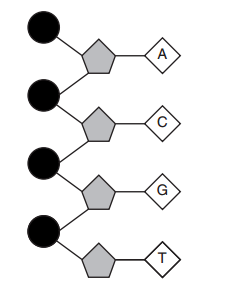
The diagram below represents a portion of a DNA molecule. The letters represent different types of
a)
sugar molecules
b)
nitrogen bases
c)
enzymes
d)
proteins
80.
DNA is replicated during the ______ phase of the cell cycle.
a)
G1
b)
Synthesis
c)
G2
d)
G0
81.

Fruit fly body cells have 8 chromosomes. After mitosis, you would expect a resulting fruit fly daughter cell to have ...
a)
16 chromosomes.
b)
46 chromosomes.
c)
8 chromosomes.
d)
4 chromosomes.
82.

Structure B is pointing to the _____.
a)
chromosome
b)
centromere
c)
DNA
d)
chromatid
83.

How many chromosomes are normally found in human body cells?
a)
46
b)
23
c)
26
d)
44
84.

Identify the phase of mitosis.
a)
prophase
b)
metaphase
c)
anaphase
d)
telophase
85.

a)
Anaphase
b)
Cytokinesis
c)
Telophase
d)
Metaphase
86.

a)
Cytokinesis
b)
Interphase
c)
Anaphase
d)
Metaphase
87.

a)
Anaphase
b)
Cytonkinesis
c)
Interphase
d)
Prophase
88.
What causes genetic variation in meiosis?
a)
chromosomes lining up
b)
crossing over of chromosomes
c)
separation of chromosomes
d)
chromosomes pulling apart
89.
What kind of cells are made in MEIOSIS?
a)
Haploid cells
b)
Diploid Cells
c)
Skin Cells
d)
Liver Cells
90.
If the Diploid number of Carrots is 18, the haploid number is
a)
18
b)
9
c)
27
d)
36
91.
The process of crossing over occurs in what phase of meiosis?
a)
anaphase 1
b)
prophase 1
c)
prophase 2
d)
telophase 1
92.
The chromosomes that pair up during meiosis, are called __________ chromosomes.
a)
homozygous
b)
asexual
c)
homologous
d)
genes
93.
When homologous chromosomes match up, they form a structure call a ___________.
a)
tetrad (pair of chromosomes, one from mom and one from dad)
b)
triad
c)
diploid
d)
quad (group of 4 replicated chromosomes, 2 from mom and 2 from dad)
94.

Which cellular process is shown?
a)
meiosis
b)
endocytosis
c)
mitosis
d)
phagocytosis
95.

What phase is represented?
a)
metaphase 1
b)
metaphase 2
c)
anaphase 1
d)
anaphase 2
96.
products of meiosis are genetically
a)
different
b)
identical
97.

Meiosis makes sperm and egg cells. In humans, sperm and egg cells each have _____ chromosomes. Therefore a fertilized human egg cell (sperm and egg cell combined) would create a cell with _____ chromosomes.
a)
23, 46
b)
46, 23
c)
2, 4
d)
50, 100
98.
How many daughter cells does Meiosis create?
a)
2
b)
4
c)
8
d)
1
99.

Variation in the cells/organisms produced...
a)
Mitosis
b)
Meiosis
100.

An exact copy of a cell/organism is produced...
a)
Mitosis
b)
Meiosis
100 %

