wayground logo

Free Printable Worksheets

Font size

S
M
L
XL
Worksheets

Biology STAAR Review

Total questions: 95

Worksheet time: 2hrs 42mins
Name
Class
Date
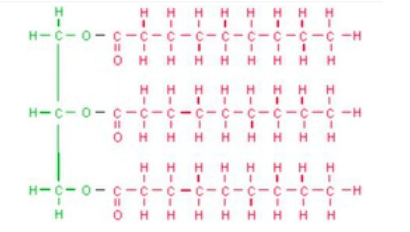
1.
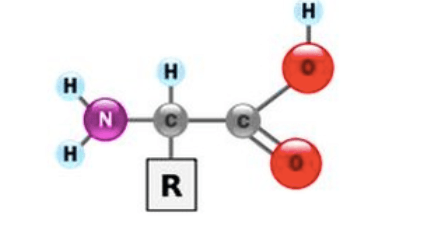
Which biomolecule is this a picture of?
a)
Protein
b)
Nucleic Acid
c)
Lipid
d)
Carbohydrate
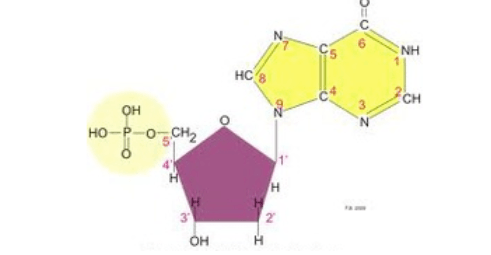
2.
Which biomolecule is this a picture of?
a)
Protein
b)
Nucleic Acid
c)
Lipid
d)
Carbohydrate
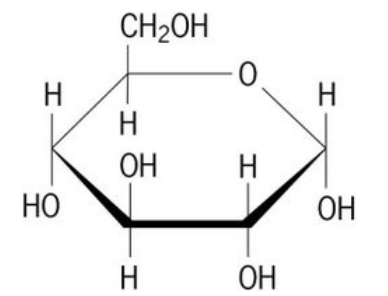
3.
Which biomolecule is this a picture of?
a)
Protein
b)
Nucleic Acid
c)
Lipid
d)
Carbohydrate
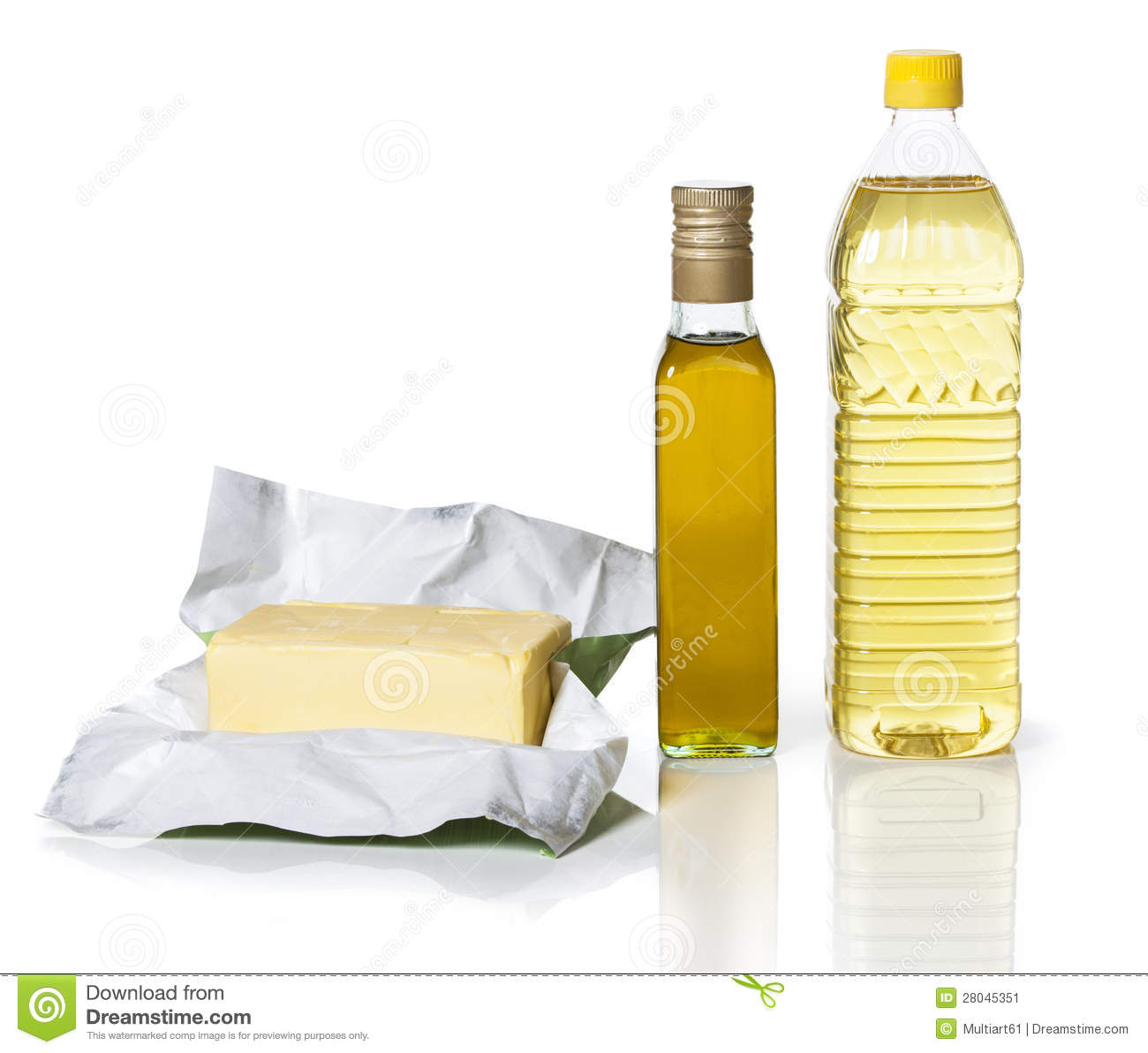
4.
Which biomolecule is this a picture of?
a)
Protein
b)
Nucleic Acid
c)
Lipid
d)
Carbohydrate
5.
Which biomolecule is also known as enzymes?
a)
Carbohydrate
b)
Lipid
c)
Nucleic Acid
d)
Protein
6.

Which biomolecule is your main source of quick energy?

a)

Nucleic Acid

b)

Protein

c)

Lipid

d)

Carbohydrate

7.
The monomer of a protein is called 
a)
an amino acid
b)
a monosaccharide
c)
a fatty acid
d)
a nucleotide
8.
Which biomolecule is found in fats, oils, and waxes and is a source of long-term energy
a)
Proteins
b)
Nucleic Acid
c)
Lipids
d)
Carbohydrate
9.

Which of the following molecules makes up the structure of a cell membrane?

a)

waxes

b)

steroids

c)

fatty acids

d)

phospholipids

10.

Which of the 4 biomolecules is used for long-term energy storage, insulation, and protection?

a)

Lipids

b)

Proteins

c)

Nucleic acid

d)

Carbohydrates

11.
What is the purpose  of an enzyme?
a)
give permission for the reaction
b)
raise activation energy
c)
speed up reactions
d)
control how many reactions occur
12.
Which of the following conclusions can be drawn from this graph?
a)
The optimum pH of the enzyme is 6.6.
b)
The optimum pH of the enzyme is 5.8
c)
The enzyme’s activity increases as pH increases 5.0 to 9.0
d)
The enzyme’s activity is greater around pH of 8.0 .
13.

Photosynthesis involves the production of sugar and oxygen. Select the diagram that shows the product of photosynthesis.

a)

A

b)

B

c)

C

d)

D

14.
A(n) ______ is a substance with a pH less than 7
a)
Acid
b)
Alkaline
c)
Base
d)
Buffer
15.
What do viruses need to reproduce?
a)
they need genetic material
b)
They need a host cell
c)
They need  bacteria
d)
They need insulin
16.

Which of the following would you find in a eukaryotic cell but not a prokaryotic cell?

a)

Nucleus

b)

Ribosome

c)

Cell Membrane

d)

DNA

17.
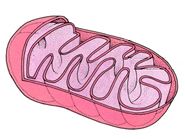
What is the name of the structure shown in the diagram where cellular respiration takes place?
a)
Chloroplast
b)
Mitochondrion
c)
Nucleus
d)
Vacuole
18.

In what way is the DNA of a nerve cell different from the DNA of a muscle cell?

a)

The DNA is the same but each cell contains different genes

b)

The DNA is the same but different genes are activated in each cell

c)

The DNA is different, but the same genes are turned on and off in each cell

d)

The DNA is different, but each cell contains the same genes

19.

Which explains active transport?

a)

Diffusion of small, uncharged molecules from high to low concentration across the cell membrane

b)

Diffusion of water molecules from high to low concentration across the cell membrane

c)

Diffusion of molecules from high to low concentration through the cell membrane with the help of a protein channel

d)

Molecules moving from low to high concentration with the use of ATP energy

20.

What is the correct order of organization?

a)

tissues-cells-organs-organ systems-organism

b)

cell-tissue-organs-organ systems-organism

c)

organism-cells-tissues-organ systems-organism

d)

tissues-cells-organs-organ systems-organism

21.
What process is almost the exact opposite of photosynthesis?
a)
dehydration synthesis
b)
hydrolysis
c)
cellular respiration
d)
reproduction
22.
What gas is released from a plant?
a)
Carbon dioxide
b)
oxygen
23.
How do gases enter and get released from a plant?
a)
through the stomata (pores)
b)
through the roots
c)
through vacuole
d)
through the golgi
24.
How are cellular respiration and photosynthesis related, in regards to energy?
a)
The energy captured in photosynthesis is used to power cellular respiration
b)
The energy transformed in cellular respiration is used to power photosynthesis
c)
Photosynthesis and respiration perform the same tasks in terms of energy transformation
d)
Energy is not involved in either photosynthesis or cellular respiration
25.
Before cells can divide, what must be copied?
a)
mitochondria
b)
cytoplasm
c)
DNA
d)
dna
Cell Wall
26.
In the S stage of interphase_______________
a)
the cell grows
b)
the nucleus divides
c)
the cell membrane divides
d)
the DNA is replicated
27.
Uncontrollable cell growth is known as _____
a)
obesity
b)
cancer
c)
diabetes
d)
hepatitis
28.
Put the following in order: G2, cytokinesis, G1, mitosis, S
a)
G1, G2, S, Mitosis, cytokinesis
b)
G1, S, G2, Mitosis, cytokinesis
c)
G1, G2, S, cytokinesis, mitosis
d)
G1, S, G2, cytokinesis, mitosis
29.
What is the end result of mitosis?
a)
2 identical gametes (sex cells)
b)
2 identical daughter cells
c)
2 daughter cells with different genetic information
d)
4 identical daughter cells
30.
Name the phase:
a)
Anaphase
b)
Telophase
c)
Metaphase
d)
Prophase
31.
What causes genetic variation in meiosis?
a)
chromosomes lining up
b)
crossing over of chromosomes
c)
separation of chromosomes
d)
chromosomes pulling apart
32.
If a father is AA and a mother is AB, what is the probability for a child with AB blood? 
a)
0%
b)
25%
c)
50%
d)
75%
33.
If two parents have type AB blood, what is the probability that their child will have type O blood?
a)
0%
b)
25%
c)
50%
d)
100%
34.

How is it possible to combine bacterial DNA with human DNA?

a)

Humans have the same exact DNA sequence as bacteria

b)

Both humans and bacteria share the same components of DNA.

c)

Humans have bacteria inside of them.

d)

Humans and bacteria are both eukaryotic organisms.

35.
A homozygous dominant dog with brown fur is crossed with a heterozygous dog with brown fur. What are the percentages of the possible genotypes?
a)
100% BB
b)
75% BB and 25%Bb
c)
50 % BB and 50% Bb
d)
50% Bb and 50% bb
36.

What is the mode of inheritance for this pedigree?

a)

sex-linked dominant

b)

autosomal dominant

c)

autosomal recessive

d)

sex-linked recessive

37.
A male beetle has the genotype Ttbb. If this beetle mates with a female with genotype TTBb, what is the chance their offspring will have the genotype TtBb?
a)
12.5%
b)
25%
c)
50%
d)
75%
38.

A male beetle has the genotype TtBb and a female beetle has the genotype TtBb. What would be phenotypic ratio seen in the offspring of these two beetles?

a)

1:2:1:1

b)

9:3:3:1

c)

1:1:1:1

d)

4:4:4:4

39.

Crosses between white-coated cattle (CWCW) and red-coated cattle (CRCR ) produce spotted offspring (CR CW). This type of inheritance pattern is known as:

a)

dominance

b)

codominance

c)

incomplete dominance

d)

sex-linkage

40.
A boy inherits genes for tallness, but his growth is limited as a result of poor nutrition. This is an example of - 
a)
environmental influence on gene expression 
b)
expression of a hidden trait
c)
an inherited disorder
41.
Which best describes how the traits of an organism are determined by the DNA in their cells?
a)
DNA provides the energy need for cellular processes
b)
DNA is copied to mRNA, which controls cellular functions
c)
DNA codes for proteins which allow an organism to grow and function
d)
DNA unzips and each strand codes for a different amino acid
42.
According to the data, the unknown bacterial species is most closely related to
a)
Species I
b)
Species II
c)
Species III
d)
Species IV
43.

A mutation can be passed to offspring only if it takes place in this kind of cell

a)

skin cell

b)

gamete cell

c)

somatic cell

d)

blood cell

44.
Which man is the father of this baby?
a)
Father 1
b)
Father 2
c)
Father 3
d)
None of them
45.
Which component of DNA determines the traits of an organism? 
a)
Nitrogen Bases
b)
Sugar-Phosphate Backbone
c)
Hydrogen bonds
46.
Which is the mRNA molecule that would be transcribed from this DNA template:
TGGCAAGTACGT
a)
ACCGTTCATGCA
b)
UGGCAAGUACGU
c)
UCCGUUCUUGCU
d)
ACCGUUCAUGCA
47.
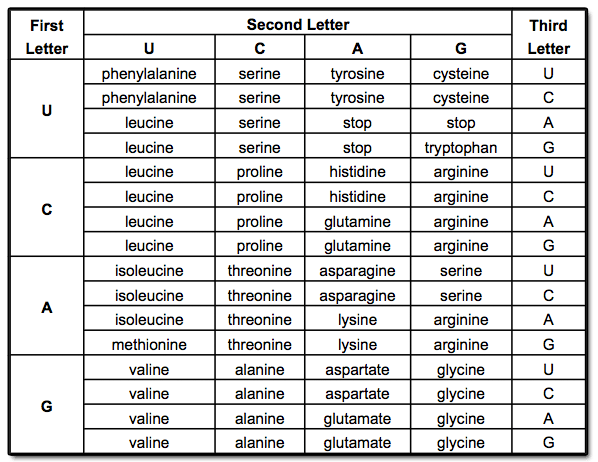
What is the correct amino acid sequence for the mRNA code AUGCCAGUAUGA
a)
Met-Pro-Ala-Val
b)
Met-Pro-Val
c)
Tyr-Gly-His
d)
Tyr-Gly-Arg-His
48.
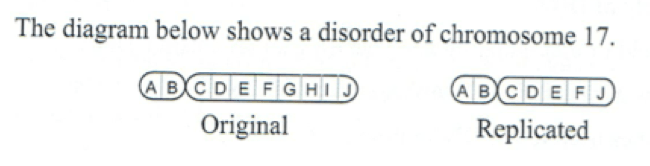
Identify the chromosomal mutation.
a)
Deletion
b)
Duplication
c)
Inversion
d)
Translocation
49.
What type of chromosomal mutation has occurred?
a)
substitution
b)
insertion
c)
deletion
d)
nondisjunction
50.
A plant growing in response to the sunlight. 
a)
Gravitropism 
b)
Phototropism
c)
Thigmotropism
d)
Hydrotropism
51.

When glucose levels in the blood rise, your brain sends a signal to your pancreas. The pancreas releases insulin, which opens channels in cell membranes to allow glucose to enter the cell, lowering blood sugar levels. This is an example of:

a)

Positive Feedback

b)

Negative Feedback

52.
The immune system interacts with the _____ system because most of the immune cells travel in the blood.  
a)
muscular
b)
circulatory
c)
digestive
d)
respiratory
53.
The nervous system interacts with the ____ system when it send a message to the adrenal glands to release the hormone "adrenaline" into our blood.  
a)
endocrine
b)
skeletal
c)
muscular
d)
digestive
54.
What systems are interacting in this picture?
a)
Digestive and nervous
b)
Endocrine and muscular
c)
Respiratory and circulatory
d)
Circulatory and Immune
55.
Which systems work together to ensure the body is protected from infectious agents?
a)
integumentary & immune
b)
muscular and respiratory
c)
excretory & expository
d)
reproductive & digestive
56.
What are your body's specific defenses?
a)
hormones & T cells
b)
B & T cells
c)
skin & mucous membranes
d)
antibiotics
57.

The scientific name for an organism is made from the:

a)

Class and family name

b)

Genus and species name

c)

Domain and kingdom name

d)

Kingdom and phylum name

58.
The 8 levels of classification, most broad to most specific.
a)
Domain, Genus, Family, Order, Class, Phylum, Kingdom, Species
b)
Domain, Species, Kingdom, Genus, Phylum, Family, Class, Order
c)
Domain, Kingdom, Phylum, Class, Order, Family, Genus, Species
d)
Order, Kingdom, Species, Domain, Phylum, Family, Class, Genus
59.
Which organisms are closely related? 
a)
American badger and leopard
b)
coyote and gray wolf
c)
european otter and leopard
d)
coyote and american badger
60.

An illustration and a dichotomous key are given. What is the correct classification for this organism?

a)

Class Insecta

b)

Order Amblygygi

c)

Order Araneae

d)

Order Scorpiones

61.

What is an advantage of using scientific names vs. common names?

a)

Common names can be confusing

b)

Scientific names are all in Latin

c)

Scientific names are universal

d)

All of these choices are true

62.
What type of cell does HIV destroy?
a)
b-helper cell
b)
WBC
c)
T-helper cells
d)
RBc
63.
The HIV virus attacks and weakens this system
a)
immune system
b)
digestive system
c)
circulatory system
d)
skeletal system
64.

What do viruses have in common with all living things?

a)

the ability to metabolize food for energy

b)

contain nucleic acid

c)

contain membrane-bound organelles

d)

the ability to maintain homeostasis

65.
What is a species? 
a)
A group of organisms that can mate with each other and produce fertile offspring. 
b)
A group of organisms that can mate and produce offspring even if those offspring are infertile.
c)
A group of organisms that genetically are very different from each other. 
d)
Indivual organisms that live in the same environment. 
66.

Two species drastically effect the evolution of the other. This is an example of:

a)

Coevolution

b)

Natural Selection

c)

Gene flow.

67.

Bird wings and bat wings are similar, but bats and birds are not closely related. This means their wings are an example of :

a)

homologous structures

b)

vestigial structures

c)

analogous structures

d)

natural selection

68.
Which species’ DNA is most similar to the DNA of the toothed whale? 
a)
Hippopotamus 
b)
Baleen Whale
c)
Grazing Mammals
d)
Camels
69.
Why are advantageous traits more likely to be passed onto offspring?
a)
Because they are more likely to survive and reproduce.
b)
Because they come from dominant alleles.
c)
Because they come from recessive alleles.
d)
Because the trait is an acquired phenotype.
70.
Where do adaptations come from?
a)
The individual organism decides to adapt
b)
Mutations that give an organism an advantage in its environment
71.
If species A and B have very similar genes and proteins, what is probably TRUE?
a)
species A and B share a relatively recent common ancestor
b)
species A evolved independently of species B for a long period
c)
species A is younger than species B
d)
species A is older than species B
72.
Which of the following pieces of evolution evidence contain both homologous and vestigial structures?
a)
fossil record
b)
comparing embryology
c)
comparing biochemistry
d)
comparing anatomy
73.
During natural selection, the organisms with the best adaptations..
a)
survive better in their environment
b)
have higher fitness
c)
pass down their traits more often
d)
All of these are correct
74.
According to the diagram, which of the following pairs of insect groups likely share the least homologies?
a)
beetles and moths
b)
grasshoppers and mosquitoes
c)
mosquitoes and flies
d)
flies and moths
75.

Which two species are most closely related?

a)

1 and 2

b)

2 and 3

c)

3 and 4

d)

1 and 4

76.
These forelimbs are considered to be evidence of common ancestry because of which of the following?
a)
They have the same functions.
b)
They contain similar structures.
c)
They are all from mammals.
d)
They all are all the same basic length.
77.
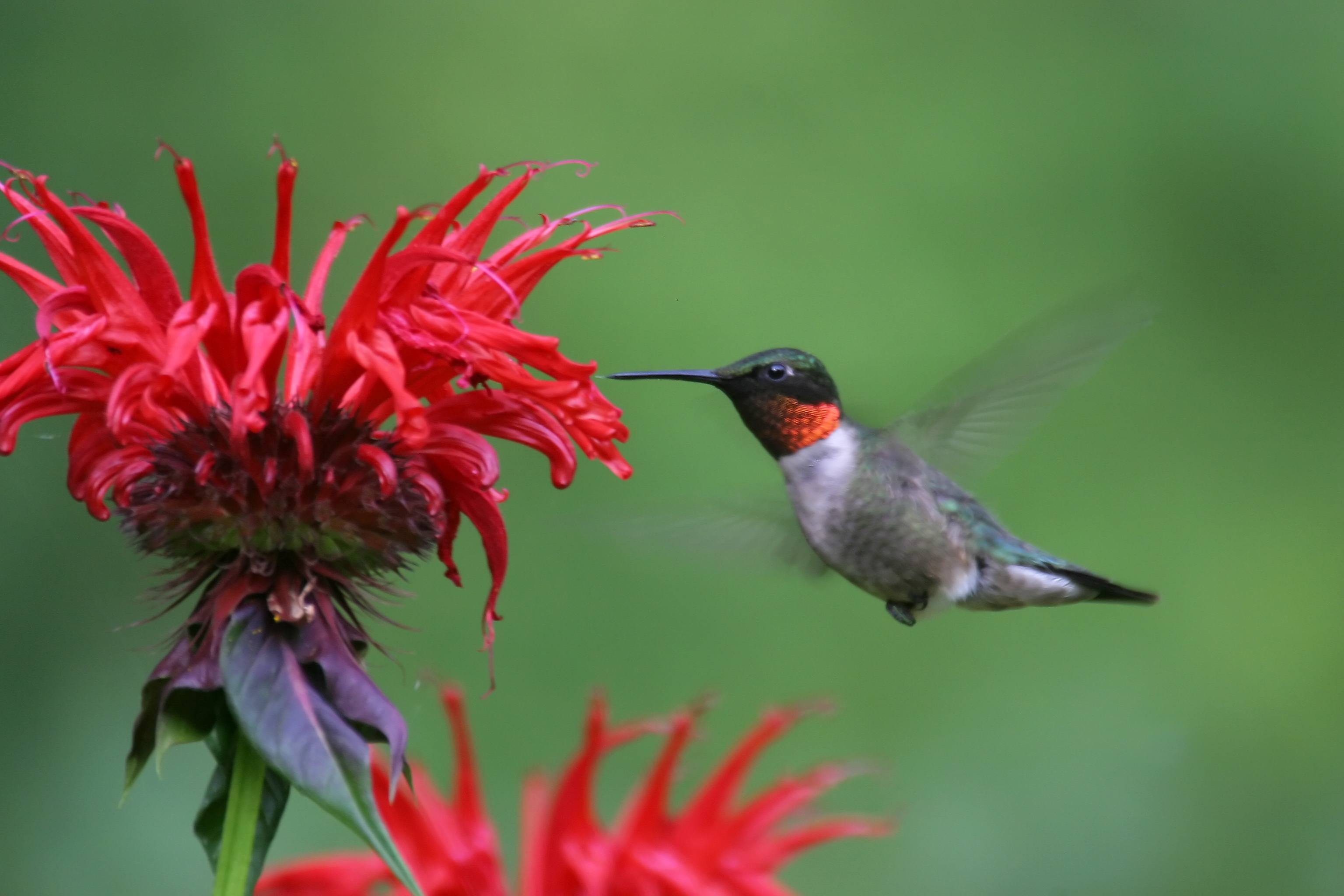
What type of symbiosis?  Hummingbirds feed on nectar from flowers.  The flowers are pollinated by hummingbirds as they move from flower to flower.
a)
commensalism
b)
mutualism
c)
parasitism
d)
predation
78.
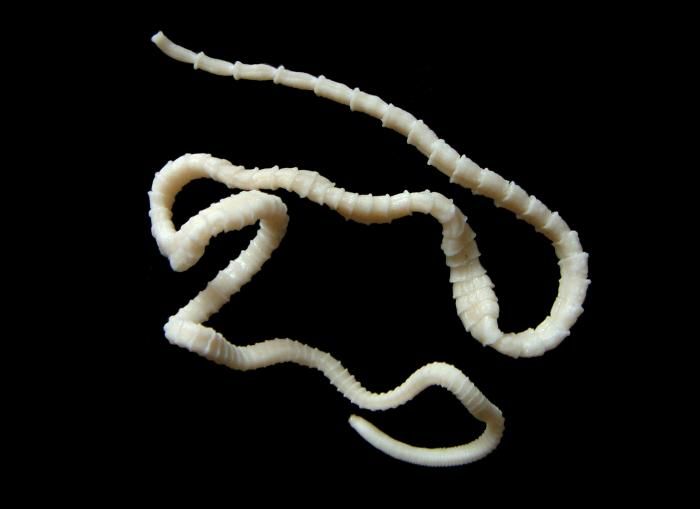
A tapeworm and a cat have this type of relationship.
a)
mutualism
b)
parasitism
c)
commensalism
d)
competition
79.
Cattle egrets forage (feed) in fields among cattle. The egret gets easy access to flying insects stirred up by the cattle, and the cattle don't care if they are there or not.
a)
mutualism
b)
commensalism
c)
competition
d)
parasitism
80.
How might the use of fertilizers negatively impact the ocean?
a)
Algae populations will decrease due to the harmful chemicals.
b)
The fertilizer creates artificial reefs that provide new habitats for fish.
c)
Algae populations will increase and create "dead zones" or areas where oxygen levels are very low.
d)
Marine predators will increase.
81.
What statement is TRUE about the graph?
a)
The prey is the green line because there needs to be more prey than predators.
b)
The prey is the red line because there needs to be more predators than prey.
c)
The green line is the producers
d)
The red line is the producers
82.

Predator population lags behind prey population because:

a)

Increase in predators leads to decrease in prey

b)

Increase in predators leads to increase in prey

c)

Increase in predators leads to decrease in producers
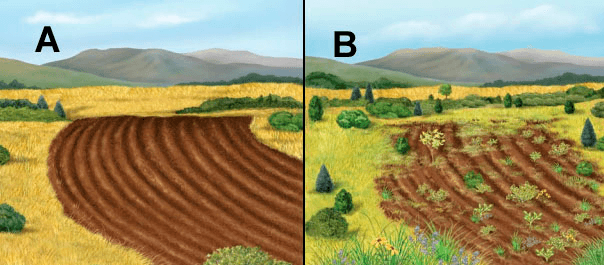
83.
What type of succession is shown going from figure A to figure B?
a)
primary succession
b)
ecological succession
c)
secondary succession
d)
intermediate
84.
What is the goal of the pioneer species in Primary Succession?
a)
To kill the dead materials after a disaster
b)
To rebuild soil
c)
To feed Johnny
d)
To put fresh oxygen into the air
85.
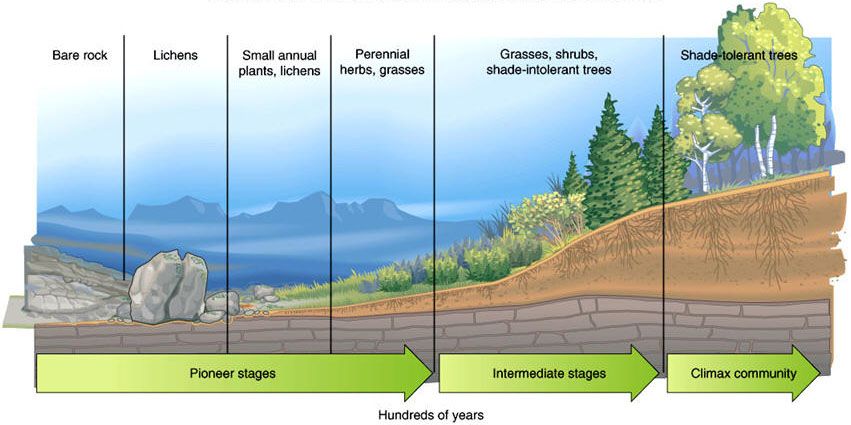
The picture shows what type of succession?
a)
primary
b)
secondary
c)
tertiary
d)
quadanary
86.
After a volcanic eruption, lava covers the land. What is the order that plants grow to repopulate the area?
a)
Lichens → Shrubs → Grasses → Trees
b)
Lichens → tree → shrubs→Grasses
c)
Grasses → Lichens → Shrubs → Trees
d)
Lichens → Grasses → Shrubs → Trees
87.
How much energy is passed on to each trophic level in an energy pyramid?
a)
10%
b)
90%
c)
50%
d)
80%
88.
Which organisms have the most available energy in an energy pyramid?
a)
Producer
b)
Consumer
c)
Decomposer
d)
Scavenger
89.
If there are 1000 Kcal of energy available in the producers, how much energy is available to the herbivores?
a)
10 Kcal
b)
1 Kcal
c)
100 Kcal
d)
1000 Kcal
90.
How do plants get the nitrogen they need?
a)
from the air
b)
from the soil or water in which they live
c)
from the Sun
d)
from broken-down rocks
91.
After decomposers return the nitrogen into the soil, what transforms a small amount of nitrogen into nitrogen gas?
a)
Bacteria
b)
Carbon
c)
Phosphorus
d)
proteins
92.
Which of the following is a consequence of excess carbon building up in Earth’s atmosphere?
a)
The amount of breathable oxygen available to living things decreases
b)
Global temperatures change, affecting normal weather patterns.
c)
The amount of solar energy reaching the earth’s surface decreases.
d)
Global air pressure increases making it more difficult for plants and animals to breathe.
93.
What are the two important jobs of a decomposer in an ecosystem?
a)
Keep waste from piling up and give carnivores energy
b)
Put energy back in the food chain and keep waste from piling up
c)
Put energy back in the food chain and compete against herbivores for food
d)
Supply the oxygen needed for plants to make food and keep waste from piling up
94.
Why do the populations of invasive species grow so quickly? 
a)
Invasive Species are native to an area. 
b)
Invasive species are prey to many animals.
c)
Invasive species have no predators.
d)
Invasive species keep the ecosystems in equilibrium.
95.

How much of the initial energy from the maize is available to the lizard?

a)

0.1%

b)

90%

c)

10%

d)

1%