
 Worksheets
Unit 2 Cells: Concepts 1-3
Total questions: 99
Worksheet time: 50mins
Name
Class
Date
1.
Controls what comes into and out of a cell; found in both plant and animal cells.
a)
Nucleus
b)
Cytoplasm
c)
Organelle
d)
Cell Membrane
2.
Rigid outer layer of plant cell.
a)
Cell Wall
b)
Nucleus
c)
Example: animal cells, plant cells
d)
Cell Membrane
3.
Gel-like fluid where the organelles are found
a)
Chromatin
b)
Chloroplasts
c)
Cytoplasm
d)
Cell
4.
Produces the energy a cell needs to carry out its functions
a)
Cell Membrane
b)
Smooth ER
c)
Nuclear envelope
d)
Mitochondria
5.
Stores food, water, wastes and other materials in the cell
a)
Nucleus
b)
Cell Theory
c)
Cytoskeleton
d)
Vacuoles
6.
Captures energy from the sunlight and uses it to produce food in plant cells
a)
Example: animal cells, plant cells
b)
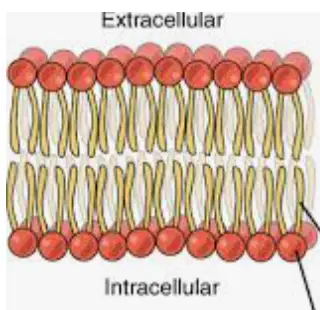
Eukaryote
c)
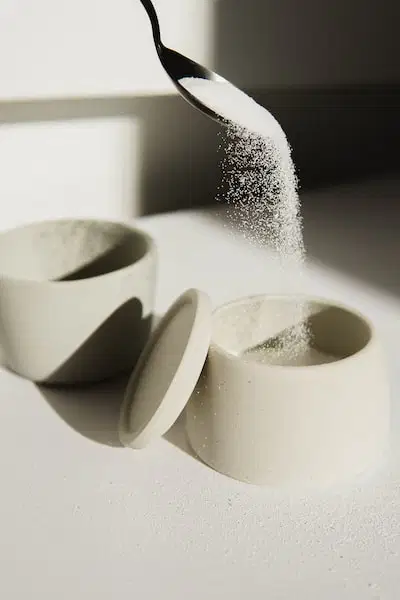
Nucleolus
d)
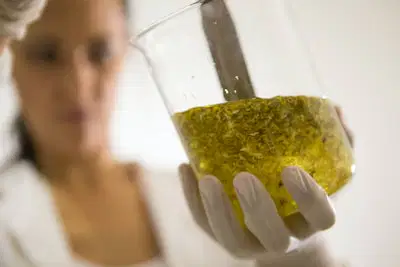
Chloroplasts
7.
Contain DNA, which controls the functions of the cell and production of proteins
a)
Nucleus
b)
Complex
c)
Chromatin
d)
Cell Wall
8.
Basic unit of life. They all contain a cell membrane, cytoplasm, ribosomes, and DNA
a)
Rough ER
b)
Complex
c)
Cells
d)
Mitochondria
9.
1.All living things are composed of one or more cells. 2. Cells are the basic unit of life. 3. Cells come from existing cells.
a)
Bacteria
b)
Cell Theory
c)
Prokaryotic
d)
Eukaryotic
10.
Specialized structure that performs important cellular functions within a cell
a)
Cytoplasm
b)
Organelle
c)
Prokaryotes
d)
2. Cells are the basic units of structure and function in living things.
11.
Chloroplasts and cell walls are found only in
a)
plant cells
b)
eukaryote
c)
animal
d)
prokaryote
12.
This means made of one cell
a)
unicellular
b)
multicellular
c)
omnicelluar
d)
microcellular
13.
This means made up of more than one cell
a)
unicellular
b)
multicellular
c)
microcellular
d)
omnicellular
14.
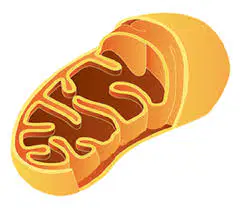
What organelle is this?
a)
nucleus
b)
cell membrane
c)
mitochondria
d)
chloroplast
15.
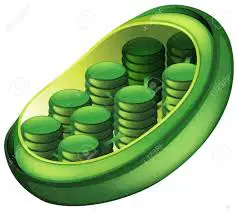
What organelle is this?
a)
nucleus
b)
cell membrane
c)
mitochondria
d)
chloroplast
16.
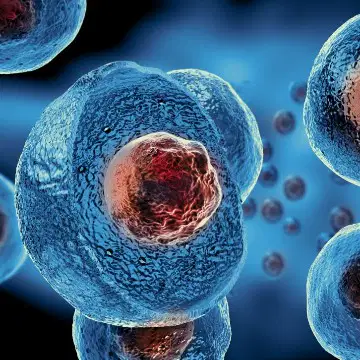
What organelle is red in the middle?
a)
nucleus
b)
cell membrane
c)
mitochondria
d)
chloroplast
17.
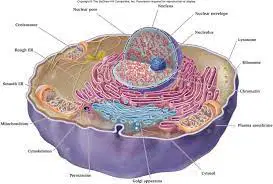
What organelle is the purple outside of the cell?
a)
nucleus
b)
cell membrane
c)
mitochondria
d)
chloroplast
18.
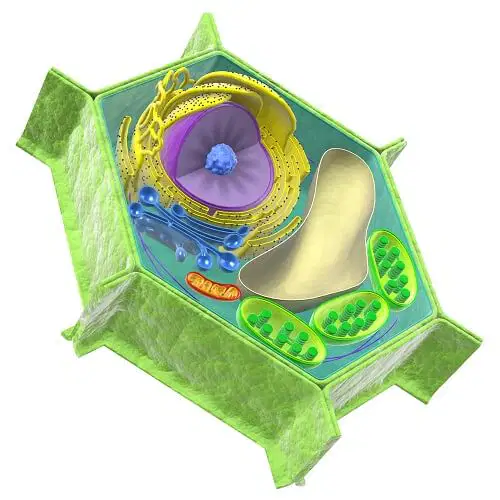
What organelle is the green outside of the cell?
a)
nucleus
b)
cell membrane
c)
cell wall
d)
chloroplast
19.
Nucleus
a)
Large balloon-like structures that hold water, food and waste that the cell doesn't need right away.
b)
Gel-like substance that fills most of the inside of the cell. Organelles "live" here.
c)
Contains a cell wall and chloroplasts.
d)
Controls the cell's activities and contains the DNA.
20.
Cell Membrane
a)
Acts as the filter of the cell. It gets to decide what enters and exits the cell.
b)
Sorts and packages proteins from the endoplasmic reticulum
c)
Makes proteins
d)
cell; "organ"; Make up cells and perform specific functions.
21.
Cytoplasm
a)
The smallest unit that performs the functions of life.
b)
Gel-like substance that fills most of the inside of the cell. Organelles "live" here.
c)
breaks down waste
d)
Large balloon-like structures that hold water, food and waste that the cell doesn't need right away.
22.
Animal Cell
a)
Acts as the filter of the cell. It gets to decide what enters and exits the cell.
b)
first to observe "small chambers" in cork and call them cells.
c)
"Highway" of the cell
d)
Doesn't have a cell wall or chloroplasts and has smaller vacuoles.
23.
Organelle
a)
breaks down energy from food for the cell; found in both plant and animal cells
b)
Makes proteins
c)
cell; "organ"; Make up cells and perform specific functions.
d)
Large balloon-like structures that hold water, food and waste that the cell doesn't need right away.
24.
Cell
a)
Only present in plant cells. Adds support to the cell. It gives the cell its rigid shape.
b)
"Highway" of the cell
c)
The smallest unit that performs the functions of life.
d)
Gel-like substance that fills most of the inside of the cell. Organelles "live" here.
25.
lysosomes
a)
Doesn't have a cell wall or chloroplasts and has smaller vacuoles.
b)
breaks down waste
c)
cell; "organ"; Make up cells and perform specific functions.
d)
Large balloon-like structures that hold water, food and waste that the cell doesn't need right away.
26.
ribosomes
a)
breaks down energy from food for the cell; found in both plant and animal cells
b)
Makes proteins
c)
Large balloon-like structures that hold water, food and waste that the cell doesn't need right away.
d)
Controls the cell's activities and contains the DNA.
27.
This type of cell has a Cell Wall and Chloroplast.
a)
Bacteria
b)
Animal
c)
Plant
d)
Prokaryote
28.
Which type of cell encloses DNA in a membrane?
a)
Bacteria
b)
Prokaryote
c)
Eukaryote
d)
Virus
29.
Who was the first person to cells under a microscope and give them a name?
a)
Leeuwenhoek
b)
Schwann
c)
Scheiden
d)
Hooke
30.
Who advanced cell theory with the conclusion that cells could only come from pre-existing cells?
a)
Leeuwenhoek
b)
Virchow
c)
Hooke
d)
Schwann
31.
He discovered that all plants were made of cells.
a)
Schleiden
b)
Schwann
c)
Hooke
d)
Leeuwenhoek
32.
He discovered that all animals were made of cells.
a)
Schleiden
b)
Schwann
c)
Hooke
d)
Leeuwenhoek
33.
Which statement not a part of cell theory?
a)
All cells come from pre-existing cells
b)
All cells move
c)
Cells are the basic building blocks of life.
d)
All living things are made of cells
34.
Organism only made up of one cell.
a)
Eukaryote
b)
Multicellular
c)
Unicellular
d)
Organelle
35.
Bacteria is classified as a _________ cell.
a)
Plant
b)
Animal
c)
Eukaryote
d)
Prokaryote
36.
The definition of homeostasis is...
a)
The maintenance of a constant internal state in a changing environment.
b)
The movement of substances across the cell membrane that requires the cell to use energy.
c)
In eukaryotic cells, one of the structures in the nucleus that are made up of DNA and protein; in a prokaryotic cell, the main ring of DNA. Packaged DNA.
d)
The process in which a cell releases a particle by enclosing the particle in a vesicle that then moves to the cell surface and fuses with the cell membrane.
37.
The definition of diffusion is...
a)
The movement of particles from regions of higher density to regions of lower density.
b)
Process by which plants, algae and some bacteria make their own food, by using sunlight, carbon dioxide, and water.
c)
The maintenance of a constant internal state in a changing environment.
38.
The definition of active transport is...
a)
The movement of substances across the cell membrane that requires the cell to use energy.
b)
The maintenance of a constant internal state in a changing environment.
c)
Process by which plants, algae and some bacteria make their own food, by using sunlight, carbon dioxide, and water.
d)
The process by which cells use oxygen to produce energy from food.
39.
osmosis
a)
The diffusion of water through a semi-permeable membrane.
b)
The movement of substances across the cell membrane that requires the cell to use energy.
c)
The process in which a cell releases a particle by enclosing the particle in a vesicle that then moves to the cell surface and fuses with the cell membrane.
d)
In eukaryotic cells, one of the structures in the nucleus that are made up of DNA and protein; in a prokaryotic cell, the main ring of DNA. Packaged DNA.
40.
endocytosis
a)
The process by which a cell membrane surrounds a particle and encloses the particle in a vesicle to bring the particle into the cell.
b)
The process in which a cell releases a particle by enclosing the particle in a vesicle that then moves to the cell surface and fuses with the cell membrane.
c)
The process by which cells use oxygen to produce energy from food.
d)
Process by which plants, algae and some bacteria make their own food, by using sunlight, carbon dioxide, and water.
41.
passive transport
a)
The movement of substances across a cell membrane without the use of energy by the cell.
b)
The process in which a cell releases a particle by enclosing the particle in a vesicle that then moves to the cell surface and fuses with the cell membrane.
c)
In eukaryotic cells, a process of cell division that forms two new nuclei, each of which has the same number of chromosomes.
d)
Process by which plants, algae and some bacteria make their own food, by using sunlight, carbon dioxide, and water.
42.
exocytosis
a)
The process in which a cell releases a particle by enclosing the particle in a vesicle that then moves to the cell surface and fuses with the cell membrane.
b)
The process by which a cell membrane surrounds a particle and encloses the particle in a vesicle to bring the particle into the cell.
c)
In eukaryotic cells, a process of cell division that forms two new nuclei, each of which has the same number of chromosomes.
43.
semi-permeable
a)
Allowing certain substances to pass through a membrane but not others.
b)
In eukaryotic cells, one of the structures in the nucleus that are made up of DNA and protein; in a prokaryotic cell, the main ring of DNA. Packaged DNA.
c)
In eukaryotic cells, a process of cell division that forms two new nuclei, each of which has the same number of chromosomes.
44.
The maintenance of a constant internal state in a changing environment.
a)
homeostasis
b)
Organelle
c)
Chromosomes
d)
semi-permeable
45.
The movement of particles from regions of higher density to regions of lower density.
a)
diffusion
b)
osmosis
c)
endocytosis
d)
exocytosis
46.
The movement of substances across the cell membrane that requires the cell to use energy.
a)
active transport
b)
homeostasis
c)
endocytosis
d)
cellular respiration
47.
The diffusion of water through a semi-permeable membrane.
a)
osmosis
b)
endocytosis
c)
exocytosis
d)
mitosis
48.
The process by which a cell membrane surrounds a particle and encloses the particle in a vesicle to bring the particle into the cell.
a)
endocytosis
b)
exocytosis
c)
mitosis
d)
homeostasis
49.
The movement of substances across a cell membrane without the use of energy by the cell.
a)
passive transport
b)
active transport
c)
semi-permeable
d)
cellular respiration
50.
The process in which a cell releases a particle by enclosing the particle in a vesicle that then moves to the cell surface and fuses with the cell membrane.
a)
exocytosis
b)
mitosis
c)
endocytosis
d)
diffusion
51.
Allowing certain substances to pass through a membrane but not others.
a)
semi-permeable
b)
Chromosomes
c)
mitosis
d)
photosynthesis
52.
The movement of gases or solids (solutes) from high to low concentration is
a)
diffusion
b)
osmosis
c)
active transport
d)
facilitated diffusion
53.
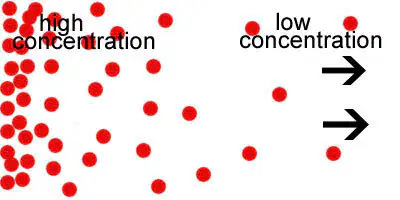
The difference in concentration of solutes on two sides of a membrane. Molecules ALWAYS move from HIGH concentration to LOW concentration.
a)
Hypotonic Solution
b)
Facilitated Diffusion
c)
Concentration Gradient
d)
Osmosis
54.
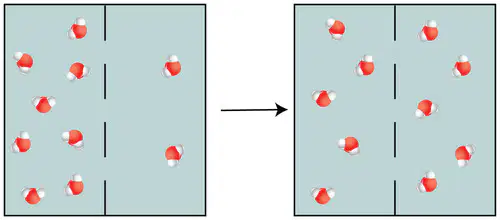
The concentration of molecules is equal or evenly dispersed throughout a space.
a)
Hypotonic Solution
b)
Equilibrium
c)
Facilitated Diffusion
d)
solution
55.

The (passive) movement of particles from an area of high concentration to low concentration
a)
Diffusion
b)
Osmosis
c)
Homeostasis
d)
Facilitated Diffusion
56.
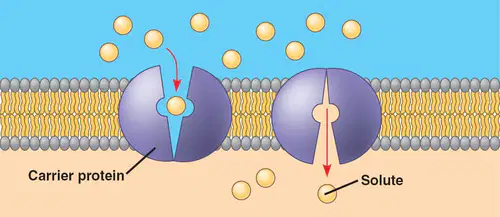
the (passive) movement of large particles or substances across the cell membrane through protein channels.
a)
Diffusion
b)
Concentration Gradient
c)
Facilitated Diffusion
d)
Hydrophilic
57.

A tunnel-like opening in a cell membrane that allows large particles or substances to enter and exit the cell through facilitated diffusion.
a)
Hypertonic Solution
b)
solvent
c)
solution
d)
Protein Channel
58.
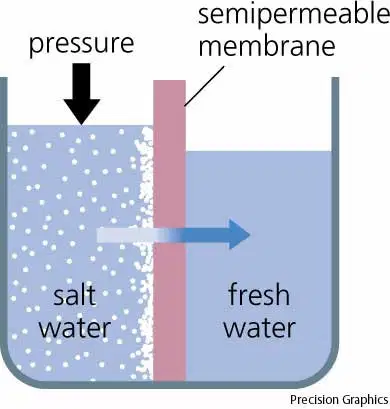
The diffusion of water across a semi-permeable membrane (cell membrane). NOTE: Water always moves from high concentration of WATER to low. Which is the same as low concentration of SOLUTE to high.
a)
Hypertonic Solution
b)
Isotonic Solution
c)
Osmosis
d)
Homeostasis
59.
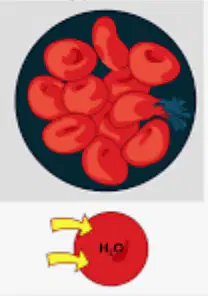
A LOW solute concentration in a solution. A cell placed in this type of solution will SWELL due to water rushing towards the high solute concentration within the cell.
a)
Diffusion
b)
Hydrophobic
c)
solvent
d)
Hypotonic Solution
60.
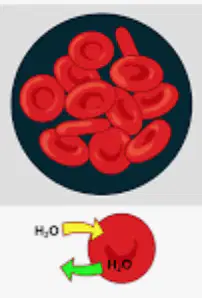
A solution with an EQUAL solute concentration. A cell placed in this type of solution will stay the SAME because water entering and exiting the cell will be an even amount.
a)
Isotonic Solution
b)
Hydrophilic
c)
Passive Transport
d)
Hypotonic Solution
61.
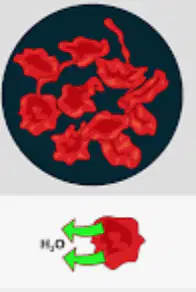
a HIGH solute concentration in a solution. A cell placed in this type of solution will SHRINK due to water leaving the cell towards the highly concentrated solution outside the cell.
a)
solute
b)
Protein Channel
c)
Concentration Gradient
d)
Hypertonic Solution
62.

"Water loving" mixes with water
a)
Hydrophilic
b)
Protein Channel
c)
Homeostasis
d)
Osmosis
63.
"Water fearing" repels water
a)
solvent
b)
Hydrophobic
c)
Facilitated Diffusion
d)
Diffusion
64.
Particles that are dissolved in the solvent
a)
solute
b)
Homeostasis
c)
Facilitated Diffusion
d)
solvent
65.

Liquid that can dissolve other substances
a)
Hypotonic Solution
b)
solvent
c)
solute
d)
solution
66.
A mixture (can be a solid, liquid, or gas) that forms when one substance dissolves another. Solvent + Solute
a)
Equilibrium
b)
Concentration Gradient
c)
Protein Channel
d)
solution
67.

"Hyper" means
a)
more
b)
less
c)
under
d)
over
68.
"Tonic" means
a)
solvent
b)
solution
c)
solute
d)
liquid
69.
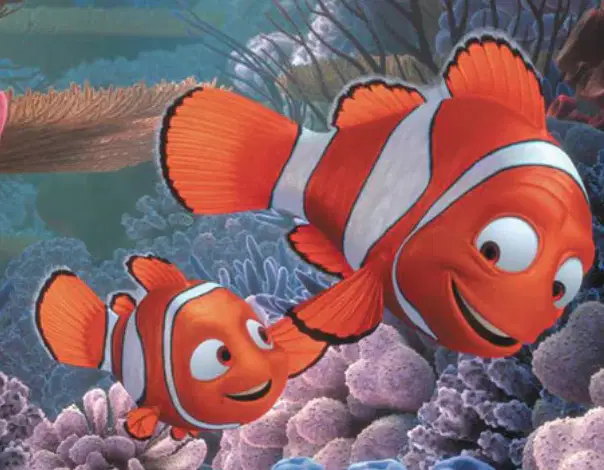
Your bestie bought you a pet saltwater fish just like Nemo for your birthday. You put the fish in a fishbowl with fresh tap water because your brother said the fish will be just fine. What will happen to your new pet?
a)
My new fishy will be just fine.
b)
My new fishy will shrink and die because I put it in a hypertonic solution.
c)
My new fishy will live because I put it in an isotonic solution.
d)
My new fish will swell and burst because I put it in a hypotonic solution.
70.
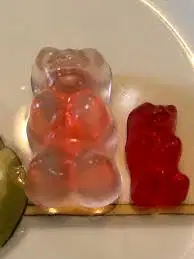
The gummy bear on the left was placed in water. What process has occurred?
a)
osmosis
b)
facilitated diffusion
c)
endocytosis
d)
exocytosis
71.
What molecule helps carry nutrients into the cell via facilitated diffusion?
a)
only proteins
b)
proteins, lipids, and carbohydrates
c)
glucose
d)
none
72.
What form of transport is the way our cells obtain oxygen?
a)
osmosis
b)
diffusion
c)
facilitated diffusion
d)
endocytosis
73.
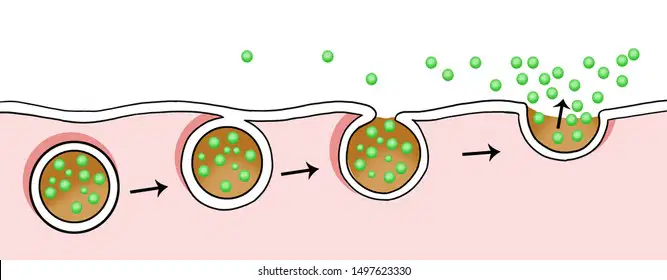
In this image a vacuole containing material is being pushed out of the cell. What process is this?
a)
endocytosis
b)
exocytosis
c)
diffusion
d)
osmosis
74.
What is the organelle responsible for letting things into and out of the cell?
a)
cytoplasm
b)
nucleus
c)
cell wall
d)
cell membrane
75.
What level of organization is represented by a group of tissues working together to complete a complex function?
a)
organ
b)
organ system
c)
cell
d)
tissue
76.
What level of organization is represented by a group of cells working together to complete a complex function?
a)
organ
b)
organ system
c)
cell
d)
tissue
77.
What level of organization is represented by a group of organs working together to complete a complex function?
a)
organ
b)
organ system
c)
cell
d)
tissue
78.
What level of organization is represented by a group of organ systems working together to complete a complex function?
a)
organism
b)
organ system
c)
cell
d)
tissue
79.
Known as the most basic unit of life.
a)
cell
b)
organism
c)
tissue
d)
organ system
80.
Which of the following is an example of INTERNAL regulation during the cell cycle?
a)
a cell receives a signal from inside the cell's own nucleus to divide
b)
hormones enter a cell and cause cell growth in a growing teenager
81.
Which of the following is an example of EXTERNAL regulation during the cell cycle?
a)
a cell receives a signal from inside the cell's own nucleus to divide
b)
hormones enter a cell and cause cell growth in a growing teenager
82.
___ regulation is when a cell receives a signal from the cell's own nucleus.
a)
Internal
b)
External
83.
___ regulation is when a cell receives a signal (hormone, nutrients, etc.) from outside of the cell.
a)
Internal
b)
External
84.
Which is true about malignant tumors?
a)
they do not require treatment
b)
the are easily removed through surgery
c)
they can cause tumors in other parts of the body
d)
they contain cells that stay clustered together
85.
If a cell has 16 chromosomes, how many chromosomes will each of its daughter cells have after mitosis?
a)
16
b)
32
c)
8
d)
64
86.
What organelle creates spindle fibers & is important in cell division?
a)
centrioles
b)
cilia
c)
vacuoles
d)
vesicles
87.
During prophase what happens?
a)
the sister chromatids appear and spindle fibers begin to form
b)
the sister chromatids line up in the middle of the cell and spindle fibers attach to sister chromatids
c)
the sister chromatids are pulled away from each other to opposite sides of the cell
d)
the nuclear membrane reforms around the chromosomes and spindle fibers disappear
88.
During metaphase what happens?
a)
the sister chromatids appear and spindle fibers begin to form
b)
the sister chromatids line up in the middle of the cell and spindle fibers attach to sister chromatids
c)
the sister chromatids are pulled away from each other to opposite sides of the cell
d)
the nuclear membrane reforms around the chromosomes and spindle fibers disappear
89.
During anaphase what happens?
a)
the sister chromatids appear and spindle fibers begin to form
b)
the sister chromatids line up in the middle of the cell and spindle fibers attach to sister chromatids
c)
the sister chromatids are pulled away from each other to opposite sides of the cell
d)
the nuclear membrane reforms around the chromosomes and spindle fibers disappear
90.
During telophase what happens?
a)
the sister chromatids appear and spindle fibers begin to form
b)
the sister chromatids line up in the middle of the cell and spindle fibers attach to sister chromatids
c)
the sister chromatids are pulled away from each other to opposite sides of the cell
d)
the nuclear membrane reforms around the chromosomes and spindle fibers disappear
91.
What makes STEM cells different from other cells in the body?
a)
they are larger than other cells
b)
they can repair other cells by absorbing the broken parts
c)
they are undifferentiated cells that can turn into specified cells
d)
they are cells that grow and divide uncontrollably
92.
Substances that are known to promote or produce cancer are known as ___.
a)
carcinogens
b)
kinases
c)
cyclins
d)
malignancies
93.
One difference between a cancer cell and a normal cell is ___
a)
cancer cells divide uncontrollably
b)
normal cells divide uncontollably
c)
cancer cells cannot make copies of DNA
d)
normal cells cannot make copies of DNA
94.
Apoptosis is programmed cell ___.
a)
death
b)
life
c)
division
d)
growth
95.
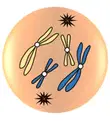
What phase of the cell cycle is pictured?
a)
prophase
b)
telophase
c)
interphase
d)
cytokinesis
96.

What phase of the cell cycle is pictured?
a)
prophase
b)
metaphase
c)
anaphase
d)
interphase
97.
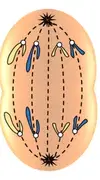
What stage of the cell cycle is pictured?
a)
anaphase
b)
prophase
c)
cytokinesis
d)
metaphase
98.
When the cytoplasm of the cell splits in half this is known as ___.
a)
cytokinesis
b)
metaphase
c)
interphase
d)
telophase
99.
What part of interphase do the number of chromosomes double?
a)
G₁ Phase
b)
G₂ Phase
c)
G₀ Phase
d)
S Phase
100 %

