wayground logo

Free Printable Worksheets

Font size

S
M
L
XL
Worksheets

Biology Semester 2 Midterm

Total questions: 93

Worksheet time: 1hrs 28mins

Name
Class
Date
1.
A heterozygous long-tusked elephant is crossed with a homozygous recessive short-tusked elephant. What is the probability of the offspring having short tusks?
a)
0%
b)
25%
c)
50%
d)
75%
2.
Dominant or recessive?
tt
a)
Dominant 
b)
Recessive
3.
Gregor Mendel is often called ....
a)
The father of heredity.
b)
The father of genetics.
c)
The king of peas
d)
The father of punnett squares.
4.

Why do scientist use Punnett Squares?

a)

A tool scientist use to to see alleles

b)

A tool scientist use to see which alleles are dominant

c)

A tool scientist use to determine possible genotypes for offspring

5.

Which of the following is a Homozygous Dominant Genotype?

a)

Yy

b)

XX

c)

zz

6.

Which of the following is a homozygous recessive genotype?

a)

HH

b)

dd

c)

Aa

7.

In a flowering plant species, red flower color (R) is dominant over white flower color (r). What is the genotype of any white-flowering plant resulting from this species?

a)

rr

b)

rR

c)

RR

d)

Rr

8.

Which of the following genotypes is homozygous recessive?

a)

Tt

b)

tt

c)

TT

d)

tT

9.

Which of the following genotypes is homozygous dominant?

a)

Yy

b)

yY

c)

yy

d)

YY

10.
Which of the following genotypes is heterozygous?
a)
Bb
b)
BB
c)
bb
d)
B
11.

Which of the following would be a phenotype?

a)

Aa

b)

red hair

c)

heterozygous

d)

DNA

12.

B = brown eyes

b = blue eyes

One brother has genotype BB and the other brother has genotype Bb.

Which statement is true about these two brothers?

a)

They have same phenotype and genotype

b)

They have different phenotypes and genotypes

c)

They have same phenotype, but different genotypes

d)

They have different phenotypes, but the same genotype
13.

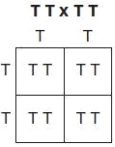
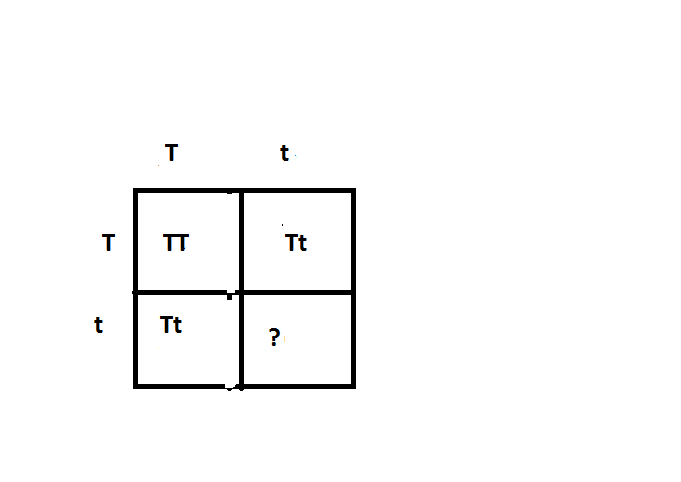
T - tall and t = short

In the punnett square below, what belongs in the missing square

a)

tt

b)

Tt

c)

Bb

d)

TT

14.
What you see, or the physical appearance.
a)
Genotype
b)
Phenotype
c)
Homozygous
d)
Heterozygous
15.
In a heterozygous genotype, the ___________ allele takes over in the phenotype.
a)
recessive
b)
dominant
c)
lower case letter
d)
both 
16.
Aa, DD, bB, yy are all examples of
a)
genotypes
b)
phenotypes
17.
Dominant alleles are represented by a:
a)
Male gene
b)
lowercase letter
c)
recessive trait
d)
capital letter
18.

Complex molecule that carries genetic information that defines an organism's traits. It is stored in the nucleus.

a)

Protein

b)

DNA

c)

RNA

d)

Glucose nucleic acid (GNA)

19.
What ratio of the offspring from the cross shown will be homozygous recessive for the  trait of tallness? 
a)
0 in 4
b)
1 in 4
c)
2 in 4
d)
4 in 4
20.
Which enzyme has the job of unzipping the double helix?
a)
Helicase
b)
Polymerase
c)
Ligase
d)
Primerase
21.
Which enzyme fixes the Okazaki fragments in the lagging strand?
a)
Helicase
b)
Polymerase
c)
Ligase
d)
Primerase
22.
If a strand reads:
3' A A A T T T C 5'
The matching strand would read...
a)
5' T T T A A A G 3'
b)
3' T T T A A A G 5'
c)
5' A A A T T T C 3'
d)
3' U U U A A A G 5'
23.
What are the gaps between the newly synthesized DNA on the lagging strand called?
a)
Okazaki fragments
b)
Polymer gaps
c)
Helicase fragments
d)
Acidic gaps
24.
The enzyme that splits open the DNA creates what's called a fork - where the DNA separates into the lagging strand and the ______ strand.
a)
leading
b)
leveraging
c)
Okazaki
d)
ligase
25.
Polymerase is able to replicate the new DNA ______ along the leading strand.
a)
continuously
b)
only in short fragments
c)
very slowly
d)
prokaryotically
26.
A DNA nucleotide contains all of the following, except...
a)
Deoxyribose
b)
Phosphate group
c)
Nitrogenous base
d)
Cholesterol
27.
What is the shape of DNA?
a)
Double helix
b)
Triple helix
c)
Flat, bilayer
d)
Three-pronged rigid ladder
28.
DNA replication turns one strand of DNA into two new strands of DNA. What percent of each new strand is the old strand?
a)
Half of each new DNA is the old DNA
b)
The old strand of DNA was digested, so none
c)
The new DNA is entirely made up of the old DNA
d)
About every sixth base comes from the old DNA
29.
Sometimes, DNA is called "semi-conservative." Why might this be?
a)
The old strand is "conserved" and used to make the new strands
b)
Uracil is "conserved" in that it is only used to make the new strands
c)
ATP is "conserved" via the usage of facilitated diffusion
d)
Ligase is "conserved" in that it is denatured by the process
30.
Which sequence of DNA bases would pair with this partial strand
CAT TCA CTG
a)
ATG TGA CAG
b)
TAC ACT GTC
c)
GTA AGT GAC
d)
CAT TCA CTG
31.
A process in which DNA has the unique ability to make an exact copy of itself.
a)
Replication
b)
Translation
c)
Transcription
32.
Why does DNA replicate?
a)
To create another copy for the new cell
b)
To create a duplicate copy in case the original gets damaged
c)
To create a new copy to replace the damaged original
33.

DNA replication results in

a)

2 completely new DNA molecules

b)

2 DNA molecules that each contain a strand of the original

c)

1 new DNA molecule and 1 old

d)

1 new molecule of DNA

34.
_______ is made during transcription and ________ is made during translation.
a)
mRNA / a protein
b)
a protein / mRNA
c)
Ribosome / Nucleus
d)
mRNA / tRNA
35.
Which RNA bases would pair with TAC  in transcription
a)
AUG
b)
ATG
c)
GCA
d)
GCA
36.
One difference between DNA and RNA is that....
a)
Only RNA has the base Uracil
b)
only RNA contains the base Thymine
c)
only RNA contains the base Cytocine
d)
only RNA contained the base Guanine
37.
A triplet (3 bases)  of mRNA is called a
a)
codon
b)
anticodon
c)
amino acid
d)
peptide bond
38.
What amino acid is represented by the codon CAG?
a)
Aspartic Acid
b)
Histidine
c)
Glutamine
d)
Methionine
39.
How many amino acids are coded for by this sequence of nucleotides:
ATG GGA  ACT
a)
4
b)
3
c)
6
d)
2
40.
Translation happens in the - 
a)
Nucleus
b)
Ribosome
c)
Chloroplast
d)
Smooth Endoplasmic Reticulum
41.
tRNA is involved in
a)
carrying amino acids 
b)
carrying ribosomes
c)
carrying glucose
d)
carrying lipids
42.
Amino acids are joined together in order to form
a)
DNA
b)
ribosomes
c)
proteins 
d)
RNA
43.
How many types of RNA are there?
a)
1
b)
2
c)
3
d)
4
44.
What do we call the process of turning DNA into mRNA?
a)
Translation
b)
Transcription 
c)
Replication
45.
What is the function of mRNA?
a)
storage of food
b)
prevents mutations
c)
provides energy
d)
carries genetic message 
46.
What is the correct sequence?
a)
RNA --> DNA --> Protein
b)
Protein --> RNA --> DNA
c)
DNA --> RNA --> Protein
d)
DNA --> Protein --> RNA
47.

What represents the "building site" or place of construction in the house analogy?

a)

r RNA

b)

m RNA

c)

ribosome

d)

t RNA

48.
In RNA, Uracil pairs with ______. 
a)
cytosine
b)
adenine
c)
guanine
d)
thymine
49.

. What are the building blocks of proteins called?

a)

nucleotides

b)

proteins

c)

amino acids

d)

carbohydrates

50.

The 3 letters found on tRNA are referred to as

a)

an amino acid

b)

the anticodon

c)

the codon

d)

the bases

51.
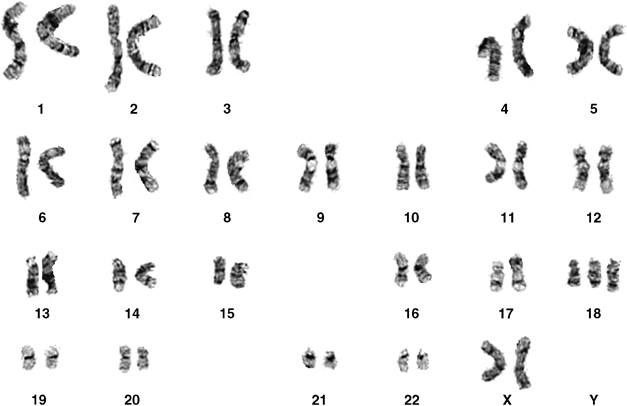
Determine the sex of the individual whose karyotype is displayed in the image.
a)
female
b)
male
52.
Determine the sex of the individual whose karyotype is displayed in the image.
a)
female
b)
male
53.

The failure of one or more pairs of homologous chromosomes or sister chromatids to separate "normally" during meiosis is called _____________________.

a)

nondisjunction

b)

anaphase I

c)

nondiploidy

d)

karyotype

54.
What is the chromosomal condition of the individual whose karyotype is seen in the image?
a)
Monosomy X (Turner's Syndrome)
b)
Trisomy 21 (Down's Syndrome)
c)
Trisomy 13 (Patau Syndrome)
d)
Trisomy 18 (Edwards's Syndrome)
55.

SELECT ALL THAT APPLY:

a)

Male

b)

Female

c)

No chromosomal abnormalities

d)

Trisomy 21

56.
What chromosome is affected by Down's Syndrome?
a)
23
b)
18
c)
13
d)
21
57.
Which of the following would be considered a Gamete cell?
a)
Egg Cell
b)
Sperm Cell
c)
Both of these
d)
None of these
58.
What would indicate a human male?
a)
XX
b)
X
c)
XY
d)
XXY
59.
A person with Turner syndrome has only one X chromosome. This means one of their gametes was missing a chromosome.
Which of the following is why gametes sometimes lack a complete chromosome?
a)
Incomplete dominance
b)
Nondisjunction
c)
Inversion mutation
d)
Substitution mutation
60.

The structure in the image is called a:

a)

Chromosome

b)

Karyotype

c)

Gene

d)

Protein

61.

How many pairs of homologous chromosomes are found in each (body) cell?

a)

46

b)

23

c)

72

d)

10

62.

Which chromosomes are shown in the image?

a)

Sex Chromosomes

b)

Autosomes

c)

Trisomy

d)

Monosomy

63.

A karyotype is:

a)

A tool scientists use to analyze chromosomes

b)

A tool scientists use to predict the potential genotypes / phenotypes of offspring

c)

A tool scientist use to identify genes in the human genome

d)

A tool scientists use to identify criminals & find relatives

64.

Identify the tool in the image:

a)

Karyotype

b)

Gel Electrophoresis

c)

DNA Fingerprint

d)

Gene Analysis

65.

XX

a)

Female

b)

Male

66.

Monosomy:

a)

Missing 1 chromosome

b)

3 chromosomes (instead of a pair)

c)

Chromosomes are normal

67.

Trisomy:

a)

Missing 1 chromosome

b)

3 chromosomes (instead of a pair)

c)

Chromosomes are normal

68.

SELECT ALL THAT APPLY:

a)

Male

b)

Female

c)

No chromosomal abnormalities

d)

Trisomy 18

69.

What type of heredity is shown in the pedigree?

a)

Sex-Linked Dominant

b)

Sex-Linked Recessive

c)

Autosomal Dominant

d)

Autosomal Recessive

70.

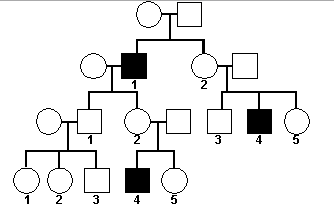
If this pedigree shows a recessive disorder, what MUST the genotype of individual 4 be?

a)

HH

b)

Hh

c)

hh

71.
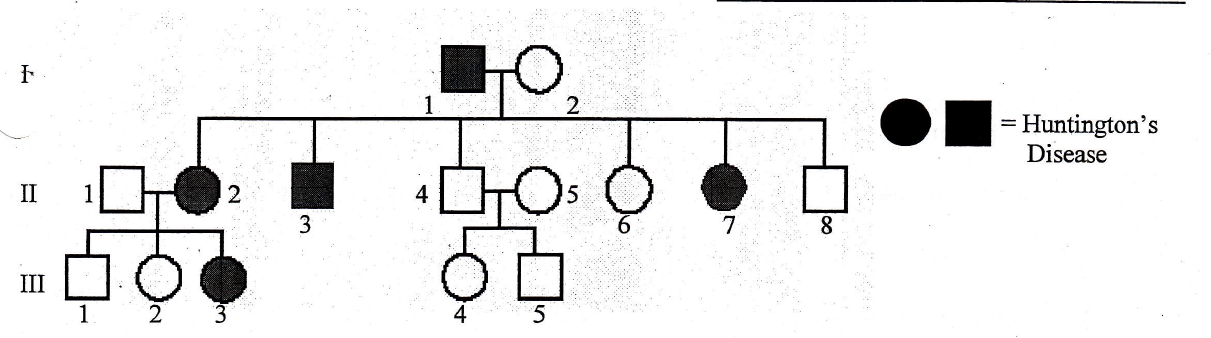
There are no carriers for Huntington's Disease- you either have it or you don't. Is Huntington's disease caused by a dominant or recessive trait?
a)
Dominant
b)
Recessive
72.
Huntington's Disease is a dominant trait.
What is the correct genotype for individual I-2?
a)
HH
b)
Hh
c)
hh
d)
H_
73.
Does this pedigree show a dominant or recessive trait?
a)
Dominant
b)
Recessive
74.
Give the genotype for person III-3
a)
GG
b)
Gg
c)
gg
75.

The pedigree is showing a _____________ trait.

a)

autosomal dominant

b)

autosomal recessive

c)

sex linked recessive

76.
What is the genotype of the mother?
a)
BB
b)
bb
c)
Bb
d)
BB or Bb
77.
What is the genotype of the father?
a)
AA
b)
aa
c)
Aa
d)
AA or aa
78.

What is the mode of inheritance shown here?

a)

Autosomal Recessive

b)

Autosomal Dominant

c)

Sex Linked Recessive

79.

Why are advantageous traits more likely to be passed onto offspring?

a)

Because they are more likely to survive and reproduce.

b)

Because they come from dominant alleles.

c)

Because they come from recessive alleles.

d)

Because the organism knew it needed that trait, survives, and passes it on.

80.

Mutations are a change in what?

a)

DNA

b)

tRNA

c)

protein

d)

rRNA

81.
The differences among a species, like different bird beaks, are called
a)
genes.
b)
variations.
c)
traits.
d)
theories.
82.
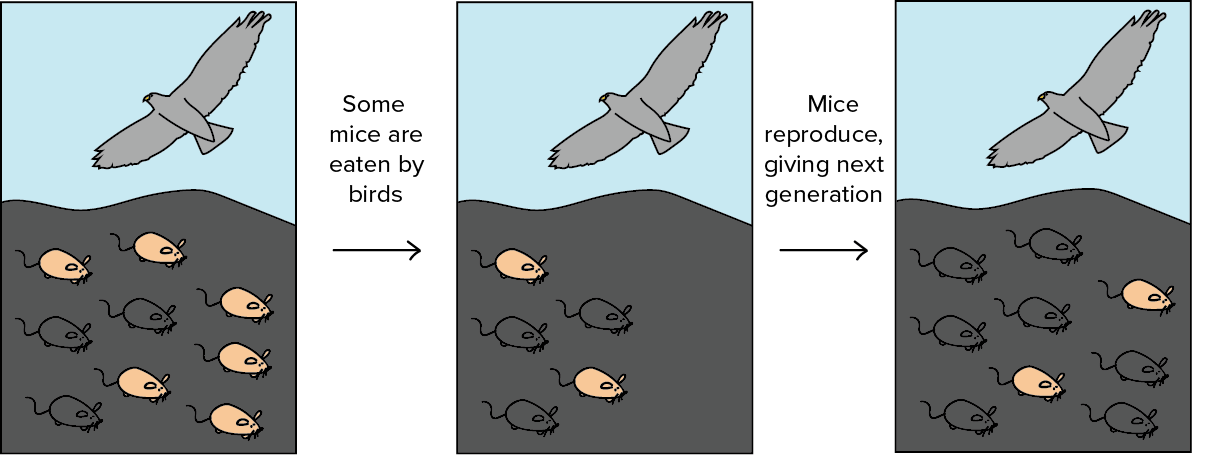
Why is the mouse population changing over time?
a)
The light mice can reproduce more successfully than the dark mice
b)
The hawks eat more dark mice than light mice because the dark mice taste better
c)
The hawks eat more light mice than dark mice because they can see the light mice more easily
d)
The hawks eat more dark mice than light mice because they can see the dark mice more easily
83.
What process is being shown in this image?
a)
Variation
b)
Natural Selection
c)
Selective Breeding
d)
Homeostasis
84.

"Organisms that are better adapted to the environment survive to pass traits to their offspring" is the definition of

a)

Natural Selection

b)

Evolution

c)

Selective Breeding

d)

Artificial Selection

85.

Which best describes the role of mutations in natural selection?

a)

Mutations help an organism to better survive in their environment

b)

An organism may acquire a helpful mutation by interacting with the environment

c)

A mutation may result in a beneficial trait that makes an organism more likely to survive and reproduce

d)

Organisms with certain traits are more likely to win competitions for mutations

86.

The more genetic variation a population has,

the more likely it is for some individuals to

a)

evolve

b)

migrate

c)

survive

d)

mutate

87.

Mutations are important because they bring about

a)

death of the organism in which they develop

b)

genetic variation needed for a population to evolve

c)

benefits for the individual, not for the population

d)

changes in genotype, but not phenotype

88.
Why do frogs and other organism reproduce so many eggs or offspring?
a)
so that their babies can have friends to play with
b)
the more offspring the more likely the offspring will survive
c)
the more offspring the less likely offspring will survive 
d)
the more offspring the less competition
89.
Which organisms are most likely to survive?
a)
the best adapted
b)
the fastest
c)
the strongest
d)
the most domesticated (tamed)
90.
Do organisms "decide" to evolve and change?
a)
Yes, they know they need to change to survive 
b)
No, they change because of natural selection
91.
The long and sharp beak of a woodpecker is an example of:
a)
Natural Selection
b)
Selective Breeding
92.
Domesticated dogs are an example of:
a)
Natural Selection
b)
Selective Breeding
93.

Why is competition important for natural selection?

a)

It shows which variations are more successful, allowing the organisms with those variations to survive.

b)

It causes organisms, regardless of which traits they have, to die out, reducing the population size.

c)

It causes organisms to get stronger due to having to outcompete other species.

d)

Competition is not important for natural selection.