
 Worksheets
EOC REVIEW
Total questions: 84
Worksheet time: 3hrs 5mins
Name
Class
Date
1.

This is an example of what kind of force?
a)
Balanced Force
b)
Pushing Force
c)
Gravity Force
d)
Unbalanced Force
2.

If an object is stationary (not moving) the forces acting upon it are _____________
a)
unbalanced
b)
weak
c)
balanced
d)
Hulk Smash!
3.
A push or pull that causes a change in motion
a)
Friction
b)
Gravity
c)
Force
d)
Mass
4.

A runner races in the 100 meter dash. It takes her 10 seconds to finish. What is her average speed?
a)
10 m/s
b)
1000 m/s
c)
100 seconds
d)
10 seconds
5.

What is the net force?
a)
5000 N right
b)
4000 N right
c)
40 N left
d)
4000 N left
6.

What is the net force?
a)
17 N Right
b)
3 N Right
c)
3 N Left
d)
17 N Left
7.

What is the average speed of the person during the first 5 seconds?
a)
0 m/s
b)
1 m/s
c)
3 m/s
d)
6 m/s
8.

How far is the person from the starting point after 3 seconds?
a)
0 m
b)
2 m
c)
3 m
d)
6 m
9.
Inside a power plant, coal is burned to produce hot gases. What type of energy conversion takes place as hot gases cause turbines to move?
a)
Thermal energy to chemical energy
b)
Thermal energy to kinetic energy
c)
electrical energy to kinetic energy
d)
Kinetic energy to thermal energy
10.
Which type of energy is converted when fireworks release heat, light, and sound?
a)
Kinetic energy
b)
Elastic Potentail energy
c)
Chemical potential energy
d)
Electromagnetic energy
11.

The diagram shows a circuit with a battery and a bulb. While the bulb is producing light, which type of energy is decreasing in the battery?
a)
gravitational potential energy.
b)
elastic potential energy
c)
chemical potential energy
d)
mechanical potential energy
12.
What is nuclear energy?
a)
Energy that created smoke.
b)
Renewable energy released by a nuclear reaction, especially by fission or fusion.
c)
Some sort of energy.
d)
Renewable energy made by wind and solar power.
13.

Which point has the most kinetic energy?
a)
A
b)
B
c)
c
d)
D
14.
What energy is in falling broccoli?
a)
GPE
b)
EPE
c)
KE
d)
Joules
15.

which point has the most potential energy
a)
G
b)
f
c)
b
d)
a
16.

When a pendulum swings, at which point is potential energy at its greatest
a)
1
b)
2
c)
3
d)
4
17.

What is the formula for potential energy?
a)
PE = weight x height
b)
PE = 2mv2
c)
PE = 1/2mv2
d)
PE = weight / height
18.
What is the kinetic energy of a ball with a mass of 5kg rolling at 10m/s
a)
50 J
b)
5 J
c)
250 J
d)
25 J
19.
What is the kinetic energy of a 4kg shotput thrown with a velocity of 13m/s
a)
676 J
b)
3.25 J
c)
17J
d)
338 J
20.
How much potential energy does a 12N book have if it is 2 meters from the ground?
a)
2.4 J
b)
12 J
c)
14 J
d)
24 J
21.
A hedgehog of mass 2kg runs at a speed of 0.5 m/s. Calculate the kinetic energy.
a)
1.25 J
b)
1.00 J
c)
0.50 J
d)
0.25 J
22.
Calculate the kinetic energy of an elephant when it walks at a speed of 2m/s having a mass, 2000kg.
a)
4,000 J
b)
8,000J
c)
1,000 J
d)
2,000 J
23.

This is an example of a _______ circuit
a)
open
b)
series
c)
parallel
d)
square
24.
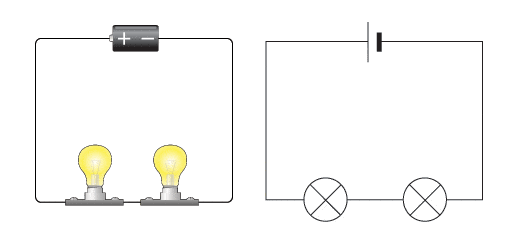
What kind of circuit is this?
a)
Series
b)
Consecutive
c)
Parallel
d)
Training
25.

What kind of circuit is this?
a)
Series
b)
Consecutive
c)
Parallel
d)
Training
26.
wood is a _____?
a)
conductor
b)
insulator
27.
brass is a _____?
a)
insulator
b)
conductor
28.

Why is this kid's hair standing up?
a)
Excess protons moved into her hair. Positives repel.
b)
Excess negatives moved into her hair. Negatives repel.
c)
Protons were sucked from her body leaving excess negative behind. Negatives repel.
d)
Electrons were sucked from her body. Excess negatives repel.
29.

The paper will eventually stick to the balloon. What is the next thing to happen?
a)
Protons move to the back of the paper
b)
electrons move to the back of the paper
c)
electrons move to the back of the balloon
d)
protons move to the back of the balloon
30.
What 'flows' in a wire?
a)
Protons
b)
Neutrons
c)
Atoms
d)
Electrons
31.
If you decreases the resistance of a circuit, what happens?
a)
Current decreases
b)
Current increases
c)
Electrons disappear
d)
Bulbs get brighter
32.
A wave carries...?
a)
energy only
b)
matter only
c)
energy and matter
d)
neither
33.
The lowest part of the wave is called the ?
a)
frequency
b)
crest
c)
amplitude
d)
trough
34.

Which wave has a greater frequency?
a)
A
b)
B
35.
When a wave's amplitude increases it means
a)
it's carrying more energy
b)
its wavelength gets longer
c)
its frequency increases
d)
its wavelength decreases
36.

When a light ray bends as it passes through a lens, what type of behavior does it demonstrate?
a)
reflection
b)
refraction
c)
dispersion
d)
absorption
37.

Which term best represents what happens when two wave pulses meet as they approach each other on a string?
a)
constructive interference
b)
destructive interference
c)
absorbed interference
d)
static interference
38.

Which is an example of a longitudinal wave?
a)
light wave
b)
sound wave
c)
visible wave
d)
radio wave
39.
A 5000N block is lifted 10 m. How much work was done?
a)
50000 J
b)
5000 J
c)
500 J
d)
50 J
40.
Work done = Force x _________
a)
a. distance
b)
b. acceleration
c)
c. velocity
d)
d. speed
41.
If 150 Joules of work is needed to move a box 10 meters, what force was used?
a)
1500 N
b)
15 N
c)
1.5 N
d)
150 N
42.

A 62 kg box is lifted 12 m off the ground. How much work was done? (hint: calculate weight of the box first)
a)
5.17 J
b)
72.91 J
c)
744.0 J
d)
7291.2 J
43.

What is the mechanical advantage of this pulley system?
a)
2
b)
3
c)
4
d)
5
44.

The mechanical advantage of this inclined plane is.....
a)
2.4
b)
3.4
c)
4.4
45.
Is the following equation balanced or unbalanced?
Fe + S --> FeS
Fe + S --> FeS
a)
balanced
b)
unbalanced
46.
True or False: When balancing chemical equations the subscripts can change.
a)
true
b)
false
47.
Which of the Following Correctly Balances this Equation?
_H2+_Cl2 --> _HCl
_H2+_Cl2 --> _HCl
a)
2H2 + Cl2 --> 4HCl
b)
H2+Cl2 --> 2HCl
c)
3H2 + 3Cl2 --> HCl
d)
H + Cl --> HCl
48.
Which of the following is an unbalanced equation?
a)
CaCO3 --> CaO + CO2
b)
PbO2 + 2H2-->2Pb + H2O
c)
2Na+ 2H2O-->2NaOH + H2
d)
CS2 + 2O2 --> CO2 + 2SO2
49.
Which is most likely to form a negative ion...
a)
an element from Group 17
b)
a metal
c)
an element from Group 1
d)
an element with atoms that have eight valence electrons
50.
A(n) _____________ is an atom or group of atoms that has an electric charge.
a)
ion
b)
electron
51.
What is the formula for magnesium phosphide?
a)
Mg3P2
b)
Mg2P3
c)
Mg2PO3
d)
Mg3(PO3)2
52.
The name of Al₂O₃ is
a)
aluminum oxide
b)
aluminum (II) oxide
c)
aluminum (III) oxide
d)
dialuminum trioxide
53.
The name of CaI₂ is
a)
Calcium iodine
b)
carbon iodide
c)
calcium (II) iodide
d)
calcium iodide
54.
Covalent bonds actually "share" electrons?
a)
true
b)
false
55.

Is this ionic bond drawn correctly?
a)
Yes
b)
No
56.
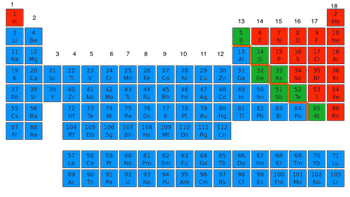
Where are metals located on the periodic table?
a)
Blue
b)
Green
c)
Red
57.
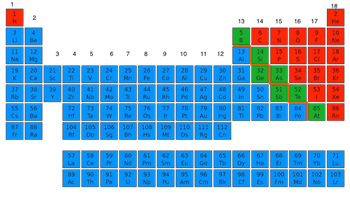
Where are the nonmetals located on the periodic table?
a)
Blue
b)
Red
c)
Green
58.

Where are the metalloids located on the periodic table?
a)
Blue
b)
Red
c)
Green
59.
if METALS are more likely to LOSE electrons, they will form ...
a)
anions
b)
negative ions
c)
positive ions
d)
cations
60.

How many protons are in this element?
a)
79
b)
196
c)
117
d)
Cannot be determined
61.

What is the atomic mass (rounded to the nearest whole number) of this element
a)
196
b)
196.95
c)
197
d)
79
62.
How many protons are in Boron (B) ?
a)
3
b)
5
c)
10
d)
11
63.
How many neutrons are in Phosphorus (P) ?
a)
15
b)
31
c)
16
d)
14
64.
How many neutrons are in Mercury (Hg) ?
a)
200
b)
80
c)
121
d)
72
65.
Which element has 31 protons ?
a)
Gallium
b)
Germanium
c)
Gadolinium
d)
Polonium
66.

Which is most acidic?
a)
milk
b)
Lemon Juice
c)
bleach
67.

Bleach is a strong base, what is the pH level of bleach?
a)
13
b)
8
c)
1
d)
2
68.
If the pH of a solution is 9, it is a....
a)
acid
b)
base
c)
both
d)
none
69.
Feels slipperty
a)
acid
b)
base
c)
salt
70.
turns litmus paper red
a)
bases
b)
salts
c)
acids
71.
turns litmus paper blue
a)
bases
b)
salts
c)
acids
72.
A saturated solution is______
a)
No more solute can be dissolved
b)
More solute can be dissolved
c)
The solvent and solution
73.

What is this process called?
a)
Evaporating
b)
Distiilation
c)
Filtration
d)
Decanting
74.

Which solute is the most soluble at 10 ⁰C?
a)
KI
b)
KClO3
c)
NH4Cl
d)
NH3
75.

Which solute is the least soluble at 90 ⁰C?
a)
SO2
b)
KClO3
c)
KI
d)
HCl
76.

Which solute does not increase in solubility as temperature rises?
a)
NH3
b)
NaNO3
c)
KNO3
d)
NaCl
77.

How many grams of K2Cr2O7, are soluble in 100 g of water at 95 ºC?
a)
83 grams
b)
75 grams
c)
40 grams
d)
12 grams
78.

How many grams of NaNO3 are soluble in 100 g of water at 10 ºC?
a)
80 grams
b)
100 grams
c)
40 grams
d)
10 grams
79.
LiBr is called
a)
lithium bromine
b)
lithium (I) bromine
c)
lithium bromide
d)
lithuim (I) bromide
80.
The name of Al₂O₃ is
a)
aluminum oxide
b)
aluminum (II) oxide
c)
aluminum (III) oxide
d)
dialuminum trioxide
81.
the name of FeCl₃ is
a)
iron chloride
b)
iron (I) chloride
c)
iron (III) chloride
d)
iron trichloride
82.
The name of Ni₂O₃ is
a)
nickel (II) oxide
b)
nickel (III) oxide
c)
nickle oxide
d)
dinickel trioxide
83.
sodium nitride
a)
NaNO3
b)
NaN
c)
NaN3
d)
Na3N
84.
silicon dioxide
a)
SO2
b)
NaO2
c)
SiO2
d)
SiO
100 %

