
NEW
Font size
S
M
L
XL
 Worksheets
7th Grade Midterm Review
Total questions: 40
Worksheet time: 1hrs 5mins
Name
Class
Date
1.
Name a biotic factor
a)
Koala
b)
Rock
c)
Sun
d)
Oxygen
2.
Name an abiotic factor
a)
rock
b)
grass
c)
tiger
d)
ladybug
3.
Name a primary consumer
a)
deer
b)
wolf
c)
tree
d)
tiger
4.
Name a producer
a)
Tiger
b)
Deer
c)
Butterfly
d)
Grass
5.
Name a primary consumer
a)
carnivore
b)
herbivore
c)
producer
d)
decomposer
6.

Cattle egrets forage (feed) in fields among cattle. The egret gets easy access to flying insects stirred up by the cattle, and the cattle don't care if they are there or not.
a)
mutualism
b)
commensalism
c)
competition
d)
parasitism
7.
A relationship between two organisms in which one organism benefits and the other is unharmed...
a)
Mutualism
b)
Competition
c)
Parasitsm
d)
Commensalism
8.

A tapeworm and a cat have this type of relationship.
a)
mutualism
b)
parasitism
c)
commensalism
d)
competition
9.
A relationship between two organisms in which both organisms benefit.
a)
Mutualism
b)
Competition
c)
Parasitsm
d)
Commensalism
10.

What type of symbiosis? Hummingbirds feed on nectar from flowers. The flowers are pollinated by hummingbirds as they move from flower to flower.
a)
commensalism
b)
mutualism
c)
parasitism
d)
predation
11.
A relationship between two species where one benefits while the other is harmed.
a)
Mutualism
b)
Commensalism
c)
Parasitism
d)
Naturalism
12.
A tick and a dog have this type of relationship.
a)
mutualism
b)
commensalism
c)
neutralism
d)
parasitism
13.
Barnacles create home sites by attaching themselves to whales. This neither harms nor benefits the whales. What kind of relationship is this?
a)
Mutualism
b)
Parasitism
c)
Commensalism
14.

High frequency waves have _________ wavelength.
a)
varying
b)
high
c)
the same
d)
low
15.
Which of the following regions of the electromagnetic spectrum has the longest wavelengths?
a)
microwave
b)
infrared
c)
x-ray
d)
gamma ray
16.
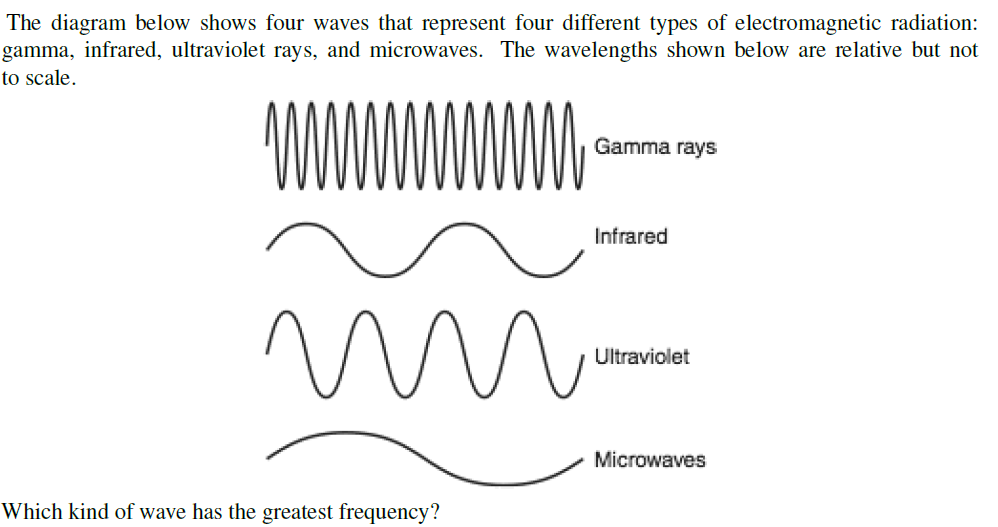
Which kind of wave has the greatest frequency?
a)
gamma rays
b)
infrared
c)
ultraviolet
d)
microwaves
17.

Look carefully at the waves. Which carries the most energy?
a)
microwave
b)
infrared
c)
ultraviolet
d)
x-ray
18.

Which has the longest wavelength?
a)
microwave
b)
infrared
c)
ultraviolet
d)
x-ray
19.

How is the Electromagnetic Spectrum organized?
a)
by wavelength
b)
by speed
c)
by path
d)
by effect
20.
Computer simulations in science can be used to do what?
a)
model predictions
b)
nothing
c)
tell us exact information
d)
fix problems perfectly
21.
How do scientists make sure that their experiments are replicable?
a)
have other scientists perform the same experiment
b)
repeat the experiment
c)
make larger sample sizes
d)
record all the information
22.
What does competition mean among organisms?
a)
when organisms compete for resources
b)
epic battles
c)
pollution
23.
What do decomposers do?
a)
Decomposers make resources available to producers by breaking down waste materials.
b)
. Decomposers are a necessary part of the diet of most consumers.
c)
Decomposers make resources available to producers by breaking down waste materials
d)
Decomposers extract energy from sunlight as they break down plant materials, adding energy to the system.
24.
Electromagnetic Radiation waves travel at the same speed.
a)
True
b)
False
25.

Which is in the correct order from lowest to highest energy?
a)
microwave, radio, xray, gamma
b)
gamma, xray, microwave, radio
c)
radio, microwave, xray, gamma
d)
gamma, radio, xray, microwave
26.
Mutualism
a)
+ +
b)
+ -
c)
+ 0
27.
Commensalism
a)
+ +
b)
+ -
c)
+ 0
28.
Parasitism
a)
+ +
b)
+ -
c)
+ 0
29.

What is this called?
a)
refraction
b)
reflection
c)
reconstroction
d)
retraction
30.
During heavy fog, visibility is reduced and light does not travel very far. Which of the following best explains the reduced visibility?
a)
light is absorbed by water vapor near the ground
b)
light is refracted by water vapor in the air
c)
light is reflected by water droplets on the ground
d)
. light is blocked by water droplets in the air
31.
What is air pollution?
a)
the contamination of the atmosphere by pollutants from human and natural sources
b)
the contamination of the water by pollutants from humans
c)
the long-term health issues related to the quality of the air
d)
Pollution that results in global warming
32.
Sound travels the fastest through solids
a)
true
b)
false
33.

What do the arrows in a food web represent?
a)
energy flow
b)
location of the animal
c)
sizes of animals
d)
types of relationships
34.
Does temperature affect the speed of sound?
a)
yes
b)
no
35.
How do the decomposers in an ecosystem obtain energy?
a)
from dead things
b)
photosynthesis
c)
the air
d)
living organisms
36.
Mistletoe sucks the life out of a tree. What is the mistletoe?
a)
a parasite
b)
a friend
c)
a host
d)
a predator
37.
When you use your chromebook for long periods of time, it gets hot. Why?
a)
Kinetic energy is converted to thermal energy.
b)
Sound energy is converted to thermal energy.
c)
Electrical energy is converted to thermal energy.
d)
Mechanical energy is converted to thermal energy
38.
Which of the following would cause greater devastation of a dense (large) population of mice?
a)
flooding
b)
Severe weather
c)
Diseases
d)
forest fires
39.
When you use your phone it get hot. What happened to the heat when the phone cooled off?
a)
The heat was destroyed.
b)
The heat was stored
c)
The heat was transformed into electricity.
d)
The heat was transferred to the air around it
40.
Overgrazing leads to desertification.
a)
true
b)
false
Reset

