
 Worksheets
Parts of the Earth/Plate Tectonics
Total questions: 30
Worksheet time: 18mins
Name
Class
Date
1.
The relatively thin layer of gases that form Earth's outermost layer is called:
a)
Biosphere
b)
Atmosphere
c)
Energy
d)
Constructive Force
2.
The Hydrosphere contains all of Earth's ______________
a)
Water
b)
Air
c)
Life
d)
All of the above
3.
The Outermost layer in the Earth is called
a)
Mantle
b)
Crust
c)
Core
d)
None of the above
4.

From the outside to the inside, the correct order of the layer of the Earth is
a)
Core, Mantle, Crust
b)
Crust, Core, Mantle
c)
Crust, Mantle, Geosphere
d)
Crust, Mantle, Core
5.
Earth's crust is broken into large pieces called
a)
Continents
b)
Countries
c)
Tectonic plates
d)
Oceans
6.
The Crust is divided into Continental and Oceanic Crust
a)
True
b)
False
7.
Convection currents in this layer move tectonic plates.Which of Earth's layers does this statement describe?
a)
inner core
b)
outer core
c)
mantle
d)
crust
8.
Which statement correctly explains how convection causes movement of the crustal plates?
a)
Crustal plates move when tides are high on one side of Earth and low on the other side.
b)
Crustal plates move when hot magma rises and more dense, cooler magma sinks.
c)
Crustal plates move when the moon's gravity pulls on different parts of Earth.
d)
Crustal plates move when water inside Earth's core changes from liquidto vapor.
9.
Tectonic plates are part of which layer of the Earth?
a)
Lithosphere
b)
Asthenosphere
c)
Mantle
d)
Outer core
10.
Describe the movement of tectonic plates at a convergent boundary.
a)
Plates move away from each other
b)
Plates move towards each other
c)
Plates slide past each other
11.
What did Wegener observe about the continents that led to his theory of continental drift?
a)
They were made up of tectonic plates
b)
They appeared to fit together like a puzzle
c)
They were moving several meters each year
d)
They seemed to be sinking into the ocean
12.
At which boundary are earthquakes most likely to occur?
a)
Convergent boundary
b)
Transform boundary
c)
Divergent boundary
13.
The San Andreas Fault is an example of a ______________ plate boundary
a)
Divergent
b)
Convergent
c)
Transform
14.
_____________ plate boundaries collide into each other
a)
Convergent
b)
Divergent
c)
Transform
15.

Circular currents in the mantle caused by the magma being heated by the core off the earth
a)
Lithosphere
b)
Plate Tectonics
c)
Convection Currents
d)
Dynamo Effect
16.
What is a divergent boundary?
a)
two plates moving towards each other
b)
two plates rubbing side to side
c)
two plates moving away from each other
d)
happens in the lithosphere
17.
What is seafloor spreading?
a)
continental crust-continental crust
b)
rift valleys
c)
seafloor spreads
d)
ocean spreads and magma rises to fill in gaps creating a Mid Ocean Ridge
18.
What grows at the divergent boundary?
a)
San Andreas Fault
b)
Mid Ocean Ridge
c)
Land ridge
d)
Pacific Ocean
19.
What layer of the Earth is the hottest?
a)
Mantle
b)
Solid Inner Core
c)
Liquid Outer Core
d)
Crust
20.

Who is the person credited with developing the theory of continental drift?
a)
Harry Hess
b)
Galileo
c)
Alfred Wegener
d)
Newton
21.

What is this a picture of?
a)
plate tectonics
b)
continental drift
c)
pangea
d)
glacier scaring
22.
What two specific continents fit together most noticeably?
a)
Africa and North America
b)
South America and Europe
c)
South America and Africa
d)
Antartica and Africa
23.
The area where one plate moves under the other plate is called the
a)
subversion zone
b)
subtraction zone
c)
subhematoma zone
d)
subduction zone
24.
When two continental plates collide,
a)
an ocean is formed
b)
mountains are formed
c)
rift valleys are formed
d)
one plate subducts under the other one
25.
New earth crust is made
a)
in the deep ocean trenches
b)
far from the mid-ocean ridge
c)
where two continental plates make mountains
d)
from the magma that comes from the mid-ocean ridges
26.
Which type of plate boundary DOES NOT cause volcanoes?
a)
Convergent
b)
Transform
c)
Divergent
27.

What kind of plate boundary is shown here?
a)
divergent
b)
convergent
c)
transform
d)
submergent
28.
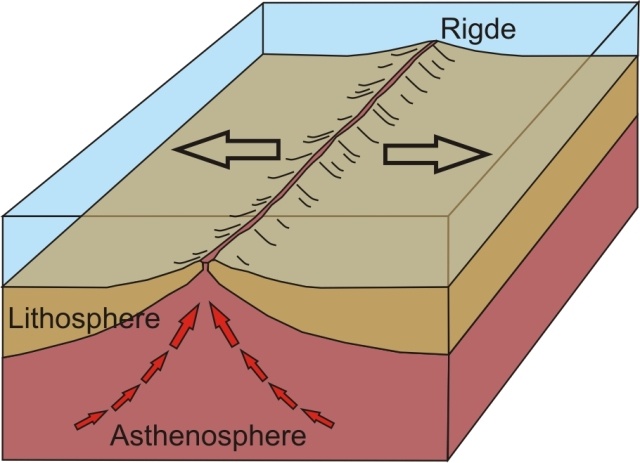
What kind of plate boundary is shown here?
a)
divergent
b)
convergent
c)
transform
d)
subducting
29.

What kind of plate boundary is shown here?
a)
divergent
b)
convergent
c)
transform
d)
strike slip
30.
What would you be most likely to find at a divergent boundary between two pieces of continental crust?
a)
Mid-Ocean Ridge
b)
Mountain
c)
Rift valley
d)
Island Arc (chain of islands)
100 %

