
 Worksheets
Solar System
Total questions: 26
Worksheet time: 22mins
Name
Class
Date
1.
A student made a model of how the Earth, Moon, and Sun orbit. She used ping-pong balls
to represent each one. She painted each one a different color. Then, she placed the Moon
and Earth close together and the Sun much further away.What is one limitation of the student's model?
to represent each one. She painted each one a different color. Then, she placed the Moon
and Earth close together and the Sun much further away.What is one limitation of the student's model?
a)
She used the same size balls.
b)
She made earth orbit the sun.
c)
She moved the Sun away from the Earth and Moon.
2.
Which planet in our solar system is closest to the Sun?
a)
Earth
b)
Jupiter
c)
Mercury
d)
Saturn
3.
Which of the following is an accurate model of how the Sun, Earth, and Moon move?
a)
Sun and moon orbit Earth
b)
Earth and moon orbit Sun
c)
Earth orbit's the Sun and the moon orbits Earth
d)
Earth and sun orbit moon
4.
What planet is eighth in the Solar System?
a)
Uranus
b)
Jupiter
c)
Neptune
d)
Mars
5.

The moon is a natural ______ of Earth.
a)
comet
b)
axis
c)
satellite
d)
space probe
6.
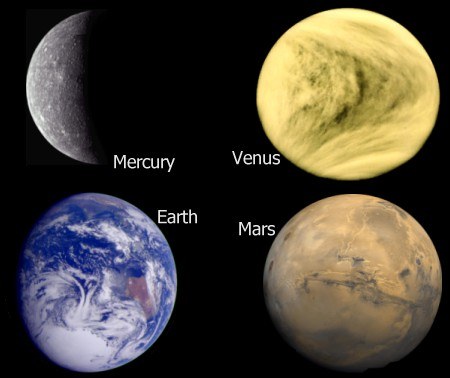
Earth and the other planets closest to the Sun are made mostly of _______
a)
gas
b)
metal
c)
water
d)
rock
7.

The __________ has planets, moons, comets, and asteroids.
a)
solar system
b)
earth
c)
rotation
d)
United States
8.
One of the main differences between the outer and inner planets is __________.
a)
The inner planets all have water
b)
the inner planets are much bigger than the outer planets
c)
the outer planets are gas planets
d)
the outer planets have rings, and the inner planets don't
9.
Where is the asteroid belt found?
a)
between earth and mars
b)
Between Uranus and Neptune
c)
Between Mercury and Venus
d)
Between Mars and Jupiter
10.
Why does Earth have different seasons?
a)
because of the distance between Earth and the sun
b)
because of the speed of Earth as it rotates on its axis
c)
because of the amount of light blocked by the moon on its axis
d)
because of the tilt of Earth on its axis as it moves around the sun
11.
Which is the largest object in our solar system?
a)
Sun
b)
Jupiter
c)
Earth
d)
Pluto
12.
A ball of ice and dust with a tail of gas and dust pointing away from the sun.
a)
Asteroid
b)
Comet
c)
Moon
d)
Meteor
13.
A small rocky object orbiting the sun.
a)
Asteroid
b)
Comet
c)
Moon
d)
Meteor
14.
_____ are loops of gas on the sun that link different parts of sunspot regions together.
a)
Prominences
b)
Solar flares
c)
Solar winds
d)
Auroras
15.
The sun's _____ is the laser of the atmosphere that has a reddish glow.
a)
photosphere
b)
chromosphere
c)
Corona
d)
Core
16.

Label part 1
a)
Core
b)
Radiation zone
c)
Convection zone
d)
Photosphere
17.

Label Part 2
a)
Core
b)
Radiation zone
c)
Convection zone
d)
Corona
18.

Label Part 3
a)
Chromosphere
b)
Radiation zone
c)
Convection zone
d)
Photosphere
19.

Label part 4
a)
Chromosphere
b)
Radiation zone
c)
Convection zone
d)
Photosphere
20.

Label part 5
a)
Chromosphere
b)
Radiation zone
c)
Convection zone
d)
Photosphere
21.

Label part 6
a)
Prominences
b)
Corona
c)
Sunspots
d)
Photosphere
22.

Label part 7
a)
#7 Prominences
b)
#7 Corona
c)
#7 Sunspots
d)
#7 Photosphere
23.
In what form does the Sun's energy travel to Earth?
a)
Heat
b)
Electrical energy
c)
Electromagnetic radiation
d)
Mechanical energy
24.
What is the definition of CONDUCTION?
a)
When heat is transferred from objects like rays of light or electromagnetically.
b)
a hot liquid or air that expands, becomes less dense, and rises or becomes more dense, and sinks.
c)
When heat transfers from objects that are touching.
d)
When heat transfers through the heater or AC in your house.
25.
What is the definition of CONVECTION
a)
When heat transfers through the heater or AC in your house.
b)
When heat transfers from objects that are touching.
c)
a hot liquid or air that expands, becomes less dense, and rises or becomes more dense, and sinks.
d)
Holding hands
26.
What is the definition of RADIATION
a)
hot liquid or air that expands, becomes less dense, and rises or becomes more dense, and sinks.
b)
When heat is transferred from objects like rays of light or electromagnetically.
c)
When heat transfers from objects that are touching.
d)
When heat transfers through the heater or AC in your house.
100 %

