
 Worksheets
Weathering Review
Total questions: 40
Worksheet time: 41mins
Name
Class
Date
1.
Porosity refers to...
a)
the shape of the particles
b)
The sorting of the particles
c)
% of pore space in a material
d)
% of cement in a material
2.
Impermeable materials...
a)
have an abundance of pores.
b)
let water in.
c)
have little to no pores.
3.
The boundary between the zone of aeration and the zone of saturation is called the...
a)
well
b)
recharge zone
c)
the water table
d)
watershed
4.
Porosity is dependent on all of the following EXCEPT...
a)
Particle shape
b)
Amount of cement
c)
Sorting
d)
Hardness
5.
Which of the following has the lowest porosity?
a)
Clay
b)
Silt
c)
Gravel
d)
Sand
6.

Poorly sorted soil...
a)
has low porosity
b)
has high porosity
c)
has high pore space
d)
means water will move through quickly
7.

Well sorted soil...
a)
has low porosity
b)
has low pore space
c)
has high porosity
d)
means water will move through slowly
8.
Which surface soil conditions allow the most infiltration of rainwater?
a)
steep slope and permeable soil
b)
steep slope and impermeable soil
c)
gentle slope and permeable soil
d)
gentle slope and impermeable soil
9.
Sand sediments are usually more permeable than silt sediments because sand grains are...
a)
larger
b)
smoother
c)
rounder
d)
more soluble
10.

Which diagram represents the soil with the greatest permeability?
a)
Choice 1
b)
Choice 2
c)
Choice 3
d)
Choice 4
11.
Soil with the greatest porosity has particles that are...
a)
poorly sorted and densely packed
b)
poorly sorted and loosely packed
c)
well sorted and densely packed
d)
well sorted and loosely packed
12.
In which sediments is the capillary action of water greatest?
a)
silt and sand
b)
sand and pebbles
c)
pebbles and cobbles
d)
cobbles and boulders
13.
Which set of conditions would produce the most runoff of precipitation?
a)
gentle slope and permeable surface
b)
gentle slope and impermeable surface
c)
steep slope and permeable surface
d)
steep slope and impermeable surface
14.

Which graph shows the effect of soil permeability on the amount of runoff in an area?
a)
Choice 1
b)
Choice 2
c)
Choice 3
d)
Choice 4
15.
Which property of loose earth materials most likely increases as particle size decreases?
a)
capillarity
b)
infiltration
c)
permeability
d)
porosity
16.
Which soil condition allows the most infiltration of precipitation?
a)
saturated soil
b)
a steep soil surface
c)
a gentle soil surface
d)
an impermeable surface
17.

Water can infiltrate loose soil when the soil is...
a)
saturated and permeable
b)
saturated and impermeable
c)
unsaturated and permeable
d)
unsaturated and impermeable
18.
The process by which water, ice, wind or gravity moves weathered rock and soil from one place to another.
a)
weathering
b)
erosion
c)
deposition
d)
dumptruck
19.
This type of weathering occurs when rock is physically broken down into smaller pieces of rock.
a)
mechanical weathering
b)
chemical weathering
c)
erosion weathering
d)
deposition
20.
How might a weathered mountain appear different than an unweathered mountain?
a)
Weathered mountain would be taller.
b)
Weathered mountain would be rounder and less jagged.
c)
Weathered mountain would be more jagged and less rounded.
d)
Weathered mountain would have no trees.
21.
How is mechanical weathering different from chemical weathering?
a)
Chemical weathering happens over much shorter time frame than mechanical weathering.
b)
Chemical weathering changes the chemical composition of rocks; mechanical weathering does not.
c)
Chemical weathering occurs only in tropical climates; mechanical weathering occurs only in cool climates.
d)
Chemical weathering occurs only in the mountains; mechanical weathering occurs only on flat land.
22.
Which process is most directly related to constructing new land?
a)
erosion
b)
polluting
c)
deposition
d)
weathering
23.

Beaches are built up by -
a)
deposition
b)
leaching
c)
abrasion
d)
erosion
24.
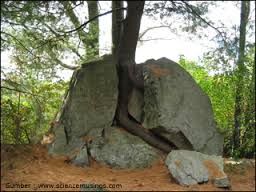
How do plants weather rocks?
a)
During photosynthesis
b)
When roots grow into cracks of rocks and expand the rock breaks.
c)
When the plant moves water from the roots to the leaves, the rock breaks.
d)
Plants don't weather rocks.
25.

Which of the following is NOT a slow change to Earth's surface?
a)
Weathering
b)
Erosion
c)
Deposition
d)
Landslides
26.
The major cause of erosion along coasts is:
a)
tornadoes
b)
earthquakes
c)
clouds
d)
wave action
27.
Acid rain causes the following type of weathering:
a)
mechanical weathering
b)
physical weathering
c)
low impact weathering
d)
chemical weathering
28.
Rust is the result of which process?
a)
oxidation
b)
erosion
c)
sublimation
d)
photosynthesis
29.
In wet environments, the major cause of erosion is:
a)
wind
b)
animal movement
c)
moving water
d)
air movement
30.
Which of the following is an example of a process that causes mechanical weathering of rocks?
a)
crystallization
b)
freezing and thawing
c)
sedimentation
d)
condensing and sublimating
31.
Both the Grand Canyon and the Palo Duro Canyon were formed by what agent of erosion?
a)
wind
b)
ice
c)
lightning
d)
moving water
32.
One way that people cause greater erosion is by ___.
a)
building terraces
b)
building walls
c)
removing plants
d)
planting grass
33.
What is sediment?
a)
the process of rocks being broken down and carried away
b)
bits of rock, sand, and silt caused by the weathering of rocks
c)
the top layer of the soil
d)
decaying plant or animal material
34.
What FORCE moves sediment downhill?
a)
Abrasion
b)
Gravity
c)
Rust
d)
Wind
35.

These rocks were made smooth by wind blowing smaller rock particles across their surface. This is an example of:
a)
ice wedging
b)
chemical weathering
c)
acid rain
d)
abrasion
36.
A cliff formed near an ocean. Which statement best describes how this cliff formed?
a)
Warm air melted the rock.
b)
Sun rays evaporated the rock.
c)
Ocean waves washed away rock.
d)
Plant roots pushed away the rock.
37.

Constance and John studied deserts. They saw a picture of a sand dune in a desert. What MOST likely made the sand dune form?
a)
rain
b)
wind
c)
flood waters
d)
strong sunlight
38.
All of the following are causes of physical weathering except...
a)
plant growth
b)
wind
c)
acid rain
d)
running water
39.

Which area of the coastline has most likely experienced the greatest effect of erosion from waves over hundreds of years?
a)
Area N
b)
Area P
c)
Area S
d)
Area T
40.

The diagrams shows a natural process that weathers rock.
Which statement best explains why this process results in weathering?
Which statement best explains why this process results in weathering?
a)
frozen water acts as a solute
b)
water expands when it freezes
c)
the mass of water increases when it freezes
d)
frozen water dissolves most types of rock
100 %

