
Font size
 Worksheets
Body Systems
Total questions: 33
Worksheet time: 21mins
Which of these is part of the cardiovascular/circulatory system?
Which is a function of the circulatory/cardiovascular system?
Which best describes the relationship between the cardiovascular (circulatory) system and the muscular system?
Put these in order from least complex to most complex.
cells
tissues
organs
systems
organism
Match the organ with the correct system.

digestive system

circulatory system

respiratory system

nervous system

skeletal system
Label the ribs, skull, and spine in the correct location.
Match the part of the skeletal system with the organ(s) that it protects.
heart and lungs
ribs
brain
skull
spinal cord
spine
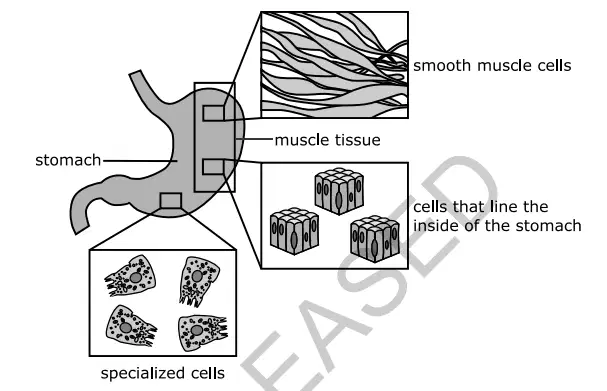
The stomach helps break down food and move it throughout the body. This diagram shows the structure of the stomach. Select three statements that correctly describe the stomach.
Stomach tissue is only composed of muscle cells.
Stomach tissue includes many different types of cells.
Muscle tissue in the stomach is made of muscle cells
The stomach is an organ inside of the digestive system.
The stomach is a tissue inside of the digestive system.

The illustrations show three different types of muscle cells in the human body. Which statement do the illustrations support?
Muscle cells are made up of connected muscle tissues.
A muscle is an organ made up of only one type of muscle cell.
Different types of muscle cells make up different types of muscle tissue in the human body.
Different types of muscle cells make up the same type of muscle tissue in all parts of the human body.
What do the digestive system and circulatory system of the human body have in common?
They work together to help give the body the ability to speak, smell, and breathe.
They work together to give cells the nutrients needed to produce energy.
They work together to reduce waste and keep the body clean.
They work together to pump blood throughout the body.
How do the digestive and circulatory systems differ in how they help the body obtain nutrients?
The digestive system breaks down food into red blood cells, and the circulatory system carries these red blood cells throughout the body.
The digestive system breaks down food into usable nutrients, and the circulatory system carries these nutrients throughout the body.
The digestive system breaks down food, and the circulatory system moves the food from the stomach to the large intestines.
The digestive system mixes food with water, and the circulatory system moves the mixture through the intestines.

