wayground logo

Free Printable Worksheets

Font size

S
M
L
XL
Worksheets

Hydrology

Total questions: 92

Worksheet time: 3hrs 52mins

Name
Class
Date
1.
Most of the Earth's water is in
a)
salty oceans
b)
freshwater lakes
c)
freshwater ponds
d)
glaciers
2.
Compound found in ocean water that effects salinity
a)
sodium chloride
b)
sodium
c)
chlorine
d)
density
3.
About how much of the Earth's surface is covered with water?
a)
1/4
b)
1/2
c)
3/4
d)
1/5
4.
The supply of freshwater under the Earth's surface.
a)
watershed
b)
mouth
c)
headwaters
d)
groundwater
5.
Where is most of the freshwater found on Earth?
a)
lakes
b)
glaciers
c)
oceans
d)
rivers
6.
Which source of freshwater is not easily available for human use?
a)
oceans
b)
freshwater lakes
c)
rivers
d)
icecaps/glaciers
7.
The change of water from a liquid to a gas.
a)
evaporation
b)
precipitation
c)
condensation
d)
transpiration
8.
Any type of moisture that falls to the Earth.
a)
evaporation
b)
precipitation
c)
condensation
d)
transpiration
9.
The release of moisture by living plants.
a)
evaporation
b)
precipitation
c)
condensation
d)
transpiration
10.
The change of water from a vapor to a liquid.
a)
evaporation
b)
precipitation
c)
condensation
d)
transpiration
11.
The flow of water from land into a body of water.
a)
groundwater
b)
headwaters
c)
run-off
d)
infiltration
12.
On which kind of day would you expect the most evaporation from the surface of a pond?
a)
warm, sunny
b)
cold, sunny
c)
warm, rainy
d)
cold, rainy
13.
What follows evaporation during the water cycle? How does this occur?
a)
Water evaporates into water vapor
b)
Water vapor condenses and forms a  cloud
c)
Water precipitates to the ground
d)
Water runs down into the hydrosphere
14.
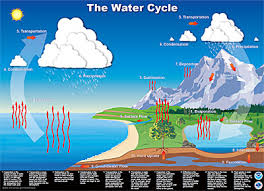
What is A?
a)
Evaporation
b)
Condensation
c)
Precipitation
d)
Runoff
15.
What is B?
a)
Evaporation
b)
Condensation
c)
Precipitation
d)
Runoff
16.
What is C?
a)
Evaporation
b)
Condensation
c)
Precipitation
d)
Runoff
17.
What is      D?
a)
Evaporation
b)
Condensation
c)
Precipitation
d)
Runoff
18.
Which represents the distribution of water on Earth?
a)
3% freshwater, 97% salt water
b)
97% freshwater, 3% salt water
c)
71% freshwater, 29% salt water
d)
29% freshwater, 71% salt water
19.
Approximately what percent of the Earth is covered by water?
a)
71%
b)
29%
c)
50%
d)
97%
20.
About three-fourths of all freshwater on Earth is contained in glaciers.
a)
true
b)
false
21.
The water in Earth’s oceans, seas, lakes, rivers, and glaciers makes up the atmosphere.
a)
true
b)
false
22.
The amount of dissolved solids present in the water
a)
salinity
b)
chlorine
c)
nitrogen
d)
density
23.
What follows evaporation during the water cycle? How does this occur?
a)
Water evaporates into water vapor
b)
Water vapor condenses and forms a  cloud
c)
Water precipitates to the ground
d)
Water runs down into the hydrosphere
24.
Where does condensation occur (forming the clouds)?
a)
Hydosphere
b)
Geosphere
c)
Lithosphere
d)
Atmosphere
25.
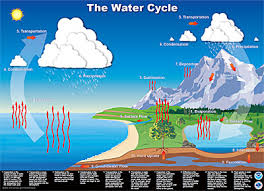
What is C?
a)
Evaporation
b)
Condensation
c)
Precipitation
d)
Runoff
26.
What is D?
a)
Evaporation
b)
Condensation
c)
Precipitation
d)
Runoff
27.
When water _________, dew forms.
a)
Melts
b)
Evaporates
c)
Condenses
d)
Precipitates
28.
During which stage do clouds form?
a)
condensation
b)
evaporation
c)
precipitation
29.
Which stages does liquid water from the ocean turn into water vapor?
a)
condesantion
b)
evaporation
c)
precipitation
d)
run off
30.
Which stage does ground water try to return to the ocean or soak into the ground?
a)
condensation
b)
evaporation
c)
precipitation
d)
run off
31.
How do waves form? 
a)
Wind blowing across the surface
b)
Time wind blows
c)
Strength of the wind 
d)
Wind when blows upwards off the water
32.
All waves carry
a)
energy
b)
light 
c)
matter
d)
particles
33.
What is the name of the largest and most powerful surface current in the North Atlantic Ocean? 
a)
Gulf of Mexico 
b)
Pacific Steam 
c)
Gulf Stream
d)
Atlantic Ocean steam 
34.
Compound found in ocean water that effects salinity
a)
sodium chloride
b)
sodium
c)
chlorine
d)
density
35.
Surface currents are a result of
a)
Global Wind Patterns
b)
Earth's Rotation
c)
Density
d)
All of the above
36.
Deep Ocean currents are a result of
a)
Global Wind Patterns
b)
Earth's Rotation
c)
Density
d)
All of the above
37.
The Coriolis Effect is caused by
a)
Earth rotating around the sun
b)
Earth rotating on its axis
c)
The tides
d)
Gravity
38.
The Gulf stream carries _____________ water from the east coast of The United States to the West coast of Europe.
a)
Cold
b)
Warm 
c)
Freezing
d)
Fresh
39.
As you go deeper in the ocean, the water is colder and less salty.
a)
True
b)
False
40.
Warm ocean currents generally come from
a)
The North Pole
b)
The South Pole
c)
The Equator
d)
Both A and B
41.
Two types of water currents are
a)
local and global
b)
sea and land
c)
surface and deep
d)
warm and cold
42.
Ocean currents have an affect on which two things
a)
climate and weather
b)
temperature and density
c)
land and sea
d)
equator and poles
43.
 When water vapor changes to liquid water 
a)
evaporation
b)
 condensation
c)
humidity
d)
precipitation
44.
. The flat area of the ocean basin is called the
a)
Ocean floor
b)
The Abyss
c)
Continental rise
d)
Abyssal Plain
45.
Why is most of Earths freshwater is not available for human use.  
a)
because it's in the ground
b)
because it's frozen in ice caps and glaciers
c)
because of pollution
d)
because of global warmin
46.
What percent of Earth’s water is freshwater 
a)
1%
b)
2%
c)
3%
d)
5%
47.
What is Salinity? 
a)
how much salt is in any given liquid
b)
salt on the rocks
c)
how much salt is in takis
48.
The edges of the continents slopes down from the shore into the ocean
a)
continental rise
b)
continental slope
c)
continental shelf
49.
What is Nekton and where can they be found in the ocean? (top/middle/bottom) 
a)
living organisms the are found in the top/surface zones of the ocean
b)
living organisms found in the bottom/midnight zones of the ocean
c)
living organisms found in the middle/twilight zones of the ocean
50.
What technology is used to measure the depth of the ocean?
a)
submarine
b)
sonic
c)
sonar
51.
How do clouds form? 
a)
smoke from factories
b)
when condensation near land freezes
c)
when water vapor condenses and cools 
52.
What gives the water cycle its energy 
a)
sun
b)
moon
c)
fire
d)
ice
53.
 What is the most abundant (most common) salt in the ocean? 
a)
sodium
b)
chloride
c)
sulfate
d)
other
54.
This is when water falls back down to the earth as rain, hail, sleet or snow
a)
partnership
b)
promotion
c)
precipitation
d)
participation
55.
What percent of Earth’s water is saltwater 
a)
79%
b)
98%
c)
3%
d)
97%
56.
What is porosity?
a)
how the holes change in rocks without water
b)
how much time it takes water to run through rocks
c)
how much water can be held in rocks and other earth's substances
57.
This occurs when there is an abundance of water vapor suspended in the air
a)
frost
b)
heat
c)
humidity
d)
dew
58.
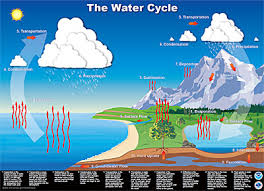
What part of the water cycle does this picture show?
a)
condensation
b)
precipitation
c)
evaporation
59.
Which of these is an example of precipitation?
a)
snow
b)
air
c)
clouds
d)
vapor
60.
A giant wave
a)
surfing wave
b)
breaker
c)
tsunami
d)
crest
61.
What is the next stage after EVAPORATION in the water cycle?
a)
CONDENSTATION
b)
GROUNDWATER
62.
What is it called when plants give off water vapor as a waste product?
a)
condensation
b)
evaporation
c)
sublimation
d)
transpiration
63.
What is an underground layer of rock or soil filled with water called?
a)
Aquifer
b)
Spring
c)
Well
d)
Reservoir
64.
Water stored below the Earth's surface is called:
a)
Groundwater
b)
Bogs
c)
Water in the ground
65.
Snow, sleet, hail, and rain are all examples of  ________________. 
a)
evaporation
b)
condensation
c)
accumulation
d)
precipitation
66.
The land area that supplies water to a river system is called a
a)
water table
b)
trailer
c)
house
d)
watershed
67.

A student takes a bottle of cold water from the refrigerator and leaves it on the counter. Ten minutes later, the student noticed there is now water on the outside of the bottle. What scientific phenomenon explains the water on the outside of the bottle?

a)

Condensation because the temperature of the air nearest the bottle increased causing water droplets to form

b)

Condensation because the temperature of the air nearest the bottle decreased causing the water droplets to form

c)

Evaporation because the temperature of the air nearest the bottle increased causing the water droplets to form

d)

Evaporation because the temperature of the air nearest he bottle decreased causing the water droplets to form

68.

What percentage of the water on Earth is fresh water?

a)

97%

b)

3%

c)

1%

d)

2%

69.

What percentage of Earth is covered with water?

a)

80%

b)

60%

c)

71%

d)

70%

70.

What percentage of the water on Earth is salt water?

a)

97%

b)

80%

c)

60%

d)

95%

71.

What percentage of freshwater sources is trapped in glaciers/icecaps?

a)

86.7%

b)

78.7%

c)

58.7%

d)

68.7%

72.

What percentage of freshwater sources is trapped underground?

a)

31.1%

b)

30.1%

c)

32.1%

d)

68.7%

73.

At what stage do we gain energy and at what stage do we lose energy?

a)

Gain:Evaporation Lose:Precipitation

b)

Gain:Precipitation Lose:Condensation

c)

Gain:Condensation Lose:Precipitation

d)

Gain:Evaporation Lose:Condensation

74.

Explain at least 5 stages of the water cycle.

a)

Evaporation, Condensation, Precipitation, Infiltration

b)

Evaporation, Condensation, Precipitation, Transpiration

c)

Evaporation, Condensation, Precipitation

d)

Evaporation, Condensation, Precipitation, Infiltration, Transpiration

75.

Describe what happens as you descend through the water column

a)

Everything decrease except temperature increases

b)

Everything increases except density decreases

c)

Everything decreases except temperature increases

d)

Everything increases except temperature decreases

76.

Name two factors that increase salinity

a)

Evaporation and freezing

b)

Near the mouth of river and freezing

c)

Condensation and Precipitation

d)

Evaporation and melting

77.

What causes tides to occur?

a)

Inertia

b)

Interaction of the Earth Sun and Moon

c)

Evaporation

d)

Condensation

78.
 When water vapor changes to liquid water 
a)
evaporation
b)
 condensation
c)
humidity
d)
precipitation
79.
What might form on the ocean floor where two plates separate?
a)
Mid-ocean ridge
b)
Ocean trench
c)
Continental shelf
d)
Seamount
80.
Which of the following is an example of non-point pollution?
a)
Lawn fertilizer
b)
Oil spills
c)
Sludge dumping
d)
Trash dumping
81.
What two elements make the ocean salty?
a)
Magnesium and chlorine
b)
Chlorine and sodium
c)
Chlorine and iron
d)
Sodium and iron
82.
What percent of Earth is water?
a)
71%
b)
50%
c)
25%
d)
89%
83.
Precipitation that flows over land into rivers, streams, and eventually into the ocean
a)
Precipitation
b)
Condensation
c)
Evaporation
d)
Runoff
84.
What stage of the water cycle forms clouds?
a)
Precipitation
b)
Evaporation
c)
Condensation
d)
Percolation
85.
This occurs when water droplets in clouds return to Earth's surface.
a)
Runoff
b)
Condensation
c)
Precipitation
d)
Evaporation
86.
What is the process of water vapor changing into liquid water?
a)
Evaporation
b)
Transpiration
c)
Condensation
d)
Infiltration 
87.
What is the process of water vapor changing into liquid water?
a)
Condensation
b)
Evaporation
c)
Precipitation
d)
Runoff
88.
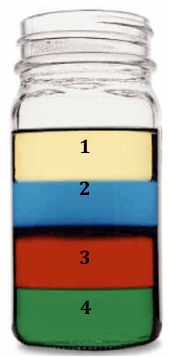
Put the liquids in order from most dense to least dense?
a)
4, 3, 2, 1
b)
1, 2, 3, 4
c)
3, 4, 2, 1, 
d)
4, 3, 1, 2
89.
What term is the measure of dissolved salts in water?
a)
Thermocline
b)
Salinity
c)
Saltiness
d)
Tides
90.

Put the Earth's water sources in order from LEAST to GREATEST

a)

Water Vapor, Lakes and Rivers, Groundwater, Glaciers, Oceans

b)

Oceans, Glaciers, Groundwater, Lakes and Rivers, Water Vapor

c)

Water Vapor, Lakes and Rivers, Glaciers, Oceans, Lakes and Rovers

d)

Lakes and Rivers, Oceans, Water Vapor, Groundwater, Glaciers

91.

What percent of the Earth's water is salt water?

a)

30%

b)

70%

c)

3%

d)

97%

92.

Which water cycle step has water cooling and condensing and going from a gas to a liquid?

a)

Evaporation

b)

Condensation

c)

Precipitation

d)

Transpiration