
 Worksheets
Universe Review
Total questions: 37
Worksheet time: 46mins
Name
Class
Date
1.
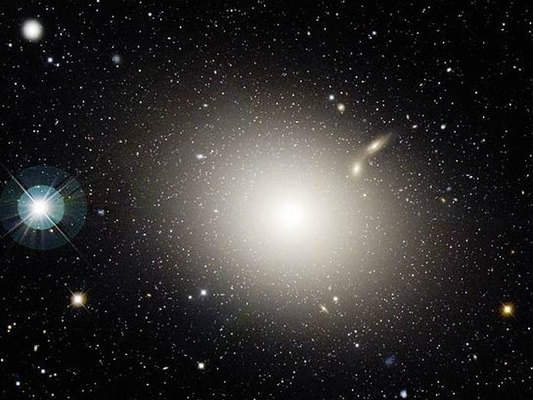
What type of galaxy is this-it contains less gas and dust than other galaxies?
a)
Spiral
b)
Elliptical
c)
Irregular
d)
Irrational
2.

What type of galaxy is this?
a)
Spiral
b)
Elliptical
c)
Irregular
d)
Irrational
3.
Which section of the spectrum is the ONLY one we can see?
a)
X-rays
b)
Visible Light
c)
Gamma Rays
d)
Ultraviolet Rays
4.
Our Sun is yellow-white, medium-sized, medium temperature star.
a)
False
b)
True
5.
Which of the following star remnants of massive stars is the most dense?
a)
White Dwarf
b)
Neuton Star
c)
Black Hole
6.
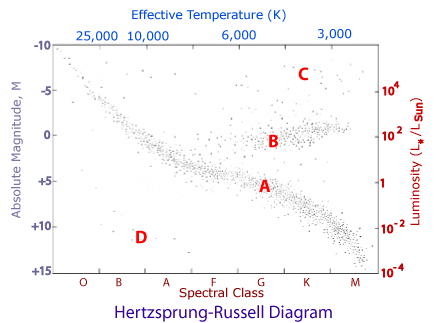
Which star has the lowest luminosity?
a)
A
b)
B
c)
C
d)
D
7.

Which star has the lowest temperature?
a)
A
b)
B
c)
C
d)
D
8.

Which star is considered a Main Sequence Star?
a)
A
b)
B
c)
C
d)
D
9.
All main-sequence stars will explode as supernovae.
a)
True
b)
False
10.

What color of star is the hottest?
a)
Blue
b)
Red
c)
Yellow
d)
Orange
11.

What is the name of baby stars?
a)
Dwarf
b)
Supergiant
c)
Protostars
d)
Nebulas
12.
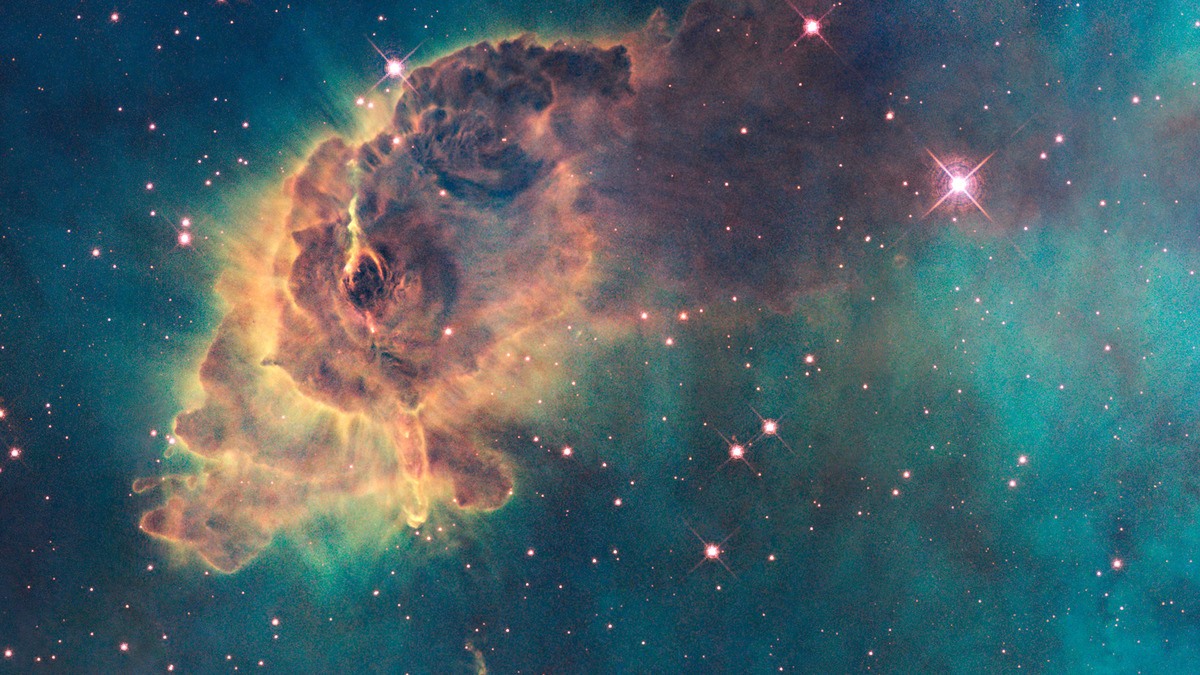
What is the name of the gas/dust clouds that form stars?
a)
Nebulas
b)
Protostars
c)
Supernova
d)
Neutron Star
13.
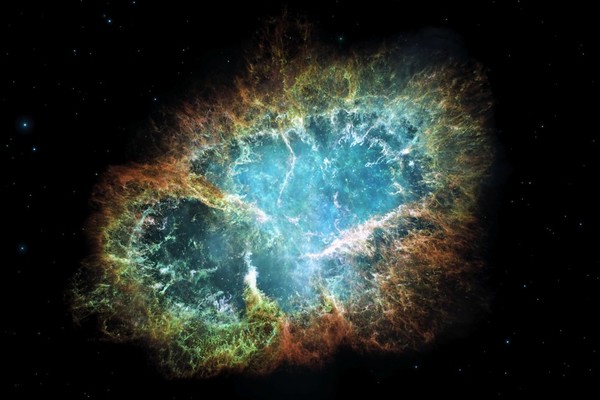
What is the name of the explosion at the death of a massive star?
a)
Supergiant
b)
Supernova
c)
Black Hole
d)
Nebula
14.
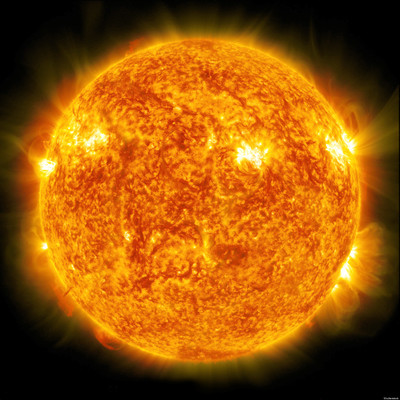
What word best describes our sun?
a)
Main sequence
b)
Supergiant
c)
Dwarf
d)
Red Giant
15.
What will the Sun become at the end of its lifecycle?
a)
red giant
b)
red dwarf
c)
black dwarf
d)
super nova
16.
Our galaxy is a....
a)
elliptical galaxy
b)
Irregular
c)
spiral galaxy
17.
Intense pressure in the protostar caused:
a)
Fire in the Sun to start
b)
Helium to break down into Hydrogen
c)
Nuclear Fusion to start
d)
Nuclear Fusion to end
18.
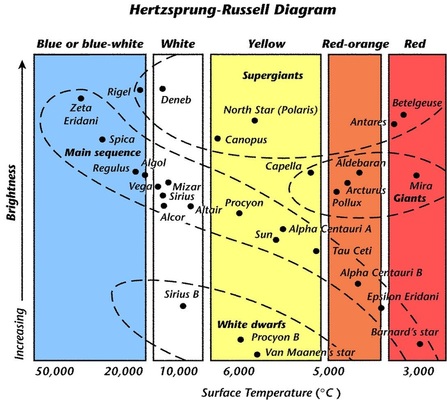
Which star is the coldest?
a)
yellow star
b)
red star
c)
orange star
d)
blue star
21.
The life cycle of a star depends on a star's...?
a)
location
b)
mass
c)
color
d)
temperature
20.
Helium is the result of ______ atoms combining in nuclear fusion.
a)
oxygen
b)
neon
c)
hydrogen
d)
iron
21.
The life cycle of a star depends on a star's...?
a)
location
b)
mass
c)
color
d)
temperature
22.
Our Galaxy is called the
a)
Milky Galaxy
b)
Milky Way Galaxy
c)
Andromeda Galaxy
d)
Pinwheel Galaxy
23.

Proxima Centauri is the closest star to Earth after the Sun and is located 4.3 light years away from Earth. How long does it take light from Proxima Centauri to reach Earth?
a)
1 year
b)
4.3 years
c)
43 years
d)
10 trillion years
24.
A light year is...
a)
The speed light travels
b)
How long it takes light to get to you from the sun
c)
The distance light can travel in a year
d)
How many years it takes light to be emitted
25.
A star is born when
a)
a nebula expands.
b)
helium and oxygen combine.
c)
nuclear fusion starts.
d)
a protostar begins to cool.
26.
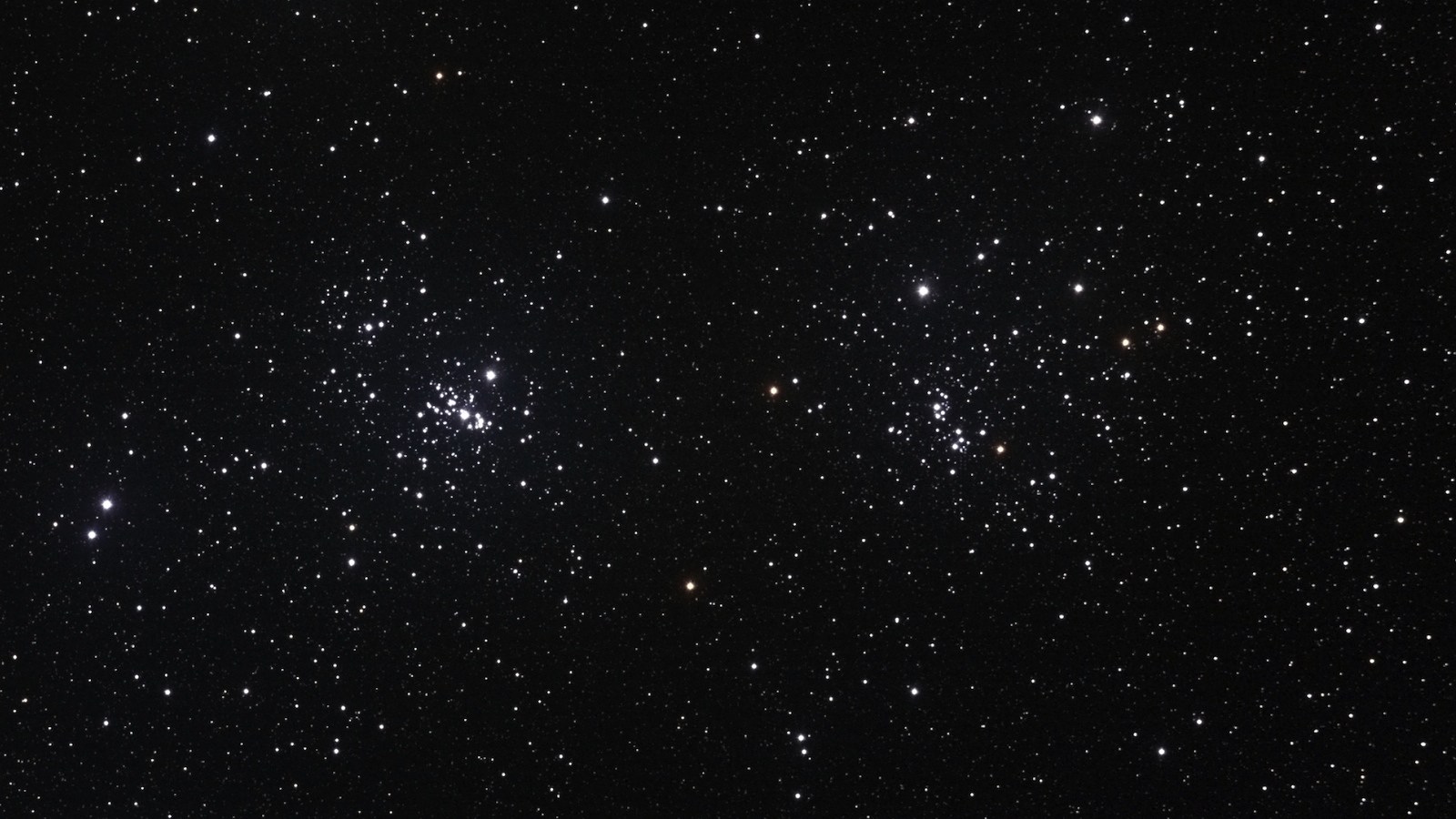
Why do other stars appear so much smaller than the sun?
a)
They are much smaller
b)
They are so far away
c)
They are not as bright
d)
They are dwarf stars
27.
Luminosity measures a star's _____________________.
a)
Color
b)
Temperature
c)
Brightness
28.

In the diagram given, what happens as we move to the left?
a)
Stars Get Larger
b)
Stars get Colder
c)
Stars get hotter
29.
The distance that light travels in one year; about 9.5 trillion kilometers. If a star is 3 light- years away how far is it in kilometers?
a)
28.5 trillion kilometers
b)
28.5 kilometers
c)
19.5 trillion kilometers
d)
9.5 trillion kilometers
30.

Where is Earth's position in our galaxy?
a)
in the center
b)
on a spiral arm, close to the center
c)
on a spiral arm, about 2/3 from the center
d)
on any spiral arm
31.
Which is in order from greatest to least mass?
a)
Universe, Sun, Galaxy, Moon
b)
Universe, Galaxy, Sun
c)
Sun, Universe Galaxy, Universe
d)
Sun, Galaxy, Universe
32.

What type of galaxy is this?
a)
Spiral
b)
Elliptical
c)
Irregular
d)
Irrational
33.
The type of galaxy that has few young stars, little gas or dust, and NO arms is a/n
a)
elliptical galaxy
b)
spiral galaxy
c)
irregular galaxy
d)
barred spiral galaxy
34.

Why are line emission spectra of elements called "atomic fingerprints"?
a)
They are all the same
b)
They are all unique
c)
They are all similar
d)
They all contain colored light
35.

What do spectroscopes do?
a)
Collect light to identify elements
b)
Refract light
c)
Absorb light
d)
Transmit light
36.
If a star is being observed from Earth and it's light has shifted towards the red side of the electromagnetic spectrum it would be...
a)
Moving towards the Earth
b)
Moving away from the Earth
c)
This is a trick question that cannot be answered
d)
It isn't a star, it is a very large blueberry.
37.
If a star is being observed from Earth and it's light has shifted towards the blue side of the electromagnetic spectrum it would be...
a)
Moving towards the Earth
b)
Moving away from the Earth
c)
This is a trick question that cannot be answered
d)
It isn't a star, it is a very large blueberry.
100 %

