
 Worksheets
Economics Midterm Review
Total questions: 89
Worksheet time: 2hrs 35mins
Name
Class
Date
1.
What is a WANT?
a)
Food
b)
Clothing
c)
New bike
d)
Shelter
2.
What is the definition of economics?
a)
The study of getting rich
b)
The study of people and economic choices
c)
Forecasts of how a certain market will do
d)
Study of the stock market
3.
Who are the people that the economy impacts?
a)
18 year old guys or girls deciding to go to college or enter the workforce full-time
b)
Companies trying to choose what to produce
c)
The government deciding whether to increase spending or not
d)
All of the above
4.
What is macroeconomics?
a)
The part of economics concerned with large-scale or general economic factors, such as interest rates and national productivity
b)
The record of how the prices of baked goods rise and fall
c)
A camera lens that allows it to take pictures close to the subject
d)
The part of economics concerned with single factors and the effects of individual decisions.
5.
What is microeconomics?
a)
The study of small things
b)
The part of economics concerned with large-scale or general economic factors, such as interest rates and national productivity
c)
The part of economics concerned with single factors and the effects of individual decisions.
d)
The unit prefix that denotes the factor of one millionth in the metric system
6.
What do you call someone who is buying a good or service?
a)
Producer
b)
Consumer
c)
Employer
d)
Merchant
7.
What do you call someone who is making a product?
a)
Consumer
b)
Producer
c)
The government
d)
Entrepeneur
8.
Soil, minerals, air, water, and coal are all examples of
a)
Fossil fules
b)
Conservation
c)
recycling
d)
natural resources
9.
The difference between a good and a service is that:
a)
Goods are available in unlimited quantaties and services are not
b)
Goods are tangible and services are not
c)
Services are available in unlimited quantaties and goods are not
d)
goods help satisfy unlimited wants and services do not
10.
________ is the most basic economic problem.
a)
Scarcity
b)
Labor
c)
Greed
d)
Capital
11.
What is an entrepreneur?
a)
A person who starts a new business.
b)
A leader of a country.
c)
A worker in a factory.
d)
A student in college.
12.
There are 4 _______________. They are land, labor, capital and entrepreneurship.
a)
Factors of Production
b)
Market Economy
c)
Profit
d)
Economics
13.
___________________ is another word for a person who works to produce goods or provides services?
a)
capital resource
b)
natural resource
c)
human resource
d)
consumer
14.
Schools, police, and fire protections are provided by ______________.
a)
taxes
b)
park services
c)
community services
d)
the country
15.
Michael used his tractor to make bales of hay. His tractor is a ____________.
a)
commercial resource
b)
capital resource
c)
natural resource
d)
human resource
16.
When people need to make economic choices due to a lack of available goods and money, this is called _________________________ in economic terms.
a)
trade offs
b)
scarcity
c)
opportunity cost
d)
incentive
17.
When I choose one item over another because I cant afford both, this is called an ...
a)
scarcity
b)
opportunity cost
c)
choice
d)
incentive
18.
Another simpler phrase for opportunity cost is ...
a)
trade off
b)
scarcity
c)
choice
d)
incentive
19.
What is the production possibilities curve?
a)
a graph that shows how much an economy can produce between two goods
b)
how much money something is
c)
the opportunity one has to give up in order to gain something else
d)
land, labor, capital, entrepreneurs
20.

What does point B represent?
a)
Production at greater than the country's minimum potential
b)
Production is less than the country's minimum potential
c)
Production is greater than the country's maximum potential
d)
Production at the country's maximum potential
21.

What does point Y represent on the PPC?
a)
Efficiency
b)
Unattainable / impossible
c)
Inefficency
d)
Nothing
22.
Exchange of one good or service for another
a)
Barter
b)
Money
c)
Swindling
d)
Theft
23.
Are credit cards considered money?
a)
Yes (It's your money)
b)
No
c)
Yes (It's like a loan)
24.
What are the four types of economies?
a)
command, demand, capitalist, communism
b)
traditional, command, market, mixed
c)
mixed, market, traditional, primary
d)
None of the above
25.
What is value?
a)
Bartering for goods that are worth the same.
b)
An amount of money, or price assigned to a good or service.
c)
Buying something at a lower cost than its worth.
d)
When good or service is worth more than the market price.
26.
Smith believed that the economy operated according to three natural laws involving this concept...
a)
self-interest
b)
compassion
c)
citizenship
d)
trustworthiness
27.
All of the following are factors of production EXCEPT:
a)
Land
b)
Labor
c)
Capital
d)
Technology
28.
What is Capitalism?
a)
A system where the government controls business
b)
Capitalism is an economic system where the means of production are privately owned and operated for profit!
c)
A economic system in which the people have limited rights
d)
An economic system in which most property and resources, such as factories or farms, are publicly owned or controlled.
29.
The rivalry between sellers to get more customers by lowering costs & better goods/services
a)
voluntary exchange
b)
competition
c)
incentives
d)
legal equality
30.
The freedom to start a business and make and sell for a profit any product allowed by law
a)
Market
b)
Industry
c)
Free Enterprise
d)
Entrepreneur
31.
The main sectors in a simple economy are
a)
Households and businesses
b)
Households and the resource market
c)
Businesss and the products market
d)
The products market and the resource market
32.
What do the households provide businesses?
a)
Labour
b)
Wages
c)
Resources
d)
Goods and services
33.
When WalMart pays income taxes, what two parts of the circular flow model are involved?
a)
consumers and producers
b)
businesses and government
c)
consumers and government
d)
store manager and consumers
34.
What is standard of living?
a)
the ability to read and write.
b)
the percentage of people in a country that can read and write.
c)
It measures how well off people in a country are.
d)
the average number of years a person in a country is expected to live.
35.
Full Employment means a 0% unemployment rate
a)
True
b)
False
36.
What is money received on a regular basis for work or through investments?
a)
salary
b)
paycheck
c)
wage
d)
income
37.
On the market demand and supply graph, the vertical axis shows
a)
demand.
b)
equilibrium.
c)
prices.
d)
quantity.
38.
On the demand and supply graph, the horizontal axis shows
a)
demand.
b)
equilibrium.
c)
prices.
d)
quantity.
39.
A surplus happens when
a)
prices are too low relative to consumer demand.
b)
prices are too high relative to consumer demand.
c)
prices are too low relative to producer demand
d)
prices are too high relative to producer demand.
40.
According to the law of supply, when prices decrease
a)
quantity supplied decreases
b)
quantity supplied increases
c)
supply decreases
d)
supply increases
41.
In economics, the term demand refers to the quantity of a good that people
a)
will buy at one particular price over a long time period
b)
would like to consume on a given date
c)
will buy at many different prices at a particular time
d)
would like to have available during a given time period
42.
Which of the following is likely to increase the demand for peanut butter?
a)
Fewer children in the population
b)
News that insects have destroyed much of the peanut crop and that there will be less peanut butter on the shelves in three months.
c)
A big increase in the price of jelly.
d)
A report from the Surgeon General of the United States that eating peanut butter makes people nutty.
43.
Supply is best defined as the measure of how much producers are willing and able to sell
a)
above the market-clearing price
b)
at any one price at a particular time
c)
at different prices at a particular time
d)
according to their resources and profit motives
44.
The amount of money people have to spend is called
a)
cash
b)
money
c)
income
d)
purchasing power
45.

Which of the following is an example of a need?
a)
A new car
b)
A vacation
c)
A form of shelter
d)
That new pair of Jordans
46.
Which of the following best describes the Law of Demand?
a)
As price goes down, demand goes down. (and vice versa).
b)
As price goes down, demand goes up (and vice versa).
c)
As demand goes down, supply goes up.
d)
As demand goes up, price becomes elastic.
47.
A change in demand is shown
a)
along the demand curve
b)
with a new demand curve above or below the original demand curve
c)
without a demand graph
d)
with a totally vertical line
48.
Consuming more of one good because of a change in price of another good is known as the
a)
income effect
b)
substitution effect
c)
elasticity effect
d)
demand effect
49.
This occurs when you feel like you have less money when the price of a good rises.
a)
Income Effect
b)
Substitution Effect
c)
Demand Effect
d)
Inflation Effect
50.
A table that lists the quantity of a good that a single person will buy at each price in a market.
a)
demand schedule
b)
market demand schedule
c)
elasticity chart
d)
supply and demand graph
51.
The demand curve always slopes
a)
down and to the right
b)
straight up and down
c)
down and to the left
d)
up and to the right
52.
Demand for a product is said to be _______ when a change in price causes very little change in quantity demanded.
a)
elastic
b)
inelastic
c)
related
d)
rigid
53.
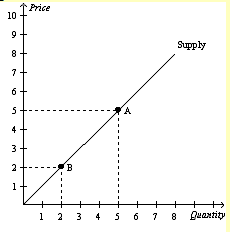
The movement from Point A to Point B represents a(n)
a)
increase in the price.
b)
decrease in the quantity supplied.
c)
shift in the supply curve.
d)
Both Orange and Blue are correct.
54.
Goods that are bought and used together are
a)
complementary goods
b)
substitute goods
c)
income goods
d)
unrelated goods
55.
What is not an example of a substitute?
a)
Disneyland and Six Flags
b)
Peanut butter and jelly
c)
Hershey's and Nestle chocolate
d)
Microsoft Word and Google Docs
56.
If substitutes are not readily available for a good or service its has
a)
inelastic demand
b)
elastic demand
57.
If substitutes ARE readily available for a good or service it has
a)
elastic demand
b)
inelastic demand
58.
If a good represents a large percentage of a person's total expenditures, it is likely to be have
a)
Elastic demand
b)
Inelastic demand
59.
Gas typically has
a)
Inelastic demand
b)
Elastic demand
60.

This curve shows
a)
Elastic Demand
b)
Inelastic Demand
61.

This curve shows
a)
Elastic Demand
b)
Inelastic Demand
62.
If a good is a necessity it is more likely to have
a)
Inelastic Demand
b)
Elastic Demand
63.
What is a subsidy?
a)
Tool government uses to encourage producers to lower prices
b)
Tool government uses to encourage producers to raise prices
c)
Example of a tariff
d)
Example of a loan
64.
In which market structure does a firm have greatest control over its product’s price?
a)
perfect competition
b)
monopoly
c)
oligopoly
d)
monopolistic competition
65.
Interdependence and price leadership are characteristics of firms in what kind of market structure?
a)
monopoly
b)
oligopoly
c)
monopolistic competition
d)
perfect competition
66.

How many cup holders are producers willing to supply at a price of $2.50?
a)
3,000
b)
4,000
c)
5,000
d)
7,000
67.

How many cup holders are producers willing to supply at a price of $6.00?
a)
4,000
b)
5,000
c)
7,000
d)
8,000
68.
Which of the following is not a variable cost?
a)
Electricity bills
b)
labor
c)
Shipping
d)
Taxes
69.
What is diminishing returns?
a)
One of more units of a variable factor that employees while other factors remain fixed.
b)
Continuing application of effort or still toward of a particular project or goal.
c)
Characterized by the slope and shape of the total product curve.
d)
The decrease in the marginal output of a production process as a single factor.
70.
When there is a perfect competition, one seller emerges as the primary controller of price as it squeezes out its competitors.
a)
True
b)
False
71.
The monopoly market structure is the opposite of the perfect competition market structure.
a)
True
b)
False
72.
This market structure can act like a monopoly when the firms all set prices the same
a)
Monopoly
b)
Monopolistic Competition
c)
Perfect Competitio
d)
Oligopoly
73.
This market structure has 3-4 firms who dominate 60-80% of the industry.
a)
Monopoly
b)
Monopolistic Competitio
c)
Perfect Competitio
d)
Oligopoly
74.
In this market structure, products are similar but have some differences.
a)
Monopoly
b)
Monopolistic Competition
c)
Perfect Competition
d)
Oligopoly
75.
Products that are offered are identical in
a)
Perfect competition
b)
Monopolistic competition
c)
Monopoly
d)
Oligarchy
76.
Windows 10 is an example of a
a)
Government Monopoly
b)
Natural Monopoly
c)
Geographic Monopoly
d)
Technological Monopoly
77.
When companies that form on oligopoly cooperate together to set or fix prices at a given level, they are engaging in
a)
Monopoly
b)
Vertical Integration
c)
Collusion
d)
Rationing
78.
If coffee and cream are complementary goods, an increase in the price for coffee will
a)
increase the price of cream
b)
decrease the demand for cream
c)
have no effect of the price of cream
d)
have no effect on the demand for cream
79.
Who developed laissez-faire economics as a en economic philosophy?
a)
Adam Smith
b)
Karl Marx
c)
John Locke
d)
Louis XVI
80.
Laissez-faire means...
a)
natural rights
b)
iron law of wages
c)
let it happen
d)
tabula rasa
81.
Susan invented a car engine that runs on fruit skins. She has received numerous investors for her business idea, located an empty garage to house her business, and is ready to begin operations of her new business. Before opening her business, Susan should apply for a:
a)
Copyright
b)
License
c)
Patent
d)
Trademark
82.
Government regulations were put into place to protect businesses and the public. Which is an example of legislation that protects businesses?
a)
Equal Employment Act
b)
Fair Labor Standards Act
c)
Patent Law
d)
Zoning Law
83.
Antitrust laws try to prevent monopoly in those markets where competition seems desirable.
a)
True
b)
False
84.
Farmers operate in a perfectly competitive market. Why?
a)
Farmers can control the output on their own land.
b)
Farmers can sell their produce directly to consumers.
c)
The amount one farmer sells has no affect on the market price.
d)
The amount one farmer sells affects the price another farmer can charge.
85.
What large US corporation was recently found to have a monopoly in one area of its business?
a)
General Motors
b)
Ford
c)
IBM
d)
Microsoft
86.
__ attempts to prohibit efforts to monopolize markets in which competition is desirable.
a)
antitrust activity
b)
merge
c)
deregulation
d)
barriers to entry
87.
A monopolized market has high __ that make it difficult for a new firm to come into the industry.
a)
barriers to entry
b)
deregulation
c)
minimum efficient scale
d)
market power
88.

If the Price is $2, there will be...
a)
A surplus of 45
b)
A shortage of 85
c)
A shortage of 45
d)
A surplus of 85
89.
What is the market equilibrium price?
a)
price where QS is greater than QD.
b)
price where QD is greater than QS.
c)
price where QS is equal to QD.
100 %

