wayground logo

Free Printable Worksheets

Font size

S
M
L
XL
Worksheets

Cell Membrane and Transport

Total questions: 45

Worksheet time: 44mins

Name
Class
Date
1.
which of the following terms means the movement of water from high concentration to low concentration
a)
diffusion
b)
prokaryotes
c)
osmosis
d)
concentration
2.
diffusion is the movement of 
a)
water from low to high concentration
b)
particles from low to high concentration
c)
water from high to low concentration
d)
particles from high to lowconcentration
3.
large molecules and ions can easily pass through the cell membrane without any help
a)
true- they pass right through
b)
false- they need a protein channel 
4.
When particles move out of a cell through facilitated diffusion, the cell ____________.
a)
gains energy
b)
uses energy
c)
releases energy
d)
does not use energy
5.
Which type of Passive Transport is being represented in this picture?
a)
Passive Diffusion
b)
Simple Diffusion
c)
Active Diffusion
d)
Facilitated Diffusion
6.
A cell in an isotonic solution will
a)
swell
b)
shrink
c)
stay the same size
d)
impossible to tell
7.
Which is true about active transport?
a)
It requires energy
b)
it does not require energy
c)
It moves substances down the concentration gradient
d)
it moves material from high to low concentration
8.
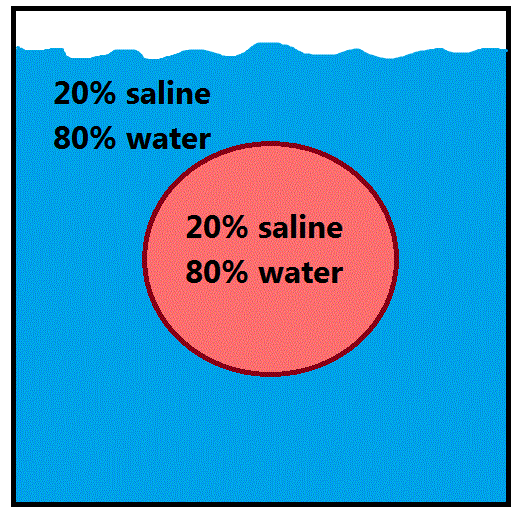
What type of solution is this cell in?
a)
Isotonic
b)
Hypertonic
c)
Hypotonic
d)
diffused
9.
Simple and Facilitated diffusion are powered by an unequal concentration gradient of HIGH to LOW
a)
True
b)
False
10.
Which transport does not require energy?
a)
Passive
b)
Active 
11.
Permeable means
a)
things can pass through
b)
the concentration levels are different
c)
it is permanent
d)
things are stuck
12.
What type of solution is this cell in?
a)
Isotonic
b)
Hypertonic
c)
Hypotonic
d)
diffused
13.
What type of solution is this cell in?
a)
Isotonic
b)
Hypertonic
c)
Hypotonic
d)
diffused
14.
Part of the plasma membrane responsible for cell recognition... 
a)
C
b)
E
c)
B
d)
D
15.
Which of the following is NOT part of the cell membrane?
a)
Lipids
b)
Carbohydrates
c)
Proteins
d)
Nucleic Acids
16.
The function of the plasma membrane is....
a)
to regulate what enters and leaves the cell.
b)
fight bacteria and viruses that enter the cell.
c)
provide rigid support and protection to the cell.
d)
make sure each cell can move
17.
What do the brown structures represent?
a)
Phospholipids
b)

Cholesterol

c)

Proteins 

d)
Cyctoskeleton Filaments
18.
Hydrophobic region of the cell membrane?
a)
E
b)
B
c)
C
d)
19.
Hydrophilic means...
a)
water-loving
b)
water-fearing
c)
nonpolar
d)
lipid soluble
20.
What forms the channels and pumps in the phospholipid bilayer?
a)
carbohydrates
b)
proteins
c)
hydrophilic heads 
d)
lipids
21.
The function of the plasma membrane is....
a)
to regulate what enters and leaves the cell.
b)
fight bacteria and viruses that enter the cell.
c)
provide rigid support and protection to the cell.
d)
make sure each cell can move
22.
True or false:  Regulating what enters and leaves the cell helps the cell maintain homeostasis. 
a)
True
b)
False
23.
Hydrophilic portion of cell membrane?
a)
A
b)
C
c)
D
d)
24.
What does "bilayer" mean?
a)
one layer
b)
two layers
c)
laminated
d)
bilateral
25.
The picture is an example of...
a)
active transport
b)
passive transport
c)
diffusion
d)
osmosis
26.
What does a cell need to transport particles by active transport?
a)
Sun
b)
Wind
c)
Energy
d)
Channels
27.
Osmosis uses a channel protein called AQUAPORIN.  What type of transport is this? *Think!
a)
Diffusion
b)
Facilitated Diffusion
c)
Active Transport
d)
Endocytosis
28.
What is one major difference between passive and active transport?
a)
Passive transport uses energy; active transport does not.
b)
Both types of transport use energy.
c)
Active transport uses energy; passive transport does not.
d)
No difference. They are both the same.
29.

Small, non-polar molecules like COand O2 and NO can pass directly through the cell membrane using what type of transport?

a)
Diffusion
b)
Osmosis
c)
Facilitated Diffusion
d)
Endocytosis
30.
The tails of a phospholipid are...
a)
Hydrophobic
b)
Hydrophilic
31.
 Engulfing of bacteria by white blood cells is called as
a)
Phagocytosis
b)
Pinocytosis
c)
Exocytosis
d)
Endocytosis
32.
Which form of active transport is being shown?
a)
Facilitated Diffusion
b)
Exocytosis
c)
Endocytosis
d)
Protein Pumps
33.
Which form of active transport is being shown?
a)
Pinocytosis
b)
Endocytosis
c)
Exocytosis
d)
Osmosis
34.
You have a solution of sugar water, which one is the SOLVENT?
a)
Sugar
b)
Water
35.

You have a solution of sugar water, which one is the SOLUTE?

a)
Sugar
b)
Water
36.
Human immune cells can engulf bacteria to destroy them. This is an example of 
a)
pinocytosis
b)
phagocytosis
c)
exocytosis
d)
acidosis
37.
A process for removing toxins and waste from the cell is
a)
exorcism
b)
exocytosis
c)
endocytosis
d)
endoplasmic reticulum
38.

Sarah is analyzing samples of red blood cells. What could have happened to cause the first cell to shrink?

a)

An anaerobic environment outside the cell.

b)

Lower solute concentration outside the cell than inside

c)

Higher solute concentration outside the cell than inside.

d)

More oxygen inside the cell than what can be utilized.

39.

A student placed 2 eggs in vinegar to dissolve the egg shells. In order to investigate osmosis, he then placed the equal-sized eggs in the solutions listed in the table. What can you conclude about the solutions from the change in mass of the eggs?

a)

Corn syrup is a hypotonic solution and distilled water is a hypertonic solution.

b)

Corn syrup is a hypertonic solution and distilled water is a hypotonic solution.

c)

Corn syrup is a hypertonic solution and distilled water is an isotonic solution.

d)

Both corn syrup and distilled water are isotonic solutions.

40.

Based on the image, water will move ___________ the cell.

a)

Into the cell

b)

In and out of the cell equally

c)

Neither, it'll stop moving

d)

Out of the cell

41.
A blood cell is placed into the jar, as seen. Where will the water go?
a)
Into the cell
b)
Out of the cell
c)
Equally in & out - it's isotonic
d)
The water is a lie
42.
Question Image

Match the letter to the label using the diagram.

a)

a

1.

glycoprotein

b)

b

2.

carbohydrate chain

c)

e

3.

cholesterol

d)

h

4.

phospholipid

e)

i

5.

glycolipid

43.

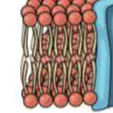
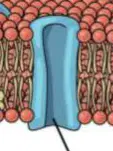
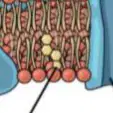
Match the following membrane part to its function.
a)

1.

make up main structure of the membrane
b)

2.

allow certain larger/charged things in
c)

3.

stabilizes the phospholipid bilayer

d)

4.

helps with cell identification

44.

Sort the following.

Categorize the following

Diffusion

Facillitated diffusion

Osmosis

Protein pumps

Exocytosis

Phagocytocis

Pinocytosis

Active Transport
Passive Transport
45.

Sort the following.

Categorize the following

Diffusion

Facillitated diffusion

Osmosis

Protein pumps

Exocytosis

Phagocytocis

Pinocytosis

Requires ATP
Does not require ATP