
 Worksheets
Heat Transfer, Local Winds, & Global Winds
Total questions: 39
Worksheet time: 45mins
Name
Class
Date
1.

This is a lava lamp. When the light bulb heats the wax, the wax rises. When the wax cools, it falls. This cycle of rising/falling is an example of:
a)
Conduction.
b)
Convection.
c)
Radiation.
2.

The baby chickens are kept warm from the heat lamps demonstrates what type of heat transfer?
a)
conduction
b)
convection
c)
radiation
3.

The Gulf Stream is a current that brings warm ocean water from the south to the north. What type of heat transfer is this?
a)
conduction
b)
convection
c)
radiation
d)
Insolation
4.
Ironing a shirt is an example of...
a)
condensation
b)
conduction
c)
convection
d)
radiation
5.
A metal spoon that gets warm when used to stir hot soup is an example of:
a)
Conduction
b)
Convection
c)
Radiation
6.
A great conductor of energy is:
a)
wood
b)
plastic
c)
metal
d)
cloth
7.
Mittens help keep your hands warm in winter because:
a)
They are conductors of heat.
b)
They are fuzzy.
c)
They are conductors of electrical energy.
d)
They are insulators.
8.
How does heat energy from the sun reach Earth?
a)
conduction
b)
convection
c)
insulation
d)
radiation
9.
Which is the best example of heat transfer by convection?
a)
frying bacon in a pan
b)
sea breeze at the beach
c)
melting ice in your hand
d)
burning your finger on the stove
10.

Walking on the warm sand sand with your bare feet.
a)
conduction
b)
convection
c)
radiation
11.

Blow drying your wet hair.
a)
conduction
b)
convection
c)
radiation
12.

A group of friends gather around a fire to stay warm.
a)
conduction
b)
convection
c)
radiation
13.
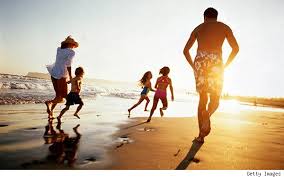
The sun shines down on this family as the play on the beach.
a)
conduction
b)
convection
c)
radiation
14.
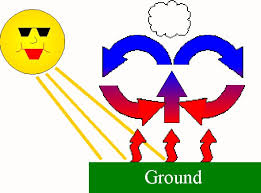
Warm air rises and the cool air sinks.
a)
conduction
b)
convection
c)
radiation
15.

In this experiment, the WARM red dye and the COLD blue dye was placed in the water at the same time. The warm red dye rose to the top while the cold blue dye sank to the bottom.
a)
conduction
b)
convection
c)
radiation
16.
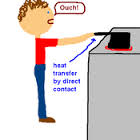
Johnny accidentally grabbed the handle of the hot pot.
a)
conduction
b)
convection
c)
radiation
17.

The chocolate bunny and the blow dryer.
a)
conduction
b)
convection
c)
radiation
18.

The chocolate bunny and the iron.
a)
conduction
b)
convection
c)
radiation
19.
What type of winds blow constantly, predictably, and over long distances?
a)
land breezes
b)
mountain breezes
c)
global winds
d)
land breezes
20.
Which term is best described as the movement of air from land to sea?
a)
global winds
b)
sea breeze
c)
land breeze
d)
local winds
21.

Which diagram shows the formation of a land breeze?
a)
diagram Y
b)
diagram X
c)
neither
d)
both
22.
Cool air moving across land and warm air rising up from the ocean will result in:
a)
land breeze
b)
sea breeze
c)
warm breeze
d)
no breeze
23.
Warm air rises over the land. As the air rises, it cools and drops over ocean. What type of breeze results?
a)
Ocean breeze
b)
Land breeze
24.

What kind of breeze is this & what time of day/night would it form?
a)
Land breeze - daytime
b)
Land breeze - nighttime
c)
Sea breeze - daytime
d)
Sea breeze - nighttime
25.
Winds are caused by
a)
equal heating
b)
unequal heating
26.

What is water doing when it is changed to water vapor?
a)
evaporating
b)
condensing
c)
precipitating
d)
runoff
27.
What causes GLOBAL winds to move in all directions?
a)
breezes
b)
coriolis effect
c)
westerlies
d)
easterlies
28.
Sea breeze is a type of global wind.
a)
True
b)
False
29.
In which direction do prevailing westerlies flow?
a)
from east to west
b)
from west to east
c)
from north to south
d)
from south to north
30.
Which types of winds cause weather in North Carolina?
a)
polar easterlies
b)
prevailing westerlies
c)
polar westerlies
d)
prevailing easterlies
31.
Global winds over the United States blow in which direction?
a)
east to west
b)
north to south
c)
south to west
d)
west to east
32.
In a sea breeze, the air is warmer above the _____.
a)
land
b)
ocean
c)
sky
d)
beach
33.

Is this a land or a sea breeze?
a)
land breeze
b)
sea breeze
34.
What causes wind?
a)
differences in pressure
b)
conduction currents
c)
density
d)
tropical currents
35.
This area of Earth has little or NO wind and is between 5 degrees N and 5 degrees S.
a)
Horse Latitudes
b)
Trade Winds
c)
Prevailing Westerlies
d)
The Doldrums
36.
This type of wind blows from WEST to EAST and often carries moist air that produces RAIN and SNOW.
a)
Horse Latitudes
b)
The Doldrums
c)
Prevailing Westerlies
d)
Polar Easterlies
37.
This type of wind helped blow trader's ships from Europe to the Americas. It blows winds from EAST to WEST.
a)
Polar Easterlies
b)
Trade Winds
c)
Prevailing Westerlies
d)
Horse Latitudes
38.
This type of wind comes from the POLES. It blows from east to west and brings freezing weather.
a)
Prevailing Westerlies
b)
Polar Easterlies
c)
Polar Westerlies
d)
Horse Latitudes
39.
This area of Earth has little or no wind and is located at 30 degrees N and 30 degrees S. Sailors threw their horses overboard in this area.
a)
Polar Express
b)
Horse Latitudes
c)
My Little Pony
d)
Trade Winds
100 %

