
 Worksheets
Moon Phases
Total questions: 30
Worksheet time: 26mins
Name
Class
Date
1.
During the phases of the Moon, the Moon appears to change shape. This change in appearance is due to the Moon...
a)
physically changing size and shape.
b)
moving closer and then farther away from Earth.
c)
reflecting a different amount of light due to alignment with Earth and the Sun.
d)
having craters on its surface.
2.
What part of the moon do we see from Earth?
a)
all of it
b)
the same side
c)
none of it
d)
only one quarter
3.
As the moon's shape appears to get smaller, we say that the moon is _.
a)
swelling
b)
waxing
c)
waning
d)
disappearing
4.
Which moon phase is when you can't see the moon at all?
a)
Waning crescent
b)
Full moon
c)
Waxing gibbous
d)
New moon
5.
Phases of the moon in which the moon appears to be getting larger are referred to as _.
a)
waxing
b)
waning
c)
new
d)
eclipse
6.
The complete cycle of the moon lasts about a _.
a)
day
b)
year
c)
week
d)
month
7.

What Moon phase is this?
a)
Full Moon
b)
Waxing Gibbous
c)
New Moon
d)
Half Moon
8.

What phase comes AFTER this one?
a)
Waxing Crescent
b)
Waning Gibbous
c)
Waxing Gibbous
d)
Third Quarter
9.

What Moon phase is this?
a)
Waxing Crescent
b)
Waning Gibbous
c)
Waning Crescent
d)
Waxing Gibbous
10.

What phase comes BEFORE this one?
a)
New Moon
b)
Third Quarter
c)
Waxing Crescent
d)
Full Moon
11.

What Moon phase is this?
a)
Last Quarter
b)
New Moon
c)
Third Quarter
d)
First Quarter
12.

What Moon phase is this?
a)
Waxing Gibbous
b)
Waning Crescent
c)
Waning Gibbous
d)
Full Moon
13.

What Moon phase is this?
a)
Old Moon
b)
Far Side of the Moon
c)
New Moon
d)
Waxing Gibbous
14.

What phase comes BEFORE this one?
a)
Waxing Crescent
b)
Waxing Gibbous
c)
Waning Gibbous
d)
Waning Crescent
15.

What Moon phase is this?
a)
Waning Crescent
b)
Waxing Crescent
c)
Waxing Gibbous
d)
Waning Gibbous
16.

What phase comes BEFORE this one?
a)
Full Moon
b)
Third Quarter
c)
New Moon
d)
First Quarter
17.

What phase comes BEFORE this one?
a)
Waxing Gibbous
b)
Waxing Crescent
c)
Waning Gibbous
d)
Waning Crescent
18.

What Moon phase is this?
a)
Waxing Crescent
b)
Waning Gibbous
c)
Waxing Gibbous
d)
Waning Crescent
19.

What phase comes AFTER this one?
a)
Waning Crescent
b)
Waning Gibbous
c)
Waxing Crescent
d)
Third Quarter
20.

What happens when the area in which you live tilts away from the sun?
a)
It is summer.
b)
It is spring.
c)
It is winter.
d)
It is fall.
21.

Why does the area around the equator stay the same temperature all year?
a)
The equator rotates slower than the poles.
b)
The equator remains the same distance from the sun.
c)
The equator always receives direct sunlight.
d)
The equator has 18 hour days.
22.
What are the reasons for the seasons?
a)
Earth's tilt and rotation.
b)
Earth's rotation and revolution.
c)
Earth's tilt and revolution.
d)
Earth's tilt and resolution
23.
The moon cycle (lunar cycle) takes approximately _______________ to complete.
a)
14 days
b)
28 days/approximately one month
c)
58 days
d)
1 week
24.
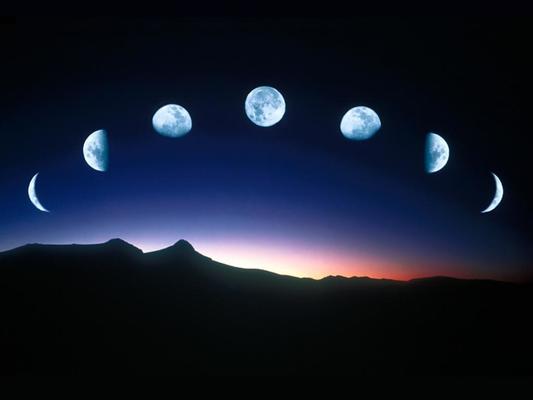
When the moon waxes, it ________.
a)
adds a thick covering to its crust
b)
seems to get bigger in size
c)
goes from a full moon back to a new moon
d)
shaves its legs
25.

When the moon wanes, it ________.
a)
goes from a new moon to a full moon
b)
goes from a full moon to a new moon
c)
appears to get larger in size
d)
cries a lot
26.
Why don't we have a solar or lunar eclipse every month?
a)
The moon and sun don't align properly
b)
because the sun is too big to be blocked
c)
because the moon is usually on a different plane
d)
They DO occur every month, we just don't see them!
27.
Why do we always see the same side of the moon from Earth?
a)
because the phases change
b)
because it rotates and revolves at the same rate
c)
because half of the moon always receives sunlight
d)
The moon changes positions�
28.
How many phases does the moon have?
a)
7 phases
b)
5 phases
c)
I do not know
d)
8 phases
29.
How much of the moon is always lit?
a)
can't tell
b)
always changes
c)
half
d)
3/4
30.

What season is it in the Southern Hemisphere when it is fall in the Northern Hemisphere?
a)
winter
b)
spring
c)
summer
d)
fall
100 %

