
 Worksheets
1st semester review
Total questions: 30
Worksheet time: 16mins
Name
Class
Date
1.

Nuclear Power is a __________ energy resource.
a)
Renewable
b)
Nonrenewable
2.
What do June 21 and December 21 have in common?
a)
equinox dates
b)
the moon is full
c)
solstice dates
d)
the cold fronts blow in
3.
Why do we experience the changing of the season on the earth?
a)
distance from the sun
b)
rotation of the earth
c)
change in solar output
d)
tilt of the earth's axis
4.
We have day and night because of the Earth's _________________?
a)
revolution
b)
orbit
c)
rotation
d)
oval
5.
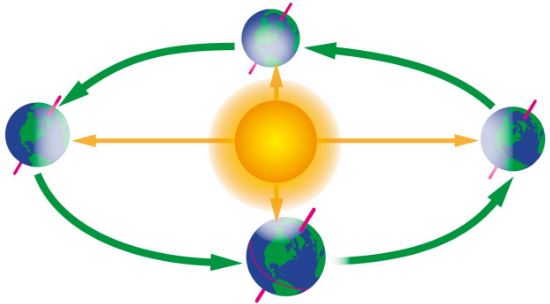
In spring/fall, the axis of the earth is pointed away or toward the sun?
a)
towards
b)
Neither away or toward
c)
away
6.
Fossil Fuels are fuels
a)
formed from the decaying remains of plants only
b)
formed from the decaying remains of plants and animals that were compressed over a short period of time
c)
formed from the decaying remains of plants and animals that lived millions of years ago
d)
formed from decaying food
7.

A type of reaction that provides energy when atoms split is
a)
nuclear fusion
b)
nuclear fission
c)
chemical fusion
d)
thermal fission
8.

Which season is taking place in the Northern Hemisphere in Earth in the left side of the diagram?
a)
Winter
b)
Spring
c)
Summer
d)
Fall
9.

Which season is taking place in the Northern Hemisphere in the Earth at the bottom of the diagram?
a)
Winter
b)
Spring
c)
Summer
d)
Fall
10.

Which season is taking place in the Southern Hemisphere in the Earth at the top of the diagram?
a)
Winter
b)
Spring
c)
Summer
d)
Fall
11.
True or False. Seasons are caused by the tilt of the Earth's axis as it revolves around the sun which affects how the sun's rays hit the Earth.
a)
True
b)
False
12.
When graphing data from an experiment, the _____ is on the X (horizontal) axis.
a)
independent variable
b)
dependent variable
c)
control
d)
title
13.
Which is used to make qualitative observations?
a)
a barometer
b)
a triple beam balance
c)
a magnifying lens
d)
a scale
14.
The part of an experiment that I change on purpose is the
a)
control.
b)
dependent variable.
c)
independent variable.
d)
hypothesis.
15.
Shawna saw bubbling and felt the beaker get warmer when she was performing an experiment. She is making a ___.
a)
conclusion
b)
quantitative observation
c)
hypothesis
d)
qualitative observation
16.
Cameron wondered if he would be able to run hurdles faster if he started lifting weights. The dependent variable is
a)
the amount of weight he lifts.
b)
the height of the hurdles.
c)
the speed he runs the hurdles.
d)
the amount of protein in his diet.
17.
Which statement is true about graphing?
a)
A title isn't necessary if you have labels on each axis.
b)
The independent variable goes on the X-axis and the dependent variable goes on the Y-axis.
c)
The dependent variable goes on the X-axis and the independent variable goes on the Y-axis.
d)
Units are not necessary when labeling the graph.
18.
Which of the following is necessary to make a quantitative observation?
a)
your fingers
b)
a microscope
c)
a calculator
d)
a thermometer
19.
An example of a biomass is
a)
oxygen
b)
petroleum
c)
wood
d)
minerals
20.
Geothermal energy is
a)
heat energy naturally produced in earthquakes
b)
is heat naturally produced in the air
c)
is heat naturally produced within Earth
d)
is heat energy naturally produced in the water
21.
Which energy source would least likely be affected by increasing human population?
a)
hydropower
b)
nuclear
c)
coal
d)
natural gas
22.
Which energy source comes from uneven heating of the Earth at the surface?
a)
geothermal
b)
wind
c)
biomass
d)
solar
23.
The beginning of a river.
a)
the headwaters
b)
the mouth
c)
the meander
d)
the tributary
24.
Which type of pollutant is point source pollution?
a)
a leaking underground sewage pipe
b)
pesticides sprayed on an orchard
c)
fertilizer spread on a county park
d)
road salt spread in Muskegon County
25.
An area of land that drains into a body of water
a)
headwaters
b)
river channel
c)
watershed
d)
wetland
26.
the area that separates 2 watersheds
a)
a drainage divide
b)
a river
c)
a wetland
d)
the river mouth
27.

What feature of a river is shown?
a)
tributary
b)
headwaters
c)
meander
d)
mouth
28.
In the northern hemisphere, the shortest day (least amount of daylight) occurs on the
a)
vernal equinox.
b)
winter solstice.
c)
summer solstice.
d)
autumnal equinox.
29.

Which part of the Earth is getting the most direct rays?
a)
equator
b)
Tropic of Capricorn
c)
Tropic of Cancer
d)
Antarctic Circle
30.
The part of the experiment that is left alone and doesn't include the experimental variable is the
a)
independent variable.
b)
experimental group.
c)
constant.
d)
control group.
100 %

