
 Worksheets
Cellular Processes
Total questions: 46
Worksheet time: 1hrs 4mins
Name
Class
Date
1.

Where is there a low concentration of dye?
a)
at the bottom of cup
b)
in the color
c)
at the top of cup
d)
no concenteraion gradient
2.
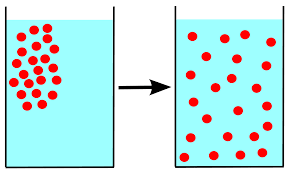
The picture below is an example of _________________.
a)
osmosis
b)
isotonic
c)
diffusion
d)
active transport
3.
When both inside and outside of a cell have the same amount of water it is said that the cell has reached a state of ___________.
a)
osmosis
b)
equilibrium
c)
diffusion
d)
hypertonic
4.

_______ regulates what enters and leaves a cell.
a)
Cell Membrane
b)
Nucleus
c)
Mitochondria
d)
Cytoplasm
5.
Passive transport requires no
a)
concentration gradients
b)
osmosis
c)
motion
d)
energy
6.

What is the definition of Selective Permeability?
a)
The movement of materials across the cell membrane that requires NO ENERGY from the cell.
b)
The movement of materials through (or across) the cell membrane
c)
The ability of the cell membrane to allow some things to pass through while preventing other things from passing through.
d)
The movement of molecules from an area of high concentration to a area of low concentration
7.

Which diagram best shows the end result of diffusion?
a)
F
b)
G
c)
H
d)
J
8.
Osmosis is the diffusion of _____ across a selectively permeable membrane.
a)
food
b)
air
c)
water
d)
oxygen
9.
If you looked at red blood cells under a microscope and saw that several of the blood cells had burst, what would you say happened?
a)
The cells were placed in a hypotonic solution.
b)
The cells were placed in a hypertonic solution.
c)
The cells were placed in an isotonic solution.
10.

A student put a few drops of lemon juice into an uninflated balloon.The student tied a knot in the balloon, placed it in a shoe box, and covered it with a lid. The following day, the student opened the box and was able to smell lemon in the box. Through what process were molecules able to pass through the balloon?
a)
respiration
b)
fermentation
c)
osmosis
d)
diffusion
11.

The picture is an example of _________________.
a)
isotonic
b)
diffusion
c)
osmosis
d)
active transport
12.
In a solution, salt is considered the _______.
a)
solvent
b)
solute
c)
solution
13.
In this given scenario, corn syrup is hypertonic to an egg with a dissolved shell. What will happen to the egg when it is place in corn syrup?
a)
It will stay the same.
b)
It will swell- get bigger.
c)
It will shrink- get smaller.
14.
If a cell containing 5% salt is placed into a glass of water with 20% salt, the water is _______ compared to the cell.
a)
hypertonic-
b)
hypotonic
c)
isotonic
15.
Mrs. Crandall placed 2 tablespoons of salt into a glass of water and then placed a selectively- permeable membrane into the glass that divided the glass into left and right halves. The left side is _______ to the right side.
a)
isotonic
b)
hypertonic
c)
hypotonic
16.
If a shipwrecked individual drinks sea water, they will probably die. What will happen to the cells in their body?
They will -
They will -
a)
swell up
b)
become more hypertonic
c)
shrivel up
d)
diffuse salt across the membrane
17.

The inside of this cell is _______________ compared to the outside.
a)
Isotonic
b)
Hypertonic
c)
Hypotonic
d)
Diffusion
18.
What process occurs when WATER diffuses across a membrane?
a)
endocytosis
b)
mitosis
c)
osmosis
d)
nuclear fission
19.

The cell below is in a _________ solution.
a)
Hypotonic
b)
Hypertonic
c)
Isotonic
20.

The cell below is in a _____________ solution.
a)
Hypertonic
b)
Hypotonic
c)
Isotonic
21.

Compared to the solution it is sitting in, the cell is _____________
a)
Isotonic
b)
Hypertonic
c)
Hypotonic
d)
diffused
22.
When a person smells something, what is actually traveling up their nose?
a)
solids
b)
moleulces
c)
matter
d)
plasma
23.

Where is there a high concentration of bbq smoke?
a)
In the bbq pit
b)
In the house
c)
Two streets over
d)
In the atmosphere
24.

The diagram shows two solutions that are separated by a partially permeable membrane.
In which direction will most water molecules move?
In which direction will most water molecules move?
a)
from X to Y, against their concentration gradient
b)
from X to Y, down their concentration gradient
c)
from Y to X, against their concentration gradient
d)
from Y to X, down their concentration gradient
25.

In an osmosis experiment, four potato strips, each 5 cm in length, were left in salt solutions of different concentrations. The table shows the lengths of the strips after 30 minutes. Which salt solution was the most concentrated?
a)
A
b)
B
c)
C
d)
D
26.
Which is true about active transport?
a)
It requires energy
b)
it does not require energy
c)
It moves substances down the concentration gradient
d)
it moves material from high to low concentration
27.

This picture represents which type of cellular transport?
a)
passive transport
b)
endocytosis
c)
exocytosis
d)
osmosis
28.
The most important part of the cell in cell transport is the ____________.
a)
E.R.
b)
cytoplasm
c)
nucleus
d)
cell membrane
29.
Large particles of food can be moved into the cell by ________________________.
a)
endocytosis
b)
pinocytosis
c)
exocytosis
d)
osmosis
30.
What are two types of passive transport?
a)
endocytosis and exocytosis
b)
cookies and milk
c)
equilibrium and osmosis
d)
Osmosis and diffusion
31.
What is a real life example of something that is selectively permeable?
a)
door
b)
window screen
c)
table
d)
basketball hoop
32.

This picture represents what type of cell transport?
a)
endocytosis
b)
exocytosis
c)
osmosis
d)
passive transport
33.
Which type of transport requires an input of energy?
a)
Passive Transport
b)
Osmosis
c)
Simple Diffusion
d)
Active Transport
34.
Active transport moves molecules from a high concentration to a low concentration
a)
True
b)
False
35.
You have a solution of sugar water, which one is the SOLVENT?
a)
Sugar
b)
Water
36.
What is the difference between active and passive transport?
a)
Active does not need energy and passive uses ATP (energy)
b)
Active uses ATP (energy) and passive does not need energy
c)
Active stores transport proteins and passive releases
d)
Active uses hormones and passive does not
37.
What pigment in the leaf captures energy from the sun?
a)
carbon
b)
chlorophpyll
c)
air
38.
What are the products of photosynthesis? (think of the equation)
a)
glucose and oxygen
b)
water
c)
sunlight and water
39.
What chemical compound that humans need from plants?
a)
H2O
b)
CO2
c)
O2
d)
C6H12O12
40.
What are the reactants (what's needed) for photosynthesis?
a)
glucose and oxygen
b)
light, water, and carbon dioxide
c)
oxygen and water
d)
carbon dioxide and water
41.
What is another name for glucose?
a)
Chlorophyll
b)
Chloroplasts
c)
Stomata
d)
Sugar
42.
Where does cellular respiration takes place?
a)
chloraplast
b)
nucleus
c)
mitochondria
d)
ribosome
43.

The process by which cells use oxygen to produce energy from food is called?
a)
photosynthesis
b)
transpiration
c)
cellular respiration
d)
germination
44.
What is the chemical reaction formula for Cellular Respiration?
a)
Light + CO2 --> O2 + C6H12O6
b)
ATP + C6H12O6
c)
CHO + O --> CO + H2O +ATP
d)
C6H12O6 + O2 --> CO2 + H2O + ATP
45.

The diagram shows the relationship between photosynthesis and cellular respiration and the organelles in which they occur.
Which statement describes how photosynthesis and cellular respiration are interrelated?
Which statement describes how photosynthesis and cellular respiration are interrelated?
a)
Oxygen is produced during cellular respiration and stored during photosynthesis.
b)
Carbon dioxide and water released by cellular respiration are used in photosynthesis.
c)
Photosynthesis releases the energy that is stored during the process of cellular respiration.
d)
Glucose is used during cellular respiration to produce food that is broken down during photosynthesis.
46.
What are the products (things that are made) in cellular respiration
a)
ATP
b)
Carbon dioxide (CO2)
c)
Water
d)
All of the above
100 %

