
 Worksheets
Unit 8 Waves_Lockhart
Total questions: 29
Worksheet time: 25mins
Name
Class
Date
1.
A wave that requires a medium through wave which to travel
a)
A. electromagnetic wave
b)
B. longitudinal wave
c)
C. mechanical wave
d)
D. transverse wave
2.
A wave in which the particles of the medium vibrate parallel to the direction of the wave motion
a)
A. mechanical wave
b)
B. surface wave
c)
C. longitudinal wave
d)
D. wave
3.
The distance from any point on a wave to an identical point on the next wave
a)
A. frequency
b)
B. wavelength
c)
C. wave speed
d)
D. amplitude
4.
The maximum distance that the particles of a wave’s medium vibrate from their rest position
a)
A. frequency
b)
B. wavelength
c)
C. wave speed
d)
D. amplitude
5.

How are frequency and wavelength related?
a)
Higher frequency = longer wavelength
b)
Lower frequency = shorter wavelength
c)
Higher frequency = shorter wavelength
d)
No relation
6.
Waves transfer _______ but not ________.
a)
matter......energy
b)
energy.....matter
c)
speed.....particles
d)
particles.....speed
7.

This is an example of which type of wave behavior?
a)
Reflection
b)
Diffraction
c)
Constructive Interference
d)
Destructive Interference
8.
This is the number of wave cycles that happens in a matter of one second
a)
wavelength
b)
amplitude
c)
period
d)
frequency
9.
This type of wave has both a transverse and longitudinal wave and it separates the two different media the waves travel through
a)
Transverse Wave
b)
Longitudinal Wave
c)
Surface Wave
d)
Tidal Wave
10.

the time required for one complete cycle of a periodic motion
a)
surface wave
b)
periodic motion
c)
period
d)
frequency
11.
The lowest point on a wave is the:
a)
Amplitude
b)
Crest
c)
Trough
d)
Wavelength
12.

Which vocabulary term is used to identify the distance between points C & G?
a)
Amplitude
b)
Crest
c)
Frequency
d)
Wavelength
13.
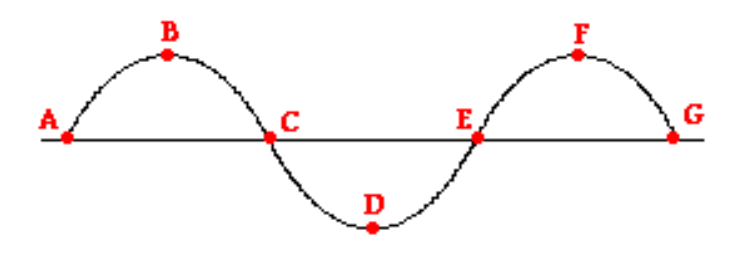
Which letter(s) represent the crest of the wave?
a)
A
b)
B & D
c)
B & F
d)
F
14.
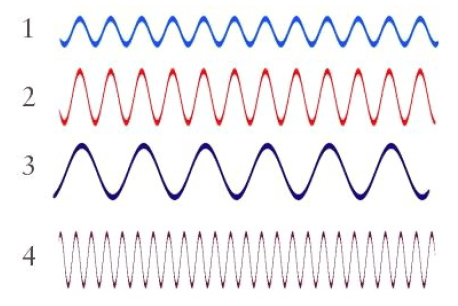
Which wave in the diagram has the greatest frequency?
a)
1
b)
2
c)
3
d)
4
15.
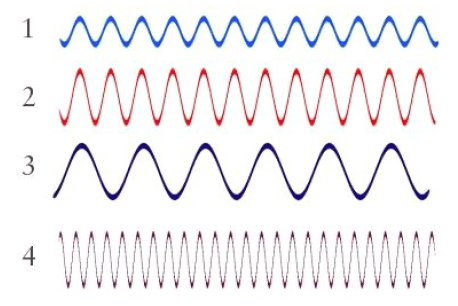
Which wave in the diagram has the greatest wavelength?
a)
1
b)
2
c)
3
d)
4
16.
Which of the following can sound travel through?
a)
solid
b)
liquid
c)
gas
d)
all of the above
17.
which material does sound travel the fastest?
a)
solid
b)
liquid
c)
gases
18.

What kind of wave is pictured below?
a)
compressional wave
b)
transverse wave
c)
sound wave
d)
mechanical wave
19.
What do we call the part of a longitudinal wave that is when the waves are squeezed together?
a)
compression
b)
rarefaction
c)
crest
d)
trough
20.
Sound waves are what kind of wave?
a)
Longitudinal
b)
Transverse
c)
Surface
d)
Electromagnetic
21.
If you want to change the pitch of a sound, you have to change the ___
a)
frequency
b)
amplitude
c)
speed
d)
volume
22.
True or False: Can sound travel through a vacuum (space).
a)
True
b)
False
23.
Why is sound able to travel faster through a solid than a gas?
a)
Gas molecules are packed tightly.
b)
Sound does not travel faster through a solid than a gas.
c)
Solid molecules are packed tightly.
d)
Gas molecules move slowly.
24.

If the distance represented by the letter A were increased, how would it change the way the sound was heard?
a)
The sound would be higher.
b)
The sound would be lower.
c)
The sound would be softer.
d)
The sound would be louder.
25.

What is A?
a)
crest
b)
trough
c)
compression
d)
rarefaction
26.

What is B?
a)
crest
b)
trough
c)
compression
d)
rarefaction
27.

True or False: The Doppler effect occurs when a wave source moves towards an observer.
a)
True
b)
False
28.

Which wave in the diagram has the highest frequency?
a)
1
b)
2
c)
3
d)
4
29.

Which wave in the diagram has the greatest wavelength?
a)
1
b)
2
c)
3
d)
4
100 %

