
NEW
Font size
S
M
L
XL
 Worksheets
Earth Science Intro & Scientific Inquiry
Total questions: 30
Worksheet time: 23mins
Name
Class
Date
1.

Complete the hypothesis:
If I eat too much....
If I eat too much....
a)
then I will get an upset stomach
b)
I will get an upset stomach
c)
it's bad for me
d)
nothing will happen
2.
What are other NAMES for dependent variable?
a)
responding variable and outcome
b)
outcome and change
c)
manipulated variable and test
d)
manipulated variable and responding variable
3.
This person's hypothesis is: "If I add salt to the plant, then it will grow taller."
When planning their experiment, what should be 2 constants (controlled variables)?
When planning their experiment, what should be 2 constants (controlled variables)?
a)
type of plant and amount of light
b)
type of plant and amount of salt
c)
amount of growth and amount of water
d)
amount of growth and amount of salt
4.
Is this a good hypothesis?
If I raise the temperature of a cup of water, then the amount of sugar that can be dissolved in it will be increased.
If I raise the temperature of a cup of water, then the amount of sugar that can be dissolved in it will be increased.
a)
Yes
b)
No
5.
Many breeds of dogs are used for work. In many cultures dogs are used to herd sheep. The dogs keep the flock from being attacked by animals such as wolves. They also keep sheep from wandering off. Sheepdogs are known for their loyalty and gentleness. Based on your reading of the text, you can INFER that:
a)
Sheepdogs are not very smart dogs.
b)
Sheepdogs are gentle and loyal.
c)
There are many breeds of dogs.
d)
Wolves are afraid of sheepdogs.
6.
The tool used to measure the mass of a substance or object is a ______________.
a)
balance
b)
graduated cylinder
c)
ruler
d)
thermometer
7.

What is the volume of Object X?
a)
10.0 cm3
b)
15.0 cm3
c)
20.0 cm3
d)
25.0 cm3
8.

I have two objects with the same volume but different masses. Which object will be more dense?
a)
The object with less weight.
b)
The object with more weight.
c)
The object with more mass.
d)
The object with less mass.
9.
Frank has a paper clip. It has a mass of 9g and a volume of 3cm3. What is its density?
a)
3 g/cm3
b)
1/3 g/cm3
c)
27 g/cm3
d)
39 g/cm3
10.
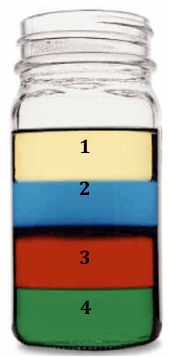
Put the liquids in order from most dense to least dense?
a)
4, 3, 2, 1
b)
1, 2, 3, 4
c)
3, 4, 2, 1,
d)
4, 3, 1, 2
11.

Which box has a higher density?
a)
Box A
b)
Box B
c)
cannot be determined
d)
they are the same
12.
Frank has an eraser. It has a mass of 4g, and a volume of 2cm3. What is its density?
a)
8 g/cm3
b)
2 g/cm3
c)
1/2 g/cm3
d)
24 g/cm3
13.
Which lab tool might you use to measure the volume of a liquid?
a)
electric scale
b)
bunsen burner
c)
test tube
d)
graduated cylinder
14.
What is the formula for density?
a)
density = mass x volume
b)
density = mass / volume
c)
density = mass + volume
d)
density = mass - volume
15.
Studies the solid portions of the earth, including volcanoes, earthquakes, and fossils.
a)
Geology
b)
Geography
c)
Cartography
d)
Oceanography
16.
Weather, climate, and the atmosphere are studied in this branch of Earth Science.
a)
Astronomy
b)
Meteorology
c)
Cartography
d)
Geology
17.
The study of the physical and biological parts of Earth's oceans.
a)
Geology
b)
Geography
c)
Cartography
d)
Oceanography
18.
The study of the stars and other celestial bodies.
a)
Meteorology
b)
Astronomy
c)
Oceanography
d)
Astrology
19.

This picture shows
a)
Atmosphere
b)
Biosphere
c)
Hydrosphere
d)
Geosphere
20.

A farmer plowing a field to plant crops:
a)
Biosphere-Atmosphere
b)
Biosphere-Geosphere
c)
Biosphere-Hydrosphere
d)
Geosphere-Hydrosphere
21.

Caves are formed:
a)
Biosphere-Atmosphere
b)
Geosphere-Hydrosphere
c)
Hydrosphere-Atmosphere
d)
Biosphere-Hydrosphere
22.

This volcano is an example of something you would find in the:
a)
Atmosphere
b)
Biosphere
c)
Hydrosphere
d)
Geosphere
23.
Which is NOT a step in the scientific method?
a)
Make observation
b)
Form a theory
c)
Collect data
d)
Form a hypothesis
24.
Should experiments be repeated over and over to see if the results are the same each time?
a)
yes
b)
no
25.
There are two types of data. Which type of data involves numbers that are obtained by counting or measuring?
a)
quantitative
b)
qualitative
26.
There are two types of data. Which type of data involves descriptions that cannot be counted or measured?
a)
qualitative
b)
quantitative
27.
If an object has a density of 3.6 g/mL and you put it into water, will it sink or float?
a)
sink
b)
float
28.

What is the volume of the fish?
a)
18.0 cm3
b)
6.0 cm3
c)
38.0 cm3
29.
______ is the ability of an object to float in a liquid.
a)
Density
b)
Buoyancy
c)
Archimedes' Principle
d)
Volume
30.
Why does ice float?
a)
Liquid water is less dense than solid water.
b)
Solid water is less dense than liquid water.
c)
Gaseous water is less dense than solid water.
d)
Liquid water is less dense than gaseous water.
Reset

