
 Worksheets
Surface Area of Prisms and Pyramids
Total questions: 50
Worksheet time: 2hrs 20mins
Name
Class
Date
1.

Find the total surface area of the prism.
a)
48 square inches
b)
64 square inches
c)
88 square inches
d)
76 square inches
17.
What is surface area?
a)
Inside of the object
b)
the sum of all theareas of all the shapes that cover the surface of the object.
c)
Something Mr. Strickland made up?
d)
Surface area is what you get when you boil unicorn tears.
13.
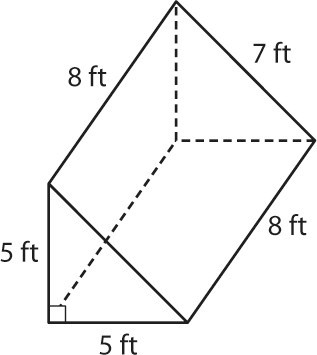
Find the total surface area of the prism.
a)
161 square feet
b)
1,700 square feet
c)
75 square feet
d)
186 square feet
4.
To calculate the amount of cardboard needed to make a cereal box, which of the following should you find:
a)
Area
b)
Perimenter
c)
Surface Area
d)
Volume
5.
To calculate the amount of carpeting needed for your bedroom, which of the following should you find:
a)
Area
b)
Perimeter
c)
Surface Area
d)
Volume
6.
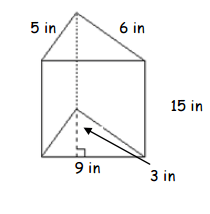
Jesse needs to wrap the present shown below. How much wrapping paper would he need?
How much wrapping paper is needed?
How much wrapping paper is needed?
a)
300 in2
b)
558 in2
c)
327 in2
d)
354 in2
7.
Shelby wants to wrap a present in a box for Sarah. The top and bottom of the box is 8 in. by 3 in., the sides are both 3 in. by 2 in. and the front and back are 8 in. by 2 in. How much wrapping paper will Chloe need to wrap the present?
Is this problem asking about Lateral or Total surface area?
Is this problem asking about Lateral or Total surface area?
a)
Lateral
b)
Total
8.
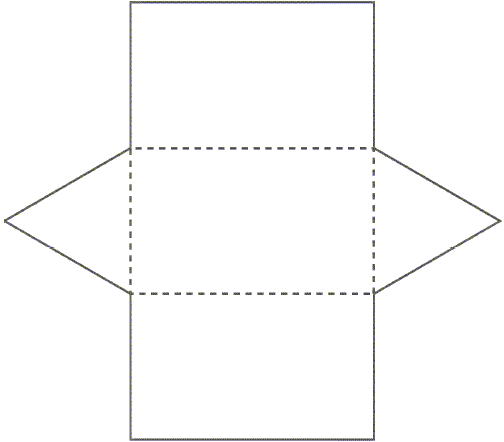
What 3D solid does this net create?
a)
Triangular Prism
b)
Triangular Pyramid
c)
Rectangular Pyramid
d)
Square Prism
9.

What is the lateral area of the prism?
a)
299 units2
b)
21 units2
c)
320 units2
d)
784.9 units2
10.

What is the total surface area of the triangular prism shown?
a)
468 in2
b)
540 in2
c)
576 in2
d)
700 in2
11.
Rudy wants to make a cube-shaped box with no top. How much cardboard is needed to make the box if each edge is 16 inches long?
a)
1280 in2
b)
1536 in2
c)
4096 in2
d)
96 in2
12.
How do you find the surface area of a 3 dimensional object?
a)
Divide the area of the base by 2 and multiply by the height.
b)
Divide the sum of the bases and multiply by the height.
c)
Multiply the sum of all the faces by two.
d)
Find the sum of all of the areas of all of the faces.
13.
Find the total surface area of the prism.
a)
161 square feet
b)
1,700 square feet
c)
75 square feet
d)
186 square feet
14.
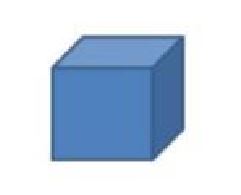
How many faces does this shape have?
a)
6
b)
3
c)
9
d)
5
15.
Find the surface area of the rectangular prism with the following dimensions:
length = 4 m
height = 3 m
width = 8 m
length = 4 m
height = 3 m
width = 8 m
a)
130 m squared
b)
125 m squared
c)
136 m squared
d)
96 m squared
16.

Find the surface area of the rectangular prism.
a)
94 cm. squared
b)
60 cm. squared
c)
12 cm. squared
d)
19 cm. squared
17.
What is surface area?
a)
Inside of the object
b)
the sum of all theareas of all the shapes that cover the surface of the object.
c)
Something Mr. Strickland made up?
d)
Surface area is what you get when you boil unicorn tears.
18.

What do we call this object below?
a)
Net
b)
Triangle
c)
Geometry
d)
y = mx + b
19.

Find the Surface Area
a)
500 ft2
b)
515 ft2
c)
525 ft2
d)
510 ft2
20.
A box shaped like a rectangular prism has a length of 4m, width of 3m, and is 2m tall. How much cardboard is needed to make the box?
a)
52 m2
b)
24 m2
c)
9 m2
d)
26 m2
21.

Find the Surface Area
a)
556 cm2
b)
278 cm2
c)
680 cm2
d)
340 cm2
22.

find the surface area . ?
a)
15.6m2
b)
96m2
c)
52.3m2
d)
890m2
23.

Find the total surface . ?
a)
10.30cm2
b)
130cm3
c)
144cm2
d)
130cm2
24.

Find the total surface area. Round to the nearest tenth.
a)
15 m2
b)
16 m2
c)
18 m2
d)
20 m2
25.

Find the total surface area. Round to the nearest tenth.
a)
15 m2
b)
16 m2
c)
18 m2
d)
20 m2
26.

Find the Surface Area
a)
15m2
b)
16m2
c)
18m2
d)
20m2
27.

A square pyramid is covered with decorative wrapping paper with no overlap. The net of the box is shown on the right. How many square centimeters of wrapping paper are needed to cover the surfaces of the box?
a)
108 cm2
b)
324 cm2
c)
180 cm2
d)
432 cm2
28.

What 3D solid does this net create?
a)
Rectangular Prism
b)
Rectangular Pyramid
c)
Cube
d)
Square Prism
29.
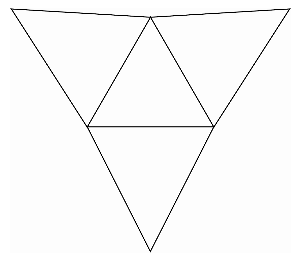
What 3D solid does this net create?
a)
Triangular Prism
b)
Triangular Pyramid
c)
Triangular Sphere
d)
Triangular Polygon
30.

What 3D solid does this net create?
a)
Triangular Prism
b)
Triangular Pyramid
c)
Rectangular Pyramid
d)
Square Prism
31.

What 3D solid does this net create?
a)
Triangular Pyramid
b)
Triangular Prism
c)
Square Pyramid
d)
Square Prism
32.
A cube is measured at 4 cm in length, what is the surface area?
a)
96 cm2
b)
16 cm2
c)
64 cm2
33.

Find the lateral area and surface area of each figure. Round your answers to the nearest tenth, if necessary.
a)
212 ft²; 322 ft²
b)
152.6 cm²; 187.7 cm²
c)
219.6 in²; 313.2 in²
d)
50.4 in²; 66.4 in²
34.

Find the Surface area of the shape below?
a)
258 m2
b)
268 m2
c)
248 m2
d)
278 m2
35.

a)
Rectangular Prism
b)
Cube
c)
Rectangular Pyramid
d)
Triangular Prism
36.

Identify the net.
a)
triangular prism
b)
triangular pyramid
c)
triangle
d)
cube
37.

Identify the net.
a)
sphere
b)
cone
c)
cylinder
d)
circle
38.

Identify the net.
a)
hexagonal prism
b)
pentagonal prism
c)
hexagonal pyramid
d)
pentagonal pyramid
39.

Find the surface area of the following triangular pyramid.
Each triangle is congruent, with a base of 7 ft. and a height of 6ft.
Each triangle is congruent, with a base of 7 ft. and a height of 6ft.
a)
168 ft²
b)
126 ft²
c)
84 ft²
d)
42 ft²
40.
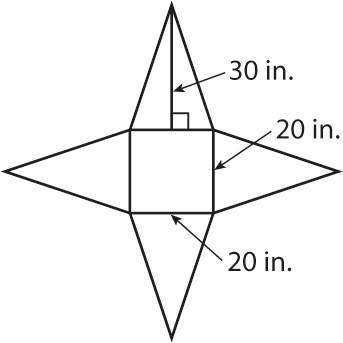
What is the total surface area of the rectangular pyramid whose net is shown?
a)
400 in2
b)
800 in2
c)
1,200 in2
d)
1,600 in2
41.

What is the name of this figure?
a)
cone
b)
octagonal prism
c)
hexagonal pyramid
d)
pentagonal pyramid
42.

a)
60°
b)
120°
c)
90°
d)
180°
43.

a)
100°
b)
80°
c)
90°
d)
180°
44.

a)
100°
b)
80°
c)
90°
d)
180°
45.

a)
100°
b)
80°
c)
90°
d)
180°
46.
What are complementary angles?
a)
Angles that add up to 180°
b)
Angles that add up to 90°
c)
Angles that are equal to each other
d)
Angles that are opposite of each other when lines intersect.
47.
What are supplementary angles?
a)
Angles that add up to 180°
b)
Angles that add up to 90°
c)
Angles that are equal to each other
d)
Angles that are opposite of each other when lines intersect
48.
What are vertical angles?
a)
Angles that are adjacent to each other
b)
Angles that add up to 180°
c)
Angles that are opposite of each other when lines intersect
d)
Angles that add up to 90°
49.
Is it possible to find the complement angle of 103°? If so, what is it?
a)
Yes, the complement angle is 77°
b)
Not possible.
c)
Yes, the compliment angle is 83°
d)
Yes, the complement angle is 13°
50.
What is the supplement angle to 42°?
a)
48°
b)
138°
c)
100°
d)
Not possible
100 %

