
 Worksheets
Force and Motion Review
Total questions: 32
Worksheet time: 2hrs 36mins
Name
Class
Date
1.
A student placed a stuffed animal on the dashboard of a car. When the car accelerated quickly, the stuffed animal flew back onto the seat. Which principle BEST describes the motion of the stuffed animal as the car accelerated.
a)
inertia
b)
speed
c)
momentum
d)
gravity
2.
What is the difference between the velocity and the speed of an object?
a)
Velocity is the change in distance over time, while speed is the change in velocity overtime.
b)
Velocity has a direction associated with it, while speed has no specific direction.
c)
Velocity has no direction associated with it, while speed has a specific direction.
d)
Velocity is the change in speed over time, while speed is the change in distance over time.
3.

The arrows in the diagram below represent the forces acting on a moving bicycle at two different times, time 1 and time 2. The length of the arrow represents the amount of force being applied. As a result of the change in the forces from time 1 to time 2 the bicyclist will...
a)
move slower in a forward direction
b)
move faster in a forward direction
c)
move in a backward direction
d)
stop moving
4.

Students are exploring the relationship between velocity and acceleration. This graph shows the acceleration of a remote-controlled toy car. Which statement is TRUE based on the graph?
a)
Segment AB and Segment CD show positive acceleration.
b)
Segment OA and Segment DE show positive acceleration.
c)
Segment OA and Segment BC show constant speed.
d)
Segment BC and Segment EF show constant speed.
5.
A student rolls a ball on the ground. Which of these causes the ball to slow down and then stop?
a)
Friction from the ground
b)
A magnetic field
c)
The motion of the ball
d)
The speed of the ball
6.

A student made a track for a toy sled using four different materials. At which section of the track is friction MOST LIKELY to cause the greatest resistance to the motion of the toy sled?
a)
3
b)
1
c)
4
d)
2
7.

A student rolls a ball down the ramp shown in the picture below. The ramp is supported by four stacked books. The student removes two books from the stack supporting the ramp and rolls the ball down the ramp again. Which of the following statements best describes how the ball's motion is different after the books are removed?
a)
The ball takes more time to reach the bottom of the ramp.
b)
The ball has a higher speed at the top of the ramp.
c)
The ball accelerates more quickly down the ramp.
d)
The ball has a higher average speed when it rolls off the ramp.
8.

The graph shows the velocity of a moving train over time. During which two intervals of time was the training moving with a constant, positive acceleration?
a)
0-5 and 10-15 minutes
b)
5-10 and 15-25 minutes
c)
10-15 and 25-30 minutes
d)
15-20 and 30-35 minutes
9.
Two equal forces act at the same time on the same stationary object, but in opposite directions. Which statement describes the object's resulting motion?
a)
The object will change direction.
b)
The object will move at a constant speed.
c)
The object will remain stationary.
d)
The object will accelerate.
10.

Identical materials are used to construct the systems shown to lift a large toy block. Which statement is TRUE about the diagrams shown?
a)
Diagram 3 will give the greatest mechanical advantage because the fulcrum is placed closest to the applied force (toy block).
b)
Diagram 2 will give the greatest mechanical advantage because the fulcrum is place evenly between the load (toy block) and the applied force.
c)
Diagram 1 will give the greatest mechanical advantage because the fulcrum is placed close to the load (toy block).
d)
Diagram 3 will give the greatest mechanical advantage because the fulcrum is placed far from the load (toy block).
11.
The net force acting on a box at rest on a table top is:
a)
in the leftward direction
b)
in the upward direction
c)
in the downward direction
d)
zero
12.

The graph below represents the distance an object traveled in 12 seconds. Which statement describes the motion of the object between 4 seconds and 8 seconds?
a)
The object is not moving.
b)
The speed of the object is decreasing.
c)
The speed of the object is increasing.
d)
The object is moving sideways.
13.

Ms. Williams' science class uses a toy car race to study and collect data about forces and motion. The racetrack has a 6-meter ramp and a 5-meter level section to the finish line. Two cars compete at a time. The data table and graph below show the speed and total distance traveled for car 1 and car 2 during the first three seconds of a race. At which point on the track does a car reach its fastest speed?
a)
halfway down the ramp
b)
at the bottom of the ramp
c)
halfway down the level section
d)
at the finish line
14.

Four forces are acting on a box, as shown below. This box will increase in speed...
a)
upward and to the right.
b)
downward and to the right.
c)
upward and to the left.
d)
downward and to the left.
15.

The following graph represents an object's velocity over a period of time. Which of these describes the object's motion after the time shown on the graph?
a)
Its velocity will increase.
b)
It will slow down eventually stop moving.
c)
Its acceleration will increase.
d)
It will continue to move at a constant rate in a straight lane.
16.
A student pushes against a tree with a force of 10 newtons (N). The tree does not move. What is the amount of force exerted by the tree on the student?
a)
0 N
b)
5 N
c)
10 N
d)
20 N
17.

Students performed several trials using the laboratory setup shown. Students were also given this hypothesis: If friction increases, then the rolling distance of a marble will decrease. What should be changed to best test this hypothesis?
a)
Height of the ramp
b)
Height of the ramp and roughness of the ramp
c)
Roughness of the ramp
d)
Height and length of the ramp
18.

The diagram represents a person pushing a 50-kg box up a ramp. Which force will decrease if the surface of the ramp is made smoother?
a)
electricity
b)
friction
c)
gravity
d)
magnetism
19.

Which two simple machines are being used in the diagram?
a)
lever; pulley
b)
inclined plane; wheel and axle
c)
lever; wheel and axle
d)
inclined plane; pulley
20.

A teacher leaves a coffee mug on top of a car, as shown in the diagram below. The teacher drives the car in a straight line and then stops suddenly. What happens to the coffee mug when the car stops?
a)
The mug moves side to side.
b)
The mug moves forward.
c)
The mug stays in the same position.
d)
The mug moves backward.
21.

The graph below shows a runner's distance from the starting line during a 30-minute race. Distance was measured in meters (m). Time was measured in minutes (min). During which time interval was the runner moving at the greatest average speed?
a)
0-5 minutes
b)
10-15 minutes
c)
15-20 minutes
d)
25-30 minutes
22.

The diagram below shows a person using a simple machine to move a rock. Which simple machine is the person using?
a)
lever
b)
pulley
c)
inclined plane
d)
wheel and axle
23.
In a car accident, a seat belt helps prevent injuries by applying a force
a)
in the same direction as the car�s motion
b)
in the opposite direction of the passenger�s motion
c)
greater than the force of the moving car
d)
less than the force of the moving passenger
24.

A tennis player hit a tennis ball into the air, giving the ball a speed of 30 meter per second. In what direction does the force of gravity act on the ball?
a)
toward the right
b)
toward the left
c)
upward
d)
downward
25.

Equal force is applied to a baseball, a basketball, a tennis ball, and a bowling ball. Which ball will have the GREATEST change in motion?
a)
a tennis ball
b)
a basketball
c)
a bowling ball
d)
a baseball
26.

A force is acting on each of the objects below. What can be concluded about these forces?
a)
They are the same because they point toward the objects.
b)
They are the same because they have the same magnitude.
c)
They are different because they have different magnitudes.
d)
They are different because they have different directions.
27.
What is the measure of the pull of gravity on an object?
a)
weight
b)
pressure
c)
mass
d)
inertia
28.
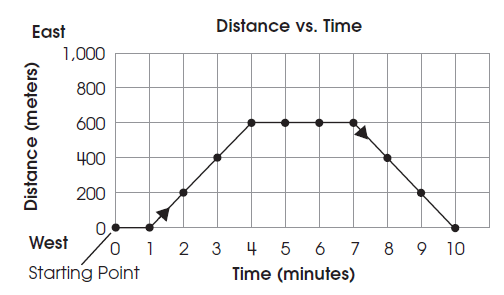
The graph below shows the position of a car in motion along an east-west road over a period of 10 minutes. The car's position is recorded at 1 minute intervals. At time = 0, the car's position is at the starting point. What is the car's motion relative to the starting point at time = 8 minutes?
a)
in motion at the starting point
b)
moving toward the starting point
c)
at rest at the starting point
d)
moving away from the starting point
29.
What information is needed to calculate the speed of a car?
a)
the distance traveled and the time to go that distance
b)
the type of engine and the amount of gas used by the engine
c)
the road condition and type of tires
d)
the car length and distance traveled
30.
A ball rolls across a level floor. Which information can be used to help find the speed of the ball?
a)
the time it takes the ball to roll 5 meters
b)
the weight of the ball
c)
the roughness of the floor
d)
the size of the ball
31.

An adult and a small child are at the playground. The child sits on the end of a seesaw, as shown below. The adult weighs twice as much as the child. At which point on the seesaw, will the adult need to sit in order to balance the child's weight?
a)
point A
b)
point B
c)
point C
d)
point D
32.
An object is moving in a straight line at a constant speed. What will happen to the object if no outside force acts on the object?
a)
The speed and direction of the object will change.
b)
The direction of the object will change; the speed will remain constant.
c)
The speed of the object will change; the direction will remain constant.
d)
The speed and direction of the object will not change.
100 %

