
 Worksheets
5th grade Plate Tectonics / Landforms
Total questions: 45
Worksheet time: 37mins
Name
Class
Date
1.
This is a low place in between two hills or mountains.
a)
Canyon
b)
Valley
c)
Desert
d)
Lake
2.
A landmass with an elevation higher than a hill.
a)
Ocean
b)
Gulf
c)
Mountain
d)
Valley
3.
A flat, treeless plain covered with tall grass.
a)
Prairie
b)
Canyon
c)
Desert
d)
Swamp
4.
A deep valley with steep walls that cut into the earth caused by erosion from running water.
a)
Valley
b)
Canyon
c)
Gulf
d)
River
5.
A landslide occurs when rock loosens and is pulled down by gravity. Yet, the rock piles up and creates new landforms such as hills. This is an example of…
a)
Destructive Force
b)
Constructive Force
c)
Landslide Building
d)
Constructive and Destructive Forces
6.
Which landform is created by deposition?
a)
sand dune
b)
canyon
c)
mountain
d)
volcano
7.
Wind blowing sand from one location to another is an example of…
a)
erosion
b)
weathering
c)
deposition
d)
wind blowing
8.
A ________________ forms when the ground underneath the crust is softened and then suddenly collapses.
a)
epicenter
b)
jetties
c)
sinkhole
d)
earthquake
9.
The sudden release of stress from within the Earth’s crust is called a(n) __________________________.
a)
epicenter
b)
jetties
c)
sinkhole
d)
earthquake
10.
The point directly above the focus of an earthquake is called an _____________________.
a)
epicenter
b)
jetties
c)
sinkhole
d)
earthquake
11.
People sometimes put up _________________to prevent erosion of one side of the beach.
a)
epicenter
b)
jetties
c)
sinkhole
d)
earthquake
12.
The _____________________of Georgia includes mountains, rivers, rolling hills, plains, and swamps.
a)
topography
b)
landforms
c)
San Andreas Fault
d)
seismologists
13.
California is well-known for the famous ____________________________where the North American plate and Pacific plate meet.
a)
topography
b)
landforms
c)
San Andreas Fault
d)
seismologists
14.
_______________________ are scientists that study earthquakes.
a)
topography
b)
landforms
c)
San Andreas Fault
d)
seismologists
15.
Which Region of Georgia do we in live in?
a)
Ridge and Valley
b)
Blue Ridge
c)
Piedmont
d)
Coastal Plain
16.
Which is an example of a constructive process?
a)
weathering
b)
landform
c)
erosion
d)
deposition
17.
In what region of Georgia would you find a swamp?
a)
Piedmont
b)
Coastal Plain
c)
Blue Ridge
d)
Valley and Ridge
18.
A mound of earth with a rounded top, much smaller than a mountain is...
a)
Mountain
b)
Mount Everest
c)
Hill
d)
Plateau
19.
An area of land completely surrounded by water is...
a)
Peninsula
b)
Island
c)
Isthmus
d)
Mountain
20.
Large area of flat land is...
a)
Mountain
b)
Hill
c)
River
d)
Plain
21.
Thin strip of land that extends out into a body of water. It is surrounded by water on three sides.
a)
Island
b)
Japan
c)
Peninsula
d)
Mountain
22.
What is a difference between physical and chemical weathering?
a)
Chemical weathering changes rocks into new substances.
b)
They break down rocks into smaller pieces.
c)
Physical weathering changes rocks into new substances.
23.
What is a similarity between physical and chemical weathering?
a)
Acid rain is an example of physical and chemical weathering.
b)
They change rocks into new substances.
c)
They both break rocks into smaller pieces.
24.
How does chemical weathering change landforms?
a)
Freezing and thawing causes rocks to spilt.
b)
Acid rain reacts with calcite and wears it away.
c)
Abrasion causes rocks to rub and bang into each other.
25.
Which answer lists processes that change landforms SLOWLY?
a)
earth quakes, volcanoes, and flash floods
b)
Blowing sand, freezing water, volcanoes, and earthquakes.
c)
freezing water, tree roots, blowing sand, and chemical weathering.
26.
Which answer lists all processes that change landforms FAST?
a)
tree roots, flash floods, and chemical weathering
b)
blowing sand, freezing water, and chemical weathering.
c)
flash floods, volcanoes, and earthquakes.
27.
A mountain that forms as molten rock flows through a crack onto Earth's surface.
a)
volcano
b)
lava
c)
landslide
28.
Molten rock that flows from a volcano onto Earth's surface.
a)
river
b)
earthquake
c)
lava
29.
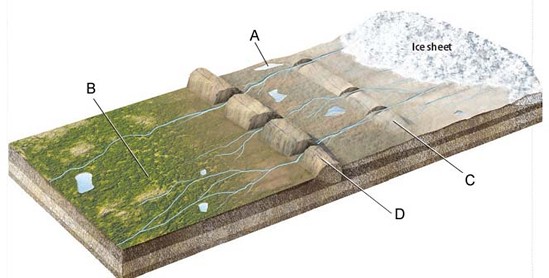
What glacial features are indicated by the labels C and D on the figure?
a)
moraines
b)
outwash plains
c)
kettle lakes
d)
ice sheets
30.
Rain washing away soil from a hillside
a)
Weathering
b)
Erosion
c)
Deposition
31.
Layers of sediment forming at the bottom of the ocean floor
a)
Weathering
b)
Erosion
c)
Deposition
32.
Glaciers dropping rock and sand to form moraines (deposition of debris)
a)
Weathering
b)
Erosion
c)
Deposition
33.
Caves being formed by acid rain dissolving underground limestone
a)
Weathering
b)
Erosion
c)
Deposition
34.
Deltas forming at the mouths of rivers
a)
Weathering
b)
Erosion
c)
Deposition
35.
Water getting into cracks, freezing, and breaking the rocks or pavement apart
a)
Weathering
b)
Erosion
c)
Deposition
36.
Wind blowing sand from one location to another
a)
Weathering
b)
Erosion
c)
Deposition
37.
Wind blasting sand at rock and carving out arches
a)
Weathering
b)
Erosion
c)
Deposition
38.
Glaciers scraping rocks across the earth’s surface
a)
Weathering
b)
Erosion
c)
Deposition
39.
This layer of Earth is the thickest part
a)
crust
b)
outer core
c)
mantle
d)
inner core
40.
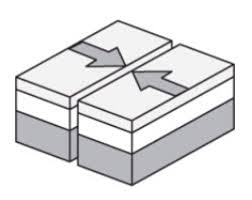
Name the boundary
a)
convergent boundary
b)
divergent boundary
c)
transform boundary
d)
sergent boundary
41.

Name the boundary
a)
convergent boundary
b)
divergent boundary
c)
transform boundary
d)
sergent boundary
42.
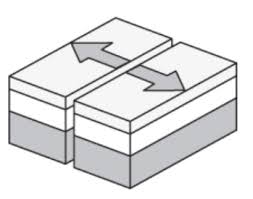
Name the boundary
a)
convergent boundary
b)
divergent boundary
c)
transform boundary
d)
sergent boundary
43.
A subduction zone is formed...
a)
when one tectonic plate sinks below another
b)
at every type of convergent plate boundary
c)
at every type of divergent plate boundary
d)
at transform boundaries
44.
What does the theory of continental drift state?
a)
The continents were once joined in a super-continent and have moved over time
b)
Continents are stationary and do not move
c)
The Earth is broken into lithospheric plates that move due to convection currents
d)
none of the above
45.

Who is the person credited with developing the theory of continental drift?
a)
Harry Hess
b)
Galileo
c)
Alfred Wegener
d)
Newton
100 %

