
 Worksheets
Early Republic and Industrial Revolution
Total questions: 74
Worksheet time: 1hrs 16mins
Name
Class
Date
1.
The decision in Marbury v. Madison was significant in U.S. history because it —
a)
reinforced federal authority over American Indian affairs
b)
confirmed the power of Congress to regulate interstate commerce
c)
established the practice of judicial review by the Supreme Court
d)
upheld the power of the Electoral College to choose the vice president
2.
What was a major effect of the use of steamboats and canals?
a)
the cost to transport goods decreased
b)
the production of wagons increased
c)
new states were added to the Union
d)
railroads were no longer used
3.
How did Samuel Morse’s best-known innovation contribute to U.S. growth and development?
a)
It enabled instantaneous long-distance transmission of information
b)
It allowed manufactured goods to be produced at lower costs.
c)
It boosted the speed of cross-country mail delivery.
d)
It increased national unity by reducing sectional differences.
4.
In 1862, Congress passed the Pacific Railway Act. What was their main goal?
a)
to promote settlement in the West
b)
to protect industry in the Northeast
c)
to improve transportation to the South
d)
to transport manufactured goods to the East
5.
What was the purpose of the Monroe Doctrine?
a)
prevent further European colonization in the Western Hemisphere
b)
deter Spain from inciting revolution in former U.S. colonies
c)
encourage European powers to invest in Latin America
d)
keep the war between France and Spain from spreading to Latin America
6.

What did the Monroe Doctrine say?
a)
Monroe said that S. America was going to be added to the United States
b)
Monroe told European countries to stay out of the Americas
c)
Monroe said that the Western Hemisphere had the best countries of the world
d)
He said that the United States should just give money to help Australia
7.

What did the Louisiana Purchase do for the United States?
a)
Tripled its size
b)
Doubled its size
c)
decreased its size
d)
Divided it by pi
8.

Which of the following was a major cause for the War of 1812?
a)
Federalism
b)
firing of soldiers
c)
consignment of sailors
d)
Impressment of sailors
9.
The Bessemer process was a method of producing cheap
a)
Oil
b)
Steel
c)
electricity
d)
cotton cloth
10.
What U.S. railroad connected the East and West?
a)
The Reading Railroad
b)
Transatlantic Railroad
c)
Transpacific Railroad
d)
Transcontinental Railroad
11.

Farmers in the Southern Colonies grew crops on _________ & used __________ to do the work so they could grow CASH CROPS cheaply.
a)
farms; indentured servants
b)
plantations; slaves
c)
fields; workers
d)
rice fields; immigrants
12.
What is suffrage?
a)
the right to vote
b)
the act of suffering
c)
anything that is disliked or hated
d)
limiting voting
13.

Which region of the country had a lot of manufacturing?
a)
the north
b)
the south
c)
the west
d)
Alaska
14.

How did the Louisiana Purchase affect the United States?
a)
It led to war.
b)
It doubled the nation's size.
c)
It limited trade opportunities.
d)
It led to the discovery of a water route across the country.
15.
The Whiskey Rebellion, the creation of the National Bank, the Alien and Sedition Acts, and Marbury vs. Madison are all examples of
a)
topics discussed during the 2nd Constitutional Convention
b)
domestic issues faced by leaders of the new republic
c)
weaknesses of the government under the Articles of Confederation
d)
issues leading to the ratification of the first constitutional amendments
16.
The North had factories and many canals. The South had many plantations and fertile soil for cash crops. Which statement is true about the West?
a)
They had large farms and slave labor
b)
They had cottage industry and mild weather
c)
They had mining and metal ores/minerals
d)
They had raching and railroads to transport goods/people
17.
This invention made it possible for factories to be built anywhere
a)
spinning jenny
b)
steam engine
c)
flying shuttle
d)
Delorean Time Machine
18.
Which of the following best explains the increased urbanization during the mid-1800s?
a)
New laws restricted the flow of immigration from Ireland.
b)
People moved to cities to find better paid jobs.
c)
Urban residents fled the cities for the countryside.
d)
The number of factories in the countryside decreased.
19.
Which of these was a result of the invention of the cotton gin?
a)
It greatly reduced the need to plant cotton seeds by hand.
b)
It provided a faster method for separating seeds from cotton fibers.
c)
It enabled slaves to work in factories operating textile machines.
d)
It introduced a new process for weaving cotton into cloth.
20.

Which of the following best completes the diagram?
a)
American manufacturers became more reliant on imported parts.
b)
More skilled workers were needed to give each manufactured item its own unique characteristics.
c)
Many manufactured goods could be assembled and repaired more easily.
d)
The American machine-tool industry rapidly declined.
21.
What effect did technological advances such as the steamboat, cotton gin, and the introduction of interchangeable parts have on the American economy?
a)
They lowered the average quality of American manufactured goods.
b)
They decreased the number of American manufactured goods.
c)
They reduced the need for unskilled workers in manufacturing.
d)
They brought down the price of many manufactured goods
22.
Which invention increased the capacity and speed for river travel helping to lower the cost of manufactured goods?
a)
Mechanical Reaper
b)
Cotton Gin
c)
Steamboat
d)
Telegraph
23.
Which invention by Eli Whitney increased profitability of plantations?
a)
Mechanical Reaper
b)
Cotton Gin
c)
Steamboat
d)
Telegraph
24.
The time after War of 1812 where America experiences a sense of Nationalism and pride for the country was called the__
a)
Immigration Explosion
b)
Time of Our Lives
c)
Monroe Doctrine
d)
Era of Good Feelings
25.
What is the man made water route that improved steam boat trade from New York to Ohio River Valley, stimulating the growth of New York?
a)
Erie Canal
b)
Transcontinental Canal
c)
The Great Lakes
d)
The River of Man
26.
What is the invention that led to the sending of electrical impulses usually in code language, along a wire?
a)
Telegraph
b)
Electronic Mail
c)
Wired Transfer
d)
Electrical Coding
27.
What was the extreme change in the U.S. early in the 1800's shifting from handmade goods to factory made goods taking the U.S. from mostly farming to a society based on industry & manufacturing?
a)
Mass Production
b)
Industrial Revolution
c)
Urbanization
d)
Factory System
28.
Which factor was an immigration pull that drew many to the U.S. and cities?
a)
Factory jobs in urban areas
b)
The Statue of Liberty being made
c)
Easier Travel
d)
More shopping in city centers
29.

Which factor best completes this diagram?
a)
A. New transportation systems
b)
B. Increased government regulation
c)
C. A decline in agricultural production
d)
D. The growth of labor unions
30.

These developments occurred as a result of increased —
a)
A. industrialization
b)
B. westward migration
c)
C. expansion of U.S. territory
d)
D. government regulation of business
31.

Which of these best completes the diagram above?
a)
A. The demand for slaves increases in the South.
b)
B. More textile factories are established in the South.
c)
C. The number of European immigrants arriving at southern port cities increases.
d)
D. More tobacco and food crops are cultivated on southern plantations.
32.
The introduction of interchangeable parts led directly to the —
a)
A. formation of the patent system
b)
B. creation of labor unions
c)
C. use of mass-production techniques
d)
D. eight-hour workday
33.
Which of these was an effect of the Industrial Revolution on U.S. women in the early nineteenth century?
a)
A. Women in unions gained bargaining power with employers.
b)
B. The government passed laws to improve safety for women in the workplace.
c)
C. Women seeking work migrated from rural communities to cities.
d)
D. State governments called conventions in support of women’s suffrage.
34.
During the early 1800s many young women in New England were employed outside their homes as —
a)
A. crew members on cargo ships
b)
B. cloth weavers in textile mills
c)
C. staff reporters for local newspapers
d)
D. legal counselors in state courts
35.

Who Invented the cotton gin and interchangeable parts
a)
Eli Whitney
b)
Robert Fulton
c)
Slater
d)
Lowell
36.
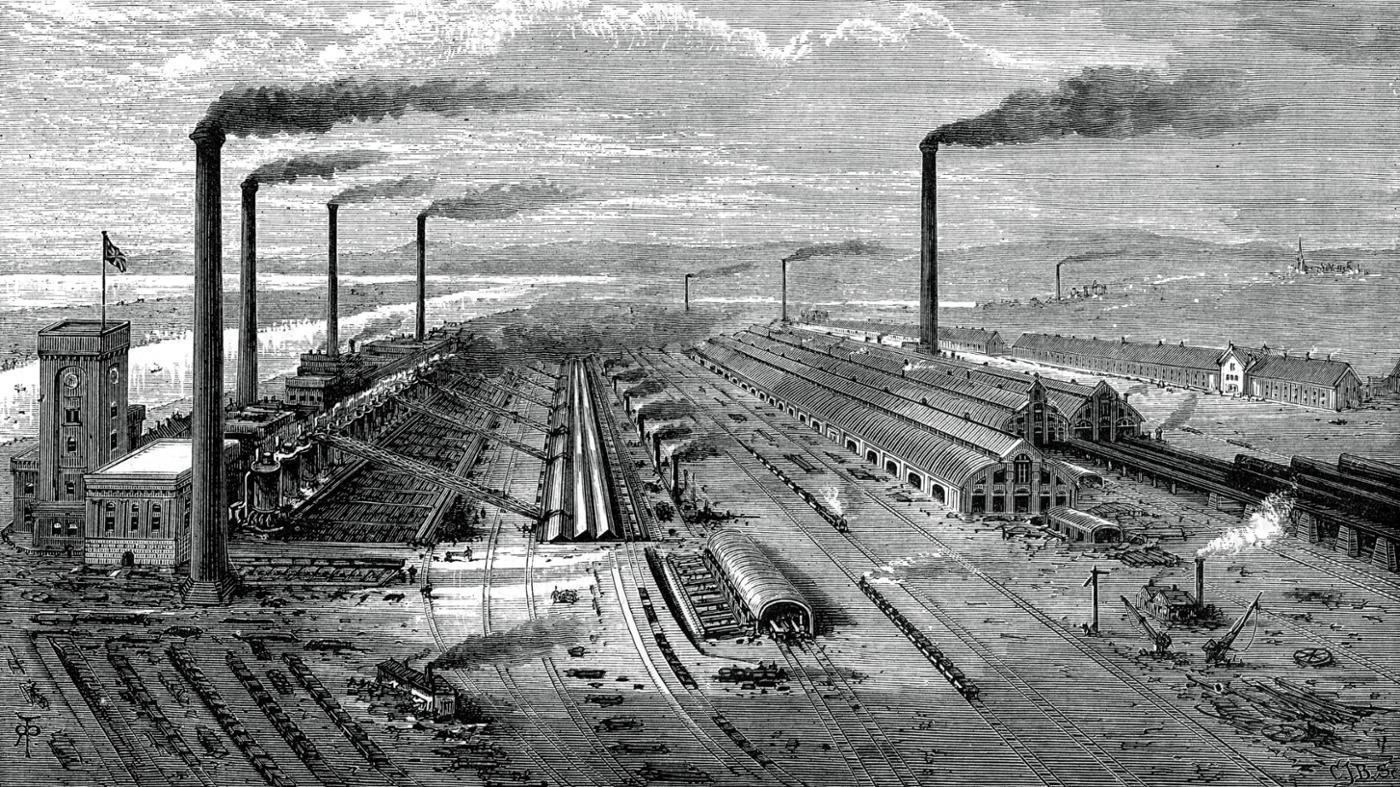
What is the area of the United States where the Industrial Revolution began
a)
South
b)
Midwest
c)
New England
d)
South
37.

The invention of the cotton gin increased the efficiency of cotton production and actually increased the demand for this
a)
Water Power
b)
Coal
c)
FIre
d)
Slaves
38.

He began the factory system in which all manufacturing steps are combined in one place
a)
Eli Whitney
b)
Robert Fulton
c)
Francis Lowell
39.

This invention by Eli Whitney made it possible to produce items in large numbers by standardizing parts to allow for easier replacement
a)
Interchangeable Parts
b)
Cotton Gin
c)
Steamboat
d)
Factory System
40.

This artificial waterway was built to connect New York City with the Great Lakes Region.
a)
Slave States
b)
Mississippi River
c)
Toll Road
d)
Erie Canal
41.

His steamboat, the Clermont, allowed passengers to travel upstream ushering in a new age of river travel.
a)
Eli Whitney
b)
Robert Fulton
c)
F. Lowell
d)
Slater
42.

This agreement maintained a balance between the free states of the North and the slave states of the South in the Senate
a)
Monroe Doctrine
b)
National Road
c)
Missouri Compromise
d)
Adas-Onis Treaty
43.
The McCulluch v. Maryland case stated that
a)
States cannot tax the federal goventment
b)
Judicial Review
44.
The Gibbons v. Ogden case
a)
Gave power to the federal goventment to regulate interstate
b)
Judicial Review
45.
The railroad industry grew because of the construction of what national railway?
a)
Union Railroad
b)
USA Railway
c)
Transcontinental Railroad
d)
Interstate 95
46.
How did the US economy change after the War of 1812?
a)
Manufacturing increased
b)
Agriculture increased
c)
Plantation farming increased
d)
Imports of materials increased
47.
Supreme Court power gained through the decision of Marbury v. Madison that states the Supreme Court can rule a law unconstitutional is known as -
a)
Judicial Review
b)
Separation of Powers
c)
Monroe Doctrine
d)
Popular Sovereignty
48.

The Monroe Doctrine -
a)
Stated that European countries could NOT continue to colonize in North and South America
b)
Stated that the US would NOT continue to trade with France or Britain
c)
Stated that it was ILLEGAL for the US to form alliances
d)
Stated that European countries were welcome to colonize in North & South America
49.
What was the idea Monroe drew upon that came from Washington's Farewell Address?
a)
Avoiding war
b)
Staying out of Europe's affairs
c)
Not trying to conquer other nations
d)
none of the above
50.

Factory owners used child labor because children--
a)
Read better than their parents
b)
Are more efficient than other workers
c)
Can be paid less than adults
d)
Needed jobs to support parent
51.

The movement to grant woman the legal right vote was called--
a)
Prohibition
b)
Woman Sufferage
c)
The Temperance Movement
d)
Jim Crow Law
52.
Thomas Jefferson's purchase of the Louisiana Purchase is an example of
a)
Strict Interpretation of the Constitution
b)
Loose Interpretation of the Contitution
53.
What did the Warhawks want?
a)
To go to war over how the British had been treating the US. & to take Canada
b)
To fly far away from war
c)
To use aircraft in war against the British and take Canada
d)
To kill all the Democratic-Republicans and let Federalists rule
54.
Who invented the cast steel plow?
a)
Eli Whitney
b)
John Deere
c)
Samuel Morse
d)
Wright Brothers
55.
Who invented the Mechanical Reaper?
a)
Cyrus McCormick
b)
Eli Whitney
c)
Thomas Edison
d)
Alexander Graham Bell
56.
What is the defintion of IMPRESSMENT?
a)
British capturing American sailors
b)
Showing off to the person next to you
c)
Forcing Native Americans west of the Mississippi
d)
British giving guns and ammunition to Native Americans
57.
What happened in the year 1803
a)
Mayflower compact
b)
Jamestown founded
c)
Monroe Doctrine
d)
Louisiana Purchase
58.
George Washington stated what about foreign affairs?
a)
Get involved
b)
Choose a side
c)
Remain Neutral
d)
No political parties
59.
This political party wanted to limit the federal government’s power.
a)
Democratic-Republicans
b)
Whigs
c)
The Federalist Party
d)
Free Republicans
60.
What was one of the effects of the Louisiana Purchase in 1803?
a)
It forced us to buy land from England
b)
It doubled the size of the United States.
c)
We fought a war with France for Louisiana
61.
Who wanted war with Britain to gain land and increase the nation's power?
a)
War Hawks
b)
War Judges
c)
Thomas Jefferson
d)
James Madison
62.
Washington raised an Army to help put down the____________________________
a)
Whiskey Rebellion
b)
Shay's Rebellion
c)
Mexican Revolution
d)
American Civil War
63.
This act made it illegal for anyone to criticize the government. Under the Sedition Act, many newspaper publishers (especially non federalists) were arrested for printing negative articles/opinions about Adams and his Federalist Government
a)
Non-Intercourse act
b)
Embargo Act
c)
Alien+Sedition Act
d)
Nuetrality Act
64.
Supreme Court has the power to review laws and determine their constitutionality
a)
Judiciary Act 1789
b)
Judicial Review
c)
Civic Review
d)
Court Act 1799
65.
In order to help the country pay off it's debt, Alexander Hamilton proposed ---
a)
passing the Federal Judiciary Act
b)
granting states more power
c)
focusing the country's economy on agriculture and cash crops.
d)
creating a national bank.
66.

Which is a warning issued by George Washington during his "Farewell Address" in 1797?
a)
Don't become entangled in European wars.
b)
Focus on an industrial economy.
c)
Stay away from whiskey.
d)
Don't trade with Great Britain.
67.
Judicial Review...
a)
Allows the Supreme Court to see if laws are Constitutional.
b)
Lets the President control the military.
c)
Lets the states make marriage laws.
d)
Allows the legislative branch to draft laws.
68.
The formation of political parties in the United States can be traced back to a disagreement over whether —
a)
the President has the power to create a Cabinet with the heads of the executive departments
b)
the Articles of Confederation should be revised to create a stronger national government
c)
Congress should create a national bank and raise tariffs
d)
the United States should purchase the Louisiana Territory from France
69.
Which slogan portrayed the US response to the XYZ Affair?
a)
Free trade and sailors’ rights!
b)
No taxation without representation!
c)
Millions for defense, but not one cent for tribute!
d)
First in war, first in peace, first in the hearts of countrymen!
70.
Conflicts between Jeffersonians and Hamiltonians during President George Washington’s first administration led directly to the
a)
end of the Era of Good Feelings
b)
decision to replace the Articles of Confederation
c)
addition of the elastic clause to the Constitution
d)
start of the first political parties
71.
Which of these was one of the ways Republicans viewed the Alien and Sedition Acts?
a)
as a tool to remove political parties
b)
as a way to increase citizen’s rights
c)
as an attack on the right of free speech
d)
as a necessity to keep order in the new nation
72.
Which statement correctly describes one of the first American political parties?
a)
Democratic-Republicans looked to Alexander Hamilton and John Adams for leadership.
b)
Democratic-Republicans favored a “strict” construction of the U.S. Constitution.
c)
Federalists supported giving the vote to all adult males.
d)
Federalists feared a strong national government.
73.
-Maintaining national security
-Creating a stable economic system
-Setting up the court system
-Defining the authority of the central government
Which is the best title for the above?
-Creating a stable economic system
-Setting up the court system
-Defining the authority of the central government
Which is the best title for the above?
a)
A. Causes of European Colonization
b)
A. Problems of the New Republic
c)
A. Characteristics of Economic Systems
d)
A. Effects of the Columbian Exchange
74.
What were the first political parties?
a)
Loyalist vs. Patriots
b)
Federalist vs. Anti-Federalists
c)
Federalists vs. Democratic-Republicans
d)
Whigs vs. Know-Nothings
100 %

