
NEW
Font size
S
M
L
XL
 Worksheets
Solar System Review Quiz
Total questions: 35
Worksheet time: 37mins
Name
Class
Date
1.
A student made a model of how the Earth, Moon, and Sun orbit. She used ping-pong balls
to represent each one. She painted each one a different color. Then, she placed the Moon
and Earth close together and the Sun much further away.What is one limitation of the student's model?
to represent each one. She painted each one a different color. Then, she placed the Moon
and Earth close together and the Sun much further away.What is one limitation of the student's model?
a)
She used the same size balls.
b)
She made earth orbit the sun.
c)
She moved the Sun away from the Earth and Moon.
2.
Which planet in our solar system is closest to the Sun?
a)
Earth
b)
Jupiter
c)
Mercury
d)
Saturn
3.
Which of the following is an accurate model of how the Sun, Earth, and Moon move?
a)
Sun and moon orbit Earth
b)
Earth and moon orbit Sun
c)
Earth orbit's the Sun and the moon orbits Earth
d)
Earth and sun orbit moon
4.
What planet is eighth in the Solar System?
a)
Uranus
b)
Jupiter
c)
Neptune
d)
Mars
5.

The moon is a natural ______ of Earth.
a)
comet
b)
axis
c)
satellite
d)
space probe
6.
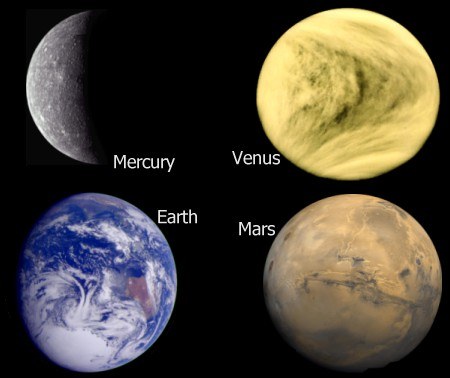
Earth and the other planets closest to the Sun are made mostly of _______
a)
gas
b)
metal
c)
water
d)
rock
7.

The __________ has planets, moons, comets, and asteroids.
a)
solar system
b)
earth
c)
rotation
d)
United States
8.
One of the main differences between the outer and inner planets is __________.
a)
The inner planets all have water
b)
the inner planets are much bigger than the outer planets
c)
the outer planets are gas planets
d)
the outer planets have rings, and the inner planets don't
9.
Why does Earth have different seasons?
a)
because of the distance between Earth and the sun
b)
because of the speed of Earth as it rotates on its axis
c)
because of the amount of light blocked by the moon on its axis
d)
because of the tilt of Earth on its axis as it moves around the sun
10.
Which is the largest object in our solar system?
a)
Sun
b)
Jupiter
c)
Earth
d)
Pluto
11.
Which planet has the longest year?
a)
Mercury
b)
Earth
c)
Venus
d)
Mars
12.
Our sun is the biggest star in the universe.
a)
True
b)
False
13.
There are _____ planets that orbit the sun.
a)
7
b)
8
c)
9
d)
11
14.
People used to think that Earth was the center if the solar system, They thought everything orbited around it. They called this the _________ model.
a)
Geocentric
b)
Earth First
c)
Egocentric
d)
Solarology
15.
The inner planets are:
a)
Jupiter, Earth, Mars, Mercury
b)
Saturn, Uranus, Mars, Earth
c)
Earth, Pluto, Neptune, Mars
d)
Mercury, Venus, Earth, Mars
16.
The GAS GIANTS or Outer planets are:
a)
Mercury, Earth, Jupiter, Saturn
b)
Saturn, Neptune, Pluto, Mars
c)
Saturn, Jupiter, Uranus, Neptune
d)
Earth, Mars, Saturn, Neptune
17.
It is about half the size of Earth. It's surface looks like it may have had water once. It is known as the "Red Planet".
a)
Neptune
b)
Mars
c)
Saturn
d)
Mercury
18.
It is covered by a thick, poisonous gas. It is hot enough to melt metal and the pressure would crush your measly little bones!
a)
Venus
b)
Uranus
c)
Saturn
d)
Mars
19.
This is the biggest planet in our solar system. It is known for its storms, including one so large it is called the Great Red Spot!
a)
Jupiter
b)
Earth
c)
Mars
d)
Uranus
20.
The force that causes objects to fall to Earth is called_________.
a)
Forced landing
b)
Shuttles
c)
Gravitation
d)
Push and Pull Factors
21.
Day and night is caused by the _____________ of earth on its axis.
a)
revolution
b)
orbit
c)
rotation
22.
As the Earth travels around the sun, this tilt causes different areas of the Earth’s surface to get different amounts of daylight at different times of the year. The angle of the Sun’s rays to the surface also causes areas to have more or less of the Sun’s energy. This causes the ________.
a)
months
b)
day and night
c)
seasons
d)
years
23.
Which outer planets have rings?
a)
Just Saturn
b)
Saturn and Jupiter
c)
Jupiter, Neptune, and Saturn
d)
all 4 of them
24.
What is the fourth planet from the Sun?
a)
Earth
b)
Mars
c)
Jupiter
d)
Mercury
25.
Which planet in our solar system is closest to the Sun?
a)
Earth
b)
Jupiter
c)
Mercury
d)
Saturn
26.
How many days does it take the Earth to revolve around the Sun?
a)
30 days
b)
365 days
c)
100 days
d)
40 days
27.
Which planet is seventh from the sun?
a)
Saturn
b)
Earth
c)
Venus
d)
Uranus
28.
Which is the sixth planet from the sun?
a)
Earth
b)
Uranus
c)
Saturn
d)
Neptune
29.
Which planet is fifth from the sun?
a)
Saturn
b)
Jupiter
c)
Mars
d)
Earth
30.
Which planet is third from the sun?
a)
Mars
b)
Pluto
c)
Venus
d)
Earth
31.
Which is the second closest planet to the sun?
a)
Earth
b)
Saturn
c)
Venus
d)
Mercury
32.
The four terrestrial planets all have
a)
Rocky surfaces
b)
Hot temperatures
c)
Deep atmospheres
d)
Large size
33.
T/F (if false replace the word in blue)
Uranus has a storm called the Great Red Spot.
Uranus has a storm called the Great Red Spot.
a)
True
b)
Saturn
c)
Jupiter
d)
Neptune
34.
Which planet is the hottest planet?
a)
Mercury
b)
Mars
c)
Venus
d)
Saturn
35.
Which is not a planet?
a)
Mars
b)
Venus
c)
Jupiter
d)
Pluto
Reset

