
 Worksheets
Genetics II
Total questions: 125
Worksheet time: 2hrs 41mins
Name
Class
Date
1.
The purpose of selective breeding is to
a)
Get bigger animals
b)
get smaller animals
c)
create animals with desirable traits
d)
karycreate animals with bad traits
2.
It is very common for yellow labs to have bad hips. This is because owners want purebred yellow labs who are good hunting dogs. This is an example of
a)
Natural Selection
b)
Selective breeding
c)
Mitosis
d)
Fossil Record
3.

All of the following statements are reasons for selective breeding except:
a)
To produce offspring with desirable characteristics
b)
Farmers increase their profit by improving crops
c)
To improve the quality of food products
d)
To increase migration patterns
4.
Which of the following best represents inbreeding?
a)
removing DNA from an organism
b)
changing traits based on environment
c)
crossing 2 similiar animals
d)
crossing 2 different animals
5.

What is inbreeding?
a)
two sets of genes
b)
every trait called alleles
c)
reproduction from mating of two genetically related parents
d)
combination of parental genes
6.
Problems with selective breeding include
a)
Better animals
b)
More Meat
c)
Animals can have bad health problems
d)
more diversity
7.
The transfer of a gene from the DNA of one organism into another organism in order to produce an organism with desired traits.
a)
Genetic Engineering
b)
Karyotype
c)
Pedigree
d)
Genome
8.
The process of selecting a few organisms with desired traits to serve as parents of the next generation.
a)
Gene Therapy
b)
Genome
c)
Selective Breeding
d)
Pedigree
9.
The physical appearance of a gene:
a)
Genotype
b)
Heredity
c)
Phenotype
d)
Allele
10.
The genetic make up of a trait:
a)
Genotype
b)
Phenotype
c)
Chromosome
d)
Hybrid
11.
What do you call the physical characteristics that are studied in genetics called?
a)
Alleles
b)
Genes
c)
Traits
d)
Chromosome
12.
A family choses a larger dog to mate with their dog because they wanted a large have dog to guard their home.
a)
Heredity
b)
Selective Breeding
c)
Genetics
d)
Probability
13.
Mutations are seldom considered harmful.
a)
True
b)
False
14.
Inbreeding attempts to preserve the special characteristics of a breed.
a)
True
b)
False
15.
A gene mutation may result in an incorrect protein being produced.
a)
True
b)
False
16.
Many mutations produce no noticeable effect in an organism.
a)
True
b)
False
17.

A karyotype is a visual image of chromosomes, like the image here.
a)
True
b)
False
18.
how many chromosomes are in the body cells of humans?
a)
46
b)
23
c)
12
d)
92
19.

What type of bond holds together the nitrogenous bases in DNA?
a)
covalent
b)
hydrogen
c)
ionic
d)
James
20.
What is the complementary base pair to Cytosine in DNA?
a)
Cytosine
b)
Guanine
c)
Thymine
d)
Uracil
21.
What is the complementary base pair to Adenine in DNA?
a)
Cytosine
b)
Guanine
c)
Thymine
d)
Uracil
22.
Replicate the following strand of DNA:
AATCATGGA
AATCATGGA
a)
AATCATGGA
b)
TTAGTACCT
c)
UUAGUACCU
d)
GGATAUCUA
23.
Original: ATC CAT
Mutation: ATC GCAT
What mutation occurred?
Mutation: ATC GCAT
What mutation occurred?
a)
deletion
b)
insertion
c)
silent
d)
transverse
24.
Original DNA: CAT GAT
New DNA: CAT AT
What mutation occurred?
New DNA: CAT AT
What mutation occurred?
a)
deletion
b)
substitution
c)
tranverse
d)
insertion
25.
Gene: ABC
New Gene: BBC
What mutation
New Gene: BBC
What mutation
a)
deletion
b)
insertion
c)
substitution
d)
transversion
26.
Any change in the sequence of DNA is...
a)
transgenic shift
b)
Single Genotype
c)
Monohybrid Trait
d)
Mutation
27.
What mutation has occurred here?
T-G-A-C-C-A
T-G-A-G-C-A
T-G-A-C-C-A
T-G-A-G-C-A
a)
Substitution
b)
Deletion
c)
Insertion
d)
Frameshift
28.
DNA molecule segment is : TTACGCAAG
The mutated DNA segment is TTCGCAAG. This is an example of ___ mutation.
The mutated DNA segment is TTCGCAAG. This is an example of ___ mutation.
a)
Substitution
b)
Deletion
c)
Insertion
d)
Inversion
29.
What causes mutations?
a)
Mistakes in replication or environmental substances
b)
The amino acids
c)
Passed down by genetics
d)
It's how your born
30.
Are all mutations bad?
a)
Yes
b)
No
31.
A mutation that does NOT alter the protein production is called a
a)
deletion mutation
b)
inversion mutation
c)
silent mutation
d)
transverse mutation
32.
DNA molecule segment is : TTACGCAAG
The mutated DNA segment is TTATCGCAAG. This is an example of ___ mutation.
The mutated DNA segment is TTATCGCAAG. This is an example of ___ mutation.
a)
Deletion
b)
Substitution
c)
Insertion
d)
Inversion
33.
DNA molecule segment is : TTACGCAAG
The mutated DNA segment is TTACGCAAC. This is an example of ___ mutation.
The mutated DNA segment is TTACGCAAC. This is an example of ___ mutation.
a)
Substitution
b)
Insertion
c)
Inversion
d)
Translocation
34.
Any change in the sequence of DNA is...
a)
transgenic shift
b)
Single Genotype
c)
Monohybrid Trait
d)
Mutation
35.
Normal-
GAG-CTC-GAC-AGA
Mutant
GAG CTC-CAC-AGA
GAG-CTC-GAC-AGA
Mutant
GAG CTC-CAC-AGA
a)
no mutation
b)
substitution
c)
insertion
d)
deletion
36.

illustration shows.
a)
sickle cell
b)
hemophilia
c)
turner's
d)
tay-sachs.
37.
Cell mutations within a DNA sequence are
a)
unnatural events that are harmful to genetic diversity
b)
unnatural events that always affect the phenotype
c)
natural events that produce genetic diversity
d)
natural events that always affect the phenotype
38.
Where do mutations occur?
a)
DNA and RNA
b)
DNA
c)
RNA
d)
mRNA and tRNA
39.
What causes mutations?
a)
Chemicals
b)
Radiation
c)
Errors in copying DNA
d)
All three
40.
What is an ultrasound
a)
An invasive test
b)
A non invasive test
41.
What is an amniocentesis?
a)
An invasive test
b)
A non invasive test
42.
A test in which amniotic fluid is drawn from the amniotic sac through the mother's abdomen. It can detect chromosomal abnormalities or chemical problems.
a)
Chorionic Villi Sampling
b)
Ultrasound
c)
Amniocentesis
d)
Pelvic exam
43.
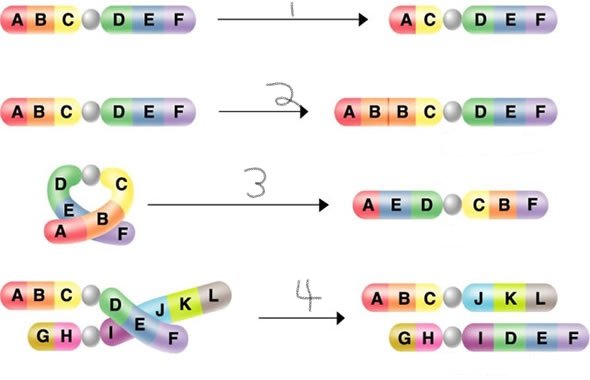
Which of these is the correct order for the chromosome mutations in the image (from top to bottom)?
a)
(1) duplication, (2) inversion, (3) substitution, (4) translocation
b)
(1) deletion, (2) duplication, (3) inversion, (4) translocation
c)
(1) deletion, (2) insertion, (3) translocation, (4) inversio
d)
(1) substitution, (2) duplication, (3) translocation, (4) inversion
44.
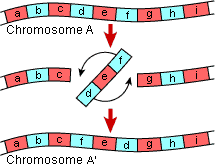
Which type of chromosome mutation is this (use image) and why?
a)
Inversion, because the genes are switching places with those of another chromosome
b)
Translocation, because the genes are switching places with those of another chromosome
c)
Inversion, because the genes of the same chromosome are switched to opposite orders
d)
Translocation, because the genes of the same chromosome are switched to opposite orders
45.
What is the result of a substitution mutation with these base pairs?
a)
TATTCGCTAGTACAT
b)
TATTGCTAGTACAT
c)
TATTGGCTTAGTACAT
d)
None of the above
46.
What is a possible result of a frameshift mutation with these base pairs TATTGGCTAGTACAT:
a)
TATTTGGCTAGTACAT
b)
TATTCGCTAGTACAT
c)
TATTGGCTAGTACAG
d)
TATTGGGTAGTACAT
47.
Which genetic abnormality can be identified through karyotyping?
a)
point mutation
b)
recessive allele
c)
extra chromosomes
d)
sex-linked allele
48.
Are all mutations harmful?
a)
Yes, they are caused by toxic chemicals and radiation
b)
No, all mutations are beneficial
c)
Yes, mutations cause fatal diseases
d)
No, some can be useful in a changing environment
49.
A genetic disorder is an abnormal condition that a person inherits through genes or chromosomes?
a)
True
b)
False
50.
Some genetic disorders are caused by what?
a)
alleles
b)
Mutations in the DNA of genes
c)
Phenotype
d)
Genotype
51.
Other disorders are caused by changes in the overall structure or number of what?
a)
Alleles
b)
Genes
c)
Chromosomes
52.
What disease affects hemoglobin a protein in red blood cells that carry oxygen?
a)
Down Syndrome
b)
Cystic Fibrosis
c)
Sickle-Cell
d)
Hemophilia
53.
What genetic disorder is when a person's blood clots very slowly or not at all?
a)
Down Syndrome
b)
Hemophilia
c)
Cystic Fibrosis
d)
Sickle-Cell
54.
Hemophilia is caused by a sex-linked allele on the X chromosome?
a)
True
b)
False
55.
Because hemophilia is a sex-linked disorder, it occurs more frequently in females than males?
a)
True
b)
False
56.
In what disorder does a person have an extra copy on its 21 chromosome?
a)
Down Syndrome
b)
Sickle-Cell
c)
Hemophilia
d)
Cystic Fibrosis
57.
Down Syndrome most often occurs when chromosomes fail to separate properly during meiosis?
a)
True
b)
False
58.
Down Syndrome is a trisomy?
a)
True
b)
False
59.
Today doctors use tools such as _____ to help diagnose genetic disorders?
a)
History Charts
b)
Tables
c)
Karyotypes
d)
Genes
60.
The doctors use karyotypes to examine the chromosomes. A karyotype is a picture of all the chromosomes in a cell.
a)
True
b)
False
61.

What is the gender of the individual whose karyotype is seen in the image?
a)
Male
b)
Female
62.
The doctors use karyotypes to examine the chromosomes. A karyotype is a picture of all the chromosomes in a cell.
a)
True
b)
False
63.
What would indicate a human male?
a)
XX
b)
X
c)
XY
d)
XXY
64.
Photograph of chromosomes grouped in ordered pairs
a)
pedigree
b)
Punnett Square
c)
Venn Diagram
d)
Karyotype
65.
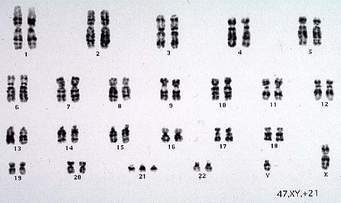
Based on the Karyotype shown, at which chromosome pair can we identify a genetic disorder?
a)
Chromosome pair 5
b)
Disorder of the sex chromosomes
c)
Chromosome pair 21
d)
There are no chromosomal disorders
66.

What is the chromosomal condition of the individual whose karyotype is seen in the image?
a)
Turner's Syndrome
b)
Trisomy 21 (Down Syndrome)
c)
Trisomy 13
d)
Trisomy 18
67.
Based on the Karyotype shown, at which chromosome pair can we identify a genetic disorder?
a)
Chromosome pair 5
b)
Disorder of the sex chromosomes
c)
Chromosome pair 21
d)
There are no chromosomal disorders
68.

a)
This karyotype shows Trisomy 21
b)
This karyotype has no abnormality
c)
This karyotype is missing a sex chromosome
d)
This karyotype is from a gamete
69.

a)
This karyotype reveals a trisomy of the 13th chromosome
b)
This karyotype could be from a sperm cell
c)
This karyotype contains homologous chromosome pairs
d)
This karyotype reveals a trisomy of the 21st chromosome
70.

Which genetic abnormality is shown in this karyotype?
a)
Partial Addition
b)
Partial Deletion
c)
Trisomoy
d)
Monosomy
71.

What is the sex of this baby?
a)
Male
b)
Female
72.

Which of the following best describes a DNA molecule?
a)
double helix
b)
contains ribose
c)
made of amino acids
d)
contains Uracil
73.
Which of the following units are repeatedly joined together to form a strand of DNA?
a)
amino acids
b)
nucleotides
c)
fatty acids
d)
polysaccharides
74.

In a molecule of double-stranded DNA, the amount of Adenine present is always equal to the amount of
a)
cytosine
b)
guanine
c)
thymine
d)
uracil
75.
Adenine bonds with ______________.
a)
Guanine
b)
Thymine
c)
Cytosine
d)
Adenine
76.
Guanine bonds with ______________.
a)
Adenine
b)
Guanine
c)
Cytosine
d)
Thymine
77.
Why is DNA important?
a)
it is very small and very complicated
b)
it's in everything
c)
it serves as the blueprint for traits of all living things
d)
because we eat it every day for energy
78.

What determines the code, or information, of a DNA molecule?
a)
the shape (structure) of the nitrogen bases
b)
the order (sequence) of the nitrogen bases
c)
the color of the nitrogen bases
d)
the frequency (number) of nitrogen bases
79.
Which 2 molecules form the sides (backbone) of the DNA ladder?
a)
deoxyribose sugar and adenine
b)
deoxyribose sugar and a hydrogen bond
c)
deoxyribose sugar and the nucleus
d)
deoxyribose sugar and phosphate
80.
Which organelle is DNA usually found in?
a)
cell membrane
b)
vacuole
c)
chloroplast
d)
nucleus
81.

Nitrogenous bases are joined by which type of bond?
a)
polar bonds
b)
ionic bonds
c)
covalent bonds
d)
hydrogen bonds
82.

Replicate the following strand of DNA:
AATCATGGA
AATCATGGA
a)
AATCATGGA
b)
TTAGTACCT
c)
UUAGUACCU
d)
GGATAUCUA
83.
The enzyme that unzips the DNA to prepare for replication
a)
helicase
b)
replicase
c)
polymerase
d)
synthase
84.

order of replication
a)
3, 2, 1, 4
b)
2, 1, 4, 3
c)
2, 3, 1, 4
d)
3, 4, 1, 2
85.
DNA replication results in two DNA molecules,
a)
each one with two original strands
b)
each one with two new strands
c)
each one with one new strand and one original strand
d)
one with two new strands and the other with two original strands
86.
A process in which DNA has the unique ability to make an exact copy of itself.
a)
Replication
b)
Translation
c)
Transcription
87.

The drawing shows the structure of what molecule?
a)
A DNA molecule
b)
A lipid molecule
c)
A carbohydrate molecule
d)
A protein molecule
88.
What are the three components of a nucleotide?
a)
sugar, hydrogen, nitrogen base
b)
sugar, oxygen, nitrogen base
c)
sugar, phosphate, nitrogen base
d)
sugar, phosphate, protein
89.
What was the first mammal to be cloned?
a)
sheep
b)
goat
c)
cow
d)
frog
90.
What does it mean to "extract" DNA?
a)
take out
b)
put in
c)
modify
d)
delete
91.
What is a GMO?
a)
A genetically modified organism
b)
An organism with altered DNA
c)
An organism developed by scientists to have desired traits
d)
All of the above
92.
It is legal to sell a cloned animal in the United States.
a)
True
b)
False
93.
A clone can be BEST thought of as a(n) _____ created in the lab.
a)
identical twin
b)
GMO
c)
science fiction experiment
94.
Cotton designed to resist pests and pesticides.
a)
Genetic engineering
b)
Cloning
95.
Rice modified to have more Vitamin A
a)
Genetic engineering
b)
Cloning
96.
Pets to be like the original one.
a)
Genetic engineering
b)
Cloning
97.
Dolly the sheep
a)
Genetic engineering
b)
Cloning
98.
During the process of gel electrophoresis, molecules are separated as they are pulled by an electric current through a molecular filter. Which best describes how molecules are separated?
a)
precisely by both size and charge
b)
approximately by size and charge
c)
by size only
d)
by charge only
99.
Which is the primary purpose of using restriction enzymes in gel elctrophoresis?
a)
It allows the strands of DNA to be cut into various lengths for testing
b)
It restricts the number of base pairs that can be tested in a sample
c)
It makes the testing simpler by moving the strands into the gel faster
d)
It charges the DNA strands
100.
Pattern of DNA fragments obtained by examining a person’s unique sequence of DNA base pairs
a)
Chromosome
b)
DNA Probe
c)
DNA Fingerprint
d)
Electrophoresis
101.
Most human cells have how many chromosomes
a)
23
b)
24
c)
46
d)
48
102.
Which model of base pairing is correct?
a)
A=T and C=G
b)
A=T=C=G
c)
A+T and G+C
d)
A=G and T=C
103.
Pattern of DNA fragments obtained by examining a person's unique sequence of DNA base pairs is?
a)
PCR
b)
Chromosome
c)
Electrophoresis
d)
DNA Fingerprinting
104.
DNA is what shape?
a)
Helix
b)
Triple Helix
c)
Double Helix
d)
Circular
105.
The sides of the helix, referred to as the backbone of DNA, are made up of:
a)
alternating sugar and phosphate molecules
b)
alternating base and phosphate molecules
c)
paired nitrogenous bases
d)
d. paired sugar molecules
106.

Mr. Jones was killed in a car accident. Afterwards, a former girlfriend filed a paternity suit claiming that Mr. Jones was the father of her child, and thus she was entitled to the man’s estate. Which sample of DNA would have to be from Mr. Jones if he were the child’s father?
a)
2
b)
3
c)
4
d)
5
107.

A boy moves to another country to live with his father. Years later, the boy decides to move back to live with the woman who raised him. Immigration officials suspected that the boy was the woman’s nephew, not her son, and therefore not legally entitled to residency. Based on the DNA fragments, is it possible that she is the boy’s mother?
a)
Yes
b)
No
108.

What is the relationship between this child and parents?
a)
Biological to mom
b)
Biological to dad
c)
Biological to both
d)
Biological to neither
109.
What method uses an electric current to separate DNA fragments by size?
a)
DNA Splicing
b)
Gel electrophoresis
c)
DNA Fingerprint
d)
Polymerase Chain Reaction
110.
The sides of the helix, referred to as the backbone of DNA, are made up of:
a)
paired sugar molecules
b)
base and phosphate molecules
c)
sugar and phosphate molecules
d)
paired nitrogenous bases
111.

Which two bear species are most closely related?
a)
Bear 1 and Bear 2
b)
Bear 1 and Bear 3
c)
Bear 2 and Bear 3
d)
There’s no way to tell
112.

Based on these results whose blood was found in the blood stain at the crime scene?
a)
Bob
b)
Sue
c)
John
d)
Lisa
113.

The computerized database used to store DNA information is:
a)
AFIS
b)
NIBIN
c)
CODIS
d)
PDQ
114.

Which suspect’s DNA matches the felon’s DNA left at the crime scene?
a)
Suspect 1
b)
Suspect 2
c)
Suspect 3
115.
If base-pairing rules state that Adenine always pairs with Thymine, and Cytosine pairs with Guanine, what would be the complementary strand to ACGGT?
a)
ACGGT
b)
TGGCA
c)
TGCCA
d)
ACCGT
116.

The four types of nucleotides that make up DNA are named for their:
a)
hydrogen bonds
b)
nitrogenous bases
c)
phosphate group
d)
ring-shaped sugars
117.

The twisted ladder shape of DNA is referred to as a ....
a)
Twizzler candy
b)
twisted ladder
c)
double helix
d)
yo mama
118.
Which DNA strands move the fastest through the gel when the electricity is turned on?
a)
The long strands
b)
The short strands
c)
The medium strands
d)
They all move the same
119.
Which tissue samples are used for DNA fingerprinting?
a)
Hair
b)
Skin
c)
Blood
d)
Any of the above
120.
The DNA in a man's blood is the same as the DNA in his skin cells and saliva.
a)
True
b)
False
121.
DNA can have forensic value even if it is decades old.
a)
True
b)
False
122.

According to the fingerprint, who committed the crime?
a)
Suspect 1
b)
Suspect 2
c)
Suspect 3
123.
What is the purpose of karyotyping?
a)
solve crimes
b)
determine abonormalities
c)
identify if a relationship exist between two people
d)
determine physical characteristics
124.
The cells produced via meiosis are called:
a)
sex cells
b)
somatic cells
c)
body cells
d)
skin cells
125.

What is the chromosomal condition of the individual whose karyotype is seen in the image?
a)
Trisomy 21 (Down's Syndrome)
b)
Trisomy 13 (Patau Syndrome)
c)
Trisomy 18 (Edward's Syndrome)
d)
XXY Sex Chromosomes (Klinefelter's Syndrome)
100 %

