
 Worksheets
Weather
Total questions: 92
Worksheet time: 8hrs 1mins
Name
Class
Date
1.

What would you expect from a Continental Polar air mass?
a)
moist, warm air
b)
dry, cold air
c)
dry, warm air
2.

What would you expect from a Maritime Tropical air mass?
a)
dry, warm air
b)
moist, cold air
c)
moist, warm air
3.

When two air masses meet it is called a
a)
front
b)
gathering
c)
air mass
4.

What type of storm front is this?
a)
warm front
b)
cold front
c)
stationary front
d)
occluded front
5.

What type of storm front is this?
a)
warm front
b)
cold front
c)
stationary front
d)
occluded front
6.

What does symbol # 3 mean?
a)
stationary front
b)
occluded front
c)
warm front
d)
cold front
7.

What does symbol # 4 mean?
a)
stationary front
b)
occluded front
c)
warm front
d)
cold front
8.

What does symbol # 1 mean?
a)
stationary front
b)
occluded front
c)
warm front
d)
cold front
9.
What type of weather is associated with a low pressure system.
a)
cloudy weather and precipitation
b)
blue skies and fluffy clouds
10.
What type of weather does a high pressure system bring?
a)
Stormy weather
b)
Clear skies, little rain
11.
Which type of weather is associated with a cold front?
a)
heavy rain, snow, thunderstorms, and snow for short periods of time
b)
Steady, light rain or snow can occur for longer periods of time
12.
When a warm air mass and a cold air mass meet, but they push at each other and neither one can move, it is called a/an -
a)
warm front
b)
cold front
c)
occluded front
d)
stationary front
13.
When a warm air mass is trapped between two cooler air masses, it is called a/an -
a)
warm front
b)
cold front
c)
occluded front
d)
stationary front
14.
When a cold air mass moves into a warm air mass, it will get colder and we will have severe weather. What type of front is this?
a)
warm front
b)
cold front
c)
occluded front
d)
stationary front
15.
When a warm air mass gently slides on top of a cold air mass, and you have drizzly rain and then warmer weather, what type of front is it?
a)
warm front
b)
cold front
c)
occluded front
d)
stationary front
16.
What type of weather would a continental tropical air mass bring?
a)
dry and cold weather
b)
wet and cold weather
c)
dry and warm weather
d)
wet and warm weather
17.

What is the giant L stand for on a surface weather map?
a)
Low Clouds
b)
Low Temperatures
c)
Light Wind
d)
Low Air Pressure
18.

What is the giant H stand for on a weather map?
a)
High Air Pressure
b)
High Temperatures
c)
Heavy Rain
d)
Hail
19.

What are the black lines on this weather map? Remember, these are lines of constant, or similar pressure?
a)
fronts
b)
isotherms
c)
high pressure systems
d)
isobars
20.
_____________ has the same temperature and moisture content throughout.
a)
convection current
b)
front
c)
air mass
d)
jet stream
21.
_____________ air is more dense and tends to sink
a)
cold
b)
warm
c)
moist
d)
dry
22.
________ air is less dense and tends to rise
a)
cold
b)
warm
c)
moist
d)
dry
23.

Looking at the surface weather map, what weather would you expect over the mountains of North Carolina?
a)
Looking at the surface weather map, I would expect cooler weather with moderate rain. This is due to the cold front near the mountains of North Carolina.
b)
Looking at the surface weather map, I would expect warm weather with moderate rain. This is due to the cold front near the mountains of North Carolina.
c)
Looking at the surface weather map, I would expect cool weather with dry conditions.This is due to the cold front near the mountains of North Carolina.
24.
A storm that forms over warm ocean water with very strong winds that blow in a circular pattern around the center of the storm.
a)
Rain storm
b)
Thunder storm
c)
Tornado
d)
Hurricane
25.
Which of the following is not a method meteorologist use to help predict weather?
a)
Radar Images
b)
Random Guesses
c)
Weather Maps
d)
Satellite Images
26.
A funnels-shaped storm with winds spinning at very high speed and destroys everything in its path.
a)
Tornado
b)
Hurricane
c)
Blizzard
d)
Thunder storm
27.
A severe storm that brings heavy rain, thunder, and lightning.
a)
Blizzard
b)
Thunder Storm
c)
Tornado
d)
Hurricane
28.
Any water that falls from the sky is known as
a)
Evaporation
b)
Condensation
c)
Run-off
d)
Precipitation
29.
What powers the water cycle?
a)
The sun
b)
Batteries
c)
A heater
d)
Electricity
30.

What instrument is shown in the picture?
a)
anemometer
b)
barometer
c)
thermometer
d)
sling psychrometer
31.

What instrument is shown in the picture?
a)
barometer
b)
hygrometer
c)
sling psychrometer
d)
thermometer
32.
Which instrument measures temperature?
a)
sling psychrometer
b)
thermometer
c)
barometer
d)
anemometer
33.
Which instrument measures air pressure?
a)
sling psychrometer
b)
hygrometer
c)
barometer
d)
anemometer
34.
Which instrument measures wind speed?
a)
anemometer
b)
wind vane
c)
barometer
d)
hygrometer
35.
Which instrument measures wind direction?
a)
anemometer
b)
sling psychrometer
c)
wind vane
d)
barometer
36.

What type of map is shown?
a)
satelite
b)
radar
c)
isobar
d)
isotherm
37.

What type of map is shown?
a)
satellite
b)
radar
c)
isobar
d)
isotherm
38.
Why is it important to know about global winds?
a)
they allow us to predict the weather
b)
they make it cold
c)
they affect our mood
39.

Which type of local breeze is shown?
a)
Sea Breeze
b)
Land Breeze
c)
Sand Breeze
d)
No Breeze
40.

Which type of breeze is shown?
a)
Land Breeze
b)
Sea Breeze
c)
Sand Breeze
d)
No Breeze
41.
The land temperature is 30 and the water is 60. What type of breeze would be present?
a)
Land Breeze
b)
Sea Breeze
c)
Sand Breeze
d)
No Breeze
42.
The land is 45 and the ocean is 45. What type of breeze is there?
a)
Land Breeze
b)
Sea Breeze
c)
No Breeze
d)
Sand Breeze
43.
What is the fast moving ribbon of air that moves across the atmosphere called?
a)
jet stream
b)
global wind
c)
local wind
d)
ocean current
44.
Does the land or ocean heat and cool faster?
a)
land
b)
ocean
c)
they heat and cool at the same rate
45.
At which humidity is it more likely to rain?
a)
50%
b)
20%
c)
77%
d)
99%
46.
What is weather?
a)
The state of the atmosphere at any particular time. (Today, Tomorrow, a specific day)
b)
The amount of moisture in the air
c)
The number of clouds in the sky
d)
A pattern of weather over a long period of time.
47.

The map shows the weather for Texas on Wednesday, October 12, 2011. Before the front passed through Houston on Tuesday, the high temperature was 57°F. Which of the following is the most reasonable prediction for the high temperature on Wednesday, after the front has passed?
a)
52 degrees
b)
54 degrees
c)
70 degrees
d)
68 degrees
48.
All of the following tools are useful in measuring local weather conditions EXCEPT -
a)
Wind Vane
b)
Rain Guage
c)
Thermometer
d)
Telescope
49.
The weather forecast indicates that a warm front will be moving into the area in the next 24 hours. Which type of weather will most likely result?
a)
clear skies and cold temperatures
b)
clear skies and hot temperatures
c)
cloudy skies and rainy weather
d)
heavy snow and ice
50.
The local weather station is predicting that a warm front will pass through Charlotte, NC in two days. How will Charlotte’s weather most likely be affected by the passing of a warm front?
a)
The wind speed will increase.
b)
The air pressure will increase.
c)
The temperature will increase
51.
Rain, snow, sleet, and hail are all forms of _____.
a)
precipitation
b)
condensation
c)
evaporation
d)
climate
52.

A _____ is a large, swirling, low-pressure system that forms over the Atlantic Ocean.
a)
blizzard
b)
cold front
c)
tornado
d)
hurricane
53.

A _____ is a person who studies the weather.
a)
meteorologist
b)
geologist
c)
weatherologist
d)
hydrologist
54.

What part of the illustration shows Evaporation?
a)
1
b)
2
c)
3
d)
4
55.

What does this symbol on a weather map indicate?
a)
High pressure system
b)
Low pressure system
c)
Cold front
d)
Warm front
56.

What does this symbol indicate on a weather map?
a)
High pressure system
b)
Low pressure system
c)
Cold front
d)
Warm front
57.
What measures temperature?
a)
barometer
b)
anemometer
c)
thermometer
d)
psychrometer
58.
What kind of weather is usually associated with a high pressure system?
a)
Sunny weather
b)
Precipitation (rain, snow, etc.)
59.
Which weather tool measures air pressure?
a)
thermometer
b)
barometer
c)
anemometer
d)
psychrometer
60.
The boundary between two air masses is known as:
a)
front
b)
storm
c)
climate
d)
flood
61.
What heat source causes convection currents in Earth's oceans & atmosphere?
a)
heat from Earth's core
b)
the sun
c)
wind
d)
geothermal energy
62.
A cold front moving into an area can bring this type of weather...
a)
Warmer Temperatures, Clear Skies
b)
Colder Temperatures, Clear Skies
c)
Warmer Temperatures, Clouds
d)
Colder Temperatures, Clouds, and Precipitation
63.
What weather instrument measures air pressure?
a)
Anemometer
b)
Barometer
c)
Thermometer
d)
Rain gauge
64.
what weather instrument measures wind speed?
a)
Barometer
b)
aneomometer
c)
thermometer
d)
rain gauge
65.
what kind of pressure predicts good weather?
a)
high
b)
low
c)
cold
d)
stationary
66.
Which weather tool measures air pressure?
a)
thermometer
b)
barometer
c)
anemometer
d)
psychrometer
67.

This weather tool is used to measure...
a)
Temperature
b)
Rainfall
c)
Wind Speed
d)
Humidity
68.
This severe weather indicates lightening, thunder, and possibly hail
a)
thunderstorm
b)
tornado
c)
hurricane
d)
blizzard
69.

This weather tool is used to determine...
a)
Temperature
b)
Wind Vain
c)
Wind Direction
d)
Rainfall
70.
A city has a temperature of 75 degrees F, with partly cloudy skies. Weather forecasters are predicting that the air pressure and temperature will drop during the day. Which type o weather is most likely for this area in the late afternoon?
a)
Rainy
b)
Sunny
c)
Snowing
d)
Hailing
71.
What are the characteristics of a high-pressure system?
a)
Wind and rain
b)
Clear skies and sun
c)
Humidity and thunder
d)
Extremely hot temperatures
72.

name this front
a)
warm front
b)
cold front
c)
stationary front
d)
occluded front
73.
This occurs when a fast moving cold air mass collides with a slow moving warm air mass.
a)
warm front
b)
cold front
c)
stationary front
d)
occluded front
74.

name this front
a)
warm front
b)
cold front
c)
stationary front
d)
occluded front
75.
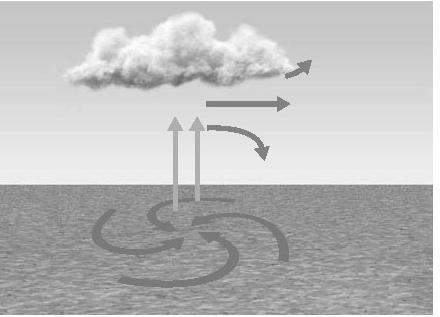
Which type of pressure system is pictured?
a)
high
b)
low
c)
medium
d)
none
76.

What type of weather would you expect with the pressure system pictured?
a)
clear
b)
cloudy
c)
severe storms
d)
hot
77.
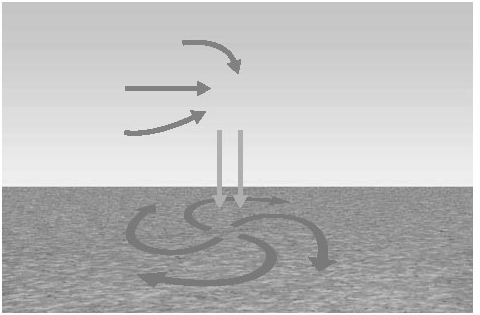
Which type of pressure system is pictured?
a)
high
b)
low
c)
medium
d)
none
78.

What type of weather would you expect from the pressure system pictured?
a)
clear
b)
cloudy
c)
hot
d)
stormy
79.
When air contains as much moisture as possible at a specific temperature, it is:
a)
at its dew point
b)
saturated
c)
at its dew point AND saturated
d)
none of the rest
80.
The temperature at which air is saturated and condensation forms is the:
a)
dew point
b)
rain point
c)
wind point
d)
relative humidity
81.
Why do hurricanes inflict more damage than tornadoes?
a)
they are larger
b)
longer duration
c)
also associated with flooding and strong rains
d)
all of the rest
82.
In _________ pressure systems, air sinks:
a)
high
b)
low
c)
medium
d)
none
83.
In _______ pressure systems, air rises
a)
high
b)
low
c)
medium
d)
none
84.
This type of front results in the same weather for several days
a)
warm
b)
cold
c)
stationary
d)
occluded
85.
This type of front can bring strong storms
a)
cold
b)
warm
c)
stationary
d)
occluded
86.
This is the scale by which tornadoes are measured
a)
Fujita
b)
Ferrari
c)
Fermi
d)
Falling
87.
Is the climate warmer near the ocean or inland?
a)
inland
b)
near the ocean
88.
Sea breeze takes place during the _____.
a)
day
b)
night
89.
Land breeze takes place during the _____.
a)
day
b)
night
90.
A sea breeze is when the sea is ____ and the land is ______.
a)
cool, cool
b)
warm, cool
c)
cool, warm
d)
warm, warm
91.
A land breeze is when the land is ____ and the sea is ______.
a)
warm, cool
b)
cool, warm
c)
cool, cool
d)
warm, warm
92.
The closer you are to the equator, the ______ the climate and temperatures.
a)
cooler
b)
warmer
100 %

