
 Worksheets
6th Grade Science 2nd Semester Review Part 2
Total questions: 97
Worksheet time: 1hrs 8mins
Name
Class
Date
1.
Which of the following evaporates water into the atmosphere
a)
clouds
b)
suns heat
c)
photosynthesis
d)
map
2.
Which of the following is a measure of air molecule movement?
a)
temperature
b)
rain
c)
humidity
d)
clouds
3.
When the temperature is high, air molecules move.....
a)
slowly
b)
rapidly
4.
When the temperature is cold, the air molecules move
a)
less rapidly
b)
more rapidly
5.
The amount of water vapor in the air is called
a)
dew point
b)
atmosphere
c)
humidity
d)
cloud
6.
The amount of water vapor in the air compared to what it can hold at a specific temperature is called
a)
humidity
b)
relative humidity
c)
dew point
d)
snow
7.
The temperature at which air is saturated and condensation forms
a)
dew point
b)
humidity
c)
rain
d)
relative humidity
8.
Clouds are formed when what type of air is forced upward?
a)
cold
b)
warm
c)
dark
9.
Stormy weather is associated with what type of air pressure?
a)
high
b)
low
10.
Barometer measures
a)
humidity
b)
precipitation
c)
air pressure
d)
temperature
11.
A boundary between two different air masses
a)
back
b)
front
c)
cloud
d)
wall
12.
Type of front that involves three air masses of different temperatures
a)
occluded
b)
stationary
c)
battle
d)
moisture
13.
Type of front in which air masses and their boundaries stop advancing
a)
stationary
b)
occluded
c)
battle
d)
smelly
14.
What occurs when movement of air inside a cloud causes parts of the cloud to become oppositely charged?
a)
tornado
b)
hurricane
c)
lightning
d)
thunder
15.
A violent, whirling wind that moves in a narrow path over land
a)
hurricane
b)
lightning
c)
tornado
d)
thunder
16.
A large swirling low pressure system that forms over tropical oceans
a)
hurricane
b)
tornando
c)
lightning
d)
thunder
17.
A blizzard is a strong winter storm with low visibility that lasts more than how many hours?
a)
2
b)
3
c)
4
d)
5
18.
When the National Weather Service says favorable conditions fro severs weather to develop
a)
watch
b)
warning
c)
promise
d)
suggestion
19.
When the National Weather Service says that severe weather conditions already exist
a)
statement
b)
watch
c)
warning
d)
promise
20.
A person who studies weather
a)
archeologist
b)
dermotologist
c)
paleantologis
d)
meteorologist
21.
Lines on a weather map connecting points of equal temperatures
a)
isobars
b)
isotherms
c)
latitude
d)
longitude
22.
Lines on a weather map connecting points of equal atmospheric pressure
a)
isobars
b)
isotherms
c)
longitude
d)
isometrics
23.
Weather fronts move from
a)
North to South
b)
South to North
c)
East to West
d)
West to East
24.
A meteorologist is trying to determine if a storm is approaching. What instrument would he use to determine the change in air pressure?
a)
Thermometer
b)
Barometer
c)
Weather Vane
25.
One day on Earth is equivalent to:
a)
One revolution
b)
One rotation
c)
One elliptical
26.
The layer of Earth that includes the crust and the upper mantle is known as the:
a)
Atmosphere
b)
Asthenosphere
c)
Lithosphere
27.
The one day of the year with the longest amount of sunlight is:
a)
Vernal Equinox
b)
Summer Solstice
c)
Summer Equinox
28.
What are the 4 different types of storms?
a)
Snowstorm, Thunderstorm, Hurricane, and Tornado
b)
Snowstorm, Blizzard, Thunderstorm, Tornado
c)
Snowstorm, Earthquake, Thunderstorm, Rainstorm
d)
Thunderstorm, Snowstorm, Earthquake, Tornado
29.
Which instrument is used to observe space systems from Earth?
a)
Telescope
b)
Microscope
c)
Magnifying Glass
30.
Tides are caused by:
a)
Rotation of planet Earth
b)
Earth's Revolution
c)
Gravitational pull of the moon
31.

What part of the water cycle is shown at Number 1?
a)
Evaporation
b)
Condensation
c)
Collection
d)
Precipitation
32.

What part of the water cycle is shown at Number 2?
a)
Evaporation
b)
Condensation
c)
Collection
d)
Precipitation
33.

What part of the water cycle is shown at Number 3?
a)
Evaporation
b)
Condensation
c)
Collection
d)
Precipitation
34.

What part of the water cycle is shown at Number 4?
a)
Evaporation
b)
Condensation
c)
Collection
d)
Precipitation
35.

What step of the water cycle is shown in #4?
a)
evaporation
b)
precipitation
c)
infiltration
d)
condensation
36.

What part of the water cycle is shown in #3
a)
evaporation
b)
precipitation
c)
condensation
d)
infiltration
37.
the process in which gas changes into a liquid
a)
evaporation
b)
condensation
c)
humidity
d)
precipitation
38.
When water is sinking into the ground where different crops grow, what part of water cycle is this?
a)
evaporation
b)
condensation
c)
precipitation
d)
infiltration
39.
What is the energy source that causes the water cycle to continue?
a)
the inner core
b)
the outer core
c)
the moon
d)
the sun
40.
In a wave, which best describes the wave crest?
a)
the distance from a crest to the next crest
b)
the distance from the top and bottom
c)
the top of a wave
d)
the bottom of the wave
41.
loss of water through a plant
a)
precipitation
b)
humidity
c)
evaporation
d)
transpiration
42.
the process that continuously moves water from the Earth's surface to the atmosphere and back again
a)
water cycle
b)
local wind
c)
physical change
d)
water vapor
43.
An underground formation that contains and stores ground water is called a(n)______.
a)
watershed
b)
water table
c)
aquifer
d)
recharge zone
44.
97% of the water on earth is _________, making it undrinkable for humans.
a)
Fresh water
b)
Ground water
c)
Salt water
d)
Surface water
45.
What percentage of the Earth's water is fresh water?
a)
70%
b)
10%
c)
3%
d)
7%
46.
What percentage of the Earth's water can be easily accessed for drinking?
a)
1%
b)
97%
c)
3%
d)
100%
47.
About this much of Earth is covered in water...
a)
3%
b)
50%
c)
70%
d)
90%
48.
The lowest point on a wave is the:
a)
Amplitude
b)
Crest
c)
Trough
d)
Wavelength
49.

Which vocabulary term is used to identify the distance between points C & G?
a)
Amplitude
b)
Crest
c)
Frequency
d)
Wavelength
50.
what is the main source of freshwater on earth
a)
ocean water
b)
well water
c)
pond water
d)
rainwater
51.
winds are pushed to the right in the northern hemisphere and to their left in thesouthern hemisphere
a)
trade winds
b)
westerlies
c)
coriolis effect
d)
doldrums
52.
measures barometric pressure
a)
anemometer
b)
hygrometer
c)
rain gauge
d)
barometer
53.

What does this symbol indicate on a weather map?
a)
High pressure system
b)
Low pressure system
c)
Cold front
d)
Warm front
54.
The boundary between two air masses is known as:
a)
front
b)
storm
c)
climate
d)
flood
55.
Hot air (RISES / FALLS) __________.
a)
RISES
b)
FALLS
56.
Cold air (RISES/ FALLS) _________.
a)
RISES
b)
FALLS
57.

Identify the type of front that is shown in the image.
a)
Occluded Front
b)
Cold Front
c)
Stationary Front
d)
Warm Front
58.
Heat transfer by conduction occurs when...
a)
particles bump into each other
b)
large numbers of atoms move from place to place
c)
atoms give off heat in the form of electromagnetic waves
d)
electromagnetic waves travel from place to place through a vacuum
59.
Identify the type of front that is shown in the image.
a)
Occluded Front
b)
Cold Front
c)
Stationary Front
d)
Warm Front
60.

The Gulf Stream is a current that brings warm ocean water from the south to the north. What type of heat transfer is this?
a)
conduction
b)
convection
c)
radiation
d)
Insolation
61.
What is your favorite class?
a)
Science
b)
Science : )
62.
A severe storm that involves winds over 119mph and forms over water is:
a)
tornado
b)
thunderstorm
c)
hurricane
d)
blizzard
63.
This is a large body of air which has the same temperature, air pressure, and humidity.
a)
air mass
b)
front
c)
cold front
d)
warm front
64.

. On the Earth’s layer diagram above, which letter represents the Outer Core?
a)
w
b)
x
c)
y
d)
z
65.

On the Earth’s layer diagram above, which letter represents the layer that contains solid iron?
a)
w
b)
x
c)
y
d)
z
66.
Which of the Earth’s layers is made of liquid iron?
a)
crust
b)
mantle
c)
OC
d)
IC
67.

Based on the Earth’s layer information on the chart, which layer best represents the Mantle?
a)
A
b)
B
c)
C
d)
D
68.
How does density and temperature change as you move from crust to the core (as you go deeper)?
a)
Density increases and Temperature decreases
b)
. Temperature increases and Density decreases
c)
Both density and temperature decrease
d)
Both density and temperature increase
69.

The gradual increase in average global surface temperature is called...
a)
global warming
b)
the greenhouse effect
c)
the trump effect
70.
At night, the denser cool air over the land moves in and replaces the less dense, warmer air that rises over the ocean. This is called
a)
sea breeze
b)
land breeze
c)
trade winds
71.
Earth would be too cold to support life without _____________________.
a)
global warming
b)
the greenhouse effect
c)
tropics
d)
seasons
72.
A severe storm which involves a funnel cloud forming over land is:
a)
hurricane
b)
tornado
c)
thunderstorm
d)
blizzard
73.

When the visible (lit) portion of the moon is increasing, the moon is:
a)
waning
b)
full
c)
waxing
d)
new
74.
About how many days does it take to moon to go through a complete cycle?
a)
7 days
b)
365 days
c)
29 days
d)
20 days
75.
Define Gibbous
a)
Less than half of moon visible
b)
More than half of moon visible
c)
All of moon visible
d)
None of moon visible
76.
Define Waxing
a)
Moon is increasing and light part appears to be growing
b)
Completely illuminated
c)
dark side is facing earth
d)
Moon is decreasing and light part appears to be�shrinking
77.

Name the moon phase
a)
Waning Crescent
b)
Waxing Crescent
c)
Waning Gibbous
d)
Waxing Gibbous
78.

Name the moon phase
a)
Waxing Gibbous
b)
Waxing Crescent
c)
Waning Crescent
d)
Waning Gibbous
79.

This picture represents day and night. What is the motion?
a)
Revolution
b)
Orbit
c)
Rotation
d)
Axis
80.

Driving around the green to get to your ball is an example of
a)
Day & Night
b)
Rotation
c)
Good Golf
d)
Revolution
81.

An underground layer of rock or sediment that holds water?
a)
Reservoir
b)
Aquifer
c)
Groundwater
d)
Watershed
82.
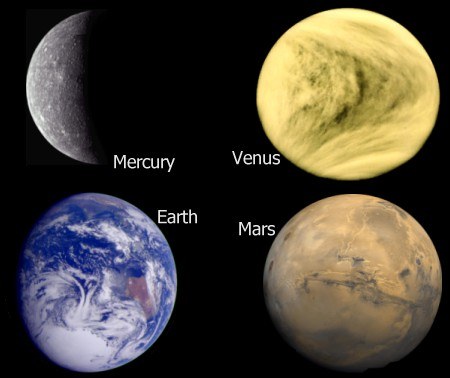
Earth and the other planets closest to the Sun are made mostly of _______
a)
gas
b)
metal
c)
water
d)
rock
83.

The __________ has planets, moons, comets, and asteroids.
a)
solar system
b)
earth
c)
rotation
d)
United States
84.
Where is the asteroid belt found?
a)
between earth and mars
b)
Between Uranus and Neptune
c)
Between Mercury and Venus
d)
Between Mars and Jupiter
85.
One of the main differences between the outer and inner planets is __________.
a)
The inner planets all have water
b)
the inner planets are much bigger than the outer planets
c)
the outer planets are gas planets
d)
the outer planets have rings, and the inner planets don't
86.
Day and night is caused by the _____________ of earth on its axis.
a)
revolution
b)
orbit
c)
rotation
87.
As the Earth travels around the sun, this tilt causes different areas of the Earth’s surface to get different amounts of daylight at different times of the year. The angle of the Sun’s rays to the surface also causes areas to have more or less of the Sun’s energy. This causes the ________.
a)
months
b)
day and night
c)
seasons
d)
years
88.
A spiral galaxy of stars that contains our Sun
a)
Planisphere
b)
Intensity
c)
Star
d)
Milky Way
89.
Which outer planets have rings?
a)
Just Saturn
b)
Saturn and Jupiter
c)
Jupiter, Neptune, and Saturn
d)
all 4 of them
90.
Which of the following causes seasons?
a)
the earths tilt
b)
the earths rotation
c)
the earths revolution around the sun
d)
the earths size
91.
The four inner planets are...
a)
Rocky and small
b)
Very large and made of ice
c)
Small and made of ice
d)
Very large and made of gases
92.
What holds the planets in their orbits around the sun?
a)
gravity
b)
speed
c)
string
d)
air currents
93.
The outer planets are...
a)
Rocky and small
b)
Very large and made of ice
c)
Small and made of ice
d)
Very large and made of gases
94.
A ball of ice and dust with a tail of gas and dust pointing away from the sun.
a)
Asteroid
b)
Comet
c)
Moon
d)
Meteor
95.
What planet is eighth in the Solar System?
a)
Uranus
b)
Jupiter
c)
Neptune
d)
Mars
96.

Which planets are terrestrial planets
a)
Inner planets
b)
Outer planets
c)
Both
d)
Asteroid belt
97.
All of the outer planets--
a)
have many moons
b)
are small
c)
have a short orbit around the Sun
d)
are rocky
100 %

