Wayground logo

Free Printable Worksheets

Font size

S
M
L
XL
Worksheets

Evolution Review

Total questions: 63

Worksheet time: 1hrs 13mins

Name
Class
Date
1.
Which three animals are most distantly related?
a)
The elephant, Manatee, and Yellow Frog
b)
The Yellow Frog, Salamander, and Bird
c)
The Lungfish, Crocodile, and Bird
d)
The Elephant, Lungfish, and Crocodile
2.
How many animals have an amniotic egg?
a)
2
b)
3
c)
4
d)
5
3.
Which two orgainsms have hair? 
a)
Sharks & Ray Finned Fish
b)
Primates & Rodents
c)
Birds & Crocodiles
d)
Rabbits & Birds
4.

Deer fighting for a mate is an example of ____________.

a)

overproduction

b)

competition

c)

variation

d)

selection

5.
What is this a picture of?
a)
Pedigree
b)
Cladogram
c)
Family Tree
d)
Oak Tree
6.
Where the better adapted organisms survive to pass traits along to offspring.
a)
Evolution
b)
Natural Selection
c)
Extinction
d)
Artifical Selection
7.
preserved remains or traces of an organism that lived in the past
a)
species
b)
Galapagos Islands
c)
evolution
d)
fossil
8.
islands off the coast of South America where Darwin studied
a)
Bahamas
b)
Hawaiin
c)
Galapagos
d)
South American
9.
Which statement is true about the fossil record?
a)
It is a record of all living things
b)
It shows how our climate has remained the same over time
c)
It provides evidence for history of life on Earth
d)
It does not support the theory of evolution
10.
Which layer is oldest?
a)
A
b)
W
c)
G
d)
Z
11.
When an organism completely dies out, it is called.....
a)
Adaption
b)
Extinction
c)
Fossilization
d)
Mutation
12.
used to divide earth's loooong history into manageable parts 
a)
fossil record
b)
geologic time scale
c)
radioactive dating
d)
absolute dating
13.
The differences among a species, like different bird beaks, are called
a)
genes.
b)
variations.
c)
traits.
d)
theories.
14.
Do organisms "decide" to evolve and change?
a)
Yes, they know they need to change to survive 
b)
No, they change because of natural selection
15.
Which term refers to the process by which individuals that are better suited to the environment survive and reproduce therefore passing down their genes to their offspring? 
a)
Evolution 
b)
Variation 
c)
Adaptation
d)
Natural Selection 
16.
The white feathers of a snowy owl allow it to blend in with its environment during the winter months (snow). This is an example of ________________
a)
Species
b)
Environmental Change
c)
Adaptation
d)
Variation
17.
Genetic differences between organisms of the same species
a)
Variation
b)
Adaptation
c)
Behavior
d)
Environment
18.
The struggle for existence against other members of an organisms species is
a)
Competition
b)
Natural Selection
c)
gene flow
d)
genetic drift
19.
Remains of ancient organisms are called
a)
Extinctions
b)
Fossils
c)
Mutations
d)
Variations
20.
A group of similar organisms that can mate with each other and produce fertile offspring is called a species.  
a)
True  
b)
False
21.
An original species from which all other species evolved.
a)
Fossil
b)
Natural Selection
c)
Descendant
d)
Common Ancestor
22.
Differences among individuals in the composition of their genes or other DNA segments.
a)
Natural Selection
b)
Derived traits
c)
Genetic Variation
d)
Adaptation
23.
Two similar structures in closely related organisms that have a different function:
a)
Vestigial
b)
Analogous
c)
Evolution
d)
Homologous
24.
Two structures that belong to organisms that are not closely related, but the structures are similar because they serve a similar purpose for each organism:
a)
Homologous
b)
Vestigial
c)
Geographical
d)
Analogous
25.
A penguin and a fish both have fins.  This is an example of:
a)
Homologous structures
b)
Vestigial structures
c)
Analogous structures
d)
DNA replication
26.
A structure that has been reduced in size and is no longer used by an organism is referred to as:
a)
vestigial
b)
analogous
c)
homologous
d)
mathematical
27.
The study of the earliest stages of development for an organism:
a)
Geography
b)
Cardiology
c)
Embryology
d)
Immunology
28.
An example of a vestigial structure is:
a)
Fins for penguins and fish
b)
Human wisdom teeth
c)
Bat arm and whale fin
d)
Human brain
29.
The human arm and the whale fin are examples of what type of structure?
a)
Analogous
b)
Vestigial
c)
DNA
d)
Homologous
30.
____ is when members of a species that are best suited for their environment survive and reproduce at a higher rate than other members of the species
a)
natural selection
b)
artificial selection
c)
speciation
d)
adaptation
31.
Most organisms have more offspring than will survive 
a)
True
b)
False
32.
Why are advantageous traits more likely to be passed on to the offspring?
a)
Because parents with those traits can teach their offspring
b)
Because parents with those traits can surive and reproduce better
c)
Because parents with those traits care more about their offspring
33.
Survival of the Fittest and Evolution were proposed by what scientist?
a)
Charles Darwin
b)
Albert Einstein
c)
Steven Hawking
d)
Isaac Newton
34.
When every organism of a species has died.
a)
Evolution
b)
Natural Selection
c)
Extinction
d)
Artificial Selection
35.
What was the name of the ship Darwin traveled the world on?
a)
HMS Beagle
b)
SS Beagle
c)
HMS Bugle
d)
SS Bugle
36.
What are the MOST studied animals in the galapagos?
a)
Finches
b)
Tortoises
c)
Turtles
d)
Lizards
37.
What is the advantage of having different shaped beaks?
a)
To look different from other species.
b)
To be able to eat the food readily available in the environment.
c)
To protect itself against predators.
d)
To protect itself against prey.
38.
Mutations are a change in what?
a)
DNA
b)
tRNA
c)
genotype
d)
phenotype
39.
Humans, birds, whales, and lizards all have similar arm bones. What is the reason for this?
a)
The function of these bones is the same in all animals
b)
They live in similar environments
c)
They have a common ancestor
d)
All organisms resemble humans
40.
Bird wings and butterfly wings are an example of
a)
Homologous structure
b)
Analogous structure
c)
Mimicry
d)
Camoflague
41.
Analogous structures show common ancestry.
a)
True
b)
False
42.
Which of the following pieces of evolution evidence deals with aged and identified fossils?
a)
fossil record
b)
comparative embryology
c)
comparative biochemistry
d)
comparative anatomy
43.
evolutionary process where an organism becomes better suited to its habitat over time
a)
taxonomy
b)
genetics
c)
variation
d)
adaptation
44.
Structures that are present in a species but the structure no longer has a purpose
a)
homologous structures
b)
vestigial structures
c)
analogous structures
d)
adapations
45.
What does Darwin's theory of evolution suggest?
a)
species change over time
b)
extinct species are not related to living species
c)
different species can interbreed
d)
animals that look alike are most closely related
46.
What characteristic did Darwin observe about the finches on the Galapagos Islands?
a)
Their feathers 
b)
Genotypes 
c)
Their beaks
d)
Their body sizes
47.
Why did Darwin's finches develop different beaks?
a)
individual birds changed their beaks based on what food they wanted to eat 
b)
they developed in different countries and then migrated to different islands on the Galapagos
c)
To tell each other apart for mating
d)
The beaks are a feeding adaptation due to competition for scarce food
48.
Which of the following means "change over time"
a)
natural selection
b)
speciation
c)
evolution
d)
isolation
49.
The structures shown are_________
a)
homologous
b)
heterologous
c)
analogous
d)
vestigial
50.
Any inherited trait that gives an organism an advantage in its environment is called ___.
a)
a mutation
b)
an adaptation
c)
evolution
d)
natural selection
51.
According to this cladogram, sharks are MOST closely related to which organism? 
a)
Amphibians
b)
Ray finned fish
c)
Crocodiles
d)
Birds
52.

True or False: Evidence from the fossil record shows that species change gradually over time.

a)

True

b)

False

53.

How do most fossils form?

a)

An insect becomes trapped in amber.

b)

An entire organism becomes frozen in ice.

c)

A dead organism becomes buried in sediment.

d)

A dead organism becomes buried in tar.

54.

Index fossils must meet two criteria, they must have existed for a short period of time and ...

a)

be few in numbers

b)

lived for a long time

c)

be widely distributed

d)

be really old in age

55.

How does the fossil record help to support the theory of evolution?

a)

the fossil record shows that organisms slowly change over time

b)

The fossil record shows that species evolve very quickly

c)

The fossil record does not support the theory of evolution

56.

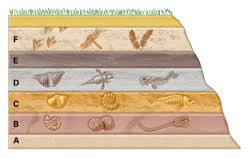
Which rock layer most likely contains fossils of the oldest organisms?

a)

1

b)

2

c)

3

d)

4

57.

Which rock layer contains the newest fossils?

a)

B

b)

C

c)

D

d)

E

e)

F

58.
In what kind of rock can fossils be found?
a)
Sedimentary Rocks
b)
Igneous Rocks
c)
Metamorphic Rocks
d)
Granite
59.
Finding the fossils of trees in an area that is currently a desert without much life might tell us that the area, millions of years ago - 
a)
was heavily eroded by strong winds
b)
received enough rain to support a forest
c)
suffered very powerful earthquakes
d)
was destroyed by the impact of meteorites
60.
Which of the following is NOT an example of a fossil?
a)
a petrified dinosaur bone
b)
a footprint captured in mud
c)
a seashell found on the beach
d)
an insect stuck in amber
61.
Which of the following is NOT something you could learn from a fossil?
a)
The size of the animal
b)
What the animal ate
c)
The color of the animal
d)
Where the animal lived
62.
In order for a fossil to form, which of the following events must happen FIRST?
a)
Slowly, minerals in the water replace the bone.
b)
Sediment covers the bone.
c)
An animal dies.
d)
The bone is no longer a bone, but a rock copy.
63.
Why don't we know what many ancient plants looked like? 
a)
They had too many soft parts.
b)
They were all eaten by dinosaurs.
c)
There weren't ancient plants.
d)
They had too many hard parts.