
 Worksheets
Titration Method
Total questions: 14
Worksheet time: 8mins
Name
Class
Date
1.
What is the long graduated piece of equipment called?
a)
Pipette
b)
Tube
c)
Burette
d)
Measuring Cylinder
2.
How do you fill a glass pipett?
a)
With a pipett filler
b)
Like a straw
c)
With a sucky thing
d)
With a Burette filler
3.
How will I ensure I get an accurate final end point?
a)
Be slow and careful
b)
Repeat until you have 3 very similar titre
c)
Rinse the Burette
d)
Always use the same Pipette filler
4.
Acid + Base ₋-->
a)
salt + hydrogen
b)
salt + water
c)
salt + carbon dioxide + water
d)
salt
5.
HCl + NaOH →
a)
NaH + ClOH
b)
NaCl + H2
c)
NaCl + H2O
d)
NaCl + Cl2
6.
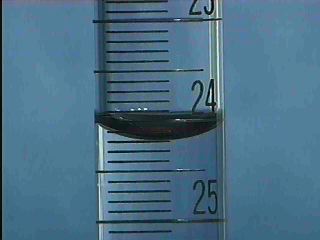
What is the volume in this burette?
a)
24.1mL
b)
24.3mL
c)
24.2L
d)
24.2mL
7.
What indicator is commonly used in titrations?
a)
Phenolphthalein
b)
Bromothymol Blue
c)
Litmus
d)
Universal
8.
What is the white tile for in titration?
a)
To help clearly see the colour change
b)
To protect the conical flask
c)
To add extra height
d)
To assist the reaction
9.

what is the reading on this burette?
a)
4.40mL
b)
3.50mL
c)
3.60mL
d)
4.50mL
10.
What does pH measure?
a)
Amount of Oxygen Ions
b)
Amount of Hydrogen Ions
c)
The amount of salt in a solution
d)
The density
11.
If phenolphthalein turns bright pink, it indicates
a)
an acid
b)
a base
c)
a neutral
12.
Why do we use water to wash the solution from the burette into the flask
a)
To ensure accuracy (all solution reacts)
b)
To dilute the reagents
c)
To help the reaction go faster
d)
To see the colour of the indicator better
13.
Forms hydroxide ions in water
a)
Acids
b)
Bases
c)
All
14.
Which is the stronger acid?
a)
pH 1
b)
pH 4
c)
pH 8
d)
pH 13
100 %

