
 Worksheets
Light and Mirrors
Total questions: 63
Worksheet time: 1hrs 10mins
Name
Class
Date
1.
Which of the following electromagnetic waves has the longest wavelength?
a)
Infrared Waves
b)
Ultraviolet Rays
c)
Visible Light
d)
Gamma Rays
2.
Which of the following waves in the electromagnetic spectrum has the highest energy?
a)
Radio Waves
b)
Ultraviolet Rays
c)
Gamma Rays
d)
Infrared Waves
3.
As wavelength decreases in the electromagnetic spectrum the frequency _____.
a)
decreases
b)
stays the same
c)
increases
d)
doubles
4.
Which color of light in the visible light spectrum has the most energy?
a)
Red
b)
Yellow
c)
Violet
d)
Green
5.
Which type of electromagnetic waves is used to image bone?
a)
Gamma Rays
b)
UV Rays
c)
X-Rays
d)
B-Rays
6.
Waves with the longest wavelength have the ____ frequency.
a)
lowest
b)
higest
7.

The following is a picture of what type of mirror?
a)
Convex Mirror
b)
Concave Mirror
c)
Plane Mirror
d)
Flat Mirror
8.
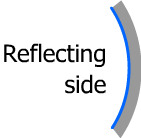
The following is a picture of what type of mirror?
a)
Convex Mirror
b)
Concave Mirror
c)
Plane Mirror
d)
Flat Mirror
9.
A material that reflects or absorbs all of the light that strikes it is called which of the following?
a)
Transparent
b)
Translucent
c)
Diffuse
d)
Opaque
10.
When light reflects off of a completely smooth surface it reflects in which way?
a)
Regular Reflection
b)
Diffuse Reflection
c)
Refraction
d)
Color Reflection
11.
An image that you can see , but does not really exist is called which of the following?
a)
Real Image
b)
Fake Image
c)
Virtual Image
d)
Digital Image
12.
What is the position of the image when an object is placed between the centre of curvature and the focus of a concave mirror?
a)
At the focus
b)
At the centre of curvature
c)
Beyond the centre of curvature
d)
Between the focus and the centre of curvature
13.
Image cannot be formed if an object is placed
a)
at the focus of a concave mirror
b)
at the centre of curvature of a concave mirror
c)
between the focus and the pole of a concave mirror
d)
beyond the centre of curvatureof a concave mirror
14.
A real image having a size of 10 cm is formed by a concave mirror. The size of the object is 5 cm.The magnification of the object is
a)
-5
b)
5
c)
2
d)
-2
15.
An object is placed 10 cm from a convex mirror. Its image is formed 5 cm behind the mirror.The focal length of the given convex mirror is
a)
-5 cm
b)
5 cm
c)
10 cm
d)
-10cm
16.
Convex mirrors are used as surveillance mirrors in libraries because they form
a)
real, erect, and magnified images
b)
real, erect, and diminished images
c)
virtual, erect, and magnified images
d)
virtual, erect, and diminished images
17.
straight arrows that represent light waves
a)
rays
b)
image
c)
reflection
d)
visible light
18.
a reflection that occurs when parallel rays of light hit an uneven surface
a)
regular reflection
b)
diffuse reflection
c)
real image
d)
virtual image
19.
a flat sheet of glass that has a smooth, silver-colored coating on one side
a)
plane mirror
b)
concave mirror
c)
convex mirror
d)
solid mirror
20.
An image that forms where light seems to come from, not where they actually converge
a)
virtual image
b)
real image
c)
diffuse reflection
d)
regular reflection
21.
an image that forms when light rays actually meet
a)
virtual image
b)
real image
c)
diffuse reflection
d)
regular reflection
22.
a mirror with a surface that curves inward like the inside of a bowl
a)
concave mirror
b)
convex mirror
c)
plane mirror
d)
flat mirror
23.
a mirror with a surface that curves outward like the outside of a bowl
a)
concave mirror
b)
convex mirror
c)
plane mirror
d)
flat mirror
24.
Objects that allow only some light to pass through them are considered __________.
a)
A. transparent
b)
B. translucent
c)
C. opaque
d)
D. solid
25.
Tracing paper is an example for _______ object.
a)
A. a transparent
b)
B. a translucent
c)
C. an opaque
d)
D. a luminous
26.
Light is a form of energy produced by a ______.
a)
A. luminous object
b)
B. transparent object
c)
C. illuminated object
d)
D. opaque object
27.
An example for an illuminated object is ___________.
a)
A. a candle
b)
B. the sun
c)
C. an electric bulb
d)
D. the moon
28.
When you look at your face in a mirror, where does your face appear to be?
a)
A. an equal distance behind the mirror to what you are in front
b)
B. a long way behind the surface of the mirror
c)
C. on the surface of the mirror
d)
D. just in front of the mirror
29.
When light is incident on a polished surface ___________ reflection takes place.
a)
A. regular
b)
B. irregular
c)
C. diffused
d)
D. normal
30.
According to the laws of reflection, if i = angle of incidence and r = angle of reflection,
a)
A. i = r
b)
B. i > r
c)
C. r > i
d)
D. i is not equal to r
31.

A figure F is placed in front of a plane mirror. Which is the correct mirror image?
a)
A
b)
B
c)
C
d)
D
32.
Which of the following is the speed of light?
a)
A. 3 metres per second
b)
B. 30 metres per second
c)
C. 300 metres per second
d)
D. 300 000 000 metres per second
33.
What is the incident ray?
a)
The ray of light leaving the mirror
b)
The ray of light approaching the mirror
34.
Real images are :
a)
Always inverted
b)
Magnified or Diminished
c)
can be obtained on screen
d)
all the above
35.
Virtual Images are
a)
Always erect
b)
can be obtained on screen
c)
magnified or diminished
d)
all the above
36.
A Shiny spoon can create
a)
erect image
b)
inverted image
c)
both erect and inverted images
d)
neither inverted nor erect image
37.
An image that forms where light seems to come from a point but light rays don't actually meet is a
a)
virtual image
b)
real image
c)
Inverted Image
d)
Pizza
38.
Convex Mirrors produce...
a)
only virtual images
b)
virtual or real images
c)
only real images
d)
inverted images
39.
convex mirrors are
a)
plane mirrors
b)
converging mirrors
c)
diverging mirrors
d)
smaller than concave mirrors
40.
Which mirror(s) have a focal point?
a)
plane only
b)
concave only
c)
plane, convex and concave
d)
concave and convex, but not plane
41.
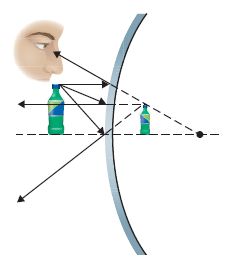
What kind of mirror is shown here?
a)
plane
b)
concave
c)
convex
d)
diffuse
42.
Why do you not see an image when light reflects off a rough surface?
a)
because not enough light is not reflected
b)
because the reflection is regular
c)
because the reflection is diffuse
d)
because the law of reflection does not apply
43.
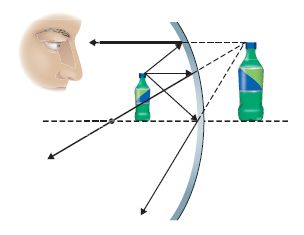
Which terms describe the reflection seen in this image?
a)
virtual, upright
b)
virtual, inverted
c)
real, upright
d)
real, inverted
44.
A light ray that bounces off of the mirror is known as
a)
Incident ray
b)
Reflected ray
c)
Normal line
d)
Source ray
45.
Where is the angle of incidence located?
a)
Between the mirror and the incident ray
b)
Between the mirror and the reflected ray
c)
Between the normal line and incident ray
d)
Between the normal line and reflected ray
46.
Where is the angle of reflection located?
a)
Between the mirror and the incident ray
b)
Between the mirror and the reflected ray
c)
Between the normal line and incident ray
d)
Between the normal line and reflected ray
47.
Which of the following letters will look the same in the mirror?
a)
A
b)
B
c)
C
d)
D
48.
As an object moves towards a flat mirror, its image
a)
moves closer to the mirror
b)
moves further from the mirror
c)
flips upside down
49.
What is the name of the perpendicular line that we use to measure angles?
a)
Incident ray
b)
Reflected ray
c)
Normal line
d)
Source ray
50.
What do we call light rays that are drawn behind a mirror
a)
Real
b)
Virtual
c)
Made up
d)
Does not exist
51.
What type of image is produced by a flat mirror?
a)
Real and upright
b)
Real and inverted
c)
Virtual and upright
d)
Virtual and inverted
52.
How much does a flat mirror magnify an image?
a)
1x
b)
2x
c)
3x
d)
4x
53.
When light reflects off of a completely smooth surface it is called:
a)
Specular Reflection
b)
Diffuse Reflection
c)
Optical Reflection
d)
Color Reflection
54.
Angles are always measured from the:
a)
Boundary
b)
Normal
c)
Incident Ray
d)
Reflected Ray
55.
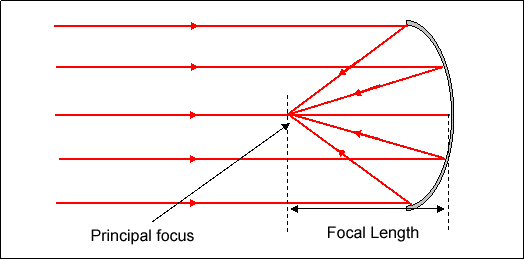
This is an example of a __________ mirror.
a)
Concave
b)
Convex
c)
Plane
d)
Magnifying
56.

This is an example of a _____________ mirror
a)
Concave
b)
Convex
c)
Plane
d)
Magnifying
57.
Convex mirrors can create real images.
a)
True
b)
False
58.
Concave mirrors can create virtual and real images.
a)
True
b)
False
59.
Plane mirrors create real images.
a)
True
b)
False
60.
You can calculate the speed of light using this formula.
a)
c = fλ
b)
c = λ/f
c)
c = f/λ
61.
Electromagnetic waves
a)
need a medium to travel through
b)
can travel through a vacuum.
c)
Are longitudinal.
62.
It takes about _______ for light to reach earth from the sun.
a)
90 minutes
b)
60 minutes
c)
8 minutes
d)
2 minutes
63.
The speed of light in air is
a)
much faster than the speed of sound.
b)
about the same as the speed of sound.
c)
much slower than the speed of sound.
100 %

