
 Worksheets
Fingerprints
Total questions: 61
Worksheet time: 39mins
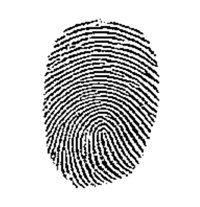
What pattern is this? (Right hand)
Ulnar Loop
Radial Loop
Plain Whorl
Tented Arch
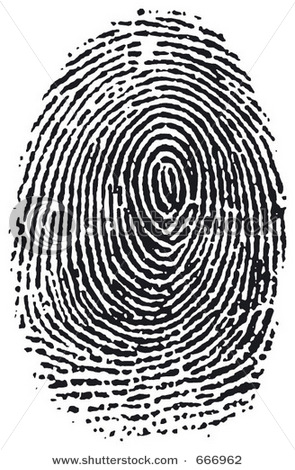
What pattern is this? (Left Hand)
Radial Loop
Ulnar Loop
Plain Whorl
Plain Arch


What pattern is this? (Right Hand)
Tented Arch
Plain Arch
Ulnar Loop
Plain Whorl

What type of fingerprint is this?
Central Pocket Whorl
Plain Whorl
Accidental Whorl
Double Loop Whorl

What type of fingerprint is this?
Central Pocket Whorl
Plain Whorl
Accidental Whorl
Double Loop Whorl

What type of fingerprint is this?
Plain Arch
Tented Arch
Accidental Whorl
Radial Loop

What type of fingerprint is this?
Central Pocket Whorl
Ulnar Loop
Accidental Whorl
Double Loop Whorl

What is the name of this minutiae?
Bifurcation
Splitting Ridge
Delta
Y

What is the name of this minutiae?
Enclosure/Eye
Island
Dot
Bifurcation

What is the name of this minutiae?
Ending Ridge
Spur
Half-Ridge
Partial Ridge
What is the most common type of fingerprint? (65%)
Arch
Loop
Whorl

What are the red triangles?
deltas
useless
forks
loops
Type of fingerprint that is left by a person with soiled or stained fingertips
plastic
patent
latent

The number of deltas found in an arch pattern is ______.
zero
one
two
three
The number of deltas found in a loop pattern is ______.
zero
one
two
three
What percentage of the population have a whorl pattern?
60% of the population
5% of the population
65% of the population
About 30% of the population

What type of whorl is this?
Double loop
Central pocket loop
Accidental
Tented

What type of whorl is this?
Accidental
Double loop
Central pocket loop
Tented
The practice of utilizing fingerprints as a means of identification is called
dermal papille
fingerprinting
dactyloscopy
ridge arrangement
The Galton-Henry system of fingerprint classification was first used by
the FBI
Scotland Yard
the KGB
local police
The first use of fingerprints was 3000 years ago in Ancient ____________.
Babylon
Thailand
Peru
China
In 1880, who is credited with recognizing the importance of fingerprints as a means of identification?
Sir William Herschel
Dr. Henry Faulds
Sir Francis Galton
Juan Vucetich
Who published "Finger Prints" which discussed the anatomy of fingerprints and pattern types?
Sir Francis Galton
Juan Vucetich
Sir Edward Richard Henry
Stephen King
Who created another fingerprint system in England (still in use today) that included grouping patterns according to arches, loops, & whorls?
Sir Edward Richard Henry
Dr. Henry Faulds
Sir William Herschel
Sir Francis Galton
What does AFIS stand for?
Automatic Finger Indicator Sensor
Automated Fingerprint Identification System
Automatic Fingerprint Identification Sensor
Automated Finger Indicator Sensor
Who is the father of fingerprints? What is he known for?
Sir Francis Galton, laid out a classification method of fingerprints
Sir Edward Henry, laid out a classification method of fingerprints
Sir Edward Henry, proposed a modified classification system which is still the basis for taking fingerprints in most English speaking countries
Sir Francis Galton, proposed a modified classification system which is still the basis for taking fingerprints in most English speaking countries
A set of prints has a loops on the left index, right thumb, both little finger, as arches on the right index and right ring finger, has whorls on left thumb, left ring finger, and both middle fingers. What is its Henry classification number?
1/1
6/21
7/10
25/1

Anthropometry- distinguishing physical characterstics based on measurements; No two people would have identical meassurements, features, etc...
Galton
Bertillon
Henry
Locard
Recognized the value of fingerprints as INDIVIDUAL EVIDENCE- began to organize them based on characterstics and used them to identify patterns and eventually suspects
Bertillon
Galton
Henry
Locard

Primary ID Number for someone who DOES NOT HAVE ANY WHORLS.
9/32
1/1
0/0
14/72

Study of HAND, FOOT, and PALM prints, including their individual ridge characteristics...
Forensic Print Analysis
Dactyloscopy
Dermal Ridge Analysis
Minutial Correspondence Testing
Classification system based on WHORLS on specific fingers. Allows one to calculate a PRIMARY ID NUMBER. For example, 25% of the population has NO WHORLS...
Bertillon
Henry
Galton
Locard

For a print to be considered a "match" about how many minutiae or subcharacteristics must be identified?
2-7
10-14
8-16
15-22

How should fingerprints be stored/packaged?
paper envelope
ziplock bag
pocket folder
cardboard box with fasteners
The ridge arrangement on every finger is unique.
True
False
The ridge arrangement on every finger is unique.
True
False


This technique is best used on paper. It reacts to amino acids in the print to create a purple/ pink print
Ninhydrine
Silver Nitrate
Superglue Fuming
Iodine

What is a basic technique that uses a filament brush?
Magnetic powder
Amido black
Polyvinylsiloxane
Standard black powder
Which technique uses Super Glue vapors?
Vacuum metal deposition
Cyanoacrylate ester
Polyvinylsiloxane (PVS)
Small particle reagent (SPR)
Which technique describes a tidy but abrasive powder that uses a wand (not a brush).
Standard black powder
Magnetic powder
Fluorescent powder
Amido black
Which technique binds with amino acids to make a purple-colored print on paper or cardboard surfaces?
Iodine fuming
Gentian violet
Ninhydrin
Amido black
Which technique is helpful for producing gray-colored prints on raw wood surfaces?
Amido black
Iodine fuming
Gentian violet
Silver nitrate
Which technique is particularly helpful on multi-colored, busy or dark surfaces?
Ninhydrin
Standard black powder
Fluorescent powder
Magnetic powder
Which technique only develops (appears) when exposed to light?
Iodine fuming
Poly light
Silver nitrate
Ninhydrin
Which technique allows investigators to lift fingerprints multiple times?
Cyanoacrylate ester
Small particle reagent (SPR)
Polyvinylsiloxane (PVS)
Vacuum metal deposition
Which technique must be photographed as soon as possible because it fades quickly?
Silver nitrate
Iodine fuming
Small particle reagent (SPR)
Gentian violet

