
 Worksheets
Forensic Ballistic Evidence
Total questions: 64
Worksheet time: 32mins
Which type of gun has a short barrel?
Handgun
Rifle
Shotgun
Which types of guns have long barrels?
Handgun
Rifle
Shotgun
What does a handgun shoot?
Cartridges
Shot shells
Paintballs
Arrows
What does a rifle shoot?
Cartridges
Shot shells
Paintballs
Arrows
What does a shotgun shoot?
Shot shells
Cartridges
Paintballs
Arrows
For a handgun, size is measured in what?
Caliber
Gauge
Inches
Newtons
For a rifle, size is measured in what?
Caliber
Gauge
Inches
Newtons
For a shotgun, size is measured in what?
Gauge
Caliber
Inches
Newtons
What is rifling in a gun barrel?
Twisted grooves carved into the barrel of the gun
A smooth interior with no grooves
External ridges on the case
Marks on the primer
What is the purpose of rifling?
To make the bullet spin, increasing accuracy and distance
To reduce noise when firing
To store more gun powder
To make the gun lighter
What gun(s) have rifling in their barrels?
Handguns and rifles
Shotguns only
All guns
None of the above
In a rifled barrel cross-section, what are the raised areas called?
Lands
Grooves
Wads
Pellets
In a rifled barrel cross-section, what are the recessed areas called?
Grooves
Lands
Wads
Pellets
The higher the caliber, the ______ the gun.
larger
smaller
rougher
lighter
The higher the gauge, the ______ the gun.
smaller
larger
heavier
longer
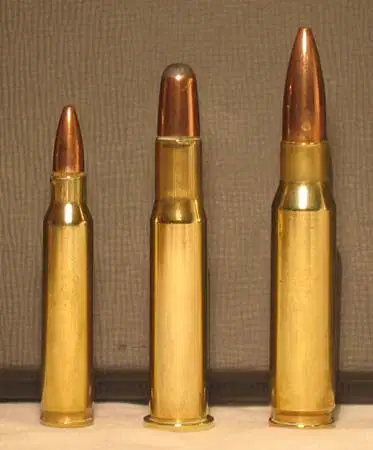
Identify the type of ammunition shown.
cartridge
shot shell
rifle stock
wad
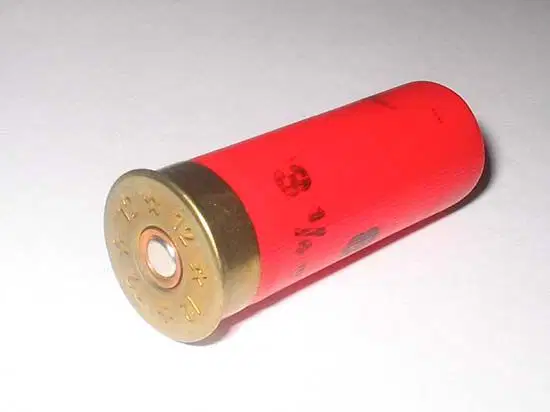
Identify the type of ammunition shown.
shot shell
cartridge
rifle stock
wad
In a cartridge, which item is the projectile?
Bullet
Shot pellets
Wad
Primer
In a shot shell, which items are the projectiles?
Shot pellets
Bullet
Wad
Primer
When the trigger is pulled, the _______ wacks the primer on the cartridge, which causes a spark that ignites the gunpowder.
firing pin
hammer
ejector
extractor
The explosion pushes the ______ out of the casing and down the barrel of the gun.
bullet
wad
shell case
firing pin
________ in the gun barrel causes the bullet to spin as it travels. Choose the correct term for the blank.
rifling
primer
breech face
extractor
The explosion of gunpowder also pushes the ______ in the opposite direction, slamming it into the breech face (back end of the gun barrel). Choose the correct term for the blank.
cartridge case
shot pellets
hammer
wad
How a Cartridge is Fired: The casing must be ejected from the gun. The blank grips the rim of the casing, pulling it backwards into the extractor, which pushes it out of the gun. Choose the correct term for the first blank.
extractor
ejector
magazine
firing pin
How a Cartridge is Fired: The casing must be ejected from the gun. The extractor grips the rim of the casing, pulling it backwards into the blank, which pushes it out of the gun. Choose the correct term for the second blank as printed.
extractor
ejector
breech face
rifling
How a Shotshell is Fired: When the trigger is pulled, the blank wacks the primer on the shotshell, which causes a spark that ignites the gunpowder. Choose the correct term for the blank.
firing pin
hammer
ejector
extractor
How a Shotshell is Fired: When the trigger is pulled, the firing pin wacks the blank on the shotshell, which causes a spark that ignites the gunpowder. Choose the correct term for the blank.
primer
wad
breech face
rifling
How a Shotshell is Fired: The explosion pushes the wad and blank out of the casing and down the barrel of the gun. Choose the correct term for the blank.
shot pellets
bullet
cartridge case
shell case
How a Shotshell is Fired: Pellets blank after leaving the barrel. Choose the correct term for the blank.
spread out
spin inward
stay tightly packed
fall immediately
Collection of Firearms Evidence: Why is it important to not put anything into the gun barrel or touch the breech face of the gun?
Contact can add new marks that alter or damage the gun’s individual characteristics used for comparison.
It makes the gun too heavy to test fire accurately.
It improves accuracy and should be avoided to keep tests fair.
Contact will erase the serial number, making ownership unclear.
Collection of Firearms Evidence: A gun is found in a pond. How do you submit it to be analyzed, and why?
Keep it submerged in the same water from the pond to prevent rust that could damage the gun and its characteristics.
Dry it thoroughly and store it with silica gel to remove moisture before submission.
Wrap it in plastic and refrigerate to slow corrosion.
Rinse briefly and air-dry to avoid water contamination.
Collection of Firearms Evidence: You find a gun in the ocean. How do you submit it to be analyzed?
Rinse the gun, oil it well, and submit it as soon as possible.
Leave it in seawater until laboratory testing begins.
Dry it in direct sunlight to speed up evaporation.
Store it in a freezer to halt corrosion.
Collection of Firearms Evidence: You find two bullets in the same location and decide to pack them together. What should you do to prevent damage to the bullets?
Wrap each bullet in paper so they cannot contact each other.
Place both bullets loose in a plastic bag to keep them together.
Seal them in a metal tin without padding.
Coat them with oil and store in a single envelope.
How is clothing packaged?
In paper bags or cardboard boxes
In plastic bags
In sealed glass jars
In metal cans
Why is it important to dry out any wet or bloody clothing before it is packaged?
To prevent bacteria and mold from destroying evidence on the fabric
To make it weigh less for shipping
To fit better in storage boxes
To keep it from wrinkling
The Firearms Division also examines…
Tool marks
Fingerprints only
Tire tracks
Blood spatter patterns
Class Characteristics of Bullets and Casings: Find and record the FIVE categories hidden on the slide. Which options list these categories?
Brand / Manufacture
Bullet weight, shape and size
Information on the headstamp of the cartridge
Caliber / gauge of the ammunition
The type of material used to make the ammunition
Every Gun Has a ‘Fingerprint’: Individual Characteristics. Describe the tank used to test fire a suspect’s gun and how it works.
A large tank full of water that stops the bullet without damaging it so it can be collected and compared to crime scene bullets
A sand barrel that shreds bullets to check metal content
An empty steel drum that ricochets bullets for trajectory tests
A vacuum chamber that evaporates gunpowder residue
Every Gun Has a ‘Fingerprint’: Individual Characteristics. What tool allows CSI to see two bullets, or two cartridge cases, at one time?
The comparison microscope
A stereoscope
A scanning electron microscope
A magnifying glass
Every Gun Has a ‘Fingerprint’: Individual Characteristics. What do analysts do if they need to test fire a damaged or broken gun?
Fix the gun using parts from the large gun inventory kept by the firearms department
Discard the gun and use a different model
Test fire without any repairs
Send the gun to the suspect to repair
You need to know how far a victim was from the shooter. Briefly describe how analysts figure this out.
Fire the suspect’s gun at varying distances into clean white cloth and compare the GSR patterns to the victim’s clothing for the best match
Measure the victim’s height and weight
Check the weather report for wind speed at the time
Estimate by the loudness of the shot
A bullet was found at a crime scene, but no gun. What can an analyst do that may still lead to an identification?
Scan the bullet markings into the ballistics database to find matching markings and possibly identify a weapon
Melt the bullet and analyze its alloy composition
Post a photo of the bullet online for tips
Ignore the bullet since the gun is missing
The Firearms Division also works with tool mark evidence and…
Explosives
Finger painting
Textile dye
Soil pH
Draw and label the FIVE marks that guns make on the cartridge case or bullet. Select all the marks that should be included.
Firing pin mark
Breech face mark
Extractor mark
Ejector mark
Rifling striations
Who invented the comparison microscope?
Calvin Goddard and Philip Gravelle
Anthony van Leeuwenhoek
Robert Hooke
Alfred Nobel
Firing Pin Mark — What is the purpose of the firing pin? What does it do?
It strikes the primer to ignite the gunpowder and propel the bullet.
It extracts the spent cartridge case from the chamber.
It engraves rifling on the bullet as it travels down the barrel.
It seals the chamber to prevent gas from escaping.
Firing Pin Mark — What part of the cartridge does the firing pin strike?
The primer
The case rim
The bullet tip
The extractor groove
Draw the location of a rim shot versus a center shot firing pin mark. Which diagram description is correct?
Rimfire has the firing pin impression on the rim and centerfire has the impression in the middle.
Rimfire has the impression in the middle and centerfire has the impression on the rim.
Both rimfire and centerfire have impressions in the middle.
Neither rimfire nor centerfire leaves a visible impression.
Breech Face Mark — In your own words, describe how a breech face mark is made. Which explanation is accurate?
When the gunpowder ignites, the case is forced backward against the breech face, imprinting its texture.
The bullet rubs against the rifling, leaving stripes on its surface.
The extractor claw scratches the case as it is pulled out of the chamber.
The magazine spring compresses the cartridge, creating parallel lines.
Draw and label the three types of breech face mark. Select all that are correct.
Parallel
Mottled
Circular
Chevron
Extractor Mark — What is the purpose of the extractor? What does it do?
It grips the cartridge case after it is fired and pulls it into position to exit the gun.
It forces the empty casing out of the gun.
It strikes and indents the primer to ignite the cartridge.
It seals the chamber against the cartridge base during firing.
Extractor Mark — In words, describe the location of an extractor mark on the casing.
On the case rim, marking both the face and the side of the rim.
Centered on the primer.
Along the case mouth only.
On the nose of the bullet.
Ejector Mark — What is the purpose of the ejector? What does it do?
It forces the empty casing out of the gun.
It grips the case to pull it into position.
It engraves rifling marks on the bullet.
It loads a fresh cartridge from the magazine.
Ejector Mark — In words, describe the location of an ejector mark on the casing.
On the headstamp area where the case strikes the ejector.
On the extractor groove only.
Across the entire case body in long scratches.
Inside the primer pocket.
Rifling Striations — In your own words, describe how rifling striations are made.
Rifling grooves in the barrel scrape the bullet as it is fired, leaving striations.
Air pressure polishes the bullet smooth as it exits, creating lines.
The extractor claws scratch the case and transfer marks to the bullet.
Magazine feed lips etch grooves onto the bullet before firing.
Rifling Striations — You find a bullet with rifling striations that point to the right. Is rifling direction class or individual evidence?
Class evidence.
Individual evidence.
Not evidence.
Latent fingerprint evidence.
Rifling Striations — Under the comparison microscope, you see the rifling striation pattern on the crime scene bullet. Which description of the test-fired bullet’s striation pattern would demonstrate they were fired from the same gun?
Striation lines with the same direction, spacing, width, and angle as the crime scene bullet.
Striation lines in the opposite direction to the crime scene bullet.
Random straight vertical lines unrelated to the crime scene bullet.
Fewer, wider lines at a different angle than the crime scene bullet.
All of the marks (firing pin, breech face, extractor, ejector, striations) made by a gun are unique to that gun—even if made by the same manufacturer. Why—what causes them to be unique?
Wear on the gun over time and random variations in manufacturing.
Strict manufacturing uniformity makes all marks identical.
Only the ammunition brand determines uniqueness of marks.
Storage temperature changes marks in identical ways across guns.
IBIS — What does IBIS stand for?
Integrated Ballistics Identification System
International Ballistics Information Service
Imaging Ballistics Indexing Software
Integrated Bullet Identification Survey
IBIS — What is the purpose of IBIS?
To store and compare digital images of ammunition and firearm markings as a searchable database.
To track firearm serial numbers for retail sales only.
To measure muzzle velocity for range safety certifications.
To license gun owners through a national registry.
What is gunshot residue and where does it come from?
Dust from the target that bounces back onto the shooter
Particles of burned and unburned gunpowder and primer residue that come out of the gun when it fires and stick to skin and clothing
Metal shavings from the bullet that remain inside the barrel only
Smoke from the gun’s exhaust that disappears immediately
You give a GSR test to a suspect in a murder case. What are you hoping to find out?
Whether the suspect recently fired a gun
Whether the suspect handled a knife
Whether the suspect was at the crime scene at any time
Whether the suspect owns a firearm
Some states do not use GSR tests. What are the problems with the GSR test? Select all that apply.
GSR wears off quickly, so a negative test does not prove a person did not shoot a gun
GSR can cross-contaminate easily from the environment to a person’s hand or skin, leading to false positives
GSR cannot be collected by any scientific method
GSR always proves guilt when present
Here are four GSR distance test panels (victim’s clothing, contact shot, 2 inches, 6 inches, 10 inches). What would the victim’s clothing likely look like if he were shot with the muzzle 4 inches away?
It should have a bit more GSR than the 6 inches panel, but not as much as the 2 inches panel
It should match the 10 inches panel exactly
It should have the same amount of GSR as a contact shot
It should have no visible GSR at all

