wayground logo

Free Printable Worksheets

NEW

Font size

S
M
L
XL
Worksheets

CPS FINAL EXAM SHOWDOWN

Total questions: 67

Worksheet time: 1hrs 16mins

Name
Class
Date
1.
_________ is the amount of energy required to raise the temperature of 1 kilogram of a substance by 1 kelvin.
a)
thermal energy
b)
specific heat
c)
thermostat
d)
temperature
2.
What does temperature measure?
a)
Heat of Molecules
b)
ºC
c)
Average Kinetic Energy of Molecules
d)
Thermal Energy
3.
What unit do you use to measure Thermal Energy?
a)
J/Kg ºC
b)
Kg
c)
ºC
d)
J
4.
Specific heat is....
a)
The measure of kinetic energy of an objects particles
b)
A measure of the energy needed to increase the average kinetic energy of the particles
c)
The heating caused by the motion of flluid due to temperature difference
d)
The transfer of energy by electromagnetic radiation
5.
How does heat flow?
a)
Always from cold to warm
b)
Always from warm to cold
c)
Both warm to cold & cold to warm
d)
It depends on the temperature
6.
What is the symbol for Thermal Energy in the specific heat formula?
a)
Q
b)
t
c)
m
d)
C
7.
What is the equation to measure change in Thermal Energy?
a)
Q=mc∆t
b)
Q=mc
c)
Q= ∆mct
d)
m=QC
8.
The upward force exerted by a liquid on an object immersed in or floating on the liquid
a)
pressure
b)
buoyant force
c)
normal force
d)
gravity
9.
When the weight of an object is greater than the buoyant force, the object will ... 
a)
Sink
b)
Float 
c)
Expand
d)
Shrink
10.
What direction is the buoyant force in?
a)
Downward
b)
Left
c)
Right
d)
Upward
11.
What is the formula for density?
a)
density = mass x volume
b)
density = mass / volume
c)
density = mass + volume
d)
density = mass - volume
12.
The amount of force pushing on an area is the definition of....
a)
Fluid
b)
Viscosity
c)
Barometer
d)
Pressure
13.
A force is applied in a closed container, the pressure increases the same amount. EX: squeezing a water bottle or toothpaste
a)
Archimede's Principle
b)
Pascal's Principle
c)
Bernoulli's Principle 
14.
Fluids can be...
a)
solids
b)
liquids
c)
gases
d)
liquids or gases
15.
According to Bernoulli's Principle, when the wind speed is high, wind pressure is ________
a)
high
b)
low
c)
not enough information
d)
None of the above
16.
To generate lift, a blade is angled so the _________ pressure air moves under the blade.
a)
high
b)
low
c)
not enough information
d)
None of the above
17.

The faster a fluid moves, the lower the pressure is in the moving fluid compared to the fluid not moving as fast. This is called

a)

Newton's Laws

b)

Bernoulli's Principle

c)

Wright Brothers Priciple

18.

Whose Principle is used to describe why flight is possible?

a)

Newton

b)

Wright Brothers

c)

Bernoulli

19.

What is the best depiction of Bernoulli's principle below?

a)

As the pressure of a fluid decreases, the speed increases

b)

As the pressure of a fluid increases, the speed increases

c)

As the pressure of a fluid decreases, the speed decreases

20.
Which one of the following would you use to separate sand from iron filings?
a)
a bar magnet
b)
filter paper
c)
chromatography paper
d)
alum
21.
Separating mixtures based on boiling points.
a)
Desalination
b)
Distillation
c)
Decantation
d)
Condensation
22.

This diagram represents...

a)

An element

b)

A molecule

c)

A compound

d)

A mixture of elements and compounds

23.
a)
element
b)
compound
c)
mixture of elements and compounds
d)
mixture of compounds
24.
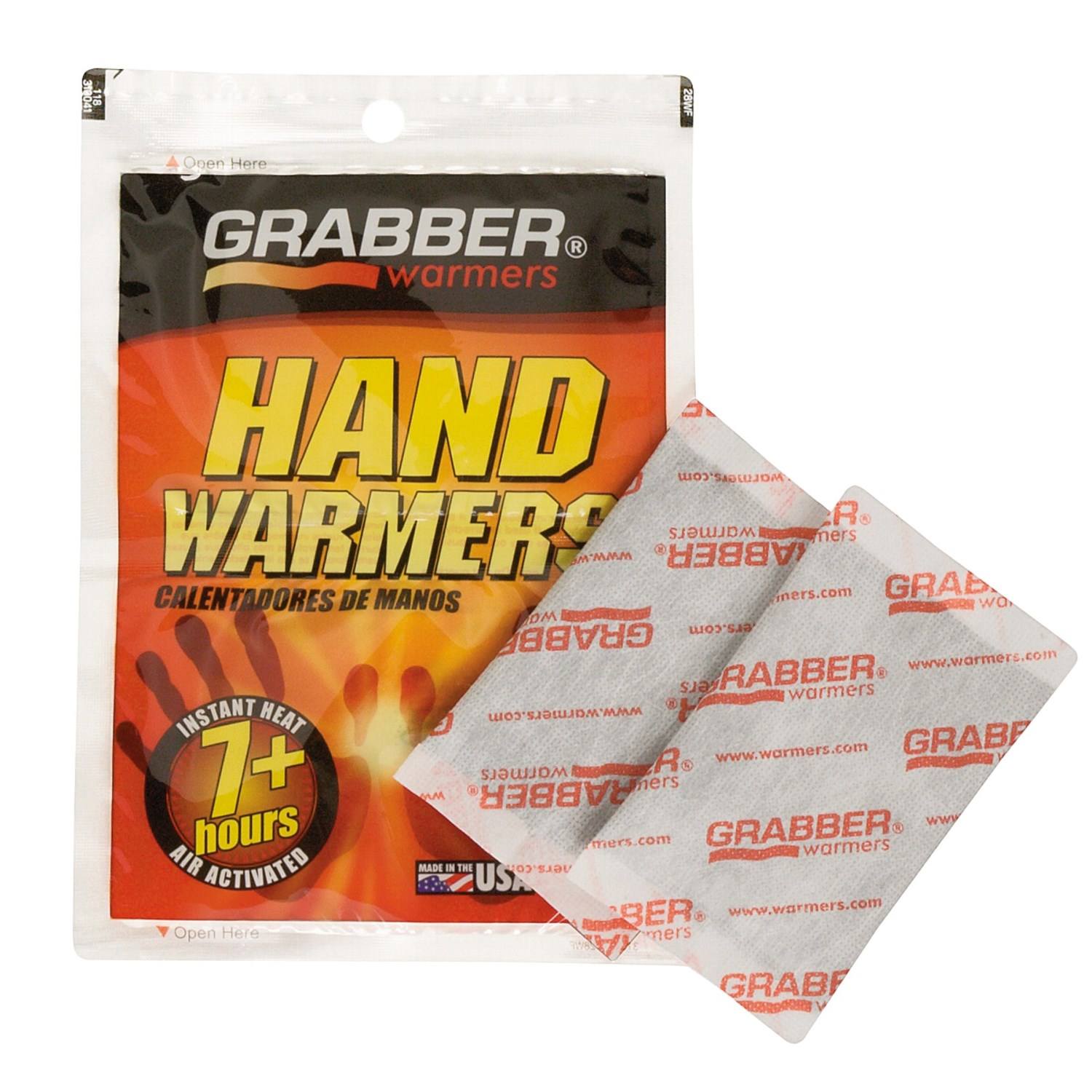
What type of reaction occurs in a hand warmer
a)
exothermic
b)
endothermic
25.
Exothermic reactions...
a)
Absorb energy
b)
Release energy
c)
Release Color
d)
Absorb Color
26.
What does Boyle's law relate to?
a)
Temperature and Volume
b)
Volume and Pressure
c)
Temperature and Pressure
27.
When the temperature of matter increases the particles...
a)
speed up and move closer
b)
speed up and move farther apart
c)
slow down and move closer together
d)
slow down and move farther apart
28.
How do gas molecules move? 
a)
in an orderly fashion 
b)
constantly and randomly
c)
in straight line paths
d)
in a circular motion
29.
The relationship of which two variables are compared in Boyle's Law?
a)
pressure & volume
b)
volume & temperature
c)
temperature & pressure
d)
volume & moles (amount of gas)
30.

The substance being dissolved is called the ________

a)

solvent

b)

solid

c)

solute

d)

solvate

31.
What is a "homogeneous mixture of two or more substances in a single phase"?
a)
Solution
b)
Solvent
c)
Solute
d)
Compound
32.
Which of the following are considered to be a homogeneous mixture?
a)
Colloid
b)
Solution
c)
Suspension
d)
All Mixtures
33.
Which scientist developed the atomic theory
a)
Aristotle
b)
Dalton
c)
Democritus
34.
The smallest unit of a pure substance that has the properties of that substance
a)
element
b)
atom
c)
neutron
d)
compound
35.
What scientist is best known for his "Plum Pudding" model of the atom?
a)
J.J. Tomson
b)
Ernest Rutherford
c)
John Dalton
d)
Democritus
36.
An atom's overall charge is ________.
a)
positive 
b)
depends
c)
neutral 
d)
negative 
37.
J.J. Thomson provided evidence that an atom...
a)
is the smallest particle of matter
b)
contains negatively charged particles
c)
has an overall negative charge
d)
has an overall positive charge
38.
Rutherford's gold foil experiment provided evidence that...
a)
negative and positive charges are spread evenly throughout the atom.
b)
alpha particles have a positive charge.
c)
gold is not a dense as previously thought.
d)
there is a dense positively charged nucleus at the center of an atom.
39.
Ernst Rutherford discovered which part of the atom through the use of gold foil?
a)
Proton
b)
Neutron
c)
Electron
d)
Orbitals
40.
The particles that are found in the nucleus of an atom are
a)
neutrons and electrons
b)
electrons only
c)
protons and neutrons
d)
protons and electrons
41.

Protium, Deuterium and Tritium are isotopes of the element Hydrogen.


Why does Tritium have a greater mass number than both Protium and Deuterium?

a)

It has more protons

b)

It has more neutrons

c)

It is electrically neutral

d)

It has more electrons

42.

What is the mass number of a nitrogen atom that has 8 neutrons?

a)

15

b)

14

c)

22

d)

8

43.
An element's identity is determined by the number of
a)
electrons.
b)
protons.
c)
neutrons.
d)
valence.
44.
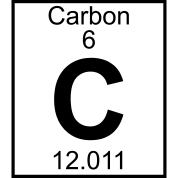
What does the 6 represent?
a)
atomic mass
b)
atomic number
c)
element name
d)
chemical symbol 
45.
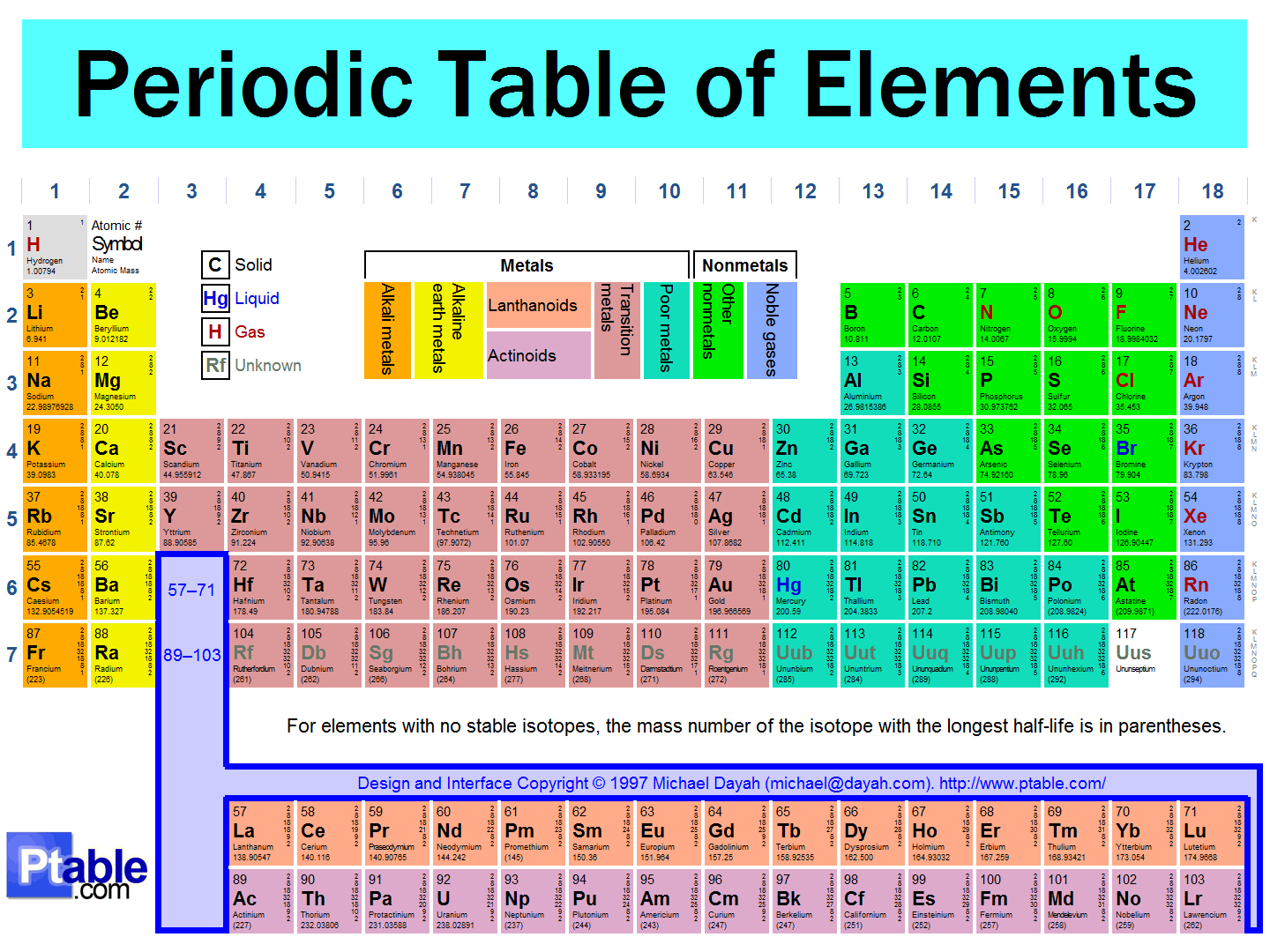
A vertical column is called...
a)
group
b)
tower
c)
period
d)
crew
46.
Pure forms of these elements are stored in oil so they won't react with oxygen and water in the air.
a)
Alkali Metals
b)
Alkaline-earth metals
c)
Halogens
d)
Noble Gases
47.
All of the actinides are ___________.
a)
stable
b)
radioactive
c)
shiny
d)
named after scientists
48.
Most of the elements on the periodic table are classified as _____.
a)
Metals
b)
Nonmetals
c)
Metalloids
d)
Periods
49.
This class of elements are sometimes called "semiconductors."
a)
Metals
b)
Nonmetals
c)
Metalloids
d)
Groups
50.
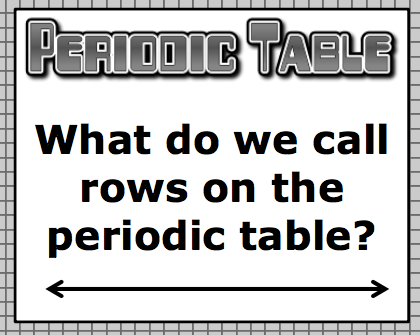
a)
Periods
b)
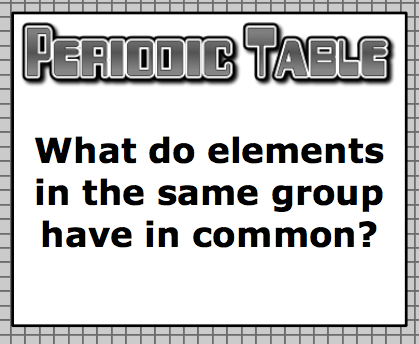
Groups
51.
a)
energy levels
b)
valence electrons
c)
protons
d)
neutrons
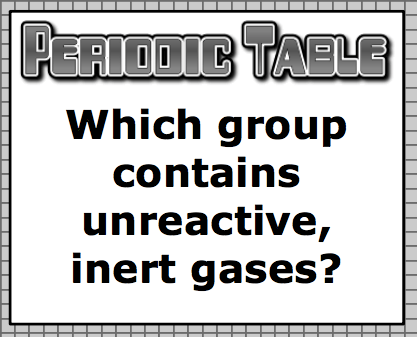
52.
a)
Group 1
b)
Group 17
c)
Group 2
d)
Group 18
53.

Which of the following describes covalent bonds?

a)

Bonds form because of opposite charges

b)

electrons are shared to fill outer electron shells

c)

Electrons are transferred between atoms

d)

Covalent bonds are magical

54.
Valence electrons are the...
a)
Innermost electrons
b)
Middle electrons
c)
Outermost electrons
d)
Any electrons
55.
Ionic bonds form between metals and ____.
a)
metalloids
b)
metals
c)
nonmetals
56.
What elements generally make a covalent bond?
a)
metal and nonmetal
b)
2 or more nonmetals
c)
metal
d)
none of the above
57.

Fill in the blank. (Copper has a charge of 2+)

Cu+ AgNO3 → Ag + _____

a)

Cu(NO3)2

b)

CuNO3

c)

CuAg

d)

Cu

58.

Predict the products of this synthesis reaction: H2 + Cl2

a)

HCl

b)

H2Cl2

c)

H2Cl

d)

HCl2

59.

Predict the products for the this Single Replacement reaction:

K + HCl →

a)

KCl + H2

b)

KHCl

c)

KH + Cl2

d)

HCl + K2

60.

Complete the balanced equation for this Double Replacement reaction.

3 NaOH + Fe(NO3)3

a)

NaFe + OH(NO3)3

b)

NaNO3 + Fe(OH)3

c)

3 NaNO3 + Fe(OH)3

d)

3 NaFe + 3 (OH)NO3

61.

Predict the product of this synthesis reaction:

Al + S₈ →

a)

AlS

b)

AlS8

c)

Al2S

d)

Al2S3

62.

What type of reaction occurs between an element and a compound?

Zn + 2HCl --> ZnCl2 + H2

a)

Synthesis

b)

Decomposition

c)

Single Replacement

d)

Double Replacement

63.
What does the Law of Conservation of Mass state?
a)
Matter cannot be gained or lost in a chemical reaction.
b)
Matter can only be lost in a chemical reaction.
c)
Matter can only be gained in a chemical reaction.
d)
Matter can be gained and lost in a chemical reaction. 
64.
What is the left part of a chemical equation called?
2H2 + O2 --> 2H2O
a)
Reactants
b)
Products 
c)
Yields 
d)
Chemical Equation 
65.
How many atoms of carbon (C) are in C6H12O6?
a)
3
b)
6
c)
12
d)
24
66.
Is the following equation balanced?...
Al + O2 --> 2Al2O3
a)
Yes!
b)
No!
67.
Which of the following reactions is balanced?
a)
2CH4 + O2 -> CO2 + H2O
b)
CH4 + 2O2 -> CO2 + H2O
c)
CH4 + 2O2 -> CO2 + 2H2O
d)
None of the chemical equations are balanced.