
 Worksheets
TWHS Unit 5 review
Total questions: 91
Worksheet time: 2hrs 42mins
A relationship between two organisms in which one organism benefits and the other is unharmed...
Mutualism
Commensalism
Parasitism
A relationship between two organisms in which both organisms benefit.
Mutualism
Commensalism
Parasitism
A relationship between two organisms in which one is benefited and the other is harmed.
Mutualism
Commensalism
Parasitism

A flea feeds on a mouse’s blood. This is good for the flea but bad for the mouse.
mutualism
commensalism
parasitism

Birds build nests out of dead twigs and leaves. They build their nests in living trees. This doesn't hurt the tree.
mutualism
commensalism
parasitism


Producers get their energy from
coffee
the soil
water
the sun

Organisms that have to eat other organisms are called
producers
autotrophs
consumers
prey

An organism that cannot make its own food is called a(n)
autotroph
heterotroph
producer

Organisms that can make their own food are called
Consumers
Producers
Omnivores
Decomposers

Another word for producer is
autotroph
heterotroph
carnivore
decomposer

According to the image, what is the producer?
plant
insect
mouse
snake


This diagram shows how energy flows through an eco-system. What is the first source of energy in this pyramid?
sharks and large birds
algae, plankton and seagrass
herbivorous fish, crustaceans and sea urchins
seals and carnivorous fish


The primary consumer is
Grass
Grasshopper
Mouse
Owl
How many calories will be passed on from 250 to the next trophic level?
2,500
25
2.5
10%
In an energy pyramid, energy _________ as you move up the pyramid.
increases
decreases
stays the same
changes up and down
A pyramid shape is used to show the amount of available energy at each trophic level because ...
energy amounts are the same at each trophic level.
energy decreases as you go up the food chain, just like the pyramid shape gets smaller as you go up.
energy increases up the food chain just like the pyramid shape gets smaller as you go up.

Organisms at higher trophic levels have less energy available to them than organisms at lower trophic levels
Organisms at higher trophic levels require smaller habitats than organisms at lower trophic levels
Organisms at lower trophic levels provide less energy than organisms at higher trophic levels
Organisms at lower trophic levels outcompete organisms at higher trophic levels

Chemosynthetic bacteria and amphipods
Zooplankton and mussels
Ratfish and octopuses (should be octopi but I'm just copying TEA here)
Galatheid crabs and zoarcid fish

Fish
Plants
Nitrobacter
Water
Decomposers break down a dead organism into ...
bacteria
harmful chemicals
nutrients
fungi
What is an example of a 'decomposer'?
tiger
fox
bacteria & fungi(mushrooms)

If the hawk population decreases, what will happen to the snakes and rabbits?
Snakes and rabbits will increase
Snakes and rabbits will decrease
Snakes will decrease, rabbits will increase
Snakes will increase, rabbits will decrease
What will happen if the snake population is DOUBLED?
The other populations will increase too
The other populations will decrease
Rabbits and hawks will decrease, grass will increase
Grass and hawks will increase, rabbits will decrease


The amount of energy the producers in this energy pyramid provide the primary consumers is 54,000 joules. From this amount, 540 joules are provided to tertiary consumers. Based on this model, how much energy was provided to secondary consumers?
53,460 J
5,400 J
540 J
54 J

Food webs such as the one shown to the right were first used in 1927 by the animal ecologist Charles Elton. The food web below represents the feeding relationships among organisms in an Alaskan ecosystem. An environmental change that removed which of these organisms from the ecosystem would cause the most instability in the ecosystem?
Auklets
Salmon
Foxes
Zooplankton
Decomposing bacteria feed on dead organisms and release nutrients into the soil. Without these bacteria, plants would ________?
Lack key nutrients necessary for survival
be much smaller than they are
have to act as decomposers too
be healthier because of less disease

The diagram shows a partial East Texas food web.
Which table correctly classifies these organisms?


According to the image, what is the secondary consumer?
plant
insect
mouse
snake

In this food web, who will be affected the most if the racoons became diseased and died?
Black Bear
Quall
Wolf
Hawks
In this food web, who will be affected the most if the racoons became diseased and died?
Black Bear
Quall
Wolf
Hawks
What converts nitrogen gas into a usable form for plants and animals?
bacteria
rain
fungi
car exhaust

The variety of life in an ecosystem.
Pioneer Species
Biodiversity
Abiotic Factors
Producers

Populations that normally live in an ecosystem: endemic, indigenous.
Native Species
Biotic Potential
Carrying Capacity
Pioneer Spcies

Populations that are introduced to an area and “take over.”
Abiotic Population
Biotic Potential
Native Species
Invasive species

The ability of an ecosystem to stay stable and recover quickly after a disturbance.
Ecosystem Instability
Ecosystem Stability
Biotic Potential
Biodiversity
What would most likely happen to the levels of carbon dioxide (CO₂) in the air and biodiversity if a wildfire occurred in a forest ecosystem?
CO₂ levels would decrease, and biodiversity would increase.
CO₂ levels would increase, and biodiversity would decrease.
CO₂ levels would stay the same, and biodiversity would increase.
CO₂ levels would increase, and biodiversity would remain unchanged.
Consider the following food chain:
Algae > Mayfly > Minnow > Trout
In a polluted ecosystem, which organism would likely have the HIGHEST level of toxic chemicals in its body?
Algae
Mayfly
Minnow
Trout
All living organisms would eventually die because the producers could not produce food


Which of the following are missing from the food web shown above?
omnivores
predators
producers
decomposers
Removing which of the following would cause the most instability in this ecosystem?
omnivores
predators
producers
decomposers
Invasive species cause damage to ecosystems by…(2 answers)
Increasing biodiversity
Outcompeting native species, causing the native species to decrease
Decreasing biodiversity
Increasing native plant or animal populations
Environmental changes or changes to the food chain _____________ biodiversity, which ultimately makes the ecosystem ____ stable.
increases, stable
increases, unstable
decreases, unstable
decreases, stable

Based on the food web, the population that contains the greatest amount of available energy would be
seals
fishes
phytoplankton
humans

Image "B" shows more biodiversity than image "A". Why?
Because "B" shows more different species than image "A"
Because image "B" has less different species than "A"
"A" has a greater number of same species plants so this statement is wrong.
Both images show the same biodiversity
The picture shows a pika, a small mammal found in grassland ecosystems. The vast grasslands of the Tibetan plateau are home to the plateau pika. The numerous pikas are prey for many predators of the grasslands, which serve as a major watershed for much of the area. The watershed drains large quantities of groundwater during the rainy season, or the monsoon season. Pikas have extensive burrows that help drain groundwater rapidly and are used as nesting sites by many bird species. However, many people advocate the eradication of the plateau pikas because they compete with livestock for grass.
Which of these will most likely happen if the plateau pikas are completely removed from the Tibetan plateau grasslands?
The ecosystem will become unstable because predators will have fewer prey, the birds will have fewer nesting sites, and the area downriver will become vulnerable to flooding without the burrows to aerate the soil and provide drainage for monsoon rains.
The ecosystem will become more stable because the pika will be replaced by other species of small mammals that can fill the niche, bird species will adapt to nesting aboveground, and the soils will become compacted without the burrows.
The ecosystem will become unstable because the predators will migrate to nearby ecosystems, the birds will nest in nearby trees, and the soils will be aerated by other small mammals.
The ecosystem will become more stable because the pika will no longer be there to eat the grasses, the birds will migrate to other ecosystems during nesting season, and the soils will be able to absorb more of the monsoon rains without the pika burrows.

What is an ecological disturbance?
A temporary change in environmental conditions that causes a pronounced change in an ecosystem.
A random event that has no impact on an ecosystem.
A gradual change in environmental conditions that causes a pronounced change in an ecosystem.
A permanent change in environmental conditions that causes a pronounced change in an ecosystem.

How do ecological disturbances affect ecosystems?
Ecological disturbances always lead to an increase in biodiversity.
Ecological disturbances only affect the physical environment, not species composition.
Ecological disturbances have no impact on ecosystems.
Ecological disturbances can disrupt the balance of species and alter the physical environment, leading to changes in biodiversity, species composition, and ecosystem functioning.

Why are Burmese pythons not a problem in their native Asia, but are a problem in Florida?
They are much bigger in Florida
Diseases, parasites, and predators help to control their population in Asia
They have more predators in Florida
They have less predators in Asia

In which organism would biomagnification be the most concentrated? (Remember the lab: Rabbits eat the grass, the snake eats the rabbit, the hawk eats the snake--the hawk is the apex predator)
grass
rabbit
snake
hawk
Toxin concentrations _____________ as you go up the food chain.
do not change
increase
decrease
What is a relationship that occurs when two or more organisms need the same resource at the same time?
Commensalism
Mutualism
Competition
Parasitism

According to this diagram, plants use nitrogen to make ________
bacteria
proteins
animals
decomposers

According to this diagram, animals get proteins from eating ______________
decomposers
bacteria
plants
sunlight

True or False: Bacteria fix nitrogen from the atmosphere into a form plants can use
True
False

True or False:
Bacteria release nitrogen from dead organisms into the soil
True
False
Which of these nitrogen cycle processes converts atmospheric nitrogen to a soil form of nitrogen that is usable by plants?
nitrogen fixation
denitrification
ammonification
assimilation

Which of the following processes in the nitrogen cycle is the conversion of soil nitrate to the nitrogen gases N2O and N2 by bacteria?
Nitrogen-Fixation
Decomposition
Nitrification
Denitrification

How nitrogen is "fixed" into useable form for plants
only through action of bacteria
only through lightning
through action of bacteria & lightning
through photosynthesis

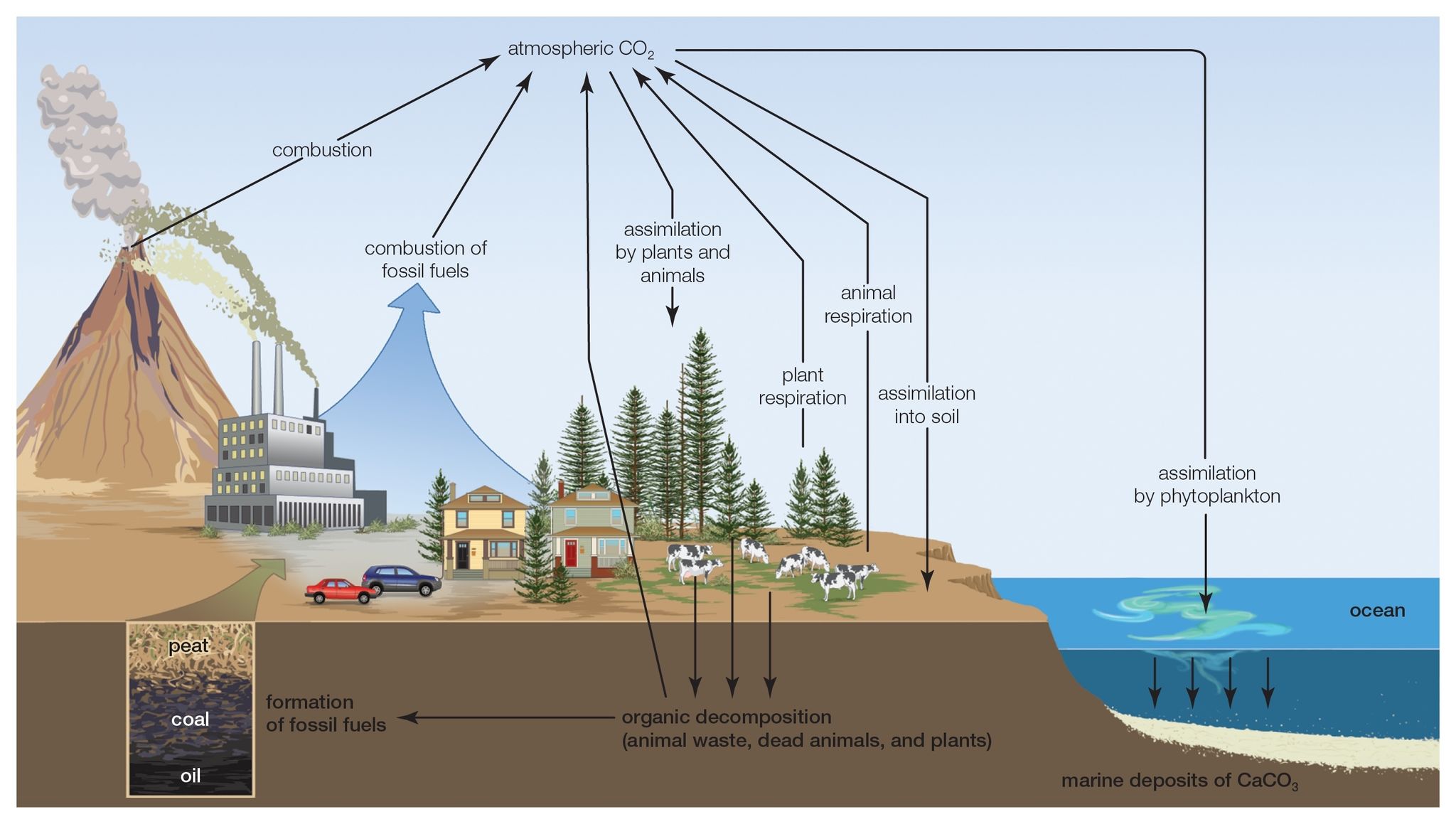
What part of the carbon cycle is represented by A?
photosynthesis
decomposition
combustion
cellular respiration

What part of the carbon cycle is represented by cow releasing CO2 back into the atmosphere?
photosynthesis
decomposition
respiration
combustion

What process is represented by D?
nitrification
assimilation
decomposition
denitrification

What process of the carbon cycle is represented by 2?
decomposition
respiration
combustion
photosynthesis
Which process in the nitrogen cycle can involve storms and lightning to move nitrogen gas to the soil in precipitation?
nitrification
ammonification
assimilation
nitrogen fixation
All of the carbon in existence is continually recycled in the carbon cycle.

Nitrogen moves through _____, ______ and ______.
Clouds, plants and soil
Air, water and animals
Air, water and soil
Nitrogen fixation...
animals eat the plants and other animals that contain nitrogen and release it through their waste
Bacteria in the soil and lightning in the atmosphere “fix” the nitrogen
Once in the ground, bacteria in the soil also nitrify the nitrogen
plants absorb nitrogen through their roots and return it back to the atmosphere
Denitrification...
animals eat the plants and other animals that contain nitrogen and release it through their waste
Bacteria in the soil and lightning in the atmosphere “fix” the nitrogen
nitrogen is released back into the atmosphere from the animal’s waste or decomposers
plants absorb nitrogen through their roots and return it back to the atmosphere
How does the chemical equation of photosynthesis:
6CO2 + 6H2O → C6H12O6 + 6O2,
model that this chemical reaction obeys the Law of Conservation of Matter?
because there are the same number of atoms of each element shown on both sides
because they both start and end with two sets of particles
because they both start and end with diatomic (two-atomed) molecules
because they both start and end with the same types of particles
According to the law of conservation of matter, in any food chain we know that
the amount of matter increases as the food web progresses from the producers to the consumers.
matter is created at the start of a food web and destroyed in the end.
matter is changed into various forms but the total quantity remains unchanged.
the quantity of matter in producers and consumers is always equal.

