wayground logo

Free Printable Worksheets

Font size

S
M
L
XL
Worksheets

IGCSE Physics Review Quiz

Total questions: 95

Worksheet time: 57mins

Name
Class
Date
1.
The specific heat of iron is 448. If a 10g block of iron was heated from 20 degrees to 70 degrees, how much energy was used to heat the block? About....
a)
200,000 J
b)
210,000 J
c)
225,000J
d)
250,000 J
2.
Energy cannot be created or destroyed.
a)
Law of Conservation of Matter
b)
Law of Conservation of Mass
c)
Law of Conservation of Energy
d)
All of the above
3.
Metal is a good...
a)
Conductor
b)
Insulator 
4.
Rubber is a good...
a)
Conductor
b)
Insulator
5.
The diagram shows a circuit with the bulb glowing. How does the energy change as it moves from inside the battery, along the wires, and through the light bulb?
a)
electrical → light → chemical
b)
light → electrical → chemical
c)
chemical → electrical → light
d)
chemical → light → electrical
6.
The picture shows a microwave oven. As a microwave oven is operated, electrical energy is transformed into all of the following types of energy EXCEPT —
a)
Solar
b)
Light
c)
Thermal
d)
Mechanical
7.
Which of the following shows the energy transformation that occurs when solar panels are used to heat a building?
a)
light → thermal
b)
chemical → electrical
c)
thermal → chemical
d)
light → mechanical
8.
What characteristic do all renewable resources share?
a)
Produced by waste products
b)
Form underground from dead organisms.
c)
Replaced in a short period of time
d)
Allow energy to pass through them easily
9.
Which of the following is a fossil fuel?
a)
Wind
b)
Coal
c)
Solar
d)
Biomass
10.
What is biomass? 
a)
energy from the sun
b)
energy from water
c)
energy from wind
d)
energy from plant and animal waste
11.
_____ is a force moving an object over a distance.
a)
Energy
b)
Work
c)
Force
d)
Ms Mel is silly
12.

What is the potential energy of a 2-kilogram potted plant that is on a 1 metre-high plant stand?

a)

1 J

b)

1.96 J

c)

19.6 J

d)

196 J

13.
What is the efficiency of a machine when the input is 263 J and the output is 142 J.
a)
1.85 %
b)
18.5 %
c)
5.39 %
d)
53.9 %
14.
Before a 4kg ball is pushed off a 5m ledge. How much PE does it have?
a)
19.6 J
b)
29.6 J
c)
50 J
d)
100 J
15.
How much KE in a 2 kg baseball moving at 10 km/per sec.
a)
10 J
b)
20 J
c)
50 J
d)
100 J
16.

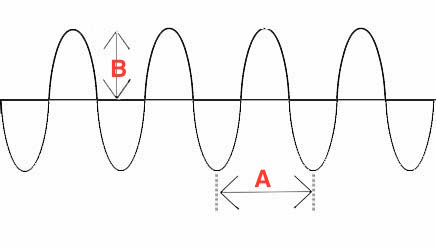
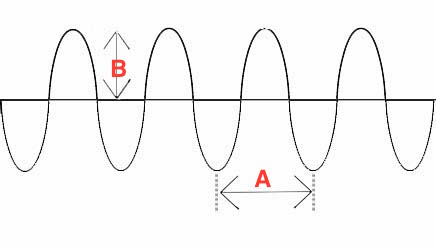
What property of this wave is represented by the letter "A"

a)

amplitude

b)

crest

c)

trough

d)

wavelength

17.
What property of the wave is represented by the letter "B"?
a)
amplitude
b)
crest
c)
trough
d)
wavelength
18.
The number of wavelengths that pass a point each per second is:
a)
frequency
b)
period
c)
longitudinal 
d)
transverse wave 
19.
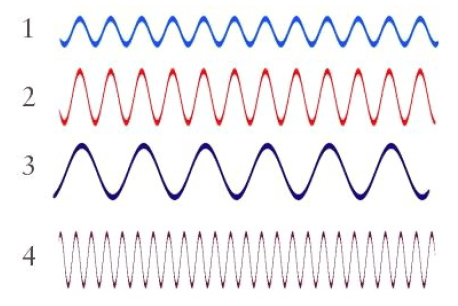
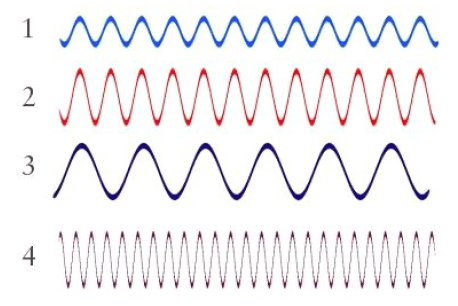
Which wave in the diagram has the greatest frequency?
a)
1
b)
2
c)
3
d)
4
20.
Which wave in the diagram has the greatest wavelength?
a)
1
b)
2
c)
3
d)
4
21.
Which of the following can sound travel through?
a)
solid
b)
liquid
c)
gas
d)
all of the above
22.
When a wave bends as it passes through at an angle from one medium to another.(example: pencil in a glass of water-)
a)
medium
b)
refraction
c)
reflection
d)
interference
23.
Amplitude is a measure of how much _________ the wave is carrying
a)
energy
b)
matter
c)
medium
d)
frequency
24.
The units for frequency are measured in _____________.
a)
hertz
b)
seconds
c)
m/s
d)
grams
25.
__________  have the most energy of the electromagnetic spectrum.
a)
infrared waves
b)
microwaves
c)
gamma rays
d)
x-rays
26.
What is the wavelength of the sound wave that has a frequency of 340 hertz as it travels through the air at 680 m/s?
a)
0.01 m
b)
0.5 m
c)
2.0 m
d)
200 m
27.
Wave that moves perpendicular to the motion of the wave
a)
transverse
b)
compressional
c)
physical 
d)
chemical
28.
The action of a wave bouncing off a surface is called __________________.
a)
rarefaction
b)
refraction
c)
reflection
d)
diffraction
29.
What kind of wave can travel through space?
a)
electromagnetic waves
b)
compressional waves
c)
transverse waves
d)
longitudinal waves
30.

The unit of energy is...

a)

Joules

b)

Newtons

c)

N/m

d)

Watts

31.

Elastic Potential energy =

a)

1/2mv2

b)

1/2kx2

c)

mgh

d)

Fd

32.

A ball rolling down a hill is a good example of which energy transfer?

a)

Elastic Potential to KE

b)

Chemical to KE

c)

KE to GPE

d)

GPE to KE

33.

Unit of Spring Constant:

a)

N

b)

N/m

c)

N/m2

d)

m

34.

Using the equation for Gravitational potential energy, mass =

a)

GPE/gh

b)

GPE x gh

c)

gh/GPE

35.
The gap between the readings in an experiment is called
a)
Range
b)
Interval
c)
Precision
d)
Accuracy
36.
When you forget to tare a weighing scale with a beaker on before measuring the mass of a powder, you make
a)
A random error
b)
An anomalous result
c)
A systematic error
d)
A fool of yourself
37.
If you investigate the relationship between the type of surface of a can and the infrared radiation it emits when containing hot water, you must keep all the same but
a)
The initial temperature of the water
b)
The surface
c)
The volume of water
d)
The temperature of the room
38.
The internal energy of particles is larger in
a)
A solid
b)
A gas
c)
A liquid
d)
A particle
39.
A change of state from liquid to solid is called
a)
Condensation
b)
Sublimation
c)
Solidifying
d)
Boiling
40.
The temperature of a glass of water at 4 degrees is placed in a room at 20 degrees. Heat transfer will be
a)
Into the water
b)
To the surroundings
c)
There won't be any heat transfer
41.
The unit of Specific Heat Capacity is
a)
Kilogram per Joule per Celsius degree
b)
Joule per kilogram per Celsius degree
c)
Celsius degree per Joule per kilogram
d)
Kilometre
42.
A liquid has
a)
Fixed shape and volume
b)
Fixed volume but not shape
c)
Fixed shape but not volume
d)
Neither a fixed shape nor a fixed volume
43.
Which bulb is most efficient?
a)
Receives 30 Joules, wastes 10
b)
Receives 40 Joules, wastes 10
c)
Receives 30 Joules, wastes 5
d)
Receives 40 Joules, wastes 5
44.
Which water power requires a floating generator?
a)
Tidal
b)
Hydroelectric
c)
Wave
d)
Toilet flush
45.
Which type of fuel can meet daily variations in electrcity demand
a)
Nuclear
b)
Biofuel
c)
Coal
d)
Gas
46.
Sound is a...
a)
Transverse wave
b)
Electromagnetic wave
c)
Mexican wave
d)
Mechanical wave
47.
The speed of a wave is
a)
Wavelength x frequency
b)
Frequency ÷ Wavelength
c)
Wavelength²
d)
Frequency
48.
The number of waves passing through a point per second is the...
a)
Frequency
b)
Wavelength
c)
Time period
d)
Amplitude
49.
The piece of equipment that is used to study water waves is
a)
A bath
b)
A think tank
c)
A ripple tank
d)
A rope tank
50.
The angle between an incoming ray of light and the surface of a material is the...
a)
angle of refraction
b)
90 - angle of incidence
c)
angle of incidence
d)
normal direction
51.
Diffraction: The narrower the gap
a)
The more diffraction
b)
The less diffraction
c)
changes nothing to diffraction
d)
The less the sumo is squeezed
52.
The wavelength of ultraviolet radiation is about
a)
10³m
b)
1m
c)
10⁻⁶m
d)
10⁻⁹m
53.
Quiet high pitched sound has
a)
High frequency, high amplitude
b)
Low frequency, low amplitude
c)
Low frequency, high amplitude
d)
High frequency, low amplitude
54.
What is the name for energy stored in a hot object?
a)
Thermal
b)
Potential
c)
Fire
d)
Electrical
55.

Which of these is a disadvantage of using wind turbines to generate electricity?

a)

They can be noisy.

b)

They release atmospheric pollution (CO2) when running.

c)

They produce dangerous waste that is difficult to dispose of.

56.

The amount of energy transferred by an appliance depends on...

a)

...its power and size.

b)

...its power and mass.

c)

...its power and the time it is on for.

57.

800 J of energy is supplied to a toaster with an efficiency of 25%. What is the useful output of the toaster?

a)

200 J

b)

775 J

c)

1000 J

58.

When a racket hits a ball, energy is transferred from the racket's kinetic energy store to the ball's kinetic energy store. This energy is transferred...

a)

...by heating.

b)

...electrically.

c)

...mechanically.

59.

Power is the...

a)

...conservation of momentum.

b)

...energy of a moving object.

c)

...rate of doing work.

60.

What is the name of a system in which there is no net change in the total energy?

a)

A closed system

b)

An open system

c)

A mechanical system

61.

Two materials with the same mass and different specific heat capacities are cooled by 10°C. Which material emits more energy?

a)

The material with the lower specific heat capacity

b)

The material with the higher heat capacity

62.

The rate of energy transfer from a house can be reduced by...

a)

...having walls with a low thermal conductivity.

b)

...having walls with a high thermal conductivity.

63.

True or False? "The current is the same at any point in a single closed loop of wire what is connected to a power supply."

a)

True

b)

False

64.

True or False? "Two components connected in parallel will each have the same potential difference across them."

a)

True

b)

False

65.

Increasing the potential difference of electricity at a given power...

a)

...increases the energy lost through heating.

b)

...decreases the current.

c)

...increases the rate of flow of charge.

66.

The resistance of an ohmic conductor at a constant temperature...

a)

...is higher when larger currents flow through it.

b)

...doesn't change as the current varies.

c)

...is low when the current flows in one direction, but much higher when current flows in the reverse direction.

67.

In a circuit with a fixed potential difference, what would happen to the current if you increased the resistance?

a)

The current would increase.

b)

The current would stay the same.

c)

The current would decrease.

68.

True or False? "Transformers are used to carry electricity all around the country."

a)

True

b)

False

69.

What type of resistor could be used in a sensing circuit designed to turn on an automatic night light when it gets too dark?

a)

diode

b)

thermistor

c)

LDR

70.

What is the name for electric current that is constantly changing direction?

a)

Alternating current (ac)

b)

Direct current (dc)

c)

Switching current (sc)

71.

True or False? "In a series circuit, the source potential difference is shared between all components."

a)

True

b)

False

72.

True or False? "Transmitting electricity at a higher potential difference and a low current is more energy efficient than transmitting at a low potential difference and a high current."

a)

True

b)

False

73.

Adding resistors in parallel decreases the total resistance of the circuit because...

a)

...it decreases the potential difference through the circuit.

b)

...it increases the total current that can flow around the circuit.

c)

...it decreases the charge that can flow through the circuit.

74.

Electric current is...

a)

...the driving force that pushes charges around a circuit.

b)

...a measure of how much charges slow down as they flow through a circuit.

c)

...the flow of electrical charge.

75.

Which wire inside a three-core cable is coated with blue plastic?

a)

Earth

b)

Live

c)

Neutral

76.

True or False? "Liquids are generally denser than solids and gases."

a)

True

b)

False

77.

True or False? "The temperature of a gas is related to the average energy in the kinetic energy stores of its particles."

a)

True

b)

False

78.

What is the specific latent heat of fusion?

a)

The amount of energy needed to melt 1 kg of a substance.

b)

The amount of energy needed to boil 1 kg of a substance.

c)

The amount of energy needed to condense 1 kg of a substance.

79.

The internal energy of a system is equal to...

a)

...the total energy that its particles have in their kinetic energy stores.

b)

...the total energy that its particles have in their potential energy stores.

c)

...the total energy that its particles have in their kinetic and potential energy stores.

80.

What is the specific heat capacity of a substance?

a)

The energy released by a substance when it freezes.

b)

The total energy stored by the particles in a system.

c)

The energy needed to raise the temperature of 1 kg of a substance by 1°C.

81.

Changes of state are different to chemical changes because...

a)

...changes of state can be reversed to recover the original properties of the material.

b)

...changes of state result in the creation of new substances.

c)

...changes of state cannot happen to gases.

82.

What happens to the mass of a substance when it changes from a solid to a liquid?

a)

It increases

b)

It decreases

c)

It stays the same

83.

What will happen to the pressure of a fixed volume of gas if its temperature is increased?

a)

It will decrease

b)

It will increase

c)

It will stay the same

84.

What is the name for atoms with the same number of protons but different numbers of neutrons?

a)

Ions

b)

Isomers

c)

Isotopes

85.

True or False? "The results of the alpha scattering experiment led to the development of the plum pudding model of the atom."

a)

True

b)

False

86.

The count rate of a radioactive sample falls from 130 Bq to 65 Bq in 15 minutes. What is its half-life?

a)

15 minutes

b)

30 minutes

c)

1 hour

87.

True or False? "Any exposure to ionising radiation will kill living cells."

a)

True

b)

False

88.

True or False? "When a radioactive nucleus emits a beta particle, its atomic number increases."

a)

True

b)

False

89.

Which type of radiation can penetrate the furthest into materials?

a)

Alpha

b)

Beta

c)

Gamma

90.

What happens to the resistance of a filament lamp as the temperature of the filament increases?

a)

It increases

b)

It decreases

c)

It stays the same

91.

What happens to a nucleus when it emits a gamma ray?

a)

Its mass decreases

b)

Its charge decreases

c)

Its mass and charge remain unchanged.

92.

A current of 0.21 A flows through a resistor for 3 s. How much charge has passed through the resistor?

a)

0.07 C

b)

0.63 C

c)

1.89 C

93.

True or False? "The pressure of a gas held at constant volume decreases if the temperature is decreased."

a)

True

b)

False

94.

What is the power of a device that transfers 20 J in five seconds?

a)

4 W

b)

20 W

c)

100 W

95.

Electricity is transferred across step-up transformers to...

a)

...increase its potential difference for transmission from power stations.

b)

...increase its potential difference for domestic use.

c)

...increase its current for transmission from power stations.