
 Worksheets
Dynamic Earth Full Review
Total questions: 90
Worksheet time: 57mins

According to the continental drift hypothesis, the presence of similar fossils in South America and Africa supports which scientific idea?
Animals easily and frequently travel from Africa to South America.
Species of animals probably traveled between continents on natural rafts (such as trees destroyed in tsunamis).
Land bridges once existed that connected the continents.
South America and Africa were once connected together.
The Appalachian Mountains in the U.S. match up with a similar mountain ranges in northern Europe. How does this support Wegener's theory of Continental Drift?
The mountains were formed after tectonic plates had moved away from each other
The similarities provide evidence North America & Europe were connected when the mountains formed.
Similar rock samples were found on the ocean floor and at the two mountain ranges indicating that they both formed around the same time.
This evidence does not support the theory of continental drift.
What type of evidence was used by Alfred Wegener to support his continental drift hypothesis? (Select 3)
evidence from landforms / geology
evidence from fossils
evidence from human remains
evidence from climate
Alfred Wegener used all of the following for evidence of his idea EXCEPT...
The shapes of the continents fitting together like a puzzle
Similar fossils on different continents
Comparable modern weather patterns on different continents
Similar rock formations on different continents
Alternating parallel bands of normal and reversed magnetic polarity are found in the basaltic bedrock on either side of the
Mid-Atlantic Ridge
Yellowstone Hot Spot
San Andreas Fault
Peru-Chile Trench
Which observation about the Mid-Atlantic Ridge region provides the best evidence that the seafloor has been spreading for millions of years?
the bedrock of the ridge and nearby seafloor is igneous rock
the ridge is the location of irregular volcanic eruptions
several faults cut across the ridge and nearby seafloor
seafloor bedrock is younger near the ridge and older farther away

Which diagram below best represents the pattern of magnetic orientation in the seafloor on the west (left) side of the ocean ridge?


Which inference can best be made from the diagram?
The orientation of the Earth's magnetic field has reversed with time.
The size of the continents has changed with time.
The elevation of sea level has changed with time.
The amount of fossil material preserved in the igneous rock has changed with time.
What formed the Hawaiian Islands?
Mantle Hot Spot
Trench
Subduction
Mid-Ocean Ridge
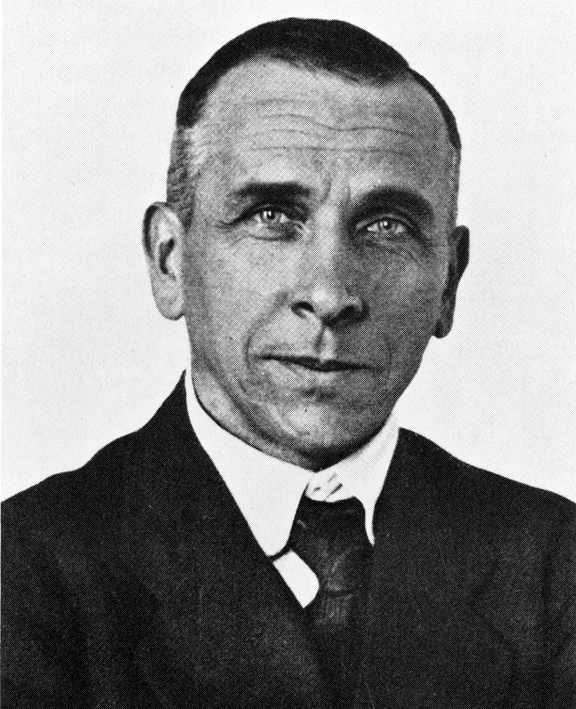
Who is the person credited with developing the theory of continental drift?
Harry Hess
Neils Bohr
Alfred Wegener
Albert Einstein
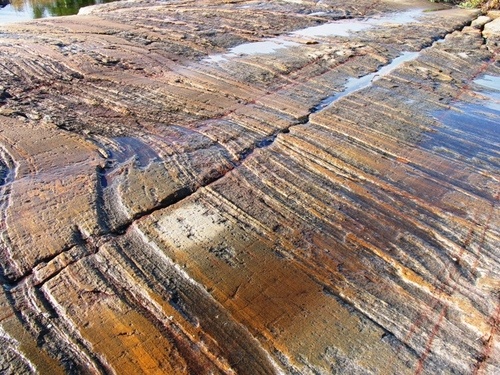
This is a picture of glacier scratches found on exposed bedrock in Africa. What are these evidence for?
Africa has always been near the equator
Africa was once in an area of the Earth that had a very cold climate
The continents have not moved
sea floor spreading
What does the theory of continental drift state?
The continents were once joined in a super-continent and have moved over time
Continents are stationary and do not move
The continents are currently moving together, and will eventually form a supercontinent called Pangea
none of the above
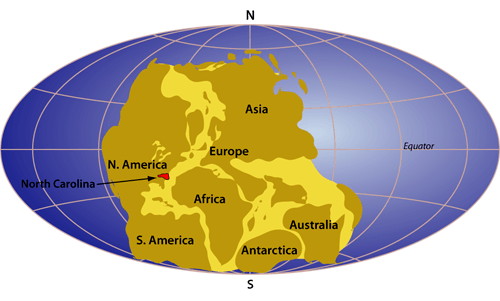
What is this a picture of?
plate tectonics
continental drift
pangea
Venus
According to Wegener's hypothesis of continental drift,
the continents float on top of the ocean because they are less dense than water
the continents DO NOT move
Earth is slowly cooling and shrinking
the continents were once joined together in a single landmass, and these plates will continue to move.
Seashell fossils in rock at the top of large mountain ranges are evidence that
sea level used to be much higher.
the seafloor has been uplifted.
contact metamorphism has occurred.
sea creatures used to be able to live on mountains.
The principle that sedimentary layers form in horizontal layers is called
the Law of Original Horizontality
the Law of Superposition
the Law of Uniformitarianism
the Law of Chuck Norris
Which choice shows FOLDING?


Which choice shows TILTING?
Which statement supports the theory of continental drift?
Basaltic rock is found to be progressively younger at increasing distances from a mid-ocean ridge.
Marine fossils are often found in deep-well drill cores.
The present continents appear to fit together as pieces of a larger land mass.
Areas of shallow-water seas tend to accumulate sediment, which gradually sinks.
Why did no one believe Wegener's ideas about continental drift?
He could not successfully explain how the continents moved
He didn't have evidence that supported his ideas that the continents have moved
They were biased against his ideas because he was a poet, not a scientist
He didn't use the right technology to gather data
Which plate boundary has the youngest crust?
Convergent (continental-continental)
Convergent (Subduction) continental-oceanic
Transform
Divergent
Ridges occur at which type of plate boundary?
Convergent (continental-continental)
Convergent (Subduction) continental-oceanic
Transform
Divergent
Trenches occur at which type of plate boundary?
Convergent (continental-continental)
Convergent (Subduction) continental-oceanic
Transform
Divergent
Convection currents occur in the
outer core
inner core
stiffer mantle
asthenosphere
What is the driving force behind plate tectonics?
Convection Currents
Volcanoes
Continental Drift
Magnetic Reversals
The presence of plant fossils in Greenland indicates that
Greenland was once much warmer.
Greenland currently has areas with tropical climates.
plants can grow on glaciers.
there were no animals on Greenland.
Alternating parallel bands of normal and reversed magnetic polarity are found in the basaltic bedrock on either side of the
Peru Chile Trench
Galapagos Hot Spot
San Andreas Fault
Mid Atlantic Ridge
Most volcanoes and earthquakes on Earth occur
at hot spots.
at plate boundaries.
at the center of large plates.
at the edge of continents.
Which type of crust is thicker?
Oceanic
Continental
Which type of crust is more dense?
Oceanic
Continental
Which type of crust is mostly composed of Granite and Rhyolite?
Oceanic
Continental
Which type of crust is more mafic?
Oceanic
Continental
What direction is the Nazca Plate moving?
North
South
East
West
Most hot spots are
randomly located.
on plate boundaries.
The Aleutian Trench was created by
convergence of the Pacific and North American plates.
convergence of the Pacific and Eurasian plates
divergence of the Pacific and North American plates.
divergence of the Pacific and Eurasian plates
Which plate is subducting at the boundary between the Eurasian Plate and Indian Australian Plate?
Eurasian Plate
Indian-Australian Plate
What type of boundary exists between the Scotia Plate and the Antarctic Plate?
Convergent
Divergent
Transform
Complex
Which type of plate boundary produces earthquakes?
Convergent only
Divergent only
Transform only
All plate boundaries
At which location is the Earth's crust thinnest?
Yellowstone Hot Spot
Mid Atlantic Ridge
Peru-Chile Trench
The center of Australia
If you could travel across the Atlantic Ocean from South America to Africa, the age of the rock on the ocean floor would get
older and then younger
younger and then older
younger
older
How do scientists know about Earth's inner layers?
Analyzing core samples from drilling rigs.
Analyzing seismic waves from earthquakes.
Analyzing igneous and sedimentary rock samples.
Asking the mole people who live deep within the Earth.
Which 2 layers make up the Lithosphere?
CHOOSE 2 ANSWERS!!
Crust
Rigid Mantle
Asthenosphere
Stiffer Mantle
What is the density of Granite?
2.7 g/cm3
3.0 g/cm3
3.4 g/cm3
5.6 g/cm3
What is the depth of the center of the Earth?
6000 km
6400 km
3.5 million km
13.1 km
Under a mid-ocean ridge, convection currents are...
rising
sinking
Under a trench, convection currents are
rising
sinking
Which is a way for scientists to infer the composition of Earth's core?
Analyzing the composition of meteorites
Studying lava from volcanoes
Collecting samples from the core
What is the composition of Earth's core?
Iron and nickel
Silicon and oxygen
Granite
Basalt
As depth inside Earth increases, pressure...
increases
decreases
stays the same
decreases, then increases
As depth inside Earth increases, temperature...
increases
decreases
stays the same
decreases, then increases
Which Earth layer is inferred to be liquid?
Inner Core
Outer Core
Stiffer Mantle
Lithosphere
How do scientists know if a layer of the Earth is liquid?
S-waves can not pass through liquid.
P-waves can not pass through liquid.
Scientists can detect the layer moving.
No seismic waves can pass through liquid.
On page 10 of your ESRT, you can tell the interior of the Earth is liquid where...
the temperature is hottest.
the pressure is highest.
the temperature is above the melting point.
the density is lowest.
What is the composition of Earth at a depth of 3500 km?
Iron and nickel
Granite
Basalt
Mantle rock
What is the temperature at the inner core-outer core interface?
6300°C
3.1°C
3.1 million °C
5100°C
What is the depth at the inner core-outer core interface?
6300 km
3.1 km
3.1 million km
5100 km
The pressure at the center of the Earth is __________ million atmospheres.
12.8-13.1
6300
6700
3.6
Which Earth layer has PARTIAL MELTING?
Inner Core
Outer Core
Stiffer Mantle
Asthenosphere
A sample of which Earth layer could have a density of 3.6 g/cm3?
Crust
Stiffer Mantle
Outer Core
Inner Core
In which of these Earth layers does the temperature increase fastest as depth increases?
Asthenosphere
Stiffer Mantle
Outer Core
Inner Core
In which Earth layer do most earthquakes take place?
Lithosphere
Asthenosphere
Stiffer Mantle
Outer Core
Which is true of lava and magma?
lava is above ground, magma is below ground
lava is below ground, magma is above ground
lava is mafic, magma is felsic
lava is felsic, magma is mafic
Which Earth layer is thinnest?
Crust
Asthenosphere
Stiffer Mantle
Outer Core
Inner Core
What is the thickness of the Outer Core?
5100 km
2900 km
2200 km
4000 km
What does 1 million "atmospheres" of pressure mean?
There is 1 million times more pressure than we feel from the atmosphere at that depth.
There are 1 million atmospheres inside the Earth at that depth.

An earthquake occurs 200 km below location B on this diagram. Location B is called the...
focus
epicenter
rigid mantle
seismograph
An earthquake occurs 200 km below location B on this diagram. This earthquake's location deep below the surface is called the
focus
epicenter
outer core
seismograph

Most major damage from earthquakes in the United States is likely to occur
at a divergent boundary only.
at a convergent boundary only.
at a mid ocean ridge and a divergent plate boundary.
at a transform plate boundary and a hot spot.
Which scale uses the measured strength of seismic waves?
Mercalli scale
Richter scale
Barometric scale
Bathroom scale
Which scale is based on the amount of damage done by an earthquake?
Mercalli scale
Richter scale
Barometric scale
Bathroom scale
Most earthquakes occur in Earth's
crust.
inner core.
outer core.
hydrosphere.

Which seismic station is closest to the epicenter of the earthquake?
A
B
C
They are all the same distance
Two seismic stations detect seismic waves from an earthquake. The closest station to the earthquake...
is the first to detect P-waves.
is the last to detect S-waves.
will measure the greatest time between P-waves and S-waves.
will measure the weakest S-waves.
Two seismic stations detect seismic waves from an earthquake. The furthest station from the earthquake...
is the first to detect P-waves.
is the first to detect S-waves.
will measure the greatest time between P-waves and S-waves.
will measure the strongest P-waves.
Which type of disaster is associated with earthquakes?
hurricane
asteroid
tornado
tsunami

As you travel away from the trench from A to B, earthquakes become
deeper
shallower
P-waves are _______________ than S-waves.
faster
slower
Which is true of P and S waves?
P-waves are push-pull; S-waves are side-to-side
P-waves are side-to-side; S-waves are push-pull
Which is true of P and S waves?
P-waves travel through all phases; S-waves travel through solid only
P-waves travel through solid only; S-waves travel through all phases
Earthquakes are
cyclic and predictable
non-cyclic and predictable
cyclic and unpredictable
non-cyclic and unpredictable
The magnitude of an earthquake is its
speed
strength
temperature
How far is a seismic station from an earthquake epicenter if the S-wave takes 9 minutes and 40 seconds to arrive?
2800 km
2400 km
6100 km
6200 km
How far is a seismic station from an earthquake epicenter if the P-wave takes 7 minutes and 20 seconds to arrive?
2000 km
4200 km
4000 km
4 km
How long does a P-wave take to travel 5300 km?
8 minutes & 40 seconds
8 minutes & 60 seconds
9 minutes & 0 seconds
15 minutes & 30 seconds
How long does an S-wave take to travel 2800 km?
5 minutes & 20 seconds
9 minutes & 40 seconds
9 minutes & 60 seconds
4 minutes & 20 seconds
S-waves are unable to travel through Earth's Outer Core because the Outer Core is
solid
liquid
Which of the following should you do to PREPARE for an earthquake?
SELECT MORE THAN ONE CORRECT ANSWER!!
Hide under a table.
Stand in a doorway.
Have extra food and water.
Have battery powered radio and flashlights.

Which seismic station detected the first S-waves?
A
B
C
Which seismic station measured the greatest difference between P-wave and S-wave arrival time?
A
B
C
Earthquakes can occur
at divergent plate boundaries only.
at transform boundaries only.
at convergent boundaries only.
at all plate boundaries.

