wayground logo

Free Printable Worksheets

NEW

Font size

S
M
L
XL
Worksheets

Unit 3 - Chemistry Revision

Total questions: 62

Worksheet time: 3hrs 42mins

Name
Class
Date
1.

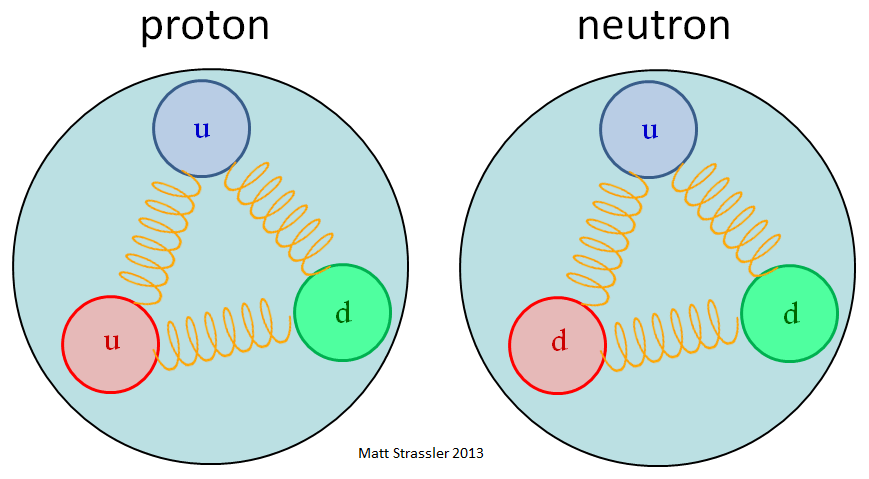
Subatomic particles with a negative charge

a)

Electrons

b)

Neutrons

c)

Protons

d)

Quarks

2.
Subatomic particles with a positive charge
a)
neutrons
b)
atomic mass
c)
protons
d)
isotopes
3.
Value representing the number of protons in an element
a)
Atomic Mass
b)
Mass Number
c)
Valence Electrons
d)
Atomic Number
4.
Subatomic particles that are neutral in charge
a)
Neutrons
b)
Protons
c)
Nucleus 
d)
Electrons
5.
Atoms of the same element with a different number of neutrons
a)
Ion
b)
Gluons
c)
Isotope
d)
Quarks
6.
A charged atom
a)
Ion
b)
Isotope
c)
Electron Cloud
d)
Quark
7.
Calculation used to find the number of neutrons in an atom
a)
Atomic Mass - Atomic Number
b)
Atomic Number - Atomic Mass
c)
Atomic Mass - Electrons
d)
none of these
8.
The only element with no neutrons in its nucleus.
a)
Oxygen
b)
Helium 
c)
Hydrogen
d)
Lithium
9.
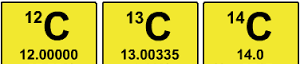
What do these isotopes of carbon all have in common?
a)
neutrons & mass number
b)
atomic number and neutrons
c)
atomic number and electrons
d)
protons, atomic number, and mass number
10.
How many neutrons does the isotope of lithium have?
a)
8
b)
3
c)
4
d)
5
11.
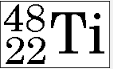
How many protons does this isotope of titanium have?
a)
48
b)
22
c)
26
d)
70
12.
In a correctly written symbol what would be located in the "A" position?
a)
number of neutrons
b)
atomic number
c)
number of electrons 
d)
mass number
13.
What quantities vary between isotopes of an element?
a)
protons, electrons, and atomic mass
b)
protons, electrons, and atomic number
c)
neutrons and electrons
d)
neutrons and atomic mass
14.
How many neutrons in C-14?
a)
6
b)
7
c)
14
d)
8
15.

Isotopes are atoms of the same element with different #’s of __________ & therefore different __________.

a)

neutrons ; atomic number’s

b)

protons ; atomic number’s

c)

electrons ; atomic masses

d)

neutrons ; atomic masses

16.
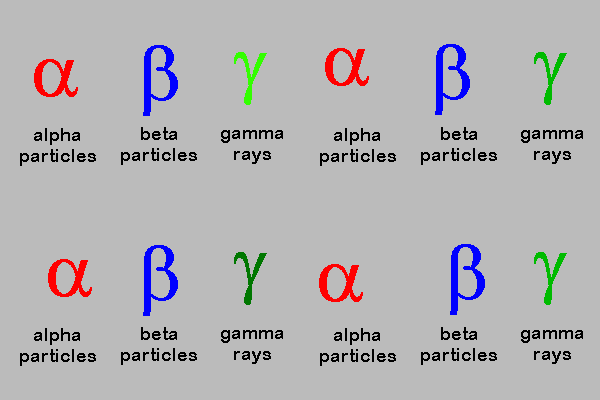
In order of most to least penetrating radiation we have
a)
Alpha , Beta,  Gamma
b)
Beta , Gamma , Alpha
c)
Gamma, Beta, Alpha
d)
Gamma, Alpha, Beta
17.
What type of radiation can be stopped by a piece of paper?
a)
Alpha radiation
b)
Beta radiation
c)
Gamma radiation
18.
What type of radiation can be stopped by a approximately 5 cm of air?
a)
Alpha radiation
b)
Beta radiation
c)
gamma radiation
19.
What type of radiation can be stopped by a approximately 1 m of air?
a)
Alpha radiation
b)
Beta radiation
c)
gamma radiation
20.
What type of radiation can be stopped by a 5 mm piece of aluminium?
a)
Alpha radiation
b)
Beta radiation
c)
gamma radiation
21.
What type of radiation can be stopped by a thick lead sheet?
a)
Alpha radiation
b)
Beta radiation
c)
gamma radiation
22.
_______________ is the process by which unstable atoms emit radiation until they become stable.
a)
Radiation
b)
Chemical Reaction
c)
Radioactive Decay
d)
Isotopes
23.
A helium nucleus with two protons and two neutrons is called a(n) ____.  
a)
alpha particle
b)
electroscope
c)
beta particle
d)
gamma ray
24.
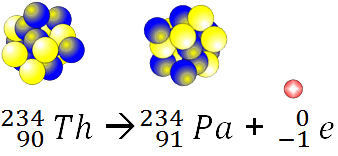
Which type of nuclear radiation is being emitted here?
a)
Alpha
b)
beta
c)
gamma 
d)
none
25.
Solve this equation for alpha decay.
85209At = ___ + 24He
a)
83205Bi
b)
86209Rn
c)
81207Tl
d)
85208At
26.

Gamma rays have

a)

no mass

b)

a huge mass

c)

a small mass

d)

an average mass

27.
Solve this equation for beta decay.
614C = ___ + -10e
a)
410Be
b)
714N
c)
210He
d)
613C
28.

During beta-particle emission, a neutron splits into a____________________.

a)

proton and electron

b)

neutron and electron

c)

neutron and proton

29.
Uranium-238  decays into  Thorium-234  by emitting .........
a)
an alpha particle
b)
a beta particle
c)
gamma rays
d)
visible light
30.
The Law of Conservation of Mass states
a)
that matter exists in all states and reacts the same
b)
that matter can only be changed into new substances by introducing a catalyst
c)
that matter exists in the same state throughout any chemical change
d)
that matter cannot be created or destroyed and that the mass of the products must equal the mass of the reactants
31.
How many Al atoms are in this compound?         4Al2O3
a)
2
b)
8
c)
6
d)
4
32.
How many F atoms are in this compound?
6MgF2 
a)
2
b)
6
c)
8
d)
12
33.
A chemical change is different than a physical change because in a chemical change
a)
Chemicals are used
b)
Molecules do not physically touch
c)
A new substance is formed and in a physical change no new substance is formed
d)
The change can be seen but in a physical change it cannot
34.
The left side of the equation below is called
a)
Products
b)
Reactants
35.
The right side of the equation below is called the
a)
products
b)
reactants
36.
A chemical reaction that absorbs heat
a)
Single replacement
b)
Exothermic
c)
Endothermic
d)
Decomposition
37.
In a chemical reaction
a)
The atoms of the reactants always stay together to form the products
b)
The atoms of the reactants unbond, rearrange, and then rebond to form the products
c)
New atoms are formed which combine to make the products
d)
Some atoms disappear while others multiply to form the products
38.
Which of the following answers will balance the equation below?
__K + __Br2 --> __KBr
a)
2, 1, 1
b)
2, 3, 2
c)
2, 1, 2
d)
1, 2, 3
39.
Which of the following options correctly balances the equation below?
__HNO+ __O2 --> __HNO3
a)
4, 1, 4
b)
1, 2, 1
c)
1, 2, 1
d)
2, 1, 2
40.
Which of these isn't in the fire triangle?
a)
Fuel
b)
Heat
c)
Oxygen
d)
Carbon dioxide
41.
Another term for burning is
a)
Fire triangle
b)
Magnesium oxide
c)
Combustion
d)
Bustion
42.
The conditions which are required for combustion to take place are:
a)
fuel
b)
heat
c)
oxygen
d)
all of these
43.
A compound that contains only carbon and hydrogen and that produces carbon dioxide and water when burned is called a(n)
a)
binary compound
b)
carbonate
c)
ionic compound
d)
hydrocarbon
44.

8.7: Combustion is when a __________ reacts with oxygen

a)

petrol

b)

fuel

c)

fire triangle

d)

carbon dioxide

45.
The word equation for combustion is: fuel + oxygen --> water + ________ __________
a)
Carbon dioxide
b)
Limewater
46.
Complete combustion is when there is plenty of oxygen to react with. 
a)
True
b)
False
47.
Incomplete combustion is when there is a limited amount of oxygen.
a)
True
b)
False
48.
What does incomplete combustion produce that complete combustion doesn't?
a)
Carbon monoxide
b)
Water
49.
What is carbon monoxide?
a)
A toxic gas
b)
A large solid
50.

Which of the following statements is true concerning acids and bases?

a)

acids and bases don't react with each other

b)

acids mixed with bases neutralize each other

c)

acids mixed with bases make stronger bases

d)

acids mixed with bases make stronger acids

51.

True or false: bases are sometimes called alkaline.

a)

True

b)

False

52.

Which is the correct set of acid properties, as described by Boyle:

a)

sour taste, corrosive, change litmus from red to blue

b)

sour taste, corrosive, change litmus from blue to red

c)

sweet taste, slippery, change litmus from blue to red

d)

sour taste, slippery, change litmus from blue to red

53.

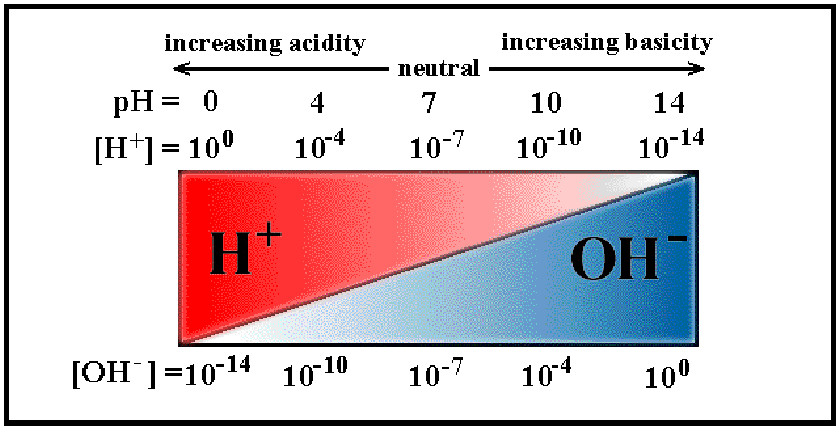
Neutral solutions have a pH of:

a)

0

b)

1

c)

7

d)

14

54.

True or false: a neutral solution has equal amounts of H+ and OH-.

a)

True

b)

False

55.

Which is true?

a)

pH of less than 7 is basic; pH of more than 7 is acidic

b)

pH of less than 7 is acidic; pH of more than 7 is basic

56.

Is pure water acidic, basic, or neutral?

a)

Acidic

b)

Basic

c)

Neutral

57.

Water found near sources of air pollution tends to be:

a)

Acidic.

b)

Basic.

c)

Neither. Air pollution doesn't alter the pH of water.

58.

Which is a characteristic of a base?

a)

tastes sour

b)

found mostly in foods

c)

feels slippery

d)

turn litmus paper red

59.

Stronger acids have a pH closer to...

a)

7

b)

0

c)

14

d)

9

60.

The pH scale is a range from:

a)

1-7

b)

0-14

c)

1-5

d)

1-14

61.
A(n) ______ is a substance with a pH less than 7
a)
Acid
b)
Alkaline
c)
Base
d)
Buffer
62.
A solution with a pH of 8.6 would be...
a)
Acid
b)
Base
c)
Neutral
d)
Acid and Base