wayground logo

Free Printable Worksheets

Font size

S
M
L
XL
Worksheets

All About Plates 2

Total questions: 62

Worksheet time: 21mins

Name
Class
Date
1.
A plate boundary at which two plate move parallel to each other in opposite directions
a)
convergent plate boundary
b)
divergent plate boundary
c)
transform plate boundary
d)
subduction
2.
a boundary at which two plates move away from each other
a)
convergent plate boundary
b)
divergent plate boundary
c)
transform plate boundary
d)
subduction
3.
a boundary at which two plate move toward each other
a)
convergent plate boundary
b)
divergent plate boundary
c)
transform plate boundary
d)
subduction
4.

What feature is formed on the continental crust at an oceanic-continental convergent boundary?

a)

volcanoes

b)

mid-ocean ridge

c)

ocean trench

d)

none of these features are formed at a oceanic-continental convergent boundary

5.

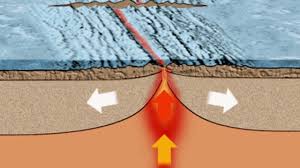
What type of boundary is in this image?

a)

convergent plate boundary

b)

divergent plate boundary

c)

transform plate boundary

d)

subduction

6.
What type of boundary is in this image?
a)
convergent plate boundary
b)
divergent plate boundary
c)
transform plate boundary
d)
subduction
7.
What new feature forms at a convergent plate boundary where two continental plates collide?
a)
mid-ocean ridge
b)
trench
c)
mountain range
d)
none of these features form
8.

What is the correct order (starting from the surface) of Earth’s layers?

a)

crust, outer core, inner core, mantle

b)

mantle, outer core, inner core, crust

c)

crust, mantle, outer core, inner core

d)

outer core, inner core, crust, mantle

9.

In sea-floor spreading, molten material rises from the mantle and erupts

a)

along the edges of all the continents.

b)

along mid-ocean ridges.

c)

in deep-ocean trenches.

d)

at the north and south poles.

10.

The process by which the ocean floor sinks beneath a deep-ocean trench and back into the mantle is known as _______

a)

convection.

b)

continental drift.

c)

subduction.

d)

conduction.

11.

Most geologists think that the movement of Earth’s plates is caused by _______

a)

convection.

b)

continental drift.

c)

subduction.

d)

conduction.

12.

The geological theory of _______ states that pieces of Earth’s lithosphere are in constant, slow motion.

a)

subduction

b)

plate tectonics

c)

deep-ocean trenches

d)

sea-floor spreading

13.

Scientists think that convection currents flow in Earth’s

a)

continents.

b)

mantle.

c)

lithosphere.

d)

inner core.

14.

Below is a picture of sea-floor spreading. How are the ocean crusts moving?

a)

Converging

b)

Diverging

c)

Sliding

d)

No movement

15.

The San Andreas Fault in California is known as an active earthquake area. What type of

boundary is it?

a)

Converging

b)

Diverging

c)

Transform

d)

Sea Floor Spreading

16.

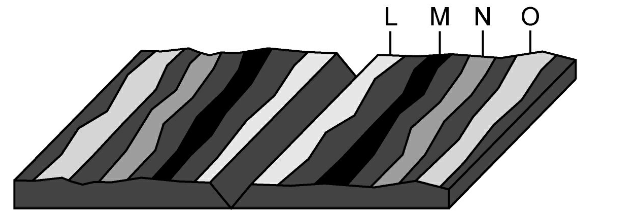
Given this is near a divergent plate boundary, where would the oldest rock be found?

a)

L

b)

M

c)

N

d)

O

17.
How is it possible for new crust to be formed without increasing the surface area of the Earth?
a)
Crust is destroyed at the same time it is created
b)
New crust is underwater where it sinks
c)
New crust breaks more easily than old crust
18.
This layer of Earth is the thickest part
a)
crust
b)
outer core
c)
mantle
d)
inner core
19.
The Himalayas in Asia are an example of what type of plate boundary?
a)
divergent
b)
continent-to-continent convergent
c)
ocean-to-continent convergent
d)
transform
20.
What are the two types of crust?
a)
continental and oceanic
b)
ocean and basin
c)
lower and upper
d)
thick and thin
21.
Mountains form from ...
a)
plates sliding past one another
b)
collision of plates
c)
plates moving away from each other
22.
What type of features are associated with a divergent boundary?
a)
Rift valleys
b)
Volcanic mountains
c)
Fold mountains
d)
Fault block mountains
23.
The mechanism that moves continents is based on heat energy moving by
a)
Radiation in the core
b)
Conduction in the lithosphere
c)
Convection in the Asthenosphere
d)
None of these options is true
24.

What two mechanisms do scientists think help convection currents in mantle move plates?

a)

Ridge push and Slab pull

b)

Normal and Reversed magnetism

c)

Action and Reaction tectonic forces

d)

Gravitational and Rotational pull

25.
Which of these phenomenon is not directly cased by plate tectonics 
a)
Volcanic eruptions
b)
Earthquakes
c)
Tsunamis
d)
Landslides
26.
A subduction zone is formed...
a)
when one tectonic plate sinks below another
b)
at every type of convergent plate boundary
c)
at every type of divergent plate boundary
d)
at transform boundaries
27.
When does a divergent plate boundary form?
a)
when a denser plate sinks below a more buoyant plate
b)
when two plates slide past each other
c)
when two plates separate
d)
when two plates collide
28.
What is the heat source for convection in the mantle?
a)
the Crust
b)
the Mantle
c)
the Core
29.
Hot matter is _________ dense and ___________
a)
less, sinks
b)
less, rises
c)
more, sinks
d)
more, rises
30.
The part of the Earth that is a solid ball of iron and nickel
a)
inner core
b)
outer core
c)
mantle
d)
crust
31.

The asthenosphere makes up the?

a)

Upper portion of the mantle

b)

The lower portion of the crust

c)

Upper portion of the outer core

d)

Inner portion of the outer core

32.
What happens to density as we move from the crust to the inner core?
a)
Density Decreases
b)
Density Increases
c)
Density decreases and then increases
33.
Plates move away from each other at ___________ boundaries.
a)
divergent
b)
convergent
c)
transorm
d)
submergent
34.
Plates move towards each another at ______________ boundaries.
a)
divergent
b)
convergent
c)
transform
d)
detergent
35.
Plates slide past each other at ____________ boundaries.
a)
divergent
b)
convergent
c)
transform
d)
submergent
36.
What would you be most likely to find at a DIVERGENT boundary between two pieces of oceanic crust?
a)
Mountains
b)
Mid-Ocean Ridge
c)
Volcanoes
37.
Earth's lithosphere is broken into separate sections called
a)
plates
b)
faults
c)
trenches
d)
rifts
38.
In the convection current of a pan of soup, the cooler, denser fluid
a)
rises to the top
b)
sinks to the bottom
c)
stays where it is
d)
stays on the top
39.
The ____________________ is the part of the mantle that can bend like plastic.
a)
core
b)
mantle
c)
crust
d)
asthenosphere
40.

Which of the following is NOT caused by plate movement?

a)

Earthquakes in California

b)

Mt. Fuji Volcano in Japan

c)

Grand Canyon in Arizona

d)

Great Rift Valley in Africa

41.

Subduction occurs when two plates separate from each other.

a)

True

b)

False

42.

What is this boundary?

a)

Convergent, Where two tectonic plates come together

b)

Divergent, Where two tectonic plates move apart

c)

Transform, Where two tectonic plates slide past each other

d)

None of the above

43.

What is true about density? (More than 1 answer)

a)

It is the amount of matter in a specific volume

b)

When most things are heated they become less dense

c)

Less dense objects rise

d)

When most thing are cooled they become more dense

e)

More dense object sink

44.

How is gravity important to Earth?

a)

Generally more dense objects have more mass which causes them to have a greater attraction of gravity. This means the more dense objects attracted the more dense objects. This caused the inner layers of Earth to be most dense. The gravitational attraction is still pulling matter to the center of the Earth.

b)

That is the most outrageously incorrect statement I have ever heard about how the layers of the Earth formed and how it is affecting Earth today.

45.

What is the theory of plate tectonics? (More than 1 answer)

a)

Earth is made up giant sections of the lithosphere (crust+upper mantle) that floats on top of the asthenosphere and these are considered tectonic plates

b)

Tectonic plates meet at places called boundaries that create cracks in the surface of the Earth

c)

Tectonic plates are slowly moving because of the convection in the liquid mantle

d)

The Earth's crust is one rigid layer that doesn't move

e)

All of the landforms on Earth were formed when the crust cooled and trapped a large portion of the Earth's matter inside of the Earth

46.
When comparing the Earth's crust to the core, the core is.....
a)
less dense, cooler, and has more iron
b)
less dense, hotter and less iron
c)
more dense, hotter, more iron
d)
more dense, cooler, less iron
47.
What would explain the formation of this trench?
a)
Sea Floor Spreading
b)
Weathering & Erosion
c)
Convergence of ocean plates
d)
Transform boundary faulting
48.
The movement of the plates is most likely driven by...
a)
Gravity
b)
Convection in the mantle
c)
Convection in the ocean
d)
Sea Floor Spreading
49.
If an island arc is formed, what can we assume about the plate movement?
a)
a deep ocean trench is found along the edge of the arc
b)
a transform fault is between the islands
c)
the crust along the arc is longer than the volcanic islands
d)
fossils from one plate match fossils from another
50.
What was the geologic process that caused this mountain range to form?
a)
An earthquake
b)
two continental plates collided
c)
a plate moved over a hot spot
d)
movement at a transform boundary
51.

What is true about the Earth's plates?

a)

The are made of solid rock that can never be seen.

b)

They are made of solid rock that can be seen if not covered by soil, rock, or water.

52.
Which type of crust is more dense?
a)
oceanic
b)
continental
c)
divergent
d)
pizza
53.
The Himalayan mountains have some of the highest peaks like Mt. Everest, on which type of convergent boundary are they located?
a)
Oceanic/Continental
b)
Oceanic/Oceanic
c)
Continental/Continental
d)
None of the above
54.
What type of event will occur at this boundary?
a)
Earthquake
b)
Volcano Eruption
c)
Tornado
d)
Mountain Building
55.

Theory that Earth's crust is divided into plates & the plates move around on the mantle

a)

Seafloor spreading

b)

Plate tectonics

c)

Continental drift

d)

Earthquakes

56.

Shaking of the ground caused by sudden movement of large blocks of rocks along a fault

a)

Earthquake

b)

Volcano

c)

Tsunami

d)

Surface waves

57.

What do geologists notice about the rocks along the sea floor?

a)

They get older as they get farther away from mid ocean ridges

b)

They get thicker closer to continents

c)

Density is impossible to measure

d)

Youngest parts of the crust are along the continents

58.

Why is the upper mantle liquid, but the lower mantle is solid?

a)

Upper mantle is hotter

b)

Lower mantle is under higher pressure

c)

Upper mantle is under higher pressure

d)

Lower mantle is hotter

59.
This layer of Earth is solid Iron and Nickel
a)
Outer Core
b)
Mantle
c)
Inner Core
d)
Crust
60.
When one plate sides under neath another, it _________ and the magma _________.
a)
hardens, sinks
b)
melts, sinks
c)
hardens, rises
d)
melts, rises
61.
Heat transfers within the Earth 
a)
Conduction
b)
Convection Current
c)
Ocean Current
d)
Radiation
62.
Which of these layers is ALL SOLID  iron and nickel?
a)
inner core
b)
outer core
c)
lithosphere
d)
mesosphere