wayground logo

Free Printable Worksheets

Font size

S
M
L
XL
Worksheets

Earth Science: Astronomy Review

Total questions: 57

Worksheet time: 43mins

Name
Class
Date
1.
What is the difference between the inner planets and the outer planets?
a)
The outer planets are smaller than the inner planets 
b)
The inner planets are smaller than the outer planets
c)
The outer planets have more rocks than the inner planets
d)
the inner planets are heavier than  the outer planets
2.
Venus is called Earth's twin because they are about the same size
a)
True 
b)
False
3.
The gas giants are different from the terrestrial planets because they
a)
have smaller atmospheres
b)
are less dense
c)
have larger atmospheres
d)
are more colorful
4.
The inner planets are called terrestrial planets because they are composed of
a)
water
b)
gas
c)
frozen surfaces
d)
rocks
5.
One factor that makes life possible on Earth is
a)
an atmospher
b)
water
c)
greenhouse effect
d)
gravity
6.
The first planet of the solar system?
a)
Sun
b)
Venus
c)
Earth
d)
Mercury
7.
The largest planet is
a)
Jupiter
b)
Saturn
c)
Neptune
d)
Pluto
8.
Movement of Earth around the sun.
a)
Rotation
b)
Revolution
9.
Spinning of Earth on its axis.
a)
Rotation
b)
Revolution
10.

Occurs when Earth is positioned between the moon and the sun and when Earth's shadow crosses the lighted half of the moon.

a)

Solar Eclipse

b)

Eclipse

c)

Lunar Eclipse

d)

Perigee

11.
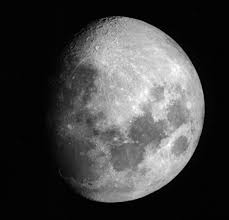
Name the moon phase
a)
waning crescent
b)
waxing crescent
c)
waning gibbous
d)
waxing gibbous
12.
Which moon phase is shown in this diagram?
a)
new moon
b)
first quarter
c)
full moon
d)
last quarter/3rd quarter
13.
Tides are caused by ___________
a)
wind
b)
gravitational pull of moon
c)
waves gravitation toward land
d)
rain
14.
Waxing means...
a)
Growing
b)
Dying
c)
Losing light
d)
Moving
15.
Name the phase of the moon for letter f
a)
Waning Gibbous
b)
Waxing Gibbous
c)
Waning Crescent
d)
Waxing Crescent
16.
A small object that appears as a streak of light as it enters earth's atmosphere.
a)
Asteroid
b)
Comet
c)
Moon
d)
Meteor
17.

Which model of the solar system has the sun in the center with all of the planets orbiting it?

a)

heliocentric

b)

geocentric

18.

Which statement best describes the geocentric model

of our solar system?

a)

The Earth is located at the center of the model

b)

The Sun is located at the center of the model.

c)

All planets revolve around the Sun.

d)

All planets except the Earth revolve around the Sun.

19.

Planets that are closest to the Sun are identified as

a)

low-density Jovian

b)

low-density terrestrial

c)

high-density terrestrial

d)

high-density Jovian

20.

As a rotating cloud collapses its rate of rotation

a)

decrease

b)

increase

c)

remains the same

21.

One factor responsible for the strength of gravitational attraction between a planet and the Sun is the

a)

degree of tilt of the planet's axis

b)

planet's period of rotation

c)

amount of insolation given off by the Sun

d)

distance between the planet and the Sun

22.

Which event takes the most time?

a)

one revolution of Earth around the Sun

b)

one revolution of Venus around the Sun

c)

one rotation of the Moon on its axis

d)

one rotation of Venus on its axis

23.

Which type of eclipse has a New Moon?

a)

solar eclipse

b)

lunar eclipse

24.

Which type of eclipse has a Full moon?

a)

solar eclipse

b)

lunar eclipse

25.

Number one in the diagram, is pointing to what part of the Earth's Shadow?

a)

umbra

b)

penumbra

26.

Number two in the diagram, is pointing to what part of the Earth's Shadow?

a)

umbra

b)

penumbra

27.

Which type of eclipse happens during the day?

a)

solar eclipse

b)

lunar eclipse

28.

What type of eclipse happens at night?

a)

solar eclipse

b)

lunar eclipse

29.

Which statement explains how a lunar eclipse happens?

a)

when the sun moves into the Earth's shadow

b)

when Earth moves into the sun's shadow

c)

when Earth moves into the moon's shadow

d)

when the moon moves into the Earth's shadow

30.
What layer of Earth is unique when compared to the other terrestrial planets?
a)
Hydrosphere
b)
Atmosphere
c)
Crust
d)
Mantle
31.
How old is our solar system?
a)
14 billion years
b)
4.6 billion years
c)
13.2 billion years
d)
225 million years
32.

In which area of the sun does gas rise as it heats up, then fall back down as it cools?

a)

the core

b)

the radiative zone

c)

the convective zone

d)

the corona

33.
When we look at the sun, what layer are we viewing?
a)
photosphere
b)
chromosphere
c)
corona
d)
convection zone
34.
What layer of the sun's atmosphere gives the sun its "white halo" during a solar eclipse?
a)
chromosphere
b)
photosphere
c)
corona
d)
atmosphere
35.
The particles of the corona extends into space for millions of kilometers and spreads into streams of electrically charged particles called:
a)
coronal discharge
b)
solar flares
c)
coronal ejection
d)
solar winds
36.
Areas of gas on the sun's surface that are cooler than gases around them are called:
a)
corona
b)
prominences
c)
sunspots
d)
solarspots
37.
Huge loops of reddish gas that connect sunspots are called:
a)
prominences
b)
solar flares
c)
coronal loops
d)
solar wind
38.
Most of the sun’s energy is a result of
a)
nuclear fusion  
b)
nuclear fission
c)
atomic reactions
d)
coronal mass ejection
39.
The sun converts matter into energy in the
a)
corona.
b)
radiative zone
c)
convection zone
d)
core
40.
What elements make up most of the sun’s mass?
a)
carbon and oxygen
b)
carbon and hydrogen
c)
helium and nitrogen
d)
hydrogen and helium
41.
What is a light year?
a)
the speed that light travels in a year
b)
the speed that light travels from the sun to earth
c)
the distance light travels in a year
42.
How much of the solar system's total mass is the sun?
a)
Less than 10%
b)
Approximately half
c)
73.8%
d)
Over 99%
43.
Our sun will eventually become a __________.
a)
Black hole
b)
Neutron star
c)
Pulsar
d)
White Dwarf
44.
Planets orbit the Sun in a shape called a(n)
a)
circle
b)
ellipse
c)
focus
d)
perihelion
45.
An ellipse is drawn around two points called
a)
aphelion
b)
perihelion
c)
foci
d)
axis
46.
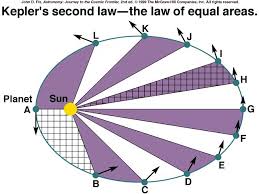
Where is the planet moving faster
a)
Position A to B
b)
Position B to C
c)
Position H to I
d)
Position I to J
47.
What has an eccentricity of zero
a)
a straight line
b)
a large ellipse
c)
a circle
d)
a small ellipse
48.

Kepler's 2nd Law deals with

a)

the shape of the planets' orbits

b)

the area the planet travels

c)

the length of time/period it takes the planet to orbit the sun

49.
A planet moves __________ when it is farthest from the sun.
a)
faster
b)
slower
50.
The farther away a planet is from the sun, the _______ it takes it to orbit the sun once. 
a)
longer
b)
shorter
51.

What does Kepler's 1st Law state?

a)

all planets move in elliptical shaped orbits around the sun

b)

all ellipses have one foci

c)

the area that a planet revolves around the sun is equal

d)

the speed that a planet revolves around the sun changes

52.

Compared to terrestrial planets, Jovian planets have

a)

Smaller diameters and shorter years

b)

smaller diameters and longer years

c)

larger diameters and longer years

d)

larger diameters and shorter years

53.

Which planet has a density that is less than the density of water

a)

Earth

b)

Saturn

c)

Mercury

d)

Mars

54.

the planets that are closest to the sun are

a)

Terrestrial and high density

b)

Terrestrial and low density

c)

Jovian and low density

d)

Jovian and high density

55.

Which position will the Satellite have the slowest orbital velocity

a)

A

b)

B

c)

C

d)

D

56.

What can be said about the area of each of the purple triangles

a)

The larger one has a larger area

b)

The smaller one has a smaller area

c)

The area of the larger one is smaller than the area of the smaller one

d)

the area of both triangles is the same

57.

Kepler's 3rd Law states that

a)

objects orbit in an ellipse shape

b)

objects move faster as they come closer to the object they are orbiting

c)

planets further from the sun orbit slower than those that are closer

d)

objects in motion stay in motion, objects at rest stay at rest

e)

for every action there is an equal and opposite reaction