
 Worksheets
Characteristics of Stars
Total questions: 66
Worksheet time: 1hrs 6mins
Which star color indicates the hottest star surface temperature?
blue
white
yellow
red
Compared with our Sun, the star Betelgeuse is
smaller, hotter, and less luminous
smaller, cooler, and more luminous
larger, hotter, and less luminous
larger, cooler, and more luminous
Which star is hotter and many times brighter than Earth's Sun?
Barnard's Star
Betelgeuse
Rigel
Pollux
Which two stars have the most similar luminosity and temperature?
Betelgeuse and Barnard's Star
Rigel and Betelgeuse
Alpha Centauri and the Sun
Sirius and Procyon B
Compared to the temperature and luminosity of the star Polaris, the star Sirius is
hotter and more luminous
hotter and less luminous
cooler and more luminous
cooler and less luminous
In nuclear fusion what occurs?
Lighter elements are converted to heavier elements.
Lighter elements are converted to even lighter elements.
Heavier elements are converted to lighter elements.
Heavier elements chemically combine with lighter elements.
Betelgeuse and Aldebaran are both red-giant stars. Give a statement comparing their luminosity and temperature values.
Betelgeuse has higher luminosity and lower temperature than Aldebaran.
Betelgeuse has lower luminosity and higher temperature than Aldebaran.
Betelgeuse has higher luminosity and higher temperature than Aldebaran.
Betelgeuse has lower luminosity and lower temperature than Aldebaran.
Compared to the surface temperature and luminosity of massive stars in the Main Sequence, the smaller stars in the Main Sequence are
hotter and less luminous
hotter and more luminous
cooler and less luminous
cooler and more luminous
Stars are made of mostly which two gases?
Hydrogen and Helium
Hydrogen and Oxygen
Hydrogen and Nitrogen
Hydrogen and Carbon
Stars give off heat and light in a process called ___________.
nuclear fusion
supernova
luminosity
spectroscopy
In the process of nuclear fusion, hydrogen atoms combine to form ___________ atoms.
helium
carbon
nitrogen
oxygen
Billions of stars are held together in groups called __________.
galaxies
solar systems
planets
comets
The luminosity of a star describes its ______________.
brightness
temperature
age
color
What color are the coolest stars?
red
blue
white
orange
What color are the hottest stars?
blue
red
white
yellow
What does the H-R Diagram tell us besides the luminosity and temperature?
Color and Size
Constellation structures
Location
Letter Classification and distance from Earth
The category that contains the most stars is
Dwarfs
Red Giants
Main Sequence
Blue Super Giants
Stars that are much bigger than the Sun are called _______________.
red supergiants
white dwarfs
main sequence
nebulae
Stars that are much smaller than the Sun are called _________________.
white dwarfs
red supergiants
main sequence
nebulae
What are the characteristics of large stars? (Select all that apply-2)
slowly burn fuel
quickly burn fuel
shorter life span
longer life span
What is the predicted outcome for a giant star?
black hole
supernova
neutron star
red giant dwarf
Whether a star ends up as a white dwarf or a neutron star largely depends on what characteristic of the star?
its color
its mass
its location
its temperature

main sequence>
red giant >
white dwarf
main sequence>
white dwarf>
red giant
protostar>
white dwarf>
red giant
red giant >
main sequence>
white dwarf
Our Sun is part of which galaxy?
Milky Way
Andromeda
Sombrero
Whirlpool
name the start that has a temperature below 6000k, its 100 times brighter than the sun and is larger than the sun
Aldebaran
polaris
Betelguese
Leroe's star
Stars may all look simular from earth. What is the main reason for their different colors?
Distance from earth
Luminosity
Temperature
Cloud cover
As the _________ of a star increases, luminosity increases.
size
distance
age
composition

Which EM waves have the longest wavelength?
radio
x-rays
ultraviolet
gamma rays
Which EM waves have the shortest wavelength?
radio
x-rays
ultraviolet
gamma rays
Which EM waves are have a SHORTER wavelength than visible?
radio
none
infrared
x-rays
Which EM waves are have the lowest frequency?
radio
none
infrared
x-rays
Which EM waves are have the highest energy & are the most dangerous?
radio
gamma rays
infrared
x-rays
Which color waves have the lowest frequency?
red
yellow
green
violet
Which color waves have the shortest wavelength?
red
yellow
green
violet

Which of the following has the most energy?
Red
Blue
Green
Violet

Which of the following has the shortest wavelength?
microwaves
UV rays
Infrared
the color blue

Which of the following has the shortest wavelength?
Gamma rays
The color blue
AM radio
Infrared

Which of the following has the highest frequency?
TV
Microwaves
the color indigo
ultraviolet rays
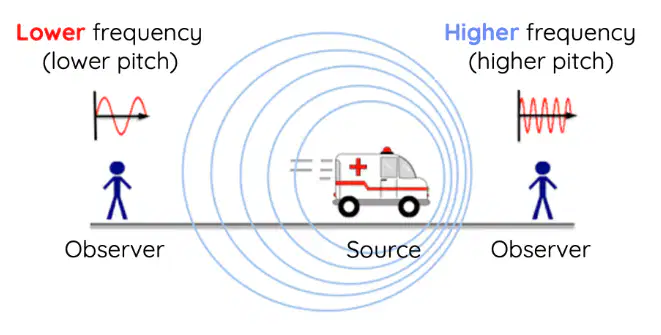
when a noise is moving towards an observer, the closer it comes...
the lower the pitch
the longer the noise
the higher the pitch
the quieter the noise
the doppler effect causes a shift in...
pitch
wavelength
frequency
All of the above
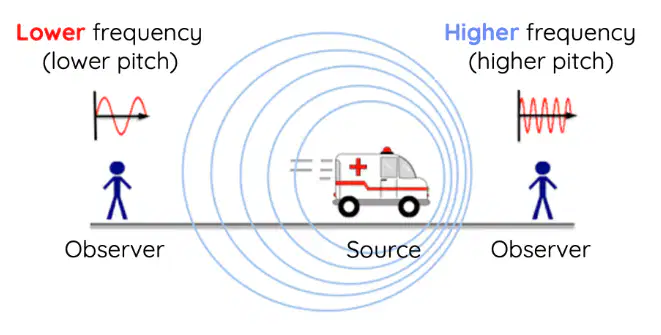
when a noise if moving away from an observer...
the pitch is lower
the pitch is higher
the noise is smoother
the energy is lower

when the frequency is higher what happens to the wavelength?
the wavelength gets longer
The wavelength gets shorter
the wavelength doesn't change
I have no idea

When pitch is lower what is happening to the frequency?
the pitch crescendos
It is unchanged
None of these
It is also lower
What is Redshift
Objects move away us, give off red light
Objects move towards us, give off blue light
Objects move towards us, give off red light
Objects move away us, give off blue light
What is Blueshift
Objects move away us, give off red light
Objects move towards us give off blue light
Objects move away us, give off blue light
Objects move towards us, give off red light
Blueshift frequency
Is increasing
Stays the same
Blueshift has no frequency
decreases
Redshift wavelength
doesn't change
stays the same
Gets longer/increases
gets shorter/decreases
What does the color red mean if an object is moving at very high speed in space relative to the observer?
The object is moving away decreasing the frequency in relation to the observer.
The object is moving closer increasing the frequency relative to the observer.
The object is stationary and the frequency is equally distributed in all directions.
The object is moving closer decreasing the frequency relative to the observer.

In redshift, the wavelengths of light become...
a different color
shorter
longer
The Doppler effect applies to light waves as well as sound waves. Astronomers use this to measure the motion of stars and galaxies. In 1929, Edwin Hubble discovered that light from distant galaxies was shifted away from the blue end of the spectrum and towards the red end of the spectrum. Red light has a longer wavelength (and a lower frequency) than blue light. What could Hubble conclude about these galaxies?
The distant galaxies are growing smaller.
The distant galaxies are moving towards the Earth.
The distant galaxies are moving away from earth
Which of these is the wavelength?

In the EM spectrum (a) have the longest wavelength and (b) have the shortest wavelength.
Match the following
Highest Frequency
Lowest frequency
Identify where the longest wavelengths are located on the electromagnetic spectrum
Place the label for the type of wave in the likely location on the image
gamma waves
microwaves
radiowaves
Radio waves
Has the longest wavelengths and the lowest frequency
Microwaves
Used in cell phone communication and police radar systems
Infrared rays
It is used in thermal imaging
UV rays
Overexposure to this can result in sunburns and skin cancer
Gamma Rays
Has the highest energy of all electromagnetic radiation and is the most damaging to human tissue

________________ have the Lowest energy and Longest wavelength of all electromagnetic waves.
Gamma
X Ray
Radio
Microwaves
What electromagnetic wave has the longest wavelengths and lowest frequencies?
Microwaves
Ultraviolet Rays
Infrared Waves
Radio Waves

