
 Worksheets
Earth in Space Review
Total questions: 66
Worksheet time: 52mins
Day and night result from earth's
Rotation
Revolution
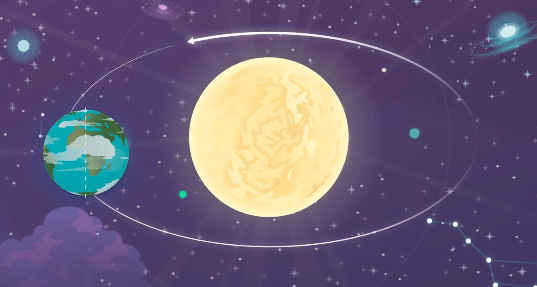
How long does it take for the Earth to make one full revolution around the Sun?
one day
one week
one month
one year
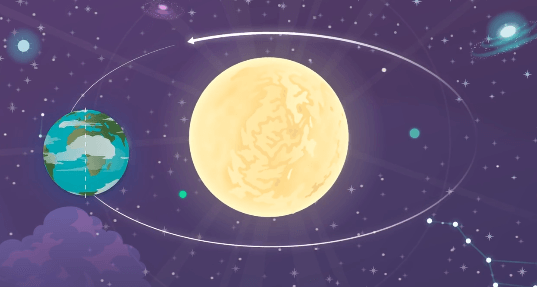
The movement of the Earth around the Sun is called its _____
revolution
rotation
precession
regression

The amount of time it takes Earth to rotate on its axis is
365 days
24 hrs
month
year

This time exposure photo show stars appearing to move in the sky. The best explanation for why this motion appears is...
Earth's rotation
Earth's revolution


Earth's rotation causes winds to be deflected to the
left in the Northern Hemisphere and right in the Southern Hemisphere
left in both the Northern and Southern Hemispheres
right in the Northern Hemisphere and left in the Southern Hemisphere
right in both the Northern and Southern Hemispheres
Earth's rate of rotation is approximately...
360 degrees per hour
15 degrees per hour
1 degrees per day
180 degrees per day
The curving of the planetary winds to the right in the Northern Hemisphere is evidence of
high-and low-pressure belts
the tilt of Earth's axis
the Coriolis effect
Earth's revolution
To an observer on Earth, how many degrees does the Sun appear to move across the sky in 4 hours?
96 degrees
60 degrees
48 degrees
4 degrees
Polaris is called the North Star because...
It is a cold star.
It is the brightest in the sky.
It is located above the Earth's North Pole.
It is only seen in the winter.

What degree is the Earth's Axis tilted to?
0°
23.5°
66.5°

At the equator, the stars set in the ___ and rise in the ___.
north, south
west, east
east, west
south, north

A constellation is a group of visible ____ that form a pattern when viewed from Earth.
planets
stars
planets and stars


The constellation Pisces changes position during the night, as shown in the diagram. Which motion is mainly responsible for this change in position?
Revolution of Earth around the Sun
Rotation of Earth on its axis
Revolution of Pisces around the Sun
Rotation of Pisces on its axis

The apparent shift of position of some stars through the year is called ...
Stellar Parallax
Constellation
Leap Year
Foucault Pendulum
A swinging pendulum that appears to change direction in a predictable manner.
Coriolis Effect
Heliocentric
Geocentric
Foucault Pendulum
Winds and ocean currents bend from their expected path.
Foucault Pendulum
Coriolis Effect
Heliocentric
Geocentric

The diagram below represents the apparent changes in the direction of swing of a Foucault pendulum. This apparent change in direction of swing provides evidence that Earth
has a spherical shape
is tilted on its axis
orbits around the Sun
turns on its axis
Evidence that Earth Revolves around the Sun is provided by the
apparent rising and setting of the Sun during one day
apparent rising and setting of Polaris during one day
seasonal changes in the apparent positions of constellations
hourly changing in the apparent direction of the swing of a Foucault pendulum.
The length of an Earth year is based on Earth's
rotation of 15 degrees per hour
revolution of 15 degrees per hour
rotation of approximately 1 degree per day
revolution of approximately 1 degree per day
To an observer on Earth, how many degrees does the Sun appear to move across the sky in 4 hours?
96 degrees
60 degrees
48 degrees
4 degrees

The accompanying diagram shows the apparent path of a projectile fired from Earth's North Pole toward a target located at 45 degrees North Latitude. The apparent curving of the projectile's path, as seen by observers on Earth, is caused mainly by
prevailing winds
convection currents
Earth's rotation
gravitational forces
Which photograph of star trails was taken by an observer facing directly north in New York State?


The diagram represents a Foucault pendulum swinging freely for 8 hours. The pendulum appears to change its direction of swing because of Earth's
tectonic plate movement
force of gravity
rotation
revolution


Earth has seasons because
it rotates on its axis exposing 1/2 to sunlight and 1/2 to darkness
its axis is tilted as it revolves around the sun leading to a differential of direct sunlight
the distance between Earth and the sun changes; when we are closer, we are hotter
the temperature of the sun changes.

In the Northern Hemisphere, the summer solstice occurs when the sun is
directly over the equator.
shining directly over the Tropic of Capricorn, the point farthest south it will ever be.
closest to Earth.
shining directly over the Tropic of Cancer, the point farthest north it will ever be.

Which type of sun rays represents direct sunlight which we (42 North latitude) receive during the summer season in the northern hemisphere?
A
B

During the summer solstice, we (42 N latitude) experience the Sun:
At 90o above the horizon
At it greatest angle above the horizon for the year but it is NOT perpendicular to the surface because we are not located at the Tropic of Cancer
Closer to us, leading to greater heat
Shining brighter but for fewer daylight hours than in winter

An equinox occurs when
the equator is receiving the most direct sunlight (directly above)
the Northern Hemisphere is tilted away from the sun.
the Northern Hemisphere is tilted toward the sun.
Earth's axis is parallel to the sun's rays.


Select the 2 reasons why Earth experiences different seasons
Earth rotates
Earth revolves around the sun
Earth is tilted on its axis
Earth has day and night


The diagram below represents the sun's path at equinox. According to the position of the Sun below, what is a possible time of the location?
9 am
12 noon
6 pm
3 pm
Which statement correctly describes the rising and setting of the Sun?
the Sun rises in the east and sets in the west
the Sun rises in the west and sets in the east
the Sun rises in the north and sets in the south
the Sun rises in the west and sets in the north
Which diagram best represents the apparent path of the Sun as seen in NY on June 21st ?


Which sun's path best represents the summer solstice?
A
B
C

Which characteristic of the Sun’s apparent daily path stays constant from month X to month Z?
the times of sunrise and sunset
altitude of the noon Sun
length of time that the Sun moves along its apparent path
rate of the Sun’s movement along its apparent path

What time is at position 3?
12 p.m. (noon)
9 a.m.
3 p.m.
6 p.m.
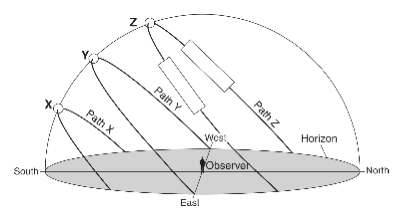
When the sun gets higher in the sky, shadows get ______.
longer
gone
shorter
darker
When the sun gets lower in the sky, shadows get______.
longer
gone
shorter
darker
Shadows are shortest around______.
morning and evening
noon
night
The sun's path hits 90 degrees during the summer solstice in New York
True
False
Sometimes

What latitude is this location?
New York
Equator
North Pole
South Pole

In which general direction is the Sun in NY
North
South
West
East
Name the point directly above an observers head
North Celestial Pole
Nadir
Zenith
Polaris
If you were standing at the North Pole, Polaris will be ___.
on the northern horizon
below the horizon
at your zenith
to the north at an altitude equal to your latitude
What does the prefix GEO mean?
sun
earth
moon
planet

What type of model is shown?
geocentric
Wheels on wheels
heliocentric
galaxy

What type of model is shown?
geocentric
Wheels on wheels
heliocentric
galaxy

