wayground logo

Free Printable Worksheets

NEW

Font size

S
M
L
XL
Worksheets

Muscular System

Total questions: 61

Worksheet time: 30mins

Name
Class
Date
1.

Found attached to bones throughout the body

a)

smooth

b)

cardiac

c)

skeletal

d)

all

2.

Found in the heart

a)

smooth

b)

cardiac

c)

skeletal

d)

all

3.

Found in the walls of hollow organs; also called visceral

a)

smooth

b)

cardiac

c)

skeletal

d)

all

4.
What are the 3 types of muscles?
a)
Skeletal, muscular, ligament
b)
Skeletal, smooth, cardiac
c)
Smooth, Cellular, Cerebrum
d)
Cardiac, smooth, brain stem
5.
Skeletal muscles always work _____.
a)
in groups
b)
in pairs
c)
singly
d)
none of the above
6.
Smooth muscle and cardiac muscle are considered _____ muscles because we can’t control them consciously.
a)
Immovable
b)
Involuntary
c)
Skeletal
d)
none of the above
7.
A ______________________ attach bones to each other at joints.
a)
Ligament
b)
Bone
c)
Joint
d)
Cell
8.
A ______ is a strong connective tissue that attaches muscle to bone.
a)
Tendon
b)
Ligament
c)
Cartilage
9.

What is shown in the colored part of this diagram?

a)

a whole muscle

b)

five muscle fibers

c)

five muscle fascicles

d)

five myofibrils

10.

Name the following in order from largest to smallest:

a)

muscle, muscle fascicle, muscle cell, myofibril, filaments

b)

muscle, muscle fascicle, muscle cell, filaments, myofibril

c)

muscle, muscle cell, muscle fascicle, myofibril, filaments

d)

muscle, muscle cell, muscle fascicle, filaments, myofibril

11.

What is the length between Z-lines of an actin molecule called?

a)

fascicle

b)

sarcomere

c)

myosin binding site

d)

sarcoplasmic length

12.

____________ attaches to actin to form the cross bridge.

a)

Troponin

b)

Tropomyosin

c)

Myosin

d)

Calcium

13.
A bundle of muscle fibers is known as a...
a)
fascicle
b)
sarcomere
c)
tendon
d)
epimysium
14.
The connective tissue that surrounds the entire muscle is called...
a)
epimysium
b)
perimysium
c)
endomysium
15.
The connective tissue that surrounds each individual muscle cell is called...
a)
epimysium
b)
perimysium
c)
endomysium
16.
Myofibrils are made up of two types of proteins known as?
a)
Actin and Myosin
b)
Troponin and Tropomyosin
c)
Myoglobin and hemoglobin
d)
none of these
17.
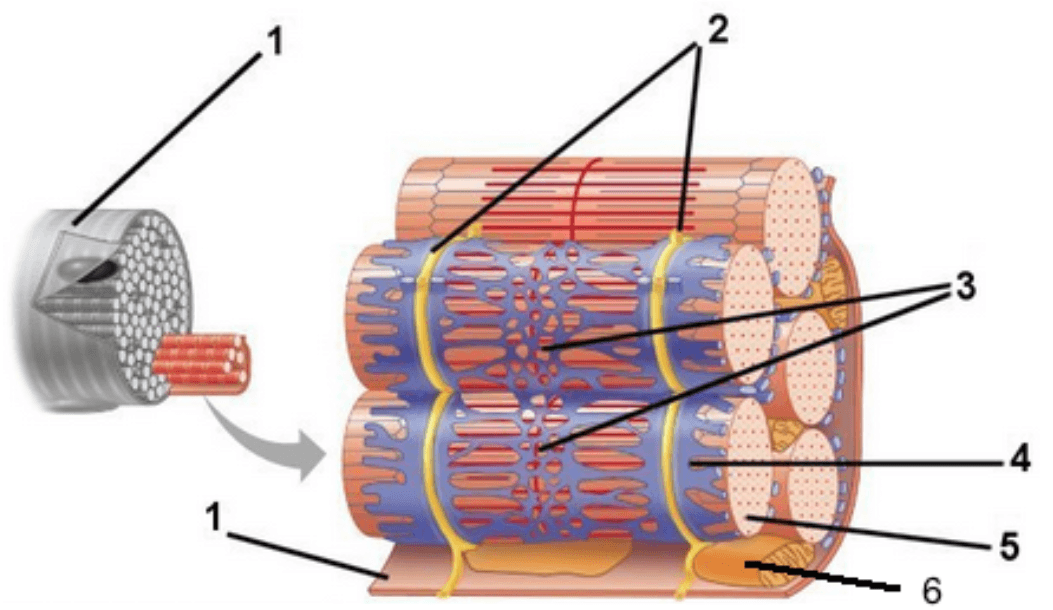
What is number 4?
a)
perimysium
b)
muscle fiber
c)
fascicle
d)
endomysium
18.
What is number 3?
a)
perimysium
b)
epimysium
c)
fascicle
d)
endomysium
19.
What is number 2?
a)
perimysium
b)
epimysium
c)
fascicle
d)
endomysium
20.
What is number 5?
a)
perimysium
b)
muscle fiber
c)
fascicle
d)
endomysium
21.
What is number 6?
a)
perimysium
b)
epimysium
c)
fascicle
d)
endomysium
22.

Thick filaments are made of ________ and thin filaments are made of ____________.

a)

myosin/actin

b)

actin/myosin

c)

calcium/sodium

d)

sodium/calcium

23.
A bundle of muscle fibers is known as a...
a)
fascicle
b)
sarcomere
c)
tendon
d)
epimysium
24.
Another name for a muscle cell is...
a)
muscle fiber
b)
fascicle
c)
sarcomere
d)
thick filament
25.
Sarcolemma is another name for...
a)
cell membrane
b)
cytoplasm
c)
endoplasmic reticulum
d)
mitochonrdia
26.
The connective tissue that surrounds the entire muscle is called...
a)
epimysium
b)
perimysium
c)
endomysium
27.
The connective tissue that surrounds fascicles is called...
a)
epimysium
b)
perimysium
c)
endomysium
28.
The connective tissue that surrounds each individual muscle cell is called...
a)
epimysium
b)
perimysium
c)
endomysium
29.
The basic functional unit of a muscle fiber separated by the Z lines is called _____.
a)
sarcolemma
b)
sarcomere
c)
filaments
d)
myofibril
30.
Myofibrils are made up of two types of proteins known as?
a)
Actin and Myosin
b)
Troponin and Tropomyosin
c)
Myoglobin and hemoglobin
d)
none of these
31.
What is number 2?
a)
perimysium
b)
epimysium
c)
fascicle
d)
endomysium
32.
What is number 3?
a)
perimysium
b)
epimysium
c)
fascicle
d)
endomysium
33.
What is number 4?
a)
perimysium
b)
muscle fiber
c)
fascicle
d)
endomysium
34.
What is number 5?
a)
perimysium
b)
muscle fiber
c)
fascicle
d)
endomysium
35.
What is number 6?
a)
perimysium
b)
epimysium
c)
fascicle
d)
endomysium
36.
What is number 7?
a)
perimysium
b)
muscle body
c)
fascicle
d)
tendon
37.
A cross bridge is the connection between which two proteins?
a)
actin/myosin
b)
actin/troponin
c)
myosin/tropomyosin
d)
actin/z-line
38.

Thick filaments are made of ________ and thin filaments are made of ____________.

a)

myosin/actin

b)

actin/myosin

c)

calcium/sodium

d)

sodium/calcium

39.

What is the function of the sarcoplasmic reticulum?

a)

stores phosphorus

b)

stores calcium

c)

stores sodium

d)

stores potassium

40.

Why is calcium needed for muscle contraction?

a)

causes the binding of neurotransmitters to receptors

b)

causes the binding of myosin to actin

c)

increases the action potential

d)

changes the shape of myosin

41.

What structure is shown here?

a)

neuromuscular junction

b)

sarcomere

c)

origin and insertion

d)

synaptic cleft

42.
List the structures of a muscle from smallest to largest
a)
myofibril, muscle fiber, fascicle, muscle
b)
fascicle, muscle, myofibril, muscle fiber
c)
fascicle, sarcomere, muscle, muscle fiber
d)
myofibril, muscle, fascicle, sarcomere
43.
What is the first step to a muscle contraction? 
a)
The muscle impulse goes down the T Tubules
b)
The nerve impulse is sent to a motor neuron
c)
Acetylecholine passes into the synaptic cleft
d)
Calcium ions diffuse into the sarcoplasm
44.
specialized smooth endoplasmic reticulum that surrounds each myofibril, it stores calcium and releases on demand
a)
sarcolemma
b)
sarcoplasmic reticulum
c)
thick filament
d)
thin filament
45.

What structure is shown here?

a)

neuromuscular junction

b)

sarcomere

c)

origin and insertion

d)

synaptic cleft

46.
What is the first step to a muscle contraction? 
a)
The muscle impulse goes down the T Tubules
b)
The nerve impulse is sent to a motor neuron
c)
Acetylecholine passes into the synaptic cleft
d)
Calcium ions diffuse into the sarcoplasm
47.

What muscle is the arrow pointing to?

a)

Pectoralis (Pecs)

b)

Biceps

c)

Triceps

d)

Lats

48.

What muscle is the arrow pointing to?

a)

Biceps

b)

Triceps

c)

Lats

d)

Quads

49.
a)
Quadriceps
b)
Satorius
c)
Hamstring
d)
Gastronecmius
50.
a)
Latissmius Dorise
b)
Erectors
c)
Deltoids
d)
Abdominal
51.
a)
Abdominal
b)
External Oblique
c)
Erectors
d)
Satorius
52.
a)
Trapezius
b)
Gluteals
c)
Deltoid
d)
Hamstring
53.
a)
Hamstrin
b)
Quadricep
c)
Tibialis Anterior
d)
Gastrocenmius
54.
a)
Hamstring
b)
Quadriceps
c)
Gastronecmius
d)
Satorius
55.
a)
Latissimius Dorsi
b)
Trapezius
c)
Triceps
d)
Erectors
56.

These muscles that make up someone's "six pack" are really called what?

a)

extermal obliques

b)

gluteus maximus

c)

rectus abdominus

d)

gastrocnemius

57.
Identify the muscle.
a)
Pectorals
b)
Tricep
c)
Bicep
d)
Quadriceps
58.
Identify the muscle.
a)
Gluteus Maximus
b)
Quadriceps
c)
Hamstrings
d)
Deltoids
59.

Identify the muscle

a)

adductor

b)

oblique

c)

abdominals

d)

quadricep

60.
Identify the muscle.
a)
Obliques
b)
Triceps
c)
Deltoids
d)
Gluteus Maximus
61.
Identify the muscle.
a)
Deltoids
b)
Quadriceps
c)
Triceps
d)
Trapezius