
 Worksheets
CP2 Final Study Guide
Total questions: 70
Worksheet time: 38mins
In humans, gametes contain
45 autosomes and 1 sex chromosome
1 autosome and 22 sex chromosomes
22 autosomes and 1 sex chromosome
1 autosome and 45 sex chromosomes
Tallness (T) is dominant to shortness (t) in pea plants. Which of the following represents a genotype of a pea plant that is heterozygous for tallness?
T
TT
Tt
tt
If nondisjunction occurs,
no gametes will be produced.
mitosis cannot take place.
a gamete will receive too many or too few copies of a chromosome.
there will be too many gametes produced.
Crossing-over occurs
during prophase II
during prophase I
at the centromere
during fertilization
Each of the following is a type of RNA except
transfer RNA.
carrier RNA.
messenger RNA.
ribosomal RNA.
A haploid cell is one that
is designated by the symbol 2n.
has chromosomes found in pairs.
has one set of chromosomes.
has two homologues of each chromosome.
Light energy is converted to chemical energy through the process of
glycolysis.
cellular respiration.
fermentation.
photosynthesis.
Which of the following shows the correct sequence of the cell cycle?
cytokinesis-mitosis-G1-S-G2
S-G1-G2-mitosis-cytokinesis
mitosis-G1-S-G2-cytokinesis
G1-S-G2-mitosis-cytokinesis
Homologous chromosomes are pairs of chromosomes containing genes that code for
DNA.
the same trait.
sex.
different traits.
Chlorophyll is green because
it reflects green wavelengths of light.
it absorbs green wavelengths of light.
it absorbs blue and yellow wavelengths, which make green.
of an optical illusion caused by transmitted light.
The first three phases of the cell cycle are collectively known as
telophase.
interphase.
a gap.
mitosis
When a phosphate group is removed from an ATP molecule,
a substantial amount of energy is used.
a substantial amount of energy is released.
energy is stored.
an enzyme is formed.
The function of rRNA is to
synthesize mRNA.
form ribosomes.
synthesize DNA.
transfer amino acids to ribosomes.
Which statement best describes galaxies?
They contain only one star but hundreds of planets.
They are similar in size to the solar system.
They may contain billions of stars in a space much larger than our solar system.
They may contain a few hundred stars in a space slightly larger than the solar system.
Which disease is caused by a problem in the regulation of the cell cycle?
sickle-cell
Down syndrome
cancer
diabetes
Normal human males develop from fertilized eggs containing which of the following sex chromosome combinations?
OO
XY
XO
XX
Each nucleotide triplet in mRNA that specifies a particular amino acid is called a(n)
codon.
anticodon.
helicase.
peptide bond.
When crossing-over takes place, chromosomes
exchange corresponding segments of DNA.
produce new genes.
decrease in number.
mutate in the first division.
Which star color indicates the hottest star surface temperature?
yellow
blue
white
red
As the sun ages it will be composed of
more helium and less hydrogen.
less oxygen and more carbon.
more oxygen and less carbon.
more hydrogen and less helium.
According to our present theories of stellar evolution, our sun will change next into
a black hole.
a white dwarf.
a red giant.
a supernova.
Mitosis is the process by which
the nucleus is divided into two nuclei.
microtubules are assembled.
cytoplasm is divided.
the cell rests.
The phenotype of an organism
is the physical appearance of a trait.
cannot be seen.
is used to represent its genetic composition.
occurs only in dominant individuals.
The non-coding portions of DNA that are separated from the portions of DNA actually used during transcription are called
introns.
exons.
exposons.
transposons.
In RNA molecules, adenine is complementary to
guanine.
cytosine.
uracil.
thymine.
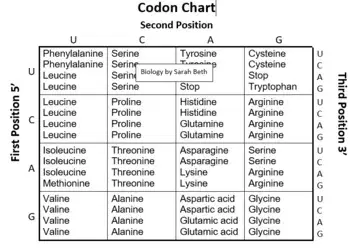
Suppose that you are given a protein containing the following sequence of amino acids: tyrosine, proline, aspartic acid, isoleucine, and cystine. Which of the following DNA sequences code for this amino acid sequence?
ATAGGGCTTTAAACA
AUGGGUCUAUAUACG
GCAAACTCGCGCGTA
ATGGGTCTATATACG
Transcription, which is a stage of gene expression, is the process by which genetic information encoded in DNA is transferred to a(n)
RNA molecule.
DNA molecule.
uracil molecule.
tRNA molecule.
If an individual possesses two recessive alleles for the same trait, the individual is said to be
heterozygous for the trait.
homozygous for the trait.
haploid for the trait.
mutated.
Cells produce ATP most efficiently in the presence of
water.
oxygen.
glucose.
carbon dioxide.
A nucleotide consists of
a sugar, a phosphate group, and a nitrogen base.
a starch, a phosphate group, and a nitrogen base.
a sugar, a protein, and adenine.
a sugar, an amino acid, and starch.
During DNA replication, a complementary strand of DNA is made from each original DNA strand. thus, if a portion of the original strand is CCTAGCT, then the new strand will be
GGATCGA.
TTGCATG.
CCTAGCT.
AAGTATC.
Molecules of DNA are composed of long chains of
nucleotides.
monosaccharides.
amino acids.
fatty acids.
The phase of mitosis that is characterized by the arrangement of all chromosomes along the equator of the cell is called
telophase.
metaphase.
anaphase.
prophase.
Which of the following is the best explanation for the presence of both chloroplasts and mitochondria in plant cells?
In the light, plants make their own glucose, but in the dark, photosynthesis stops and mitochondria make glucose.
If plants cannot produce enough ATP in the process of photosynthesis to meet their energy needs, they can produce it in aerobic respiration.
Sugars are produced in chloroplasts. These sugars can be stored and used by the mitochondria to produce ATP.
The leaves and sometimes the stems of plants contain chloroplasts, which produce ATP to meet the energy needs of these plant parts. The roots of plants contain mitochondria, which produce ATP to meet the energy needs of these plant parts.
What is the portion of the protein molecule coded for by a piece of mRNA with the sequence CUCAAGUGCUUC?
Val-Asp-Pro-His
Ser-Tyr-Arg-Gly
Pro-Glu-Leu-Val
Leu-Lys-Cys-Phe
Mendel's finding that the inheritance of one trait had no effect on the inheritance of another became known as the
law of separate convenience.
law of independent assortment.
law of dominance.
law of universal inheritance.
In humans, eye color and height are controlled by
polygenic inheritance.
incomplete dominance.
multiple alleles.
simple dominance.
Which property determines whether a giant star or a supergiant star will form?
shape
color
mass
composition
Which evidence best supports scientists' inferences about the origin and age of the universe?
formation of star constilations
cosmic background radiation
similar composition of Earth and the moon
the existence of planets
The process of cellular respiration
is performed only by organisms that are incapable of photosynthesis.
breaks down food molecules to release stored energy.
occurs before plants are able to continue photosynthesis.
occurs only in animals.
Most of the energy used by life on Earth comes from the
moon.
sun.
rotation of Earth.
weather.
ATP is composed of a nitrogenous base, a sugar, and
two phosphate groups.
one phosphate group.
four phosphate groups.
three phosphate groups.
During transcription,
proteins are synthesized.
translation occurs.
RNA is produced.
DNA is replicated.

The entire molecule shown in the diagram is called a(n)
amino acid.
pyrimidine.
polysaccharide.
nucleotide.
According to astronomers, the age of the universe is estimated to be
7.9 billion years.
13.7 billion years.
1.3 billion years.
4.6 billion years.
Cellular respiration takes place in two stages:
glycolysis, then aerobic respiration.
electron transport chain, then fermentation.
glycolysis, then photosynthesis.
fermentation, then glycolysis.
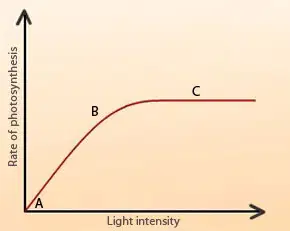
The graph demonstrates that the rate of photosynthesis
increases in response to increasing light intensity, but only to a certain point.
decreases in response to increasing light intensity.
increases indefinitely in response to increasing light intensity.
is unaffected by changes in light intensity.
If a characteristic is sex-linked, the gene for it is found on
an autosome.
a linked chromosome.
a sex chromosome.
an allele.
The unit most used by astronomers to express the distances to other galaxies is
lightyears.
kilometers.
astronomical unit.
miles.
The portions of DNA molecules that actually code for the production of proteins are called
exons.
exposons.
introns.
transposons.
Which of the following is not found in RNA?
uracil
adenine
thymine
cytosine
Which of the following stars is least bright?
a blue supergiant
a white dwarf
a red giant
the sun
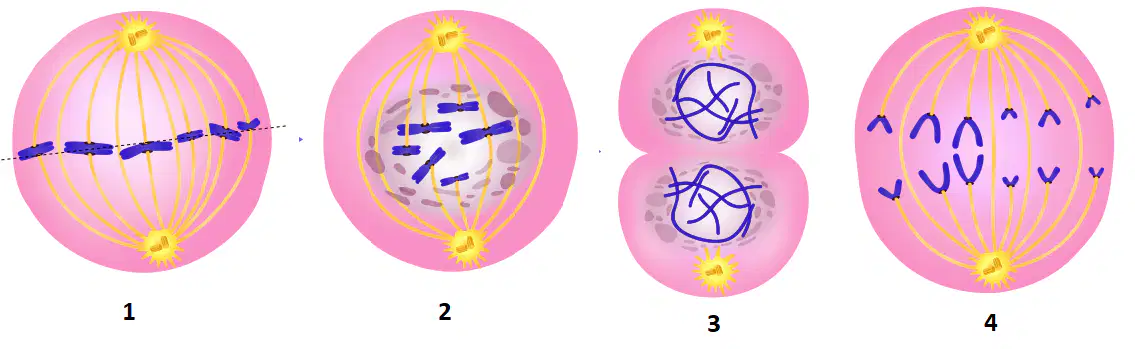
Which of the following correctly indicates the order in which these events occur?
2, 1, 3, 4
1, 3, 2, 4
1, 2, 3, 4,
2, 1, 4, 3
Compared to Earth's solar system, the universe is inferred to be
younger and larger
younger and smaller
older and smaller
older and larger
The Milky Way Galaxy is best described as
elliptical.
irregular.
spiral.
circular.
Which process generates the energy that is released by stars?
convection currents
thermal conduction
nuclear fusion
radioactive decay
The process of producing offspring is called reproduction and can be
haploid or diploid.
zygotic or gametic.
asexual or sexual.
eukaryotic or prokaryotic.
The law of segregation states that
each gene is found on a different molecule of DNA.
each gene of an organism ends up in a different gamete.
alleles of a gene separate from each other during meiosis.
different alleles of a gene can never be found in the same organism.
People with Down syndrome have
no X chromosomes.
47 chromosomes.
46 chromosomes.
45 chromosomes.
The synthesis (S) phase is characterized by
cell division.
replication of mitochondria and other organelles.
DNA replication.
the division of the cytoplasm.
The amount of guanine in an organism always equals the amount of
cytosine.
protein.
adenine.
thymine.
In humans, the male determines the sex of the child because males have
one X and one Y chromosome.
46 chromosomes.
two Y chromosomes.
two X chromosomes.
An allele that is always expressed whenever it is present is called
phenotypic.
superior.
recessive.
dominant.
How many chromosomes are in the body cells of an organism that has a haploid number of 8?
12
8
4
16
Because of photosynthesis,
animals can get energy directly from the sun.
the atmosphere is rich in oxygen gas.
water is constantly being produced.
plants produce carbon dioxide.
Transfer RNA
carries an amino acid to its correct codon.
converts DNA into mRNA.
synthesizes amino acids as they are needed.
produces codons to match the correct anticodons.
Cytokinesis in plant cells involves the formation of
a belt of protein threads.
a cell plate.
centrioles.
spindle fibers.
The red shift of light from most galaxies is evidence that
red light travels faster than other colors of light.
the light slows down as it nears Earth.
most galaxies are moving away from Earth.
a majority of stars in most galaxies are red giants.
A diagram in which several generations of a family and the occurrence of certain genetic characteristics are shown is called a
Punnett square.
monohybrid cross.
family karyotype.
pedigree.
The name of the process that takes place when organic compounds are broken down in the absence of oxygen is
oxidation.
photosynthesis.
fermentation.
respiration.

