wayground logo

Free Printable Worksheets

NEW

Font size

S
M
L
XL
Worksheets

Genetics & Heredity Review

Total questions: 75

Worksheet time: 53mins

Name
Class
Date
1.
Which of the following genotypes is homozygous dominant?
a)
BB
b)
bb
c)
Bb
d)
green eyes
2.
What is the definition of a phenotype?
a)
letter combination
b)
physical characteristic
3.
Which of the following genotypes is heterozygous?
a)
AA
b)
Aa
c)
aa
4.
Which of the following answers correctly represents this Punnett Square if freckles are dominant?
a)
25% chance freckles
b)
50% chance freckles
c)
75% chance freckles
d)
100% chance freckles
5.
What organism did Gregor Mendel study?
a)
Flowers
b)
Bacteria
c)
Humans
d)
Pea Plants
6.
Which of the following genotypes is purebred recessive?
a)
a
b)
aa
c)
Aa
d)
AA
7.
How many chromosomes are found in human body cells?
a)
0
b)
23
c)
46
d)
50
8.
How many chromosomes are found in human sex cells?
a)
0
b)
23
c)
46
d)
50
9.
If the offspring is genetically identical to it's parent, what type of reproduction occurred?
a)
Asexual Reproduction
b)
Sexual Reproduction
10.
Genetic variation is most likely to result from what type of reproduction?
a)
Asexual Reproduction
b)
Sexual Reproduction
11.

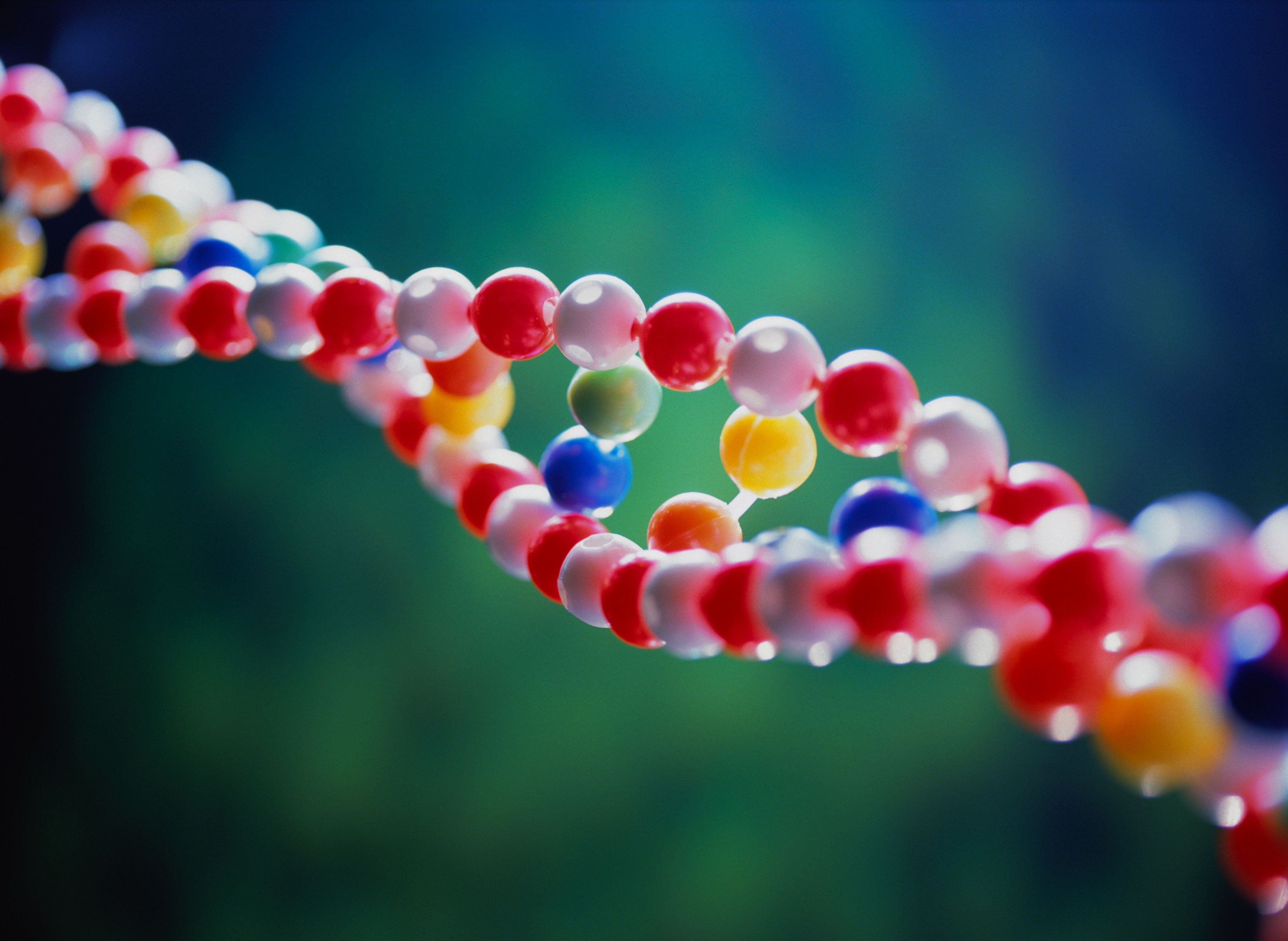
The twisted ladder shape of a DNA molecule.

a)

Gene Ladder

b)

Gene Pool

c)

Genome

d)

Double Helix

12.

The scientists who discovered the structure and function of DNA based on Rosalind Franklin’s Xray diffraction photograph.

a)

James Watson and Frances Crick

b)

Rosalind Franklin

c)

Maurice Wilkins

d)

all of the above

13.

The monomers of DNA polymers that consist of a phosphate-sugar backbone and a single nitrogenous base.

a)

Nucleotides

b)

Ribosomes

c)

Translation

d)

Replication

14.

The 4 nitrogenous bases, A, T, C, G, are arranged in patterns that become the instructions for building all parts of living things.

a)

Genetic Code

b)

Genome

c)

Geneology

d)

Hydrogen Bond

15.

Coils formed by the thin double helixstrands of DNA, held in place by special proteins called histones to enable safe storage.

a)

Helicase

b)

Genomes

c)

Chromosomes

d)

Proteins

16.

The process of reproducing the genetic code in DNA exactly so each cell in a living thing has an identical copy of DNA instructions.

a)

DNA Replication

b)

Translocation

c)

Cell Cycle

d)

Mitosis

17.

An enzyme that unzips a parental DNA strand.

a)

Mitochondria

b)

Prophase

c)

Helicase

d)

Protein

18.

An enzyme that matches new nucleotides with the complementary base to an original single strand.

a)

DNA Polymerase

b)

Helicase

c)

Proteins

d)

Lipids

19.

The two sides of the double helix that match up to each other (A-T and C-G)

a)

DNA Polymerase

b)

Prophase

c)

Nucleotides

d)

Complementary Strands

20.
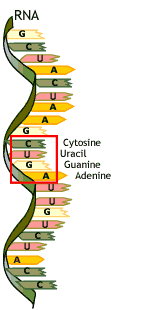
In RNA, Uracil pairs with ______. 
a)
cytosine
b)
adenine
c)
guanine
d)
thymine
21.
The process to go from DNA to mRNA is _______
a)
translation
b)
transcription
c)
replication
22.
The process to go from mRNA to a protein is called ____
a)
transcription
b)
rRNA
c)
replication
d)
translation
23.
DNA holds the code for
a)
lipids
b)
carbohydrates
c)
protein
d)
sugar
24.
Choose the nucleotide sequence of the RNA strand that would be complementary to the following strand: 
GTAGTCA
a)
UATUAGA
b)
ACGACTG
c)
CAUCAGU
d)
CATCAGT
25.
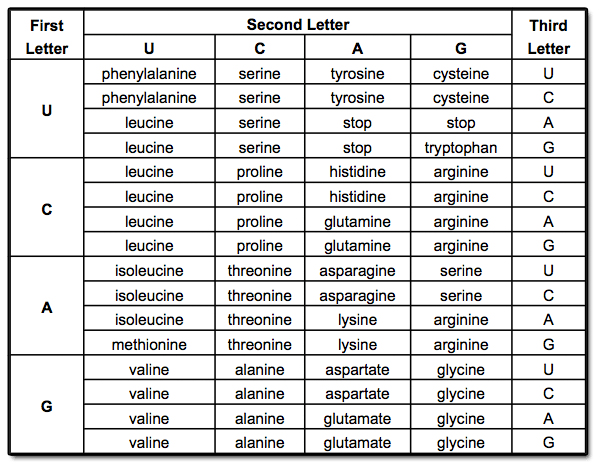
What amino acid is represented by the codon UUA?
a)
Phenylalanine
b)
Tyrosine
c)
Leucine
d)
Stop codon
26.
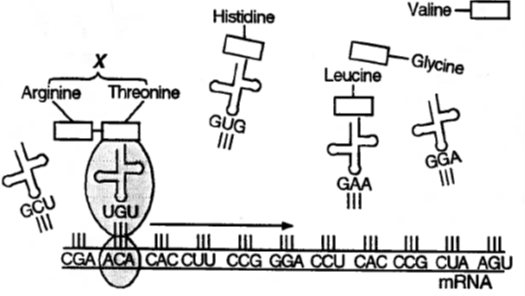
What process is going on in this photo? 
a)
Transcription 
b)
Translation 
c)
Replication 
d)
All the above 
27.
Which component of DNA determines the traits of an organism? 
a)
Nitrogen Bases
b)
Sugar-Phosphate Backbone
c)
Hydrogen bonds
28.
What is the three base sequence of mRNA that codes for a single amino acid?
a)
Anticodon
b)
Codon
c)
Protein
29.
What is the location in the cell for transcription?
a)
nucleus
b)
cytoplasm
c)
ribosome
d)
mitochondria
30.
Does the order of amino acids in a protein matter?
a)
YES!
b)
NO!
31.

The different forms of a gene are called ---

a)

traits

b)

hybrids

c)

alleles

32.

The blending of two traits is known as ---

a)

incomplete dominance

b)

codominance

33.

A condition in which both alleles for a gene are expressed so that both traits are visible is known as ---

a)

Codominance

b)

Incomplete dominance

34.

A calico cat shows both the traits for orange fur and black fur. What kind of allele expression is this?

a)

Incomplete dominance

b)

Codominance

35.

This is an example of ---

a)

Incomplete dominance

b)

Codominance

36.

Snap dragon color is a incomplete dominant trait. A red flower (RR) is crossed with white flower (WW)? What color are flowers that are RW?

a)

Red and white

b)

Red

c)

Pink

37.

A tall plant (TT) is crossed with a short plant (SS). The result is a medium plant (TS). This is what type of inheritance pattern?

a)

Incomplete dominance

b)

Codominance

38.

Incomplete dominance occurs in cats, which allows them to be Black, White, or gray as shown on this Punnett square. What percentage of the offspring will be black?

a)

25

b)

50

c)

75

d)

100

39.

The environment will affect how your genes are expressed.

a)

True

b)

False

40.

What does this picture indicate about the trait of fur color on these Himalayan rabbits?

a)

Hair color is not an inherited characteristic

b)

Color of rabbit fur is caused by gene linkage

c)

Environmental conditions affect gene expression

d)

Genetic information in cells is not influenced by the outside environment

41.

Identical twin sisters both have the gene for freckles. One twin (Mary) spent the summer at an outdoor sports camp and the other twin (Rory) spent the summer at a science camp which was mostly indoors. Mary has more freckles than Rory at the end of the summer. What is the best explanation?

a)

Mary has a stronger freckle gene than Rory

b)

The environment affected the expression of the gene that controls for freckles

c)

The twins have two different genes for freckles.

d)

Having freckles is not an inherited trait

42.

Which statement provides the best evidence that the environment interacts with genes in the development and expression of inherited traits?

a)

Identical twins who have not been raised together show differences in height and weight

b)

Organisms produced asexually are genetically identical

c)

Mutations happen randomly and may be harmful or helpful to organisms

d)

People who have cancer can pass the defective gene on to their offspring

43.

A human kidney cell and a human heart cell in the same person can have the same genetic instructions. However, these cells are different because the liver cell

a)

can reproduce but the skin cell cannot

b)

uses different genes than the skin cell

c)

carries out respiration but the skin cell does not

d)

has more dominant traits than the skin cell

44.

Even though identical twins have the same genetic material, they may develop slightly different characteristics because

a)

a gene mutation may have occurred before the zygote divided

b)

each twin receives different chromosomes from the egg

c)

one twin may only have genes from the father

d)

gene expression may be influenced by factors that switch genes on and off

45.
Heredity is when your genes are passed on from your parents to you
a)
True
b)
False
46.
In a strand of DNA, if it contains 20% of Thymine, then how much Guanine would be present?
a)
30%
b)
20%
c)
80%
d)
10%
47.
Which sequence of DNA bases would pair with this partial strand
ATG TGA CAG
a)
ATG TGA CAG
b)
TAC ACT GTC
c)
GTA AGT GAC
d)
CAT TCA CTG
48.
Why is DNA important?
a)
it is very small and very complicated
b)
it's in everything
c)
it serves as the blueprint for traits of all living things
d)
because we eat it every day for energy
49.
What are the three components of a nucleotide?
a)
sugar, hydrogen, nitrogen base
b)
sugar, oxygen, nitrogen base
c)
sugar, phosphate, nitrogen base
d)
sugar, phosphate, protein
50.
What do we call the table used to calculate the probability of an offspring's genotype?
a)
Punnett square
b)
Venn diagram
c)
Golden ratio
d)
Fibonacci sequence
51.
Which of the following are in the correct order?
a)
proteins determine traits --> genes code for proteins --> DNA divided into genes
b)
proteins determine traits --> DNA divided into genes --> genes code for proteins
c)
DNA divided into genes --> proteins determine traits --> genes code for proteins
d)
DNA divided into genes --> genes code for proteins --> proteins determine traits
52.
Which of the following is a circular DNA from bacteria that can hold a foreign gene?
a)
plasmid
b)
restriction enzyme
c)
ligase
d)
protein expression
53.
Cutting DNA from one organisms and placing it into the DNA strand of another organism is called:
a)
recombinant RNA technology
b)
recombinant DNA technology
c)
selective breeding
d)
gene cloning
54.
Restriction enzymes are used to ___ DNA.
a)
glue together
b)
cut
c)
reconnect
d)
exchange
55.
An organism that contains DNA from another organism is called:
a)
transatlantic
b)
recombinant
c)
binary
d)
selective species
56.
The first step to genetic engineering is:
a)
isolate gene of interest
b)
Cut DNA strand
c)
Reconnect DNA fragements
d)
Produce proteins
57.

What is recombinant DNA

a)

DNA from 2 different organisms combined

b)

DNA from 2 different ribosomes

c)

DNA that is separated out from a vector

58.

Which of the following could be used as a vector for a human gene?

a)

Bacterial Plasmid

b)

Bacteria

c)

A mitochondria

d)

mRNA

59.

In which ways can genetic engineering can improve crops

a)

Make them pest or drought resistant

b)

Make them more nutritious

c)

Make them larger

d)

All answers are correct

60.

Humans with genetic diseases can have a gene inserted into their body using a virus. This is called:

a)

Gene therapy

b)

Cloning

c)

DNA fingerprinting

61.
Which term refers to a farmer choosing the best corn from this year to plant next year?
a)
natural selection
b)
selective breeding
c)
genetic engineering
d)
genetic transformation
62.
Someone has a wild cat breed with a house cat in order to have a cat that looks wild but is more gentle. This is__.
a)
Genetic Modification
b)
Gene Therapy
c)
Animal Husbandry
d)
Selective breeding
63.
Parkinson's is a disease that could be potentially cured through_____. 
a)
Gene Therapy
b)
Gene Modification
c)
Selective Breeding
d)
Animal Husbandry
64.
Choosing which organisms can have offspring is_____.
a)
Selective Breeding
b)
Gene Modification
c)
Gene Therapy
d)
Animal Husbandry
65.
A clone is 
a)
recombinant DNA
b)
a transgenic organsim
c)
plasmid
d)
genetically identical 
66.
Making changes in the DNA of an organism is
a)
selective breeding
b)
artificial selection
c)
genetic engineering
d)
genetic transformation
67.
Putting the gene for bioluminescence into a fish is an example of...
a)
Genetic Engineering
b)
Selective Breeding
c)
Artificial Selection
d)
Gene Mutation
68.
Why might people be against cloning? 
a)
It's creepy
b)
It can cause unknown defects
c)
It is detrimental to genetic diversity
d)
All of the above
69.
In cloning, what is the purpose of the surrogate mother? 
a)
Donate her DNA
b)
Donate her egg cell
c)
Incubate and carry the baby until birth
d)
Nothing.  She's useless.
70.

A segment of DNA that codes for a trait

a)

gene

b)

centromere

c)

chromosome

d)

chromatid

71.

an observable characteristic

a)

trait

b)

personality

c)

cell

d)

DNA

72.

A version or variation of a gene

a)

trait

b)

gene

c)

allele

d)

DNA

73.
How many affected females are present? 
a)
1
b)
2
c)
3
d)
4
74.
How many Homozygous Dominant males are present? 
a)
2
b)
4
c)
6
d)
8
75.
If the affected female in generation 3 mates with an affected male. What will be their offspring's genotype? 
a)
100% Hybrid/Pure 
b)
100% Homozygous Dominant 
c)
100% Homozygous Recessive 
d)
100% Heterozygous