wayground logo

Free Printable Worksheets

Font size

S
M
L
XL
Worksheets

Cells and Heredity

Total questions: 70

Worksheet time: 3600secs

Name
Class
Date
1.
Which of the following is the smallest unit of life that can carry out all life functions?
a)
the mitochondria
b)
the vacuoles
c)
the nucleus
d)
the cell
2.
Which structures are found in every living cell?
a)
cell membrane and cytoplasm
b)
chloroplasts and mitochondria
c)
a cell wall and nucleus
d)
chloroplasts and cell wall
3.
Cell organelles that are responsible for digesting food, worn out organelles and other cellular wastes are called ___________________.
a)
Mitochondria
b)
Vacuoles
c)
Lysosomes
d)
Chlororplasts
4.
What is one basic function of the vacuoles?
a)
circulating oxygen
b)
producing food
c)
controlling cell processes
d)
storing water
5.
Chloroplasts in plant cells allow the plant to perform a function that animal cells cannot do.  What is the main function of the chloroplasts found in plant cells?
a)
to absorb light energy and manufacture food
b)
to remove waste materials by active transport
c)
to manufacture chemical energy from food
d)
to control the shape of the cell
6.
All cells need energy to function.  Which cell organelle is responsible for producing energy in the cell?
a)
chloroplasts
b)
mitochondria
c)
nucleus
d)
vacuoles
7.
In what part of the plant cell does the process of photosynthesis take place?
a)
nucleus
b)
mitochondria
c)
chloroplasts
d)
vacuoles
8.
Cells with a nucleus and membrane-bound organelles are called ____________________.
a)
prokaryotes
b)
eukaryotes
c)
bacteria
d)
protists
9.

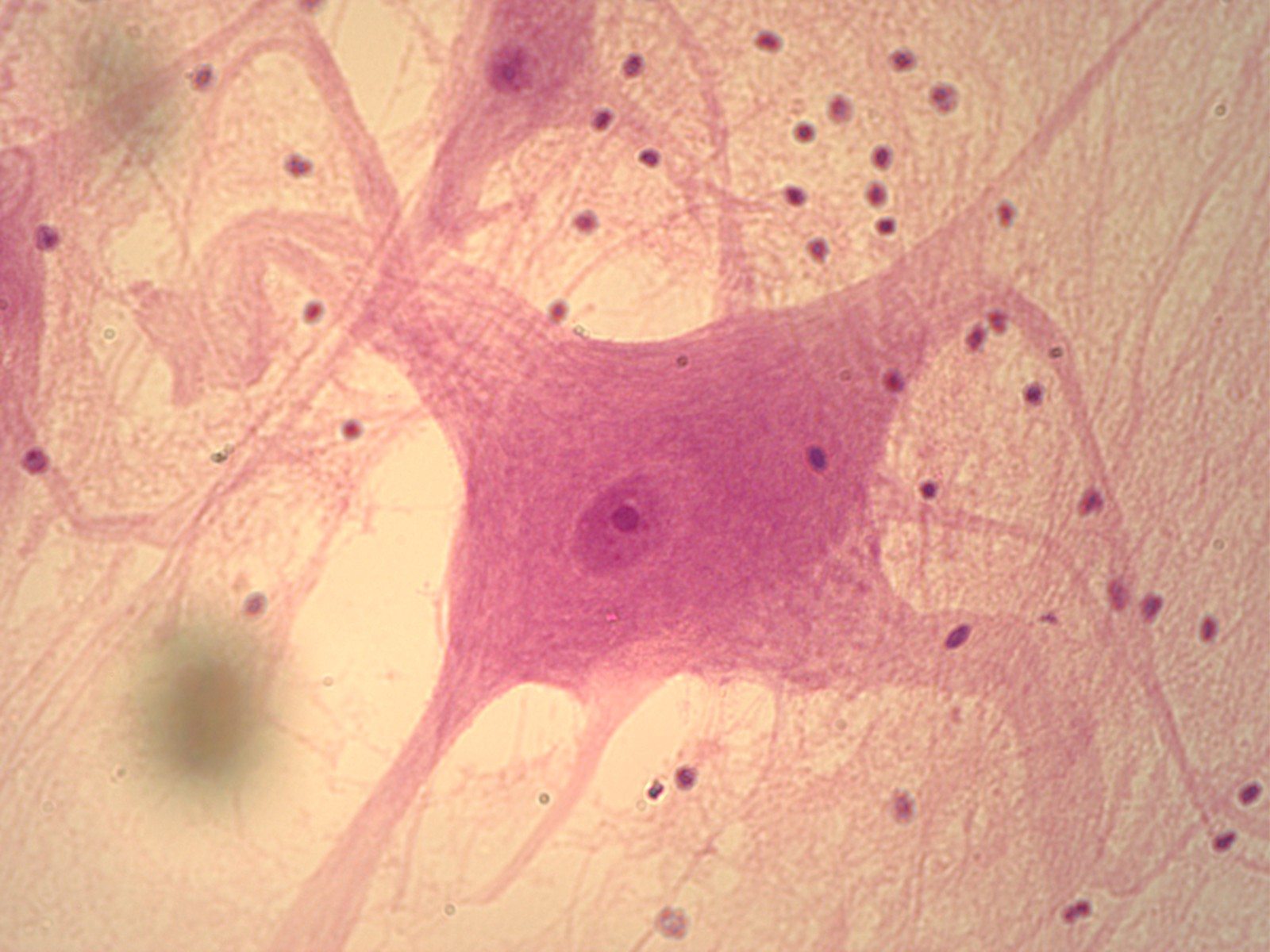
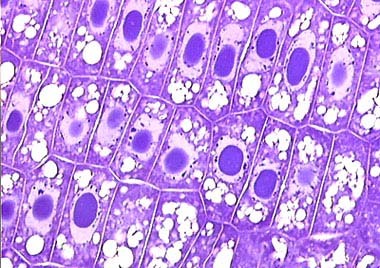
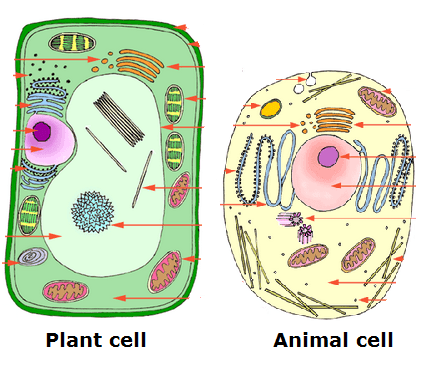
Which type of cell?

a)

Prokaryote

b)

Eukaryote

10.

The two kinds of cells are Prokaryotes and Eukaryotes. How are they different?

a)

Prokaryotes are plant cells

b)

Eukaryotes have a nucleus

c)

Prokaryotes have a nucleus

d)

There is no difference

11.

What is the gel-like substance inside of cells called?

a)

Cytoplasm

b)

Cytoskeleton

c)

Cell membrane

d)

Vacuole

12.

The _____________ holds the DNA, and controls the functions of eukaryotic cells.

a)

Nuclear membrane

b)

Nucleus

c)

mitochondria

d)

Lysosome

13.

builds proteins, each cell contains thousands, found on ER and floating throughout cell

a)

Ribosomes

b)

Nucleus

c)

Vacuole

d)

Golgi Body

14.
The brain, spinal cord, and nerves are all organs that work together to send messages throughout the body. This is an example of ____.
a)
 an organ system
b)
an organ
c)
a cell
d)
an organelle
15.
A group of cells works together to connect and support various parts of the body. This group of cells can be called a _____.
a)
an organ
b)
an organism
c)
a system
d)
a tissue
16.
A group of related tissues that work together to perform a function make up ____.
a)
a system
b)
an organism
c)
 an organ
d)
a cell
17.

This type of tissue transmits information throughout the body to and from the brain.

a)

Nervous Tissue

b)

Connective Tissue

c)

Muscular Tissue

d)

Epithelial Tissue

18.

Which of the following tissues is made up of cells that contract to help the body move?

a)

Epithelial Tissue

b)

Connective Tissue

c)

Muscle Tissue

d)

Nervous Tissue

19.

organ systems make up.....

a)

Tissues

b)

Organs

c)

Organ systems

d)

Organisms

20.

What is the correct order of organization?

a)

cells->tissue->organs->organ systems-> organism

b)

tissue->cells->organs->organ systems-> organism

c)

organs->organ systems-> organism->cells->tissue

21.
Which system takes oxygen into the body and eliminates carbon dioxide?
a)
immune
b)
nervous
c)
respiratory
d)
circulatory
22.
Which system enables the body to move, moves food through the digestive system, and keeps the heart beating?
a)
skeletal 
b)
muscular
c)
digestive
d)
nervous
23.
Which system takes food into the body, breaks down food, and absorbs the digested materials?
a)
respiratory
b)
circulatory
c)
digestive
d)
excretory
24.
Which system detects information from the environment and directs the way your body responds to this information?
a)
excretory
b)
circulatory
c)
respiratory
d)
nervous
25.

Which system collects and removes wastes from the blood?

a)

Muscular

b)

Circulatory

c)

Digestive

d)

Excretory

26.
Which system carries needed materials to the body cells and carries wastes away from the body cells?
a)
Circulatory
b)
Digestive
c)
Nervous
d)
Excretory
27.

Which two body systems deliver oxygen to your cells and take away carbon dioxide?

a)

respiratory and nervous

b)

circulatory and nervous

c)

circulatory and excretory

d)

respiratory and circulatory

28.

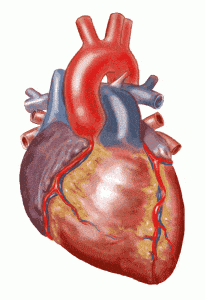
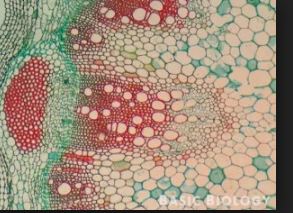
This is a example of a(n)...

a)

cell

b)

tissue

c)

organ

d)

organ system

29.

This is a example of a(n)...

a)

cell

b)

organ system

c)

organ

d)

tissue

30.

Which system provides support for the body, protects vital organs like the brain and lungs, and is where new blood cells are made?

a)

nervous system

b)

respiratory system

c)

circulatory system

d)

skeletal system

31.

Which system has glands that produce hormones like testosterone, estrogen, and adrenaline (epinephrine)?

a)

digestive system

b)

excretory system

c)

endocrine system

d)

immune system

32.

Which system includes your skin, hair, and sweat glands?

a)

integumentary system

b)

circulatory system

c)

digestive system

d)

endocrine system

33.

Which system is different between males and females and is needed to make babies?

a)

nervous system

b)

reproductive system

c)

immune system

d)

integumentary system

34.

Which system includes the kidneys which filter the blood of waste to make urine?

a)

excretory system

b)

reproductive system

c)

endocrine system

d)

circulatory system

35.

A deer hears a predator approaching and begins to run for safety. The deer has primarily engaged what body systems to escape?

a)

nervous, respiratory, and muscular systems

b)

muscular, digestive, and immune systems

c)

respiratory, endocrine, and excretory systems

d)

muscular, reproductive, and circulatory system
36.
Major organs of the digestive system
a)
Kidneys, nephrons
b)
Stomach, intestines, mouth
c)
Heart, blood vessels, blood
d)
Liver, kidneys, heart
37.

What distinguishes a plant cell from an animal cell? (How do you tell them apart) Hint: There's 3 ways (Check all 3)

a)

Central Vacuole

b)

Mitochondria

c)

Cell Wall

d)

Ribosomes

e)

Chloroplasts

38.

anchor plants in the ground and prevents erosion

a)

roots

b)

stems

c)

leaves

39.

Xylem transports...

a)

water

b)

sugar

c)

oxygen

d)

carbon dioxide

40.

Phloem transports

a)

water

b)

sugar

c)

oxygen

d)

carbon dioxide

41.

_____________________ is a vascular tissue that carries sugars and other foods throughout a plant.

a)

stems

b)

phloem

c)

roots

d)

xylem

42.

What is the vascular tissue that carries water throughout a plant?

a)

phloem

b)

seedling

c)

xylem

43.
What are the function of roots?
a)
Provides support
b)
Absorbs water
c)
Stores sugar for energy
d)
All of the above
44.

Pores under leaves

that allow for transpiration

and gas exchange

a)

Xylem

b)

Stomata

c)

Phloem

d)

Transpiration

45.

Plants make more of themselves using seeds, which can be in fruits or cones, or spores. What human body system can the production of seeds be compared to?

a)

nervous system

b)

circulatory system

c)

digestion system

d)

reproductive system

46.

Trees have bark covering their trunks, which protects them. What organ in the body is similar to the bark of a tree because it protects our organs?

a)

skin

b)

muscles

c)

bones

d)

teeth

47.

Flowers' stems give them structure to stand upright and trees have trunks. Which human system is similar, in that it gives us support to stand upright?

a)

muscular system

b)

skeletal system

c)

integumentary system

d)

nervous system

48.

Which 2 systems BOTH rid the body of waste?

a)

nervous and urinary systems

b)

digestive and circulatory system

c)

skeletal and muscular system

d)

urinary and digestive system

49.
Even when it is cold outside, the human body maintains an internal temperature of 37 °C. Which term describes the maintenance of a stable internal condition? 
a)
mitosis
b)
homeostasis
c)
endocytosis
d)
photosynthesis
50.
What are small stretches of DNA that code for traits
a)
Nucleus
b)
Chromosomes
c)
Gene
d)
Centromeres
51.
The genotype is the ______________.
a)
physical appearance
b)
Genetic makeup
c)
Alleles gained from one parent
52.
The phenotype is the _______________.
a)
physical appearance of an organism
b)
Genetic makeup 
c)
Alleles acquired from a specific parent.
53.
The passing of characters from parents to offspring is called?
a)
Monohybrid cross
b)
Heredity
c)
True breeding
d)
Genetics
54.
An allele whose trait only shows up when no dominant allele is present.
a)
hidden allele
b)
dominant allele
c)
recessive allele
d)
present allele
55.
Each parent contributes one of the genes for a particular trait. The genes of the pair are called:
a)
variables
b)
gametes
c)
hybrids
d)
alleles
56.
Two brown eyed parents (Bb) have a baby. What is the chance the baby is blue eyed?
a)
0 %
b)
25%
c)
50%
d)
75%
57.
An allele whose trait always shows up in the organism when the allele is present.
a)
recessive allele
b)
dominant allele
c)
hidden allele
d)
present allele
58.

The chromosomes inside you exist as ________, one from each of your parents.

a)

Duplicates

b)

Genes

c)

Pairs

d)

Alleles

59.

Scientists learned that __________ contain genetic information that controls traits.

a)

Chromosomes

b)

Genes

c)

Pairs

d)

Alleles

60.

A __________ is a model used to predict possible genotypes and phenotypes of offspring.

a)

Pedigree

b)

Punnett Square

c)

Codominance

d)

Genetic Make-up

61.

_________ is when the two alleles of a gene are different. Rr

a)

Heterozygous

b)

Genotype

c)

Phenotype

d)

Homozygous

62.

__________ is when the two alleles of a gene are the same. RR and rr

a)

Heterozygous

b)

Genotype

c)

Phenotype

d)

Homozygous

63.

__________ is the two alleles that control the phenotype of a trait.

a)

Genotype

b)

Phenotype

c)

Codominance

d)

Pairs

64.

___________ reproduction has the advantage of increasing genetic variation.

a)

Sexual

b)

Asexual

c)

Fission

d)

Budding

65.

Organisms produced by asexual reproduction are genetically different from the parent organism.

a)

False

b)

True

66.

Sex cells have ____________ of the DNA found in body cells.

a)

all

b)

none

c)

half

d)

a little bit

67.
If an environment suddenly changes, which type of reproduction would be most beneficial? Why?
a)
Asexual, because asexual organisms always have variation within species.
b)
Sexual, because sexual organisms have variation within species.
c)
Both Asexual and Sexual reproduction would be beneficial, because they both have variation within species.
d)
Asexual, because asexual organisms have no variation, so they can adapt to a changing environment.
68.
Pollination is the process by which pollen
a)
causes people to sneeze
b)
is formed inside a plant
c)
moves from stamen to stigma
d)
moves from stigma to stamen
69.
The seeds of apple would probably be disbursed by?
a)
animals
b)
wind
c)
water
d)
fire
70.
Which of these includes a plant embryo (seed), a food supply, and a protective covering?
a)
flower
b)
fruit
c)
stem
d)
stamen